
Business Intelligence Dissertation Topics for 2026
What Students Are Asking About BI Dissertation Topics
These questions come directly from student forums, academic Reddit threads, and university discussion boards. If you have been searching for guidance, you are not alone.
- “What are the most relevant business intelligence dissertation topics for 2026?”
- “How do I choose a BI dissertation topic that is not too broad?”
- “Are there business intelligence dissertation topics suitable for undergraduate students?”
- “What are some masters business intelligence dissertation topics that focus on data analytics?”
- “Can you give me business intelligence dissertation topics with examples and research objectives?”
- “What are the latest business intelligence research topics that universities actually care about?”
- “Which BI dissertation topics connect to predictive analytics and decision support systems?”
- “Is there a business intelligence dissertation help service that can guide me through topic selection?”
Why Your Business Intelligence Dissertation Topic Matters More Than You Think
Choosing the right dissertation topic in business intelligence is not just an academic formality. It shapes your entire research journey, from the literature you review to the methodology you adopt and the conclusions you can credibly draw.
Business intelligence (BI) sits at the crossroads of data management, strategic decision-making, and technology. Universities in the UK and globally expect dissertations in this field to demonstrate awareness of real-world data ecosystems, not just theoretical frameworks. When your topic is well defined, your research becomes more focused, your arguments become more persuasive, and your academic contribution becomes more meaningful.
Many students make the mistake of picking topics that are too broad. A topic like “the impact of data on business decisions” could fill ten books. What examiners want to see is precision. They want to know exactly what you are investigating, why it matters, and how you plan to investigate it.
In 2026, business intelligence has expanded significantly beyond traditional dashboards and reporting. Today’s BI landscape includes AI-integrated analytics, cloud-based data warehousing, real-time decision support systems, and data governance frameworks. Your dissertation topic should reflect this evolving environment.
Download Business Intelligence Dissertation Topics PDF
Students often find it useful to have a curated, ready-to-use list they can refer to throughout their proposal and planning stages. You can receive a downloadable PDF containing a personalised list of business intelligence dissertation topics, carefully curated by academic experts in data analytics and research methodology. This resource is designed to save you time and help you move forward with clarity and confidence.
Key Research Areas in Business Intelligence for 2026
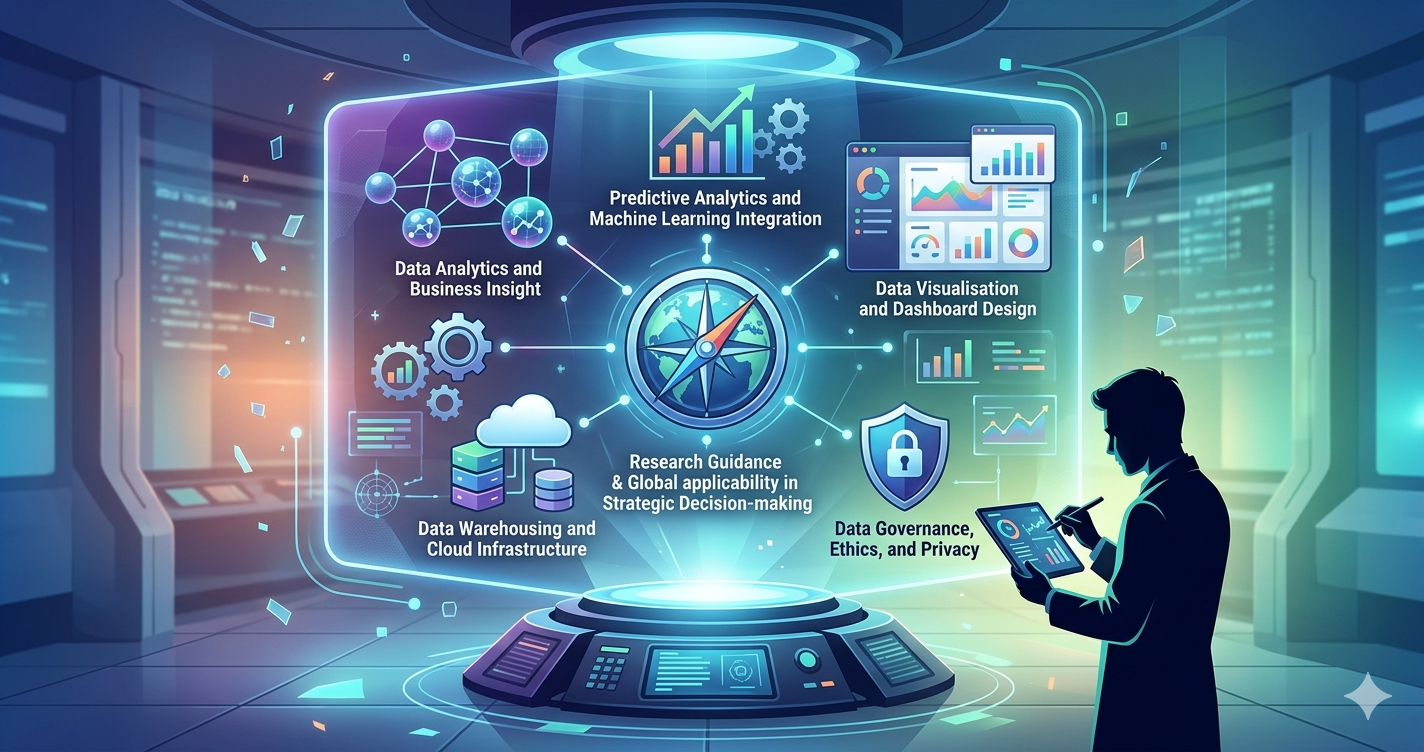
Before selecting a dissertation topic, it helps to understand the major subfields within business intelligence. These domains are well-established in academic literature and continue to evolve with industry practice.
Data Analytics and Business Insight
Data analytics sits at the heart of modern BI. Research in this area explores how organisations collect, process, and interpret data to gain competitive advantage. Studies can examine descriptive, diagnostic, predictive, or prescriptive analytics models.
Data Visualisation and Dashboard Design
Effective data visualisation transforms complex datasets into actionable insight. Research here often focuses on tools such as Power BI and Tableau, examining how visual design affects managerial decision-making and user engagement.
Data Warehousing and Cloud Infrastructure
Data warehousing underpins BI systems. Research in this area evaluates storage architecture, ETL (extract, transform, load) processes, cloud migration challenges, and performance benchmarking across enterprise environments.
Predictive Analytics and Machine Learning Integration
This is one of the fastest-growing areas in BI research. Dissertations here examine how machine learning models are embedded into BI platforms to generate forward-looking insights, and what governance challenges this creates.
Decision Support Systems and Organisational Strategy
Decision support systems (DSS) help leaders translate data into strategy. Academic research in this domain analyses how BI tools influence executive decision-making, particularly in uncertain or competitive markets.
Data Governance, Ethics, and Privacy
As BI systems grow in scale and sophistication, questions around data ownership, regulatory compliance (such as GDPR), algorithmic bias, and user privacy become increasingly important areas for dissertation research.
Five Business Intelligence Dissertation Topics With Examples
Here are five fully developed topic examples to show you how a strong dissertation is structured with a clear research aim and well-defined objectives.
1. The Effectiveness of Self-Service BI Tools in Reducing IT Dependency Within UK SME
Research Aim: To evaluate how self-service business intelligence platforms affect IT dependency and data literacy in small and medium-sized enterprises across the UK.
Research Objectives:
- To assess the current adoption rate of self-service BI tools among UK SMEs in 2024 and 2025.
- To examine how self-service BI tools affect the decision-making speed of non-technical managers.
- To identify barriers to effective self-service BI implementation in resource-limited organisations.
2. Evaluating the Role of Predictive Analytics in Reducing Supply Chain Disruption in the Retail Sector
Research Aim: To investigate how predictive analytics models embedded within BI platforms help retail organisations anticipate and mitigate supply chain disruptions.
Research Objectives:
- To review existing predictive analytics frameworks used in retail supply chain management.
- To compare the accuracy and reliability of different predictive modelling approaches within BI environments.
- To explore how real-time data integration improves supply chain resilience in large retail enterprises.
3. Assessing the Impact of Data Visualisation Quality on Executive Decision-Making in Financial Services
Research Aim: To determine how the quality and design of data visualisation within BI dashboards influences strategic decisions made by senior executives in the UK financial services sector.
Research Objectives:
- To define and operationalise key dimensions of data visualisation quality within BI reporting systems.
- To examine the relationship between dashboard design complexity and decision-making speed.
- To assess how cognitive load affects executive interpretation of BI-generated visual reports.
4. The Role of Business Intelligence in Supporting NHS Data-Driven Decision Making Post-COVID-19
Research Aim: To explore how NHS trusts in England have adopted business intelligence systems to support data-driven clinical and operational decisions in the post-pandemic period.
Research Objectives:
- To map current BI adoption levels across NHS trusts in England from 2021 to 2025.
- To evaluate how BI dashboards have been used to manage patient flow and resource allocation.
- To identify organisational and technical barriers to BI integration within public healthcare settings.
5. Big Data Integration in Business Intelligence: Challenges and Opportunities for UK Financial Institutions
Research Aim: To investigate the challenges and opportunities that arise when UK financial institutions integrate big data sources into their existing business intelligence infrastructure.
Research Objectives:
- To review academic and industry literature on big data integration strategies within regulated financial environments.
- To assess the technical compatibility of legacy BI systems with modern big data platforms.
- To explore how regulatory frameworks such as FCA guidelines affect big data integration decisions in UK banks.
100+ Business Intelligence Dissertation Topics for 2026
Below you will find more than 100 carefully developed dissertation topics organised by subfield. These cover the full range of business intelligence research areas suitable for undergraduate, master’s, and PhD-level proposals.
Business Analytics Dissertation Topics
- How do business analytics frameworks influence strategic planning in FTSE 100 companies?
- The role of advanced business analytics in identifying customer churn in the UK telecommunications industry.
- Comparing rule-based and AI-assisted business analytics models in retail inventory forecasting.
- The effectiveness of business analytics in improving employee performance management in multinational corporations.
- How business analytics platforms support ESG (Environmental, Social, Governance) reporting in UK firms.
- Business analytics adoption in UK charity organisations: opportunities and barriers.
- The relationship between business analytics maturity and firm-level financial performance.
- Using business analytics to detect financial fraud in online banking ecosystems.
- The role of business analytics in shaping pricing strategy in e-commerce platforms.
- How do small businesses in the UK use basic business analytics tools compared to enterprise-level organisations?
Data Analytics and Business Intelligence Topics
- The application of data analytics in reducing customer acquisition costs in digital marketing agencies.
- How do retail banks use data analytics to improve credit scoring models?
- The effectiveness of real-time data analytics in preventing cybersecurity breaches in UK organisations.
- Evaluating data analytics maturity models: a comparison of frameworks used in UK manufacturing firms.
- The role of data analytics in supporting evidence-based human resource management decisions.
- Data analytics and its contribution to reducing NHS waiting times: a case study approach.
- How do energy companies in the UK use data analytics to optimise grid management?
- The impact of data analytics on procurement efficiency in public sector organisations.
- Using data analytics to evaluate the return on investment of digital advertising campaigns.
- The relationship between data analytics capability and organisational agility in fast-growing startups.
Data Visualisation and Dashboard Research Topics
- How does the design of BI dashboards affect decision-making accuracy among non-expert users?
- Comparing the usability of Power BI and Tableau dashboards in financial services organisations.
- The role of interactive data visualisation in improving board-level reporting in UK plcs.
- How does colour coding in BI dashboards affect user attention and data interpretation?
- Evaluating the effectiveness of mobile-first dashboard design for field-based employees.
- The impact of narrative data visualisation on stakeholder engagement in annual reports.
- How do UK universities use data visualisation tools to monitor student outcomes and retention?
- The role of real-time dashboards in operational decision-making within logistics firms.
- Comparing static and dynamic visualisation formats in executive briefing contexts.
- User experience research in BI: how cognitive load affects dashboard comprehension across age groups.
Data Warehousing and Cloud BI Topics
- The challenges of migrating legacy data warehouses to cloud-based BI platforms in the UK banking sector.
- Evaluating the cost-benefit analysis of cloud data warehousing for mid-sized UK retailers.
- How does cloud BI infrastructure support scalability in fast-growing SaaS businesses?
- The role of ETL automation in improving data quality within enterprise data warehouses.
- Comparing on-premise and cloud-based data warehousing performance in regulated industries.
- Data latency challenges in cloud-based BI environments: a technical and strategic analysis.
- How do UK insurance companies manage data warehouse governance post-GDPR?
- The impact of hybrid cloud data architectures on BI system performance and reliability.
- Evaluating metadata management strategies in large-scale data warehousing environments.
- How real-time data warehousing is reshaping BI capabilities in the UK fintech sector.
Predictive Analytics Dissertation Topics
- The accuracy of predictive analytics models in forecasting customer lifetime value in UK e-commerce.
- How predictive analytics supports demand planning in UK food retail supply chains.
- Evaluating machine learning-enhanced predictive models for staff attrition in large organisations.
- The role of predictive analytics in personalising online learning pathways in UK higher education.
- How do UK property developers use predictive analytics to assess market demand?
- Predictive analytics in healthcare: forecasting patient readmission rates in NHS trusts.
- The effectiveness of predictive maintenance models powered by BI systems in UK manufacturing.
- Comparing regression and neural network approaches to predictive analytics in SME credit risk assessment.
- How predictive analytics improves fraud detection rates in UK insurance claims processing.
- The role of sentiment analysis within predictive analytics frameworks for brand reputation monitoring.
Decision Support Systems Topics
- How do decision support systems improve crisis management in UK local government?
- Evaluating the adoption of AI-powered DSS in strategic planning within UK retail chains.
- The role of decision support systems in optimising logistics routing for UK courier companies.
- How does the quality of BI-integrated DSS affect clinical decision-making in A&E departments?
- Decision support systems and their impact on resource allocation in UK universities.
- Evaluating user trust in automated decision support systems within UK financial advisory firms.
- The role of real-time DSS in managing risk in investment banking environments.
- How small law firms in the UK are beginning to adopt basic decision support tools.
- The effectiveness of DSS tools in supporting procurement decisions in UK public sector bodies.
- Comparing human-in-the-loop versus fully automated DSS outcomes in customer service operations.
Big Data and BI Research Topics
- How do UK retailers leverage big data to personalise the omnichannel customer experience?
- The role of big data in improving talent acquisition strategies within large UK employers.
- Evaluating the scalability of big data processing frameworks in BI environments for media companies.
- How does big data integration affect the speed and accuracy of BI reporting in logistics firms?
- The privacy implications of big data usage in UK healthcare BI systems.
- How do UK-based fintech companies use big data to assess creditworthiness in real time?
- The role of unstructured big data in shaping product innovation strategies in tech firms.
- Big data governance challenges faced by UK universities storing student and academic data.
- Evaluating the use of big data pipelines in improving BI system responsiveness for streaming platforms.
- How big data analytics supports climate-related financial disclosures in UK-listed companies.
Data Governance, Ethics, and Privacy Topics
(H3)
- The impact of GDPR on data collection and BI reporting practices in UK marketing agencies.
- How UK financial institutions manage data lineage within complex BI ecosystems.
- The role of data stewardship in maintaining data quality across enterprise BI platforms.
- Evaluating the effectiveness of algorithmic auditing frameworks in UK BI environments.
- How do UK organisations balance personalisation with data privacy in their BI strategies?
- The ethical implications of using employee performance data within internal BI dashboards.
- Data ownership disputes in collaborative BI environments: a legal and organisational analysis.
- How data ethics frameworks affect BI tool adoption in UK public sector organisations.
- The role of data anonymisation techniques in enabling compliant BI reporting in healthcare.
- Evaluating the governance challenges of cross-border data sharing in multinational BI systems.
BI Tools and Technology Topics
Comparing Microsoft Power BI and Tableau for enterprise-level reporting in UK professional services.
- The effectiveness of natural language processing (NLP) features in modern BI platforms.
- How do organisations assess ROI when implementing enterprise BI tool migrations?
- The role of augmented analytics in reducing the skills gap in BI tool usage.
- Evaluating low-code BI platforms for non-technical users in UK SMEs.
- How AI-embedded features in BI tools are changing the role of the data analyst.
- The adoption of embedded BI features within SaaS platforms: opportunities and challenges.
- Comparing open-source and commercial BI tools for use in UK academic institutions.
- How chatbot-integrated BI platforms support conversational data querying for business users.
- Evaluating the data security features of leading BI platforms in regulated UK industries.
BI in Specific Industry Contexts
- The role of business intelligence in improving customer retention strategies in UK insurance.
- How BI platforms support sustainability reporting in UK-listed manufacturing companies.
- Business intelligence adoption in UK higher education: assessing the impact on institutional planning.
- The use of BI dashboards in monitoring key performance indicators in UK hospital trusts.
- How luxury retail brands in the UK use BI to understand and predict consumer behaviour.
- The role of BI in supporting digital transformation programmes within UK central government.
- Evaluating BI maturity levels in UK construction firms and their link to project outcomes.
- How do UK charities use BI platforms to demonstrate impact to funders and stakeholders?
- The role of business intelligence in optimising energy consumption within UK smart buildings.
- BI adoption in UK legal firms: challenges, enablers, and strategic outcomes.
Emerging and Future-Focused BI Topics
- How does generative AI affect the accuracy and reliability of BI-generated insights?
- The role of edge computing in enabling real-time BI for IoT-connected manufacturing plants.
- Evaluating the potential of quantum computing to transform data processing in enterprise BI systems.
- How do organisations maintain BI system resilience during large-scale cloud outages?
- The future of augmented analytics: will AI replace the traditional business analyst role?
- How are BI vendors incorporating explainable AI (XAI) to improve user trust in automated insights?
- The role of digital twins in creating simulation-based BI environments for strategic planning.
- Evaluating the potential of federated learning for privacy-preserving BI in healthcare networks.
- How will the EU AI Act affect BI platform design and deployment in European organisations?
- The impact of 5G infrastructure on real-time data transmission capabilities in mobile BI applications.
How to Choose the Right Business Intelligence Dissertation Topic
With so many options available, narrowing your choice can feel overwhelming. Here are practical steps to guide you.
Start With Your Academic Level
Undergraduate dissertations typically explore existing frameworks and apply them to specific industries or case studies. Master’s research is expected to go further, often involving primary data collection and methodological rigour. PhD research must make an original contribution to knowledge, which means identifying genuine gaps in the existing literature.
Align Your Topic With Your Interests and Access
The best dissertation topics connect your genuine intellectual curiosity with practical research access. If you can access organisations, datasets, or practitioners who can inform your research, this dramatically improves the quality and feasibility of your work.
Check Current Academic Literature
Before finalising a topic, search Google Scholar, JSTOR, and your university library database. If you find fewer than ten peer-reviewed papers on your exact topic, it may be too niche. If you find thousands, it may be too broad. The ideal topic sits in between, with enough literature to build on and enough space to contribute something new.
Consider Methodological Fit
Some topics suit quantitative approaches, such as statistical analysis of large datasets. Others call for qualitative methods, such as interviews or case studies. Make sure your chosen topic aligns with a methodology you understand and can execute within your timeframe.
Getting the Most From Your BI Dissertation Research
Students who approach their dissertations strategically tend to produce stronger work. A few principles apply universally.
Start your literature review early and organise your sources carefully. Use reference management software from day one. Define your research problem clearly before you begin writing, and revisit this definition regularly to ensure your work stays on track.
If you need help with dissertation planning, topic selection, or research structuring, many academic support services offer expert guidance. Working with a subject specialist who understands business intelligence research can help you avoid common mistakes and build a more coherent argument.
When it comes to business analytics dissertation help, the most valuable support is usually the kind that strengthens your own academic thinking rather than replacing it. Look for guidance that helps you understand methodology, sharpen your argument, and present your findings more clearly.
Conclusion
Selecting a dissertation topic in business intelligence is one of the most consequential decisions you will make during your academic programme. The right topic gives your research direction, makes your literature review manageable, and ensures your conclusions are grounded in genuine evidence.
The field of business intelligence in 2026 is rich with research opportunity. Whether you are drawn to data visualisation, predictive analytics, decision support systems, data governance, or the integration of artificial intelligence into BI platforms, there is a topic here that can serve your academic goals.
Approach your dissertation with intellectual curiosity and academic integrity. Choose a topic that genuinely interests you, align it with established research traditions, and define your objectives clearly before you begin. The more precise your topic, the more confident and credible your research will be.