
Cryptocurrency Dissertation Topics for 2026
Questions Students Are Asking (From Forums and Academic Discussion Platforms)
Before diving in, here are some of the most common questions gathered from student forums, Reddit academic threads, and university discussion boards. These reflect exactly what students like you are searching for right now:
- What are the best cryptocurrency dissertation topics for 2026?
- How do I choose a cryptocurrency research topic that is narrow enough to research properly?
- Are there cryptocurrency dissertation topics suitable for undergraduate level?
- What masters cryptocurrency dissertation topics are currently in demand?
- How do blockchain and decentralised finance fit into a dissertation?
- Can I write a dissertation on crypto regulation and fintech?
- Where can I find cryptocurrency dissertation topics with examples?
If any of these questions sound familiar, this post is written for you. Keep reading.
Why Choosing the Right Cryptocurrency Dissertation Topic Matters
Choosing your dissertation topic is one of the most important academic decisions you will make. In a field as fast-moving as cryptocurrency, the wrong topic can leave your research feeling outdated before you even submit. The right topic, on the other hand, positions you as a student who understands where the discipline is heading.
Cryptocurrency is no longer a niche area of finance. It sits at the crossroads of economics, law, technology, and social policy. Universities expect students to engage with this complexity seriously, whether at undergraduate, master’s, or PhD level. A well-chosen topic demonstrates intellectual curiosity, awareness of current debates, and the ability to contribute something meaningful to academic knowledge.
This post will guide you through the key research areas, give you worked examples of how a good topic is structured, and then provide more than 100 original dissertation topics you can explore for your 2026 research.
Download Cryptocurrency Dissertation Topics PDF
If you would prefer a personalised list, you can request a downloadable PDF of curated cryptocurrency dissertation topics prepared by academic experts. This PDF is designed to match your level of study, whether undergraduate, master’s, or PhD, and is updated to reflect 2026 research expectations. Simply fill in the request form on our website and receive your personalised list directly to your inbox. Many students find this a helpful starting point before they meet with their supervisors.
Key Research Areas in Cryptocurrency for 2026
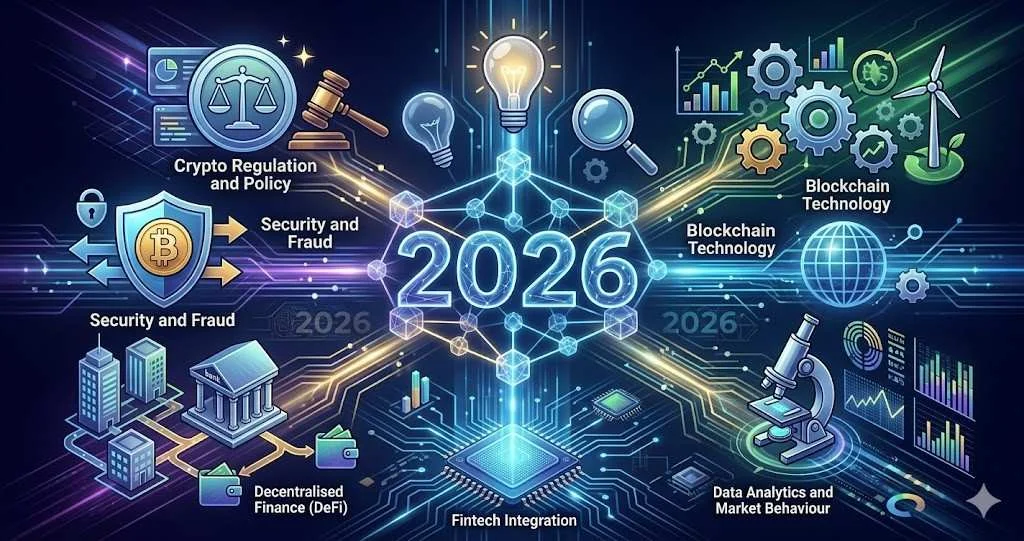
Before selecting a topic, it helps to understand the major research domains within the field. The following areas are all well-established in academic literature and continue to generate new questions worth investigating:
- Blockchain technology and infrastructure — How distributed ledger systems work and their limitations
- Decentralised finance (DeFi) — Financial services delivered without traditional intermediaries
- Crypto regulation and policy — Government responses to digital assets across different jurisdictions
- Digital payments and financial inclusion — How crypto enables or disrupts access to financial services
- Data analytics and market behaviour — Quantitative analysis of crypto price movements and trading patterns
- Fintech integration — How cryptocurrency companies are reshaping the broader financial technology sector
- Environmental impact — Energy consumption of proof-of-work systems and sustainability alternatives
- Security and fraud — Hacking, rug pulls, and consumer protection in crypto markets
- Central Bank Digital Currencies (CBDCs) — Government-backed digital currencies and their implications
- NFTs and digital asset ownership — Legal and economic questions around non-fungible tokens
Each of these areas supports multiple dissertation angles. The key is to narrow your focus to a specific question rather than trying to cover an entire subfield.
Five Dissertation Topic Examples with Research Aims and Objectives
Understanding how a well-formed dissertation topic looks in practice is essential. Below are five examples, each with a clear research aim and two to three objectives to guide your thinking.
Example 1: Crypto Regulation in the United Kingdom
Topic: How effective is the UK’s current regulatory framework in protecting retail investors from cryptocurrency fraud?
Research Aim: To evaluate the effectiveness of UK financial regulation in safeguarding retail cryptocurrency investors.
Objectives:
- To review existing UK regulatory policy relating to digital assets as of 2025
- To analyse reported cases of retail investor fraud linked to cryptocurrency platforms
- To assess gaps in current legislation and propose policy recommendations
Example 2: DeFi and Financial Inclusion
Topic: Can decentralised finance platforms improve financial access for unbanked populations in Sub-Saharan Africa?
Research Aim: To examine whether DeFi tools offer a viable path to financial inclusion in regions with limited banking infrastructure.
Objectives:
- To identify barriers to banking access in selected Sub-Saharan African countries
- To evaluate specific DeFi platforms available to users without traditional bank accounts
- To assess the risks and limitations of DeFi as a financial inclusion strategy
Example 3: Bitcoin and Inflation Hedging
Topic: Does Bitcoin function as an effective inflation hedge during periods of macroeconomic instability?
Research Aim: To determine whether Bitcoin provides meaningful protection against inflation for institutional investors.
Objectives:
- To review academic literature on Bitcoin’s correlation with inflation indicators
- To conduct quantitative analysis of Bitcoin price data against inflation rates from 2020 to 2025
- To compare Bitcoin’s hedging properties with traditional assets such as gold
Example 4: Environmental Impact of Proof-of-Work
Topic: What is the carbon footprint of Bitcoin mining, and how does it compare to traditional banking infrastructure?
Research Aim: To assess the environmental cost of Bitcoin’s proof-of-work consensus mechanism relative to conventional financial systems.
Objectives:
- To calculate estimated energy consumption of global Bitcoin mining operations
- To gather comparable energy use data from traditional banking sector sources
- To evaluate the environmental case for transitioning to proof-of-stake alternatives
Example 5: Blockchain in Supply Chain Management
Topic: How does blockchain technology improve transparency and traceability in pharmaceutical supply chains?
Research Aim: To explore the practical benefits of blockchain adoption in pharmaceutical logistics.
Objectives:
- To review existing blockchain pilot programmes in healthcare supply chains
- To assess how blockchain reduces counterfeit drug circulation
- To evaluate implementation challenges facing healthcare companies considering blockchain adoption
100+ Cryptocurrency Dissertation Topics for 2026
The following topics are organised by subfield. They are original, narrowly focused, and suitable for 2026 academic research at undergraduate, master’s, and PhD level.
Crypto Regulation and Legal Frameworks
- How effective are the EU’s MiCA regulations in standardising cryptocurrency oversight across member states?
- A comparative analysis of cryptocurrency regulation in the UK and United States post-2024
- How do anti-money laundering laws apply to decentralised cryptocurrency exchanges?
- The legal classification of utility tokens versus security tokens under UK law
- Can existing consumer protection frameworks adequately address cryptocurrency investment fraud?
- How does the Financial Action Task Force’s travel rule affect crypto service providers?
- Regulatory arbitrage in cryptocurrency: why firms relocate to low-regulation jurisdictions
- The role of the Financial Conduct Authority in overseeing UK crypto asset promotions
- How should stablecoin issuers be regulated differently from other crypto assets?
- The impact of China’s cryptocurrency ban on global digital asset markets
Decentralised Finance (DeFi)
- What are the systemic risks posed by DeFi lending protocols to traditional financial stability?
- How do automated market makers differ from centralised exchange order books in liquidity provision?
- Smart contract vulnerabilities and their impact on DeFi platform security
- Can DeFi yield farming generate sustainable returns, or is it inherently speculative?
- The role of governance tokens in decentralised autonomous organisations (DAOs)
- How do flash loan attacks exploit DeFi protocols, and what are the technical safeguards?
- A legal analysis of liability in DeFi: who is responsible when a protocol fails?
- Comparing the risk profiles of DeFi platforms with traditional peer-to-peer lending
- How decentralised insurance protocols manage risk without central underwriters
- The potential of DeFi to replace interbank settlement systems
Bitcoin Economics and Market Behaviour
- Is Bitcoin’s price volatility decreasing as institutional adoption increases?
- How does Bitcoin halving affect miner profitability and network security?
- The relationship between Bitcoin futures markets and spot price formation
- Does retail investor sentiment, measured through social media, predict short-term Bitcoin price movements?
- Comparing Bitcoin’s store-of-value properties with gold during the 2020–2025 period
- How do macroeconomic shocks, such as interest rate rises, affect Bitcoin demand?
- The impact of exchange listings on altcoin price discovery
- Are crypto market cycles predictable using traditional technical analysis?
- How does leverage trading in crypto markets amplify systemic risk?
- The role of Bitcoin in dollarised economies experiencing currency devaluation
Blockchain Technology Applications
- How does blockchain technology improve transparency in public procurement processes?
- The application of permissioned blockchain networks in healthcare records management
- Blockchain-based land registry systems: lessons from Georgia and Ghana
- Can blockchain improve election integrity in low-trust democratic contexts?
- The role of distributed ledger technology in reducing food fraud in global supply chains
- Blockchain in carbon credit trading: addressing double-counting and verification failures
- How blockchain can enhance cross-border remittance efficiency for migrant workers
- Smart contracts in insurance: automating claims processing without human intervention
- Interoperability challenges between public and private blockchain networks
- How blockchain supports digital identity verification in refugee humanitarian aid
Stablecoins and Central Bank Digital Currencies (CBDCs)
- What are the macroeconomic risks of a widely adopted algorithmic stablecoin?
- How does the design of a CBDC affect monetary policy transmission mechanisms?
- A comparative study of the digital yuan and digital euro design approaches
- Could a UK digital pound threaten the commercial banking sector’s deposit base?
- The privacy implications of CBDC adoption for citizens in authoritarian states
- How do reserve-backed stablecoins like USDC differ from fiat-pegged CBDCs in risk?
- The impact of the Terra/Luna collapse on global stablecoin regulatory confidence
- Can CBDCs support financial inclusion without requiring smartphone ownership?
- How should central banks approach the monetary policy implications of stablecoin proliferation?
- The role of CBDCs in cross-border payment settlement between central banks
Cryptocurrency and Financial Inclusion
- How do mobile cryptocurrency wallets affect financial access in rural Kenya?
- The role of Bitcoin in remittance corridors from the UK to West Africa
- Can cryptocurrency reduce transaction costs for low-income migrant workers?
- Gender disparities in cryptocurrency adoption: evidence from emerging markets
- Cryptocurrency as a savings tool in hyperinflationary economies: the case of Venezuela
- How do peer-to-peer Bitcoin platforms operate in countries without formal exchanges?
- The risks of promoting cryptocurrency as a financial inclusion solution in fragile states
- Digital literacy barriers to cryptocurrency adoption among elderly populations in the UK
- Does cryptocurrency replace or complement traditional microfinance in developing economies?
- The role of crypto aid distribution in humanitarian crisis response
NFTs and Digital Asset Ownership
- The legal ownership rights attached to NFT purchases under UK intellectual property law
- How the NFT market collapse of 2022–2023 reshaped digital collectibles investment behaviour
- Environmental criticism of NFTs: comparing proof-of-work and proof-of-stake minting costs
- NFTs as tools for creator monetisation: evidence from independent music artists
- How luxury brands use NFTs for product authentication and anti-counterfeiting
- The use of NFTs in university credential verification: feasibility and risks
- Secondary market royalty enforcement challenges in NFT smart contracts
- NFTs as speculative assets: applying traditional bubble theory to digital art markets
- How metaverse platforms use NFTs to establish virtual property rights
- The taxation of NFT sales under UK HMRC guidelines and international comparisons
Data Analytics and Quantitative Cryptocurrency Research
- Predicting cryptocurrency price crashes using on-chain data analytics
- Network analysis of Bitcoin transaction graphs to identify suspicious activity
- Sentiment analysis of Twitter data as a predictor of Ethereum price direction
- Comparing machine learning models for short-term cryptocurrency return forecasting
- The relationship between cryptocurrency trading volume and price volatility: a quantitative study
- How whale wallet activity affects retail investor behaviour in altcoin markets
- Applying the Efficient Market Hypothesis to Bitcoin: a 2020–2025 empirical review
- Cross-exchange arbitrage opportunities in cryptocurrency markets: a data-driven analysis
- The effect of regulatory announcements on intraday cryptocurrency price movements
- Modelling tail risk in cryptocurrency portfolios using extreme value theory
Fintech, Payments, and Cryptocurrency Integration
- How cryptocurrency payment gateways are reshaping e-commerce checkout experiences
- The competitive threat of cryptocurrency to established digital payment providers like PayPal
- How fintech startups are embedding crypto wallets into neobank products
- The role of the Lightning Network in making Bitcoin viable for micropayments
- Comparing the transaction cost structures of crypto payments versus SWIFT transfers
- How cryptocurrency adoption affects the revenue models of traditional money transfer operators
- Regulatory challenges facing fintech companies offering cryptocurrency trading services in the EU
- The impact of crypto payment integration on consumer spending behaviour
- How open banking frameworks interact with cryptocurrency service providers under PSD2
- The role of stablecoins in enabling programmable payments in enterprise fintech
Cryptocurrency Security, Fraud, and Ethics
- How crypto exchange hacks have shaped regulatory responses since Mt Gox
- The psychology of cryptocurrency investment scams: why victims fail to identify red flags
- Rug pull dynamics in DeFi: identifying early warning signs using smart contract analysis
- How Ponzi scheme structures replicate themselves in high-yield cryptocurrency investment platforms
- The ethical responsibilities of crypto influencers in promoting high-risk assets to retail investors
- Ransomware and cryptocurrency: how anonymity features complicate law enforcement recovery
- Darknet market cryptocurrency flows: tracing illicit finance through blockchain analytics
- The ethics of anonymous cryptocurrency use in oppressive political regimes
- How exchanges implement KYC and AML procedures to reduce criminal misuse of digital assets
- The accountability gap in decentralised autonomous organisations when fraud occurs
Emerging and Interdisciplinary Cryptocurrency Topics
- How artificial intelligence is being used to detect market manipulation in crypto trading
- Quantum computing threats to current cryptocurrency encryption standards
- The sociological impact of cryptocurrency adoption on distrust of traditional financial institutions
- Cryptocurrency in political campaign financing: transparency concerns and regulatory gaps
- How GameFi and play-to-earn models are reshaping labour and income in developing economies
- The role of zero-knowledge proofs in enhancing cryptocurrency privacy without enabling crime
- Cross-chain bridge vulnerabilities and their implications for multi-blockchain ecosystems
- The use of satellite internet and cryptocurrency to serve financially isolated communities
- How cryptocurrency is influencing monetary sovereignty debates in small island nations
- The future of decentralised identity systems built on blockchain infrastructure
Conclusion
Choosing the right cryptocurrency dissertation topic in 2026 is about more than picking something that sounds interesting. It requires you to understand the current state of research, identify a gap worth investigating, and frame a question that is specific enough to answer within the constraints of your degree level.
The 110 topics listed in this post cover a wide range of subfields, from crypto regulation and DeFi to blockchain applications and market behaviour. Each one is designed to help you think carefully about what kind of contribution you want to make. Whether you are writing your first undergraduate dissertation or a doctoral thesis, the same principle applies: the more focused your question, the stronger your research will be.
If you are still feeling unsure, cryptocurrency dissertation help is available through academic writing services staffed by subject specialists. A good supervisor or writing advisor will not choose your topic for you, but they will help you refine your ideas into something academically viable.
The cryptocurrency field is still young, and the academic literature is growing rapidly. That means there is genuine space for original thinking. Approach your dissertation with intellectual honesty, a clear methodology, and a willingness to engage with complex evidence, and you will be well on your way to producing something your examiners will find genuinely valuable.