
How to Reference: Harvard, APA 7, OSCOLA and Vancouver Explained

Which style does my department actually want, and how do I reference a source properly in it? Do my law footnotes use ibid or (n 4)? Why does my Vancouver list run in numbers when my Harvard list runs from A to Z? Students usually settle these questions the night before submission, with a half-finished reference list open in another window.
Referencing correctly comes down to three steps. Find the style your module handbook names, cite each source where you use it, and give the full details in the layout that style expects: an alphabetical reference list for Harvard and APA 7, footnotes for OSCOLA, and a numbered list for Vancouver.
The four styles below cover most UK dissertations. Harvard suits many departments, APA 7 is common in psychology and education, OSCOLA belongs to law, and Vancouver to medicine and health. MLA, Chicago and IEEE sit outside the four styles covered here, although the free reference generator formats them. Small details differ between universities, so your own institution’s version of a style has the final word.
Which Referencing Style Should You Use for Your Dissertation?
Use the style your module handbook or assessment brief names. UCL’s library guidance notes that the university has no single standard, so students check their programme handbook or ask their department. Writing for a journal is different, because the journal’s own instructions decide.
If the handbook is silent, ask your supervisor. Departments tend to choose the style that fits their field. Newcastle’s Academic Skills Kit, for example, calls Cite Them Right Harvard the most common style, then lists APA 7 for psychology and related subjects, OSCOLA for law, and Vancouver for biomedical sciences and nutritional and sport science. Leeds describes the same pattern: APA in psychology, OSCOLA on law qualifying programmes and Vancouver in medicine.
| Style | System | In the text | Full details go in | Often used in |
|---|---|---|---|---|
| Harvard (Cite Them Right) | Author-date | Surname and year in brackets | Reference list, A to Z by surname | Many UK subjects |
| APA 7 | Author-date | Surname and year in brackets | Reference list, A to Z by surname | Psychology, education |
| OSCOLA | Notes and bibliography | Footnote number | Footnotes, plus a bibliography if your school asks for one | Law |
| Vancouver | Numeric | Number in brackets or superscript | Numbered list, in order of first citation | Medicine, biomedical and health sciences |
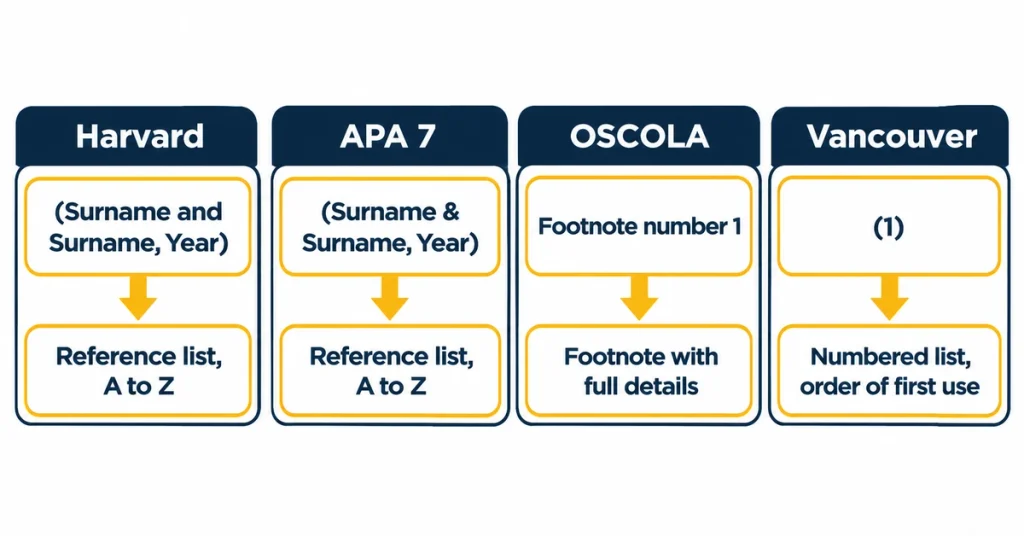
UCL groups styles into three families: author-date (Harvard, APA), numeric (Vancouver) and notes and bibliography (OSCOLA). Mixing families, or even mixing two versions of one style, is a common mistake. Because Harvard and Vancouver both exist in many university versions, pick one source of guidance for each and stay with it.
Harvard Referencing: How to Cite and Build a Reference List
Harvard is an author-date system. The surname and year go in the sentence, and the full details go in an alphabetical reference list. Unlike APA or OSCOLA, Harvard has no single official manual, so universities publish their own versions. Many UK institutions follow Cite Them Right by Richard Pears and Graham Shields, whose 13th edition (Bloomsbury, 2025) is the current one.
Some universities accepted either the 12th or 13th edition during 2025 to 2026 and expect the 13th from 2026 to 2027, as the University of the Highlands and Islands does. The change students notice most is that books no longer need a place of publication. Position correct as of November 2026; check your library’s Harvard guide for the edition it expects.
How to cite one, two, three or four authors in Harvard
Put the surname and year in brackets, and add a page number for direct quotations, as in (Jones and Henry, 2011, p. 1150). You can also build the author into the sentence: Evans (2015, p. 33) explains the point. Both patterns come from Newcastle’s Cite Them Right style sheet, and the examples below follow the same logic.
- One author: (Evans, 2015)
- Two authors: (Jones and Henry, 2011)
- Three authors: (Hill, Smith and Jones, 1997)
- Four or more authors: first author plus et al. in italics, as in Hewstone et al. (2015)
Check your own guide before relying on these cut-offs. Universities differ on when et al. begins, and some ask for every author in the reference list while others allow et al. only for long author lists.
Harvard reference list examples
Order the list alphabetically by the first author’s surname. A book in Cite Them Right 13th edition style, with no place of publication:
Pears, R. and Shields, G. (2025) Cite them right. 13th edn. Bloomsbury.
A journal article with a DOI:
Braun, V. and Clarke, V. (2006) ‘Using thematic analysis in psychology’, Qualitative Research in Psychology, 3(2), pp. 77–101. Available at: https://doi.org/10.1191/1478088706qp063oa
Small details, such as the wording before a DOI, vary between university guides. Compare each entry with the version your library names.
Can you reference ChatGPT in Harvard?
Cite Them Right’s 13th edition added coverage of AI-generated material, so Harvard now has a format for it. Whether you may use AI at all, and how you must acknowledge it, is set by your university and sometimes by the module. Read that policy first. Newcastle’s Academic Skills Kit, for instance, keeps separate guidance on acknowledging AI use.
APA 7 Referencing: Author–Date Citations, DOIs and Et Al.
APA 7 follows the American Psychological Association’s Publication Manual, 7th edition (2020). It is also an author-date style, but unlike Harvard it has one manual behind it. UK departments tend to use it in psychology and education, so a psychology dissertation topics shortlist usually comes with APA 7 attached.
How to reference two, three or more authors in APA 7
With two authors, name both every time. Use an ampersand inside brackets, as in (Braun & Clarke, 2006), and the word “and” when the authors form part of the sentence: Braun and Clarke (2006). With three or more authors, give the first author plus et al. in every citation, including the first: (Zheng et al., 2023).
One exception matters. When two sources shorten to the same form, write out as many surnames as it takes to tell them apart, then add et al.
APA 7 reference list examples
The list runs alphabetically. Invert each name, use initials, put the year in brackets, write the article title in sentence case, and italicise the journal title and volume. Give the DOI as a full https://doi.org/ address with no full stop after it. APA 7 lists up to 20 authors before an ellipsis begins.
Braun, V., & Clarke, V. (2006). Using thematic analysis in psychology. Qualitative Research in Psychology, 3(2), 77–101. https://doi.org/10.1191/1478088706qp063oa
How to cite generative AI in APA
APA published updated guidance on citing generative AI in September 2025, as a three-part series on its style blog. The AI company counts as the author, and the reference points to the specific chat where readers can retrieve it. University guides summarising that guidance use this pattern:
Company. (Year, Month Day). Title of chat [Generative AI chat]. Tool or model. URL
Because the guidance is recent, check the APA Style blog on citing generative AI for the current format. Your university’s AI policy still decides whether you may cite or use these tools in assessed work.
OSCOLA Referencing for Law: Footnotes, Subsequent Citations and Bibliography
OSCOLA, the Oxford Standard for the Citation of Legal Authorities, is the notes-and-bibliography style used by UK law schools. The Oxford Faculty of Law published the 5th edition in March 2026 and made it freely available on the OSCOLA website. The editors kept most fourth-edition rules, added guidance on public international law, and covered output from generative AI.
Law schools are phasing the new edition in at different speeds. Bristol’s UWE advised students with ongoing assignments to stay on the 4th edition until the end of 2025 to 2026, while Newcastle’s Law School now uses the 5th and is retiring the 4th. Position correct as of November 2026; ask your law school which edition applies to your assessment. Choosing a legal subject area first? Browse law dissertation topics before you set up your footnotes.
How to write OSCOLA footnotes
Each source gets its full citation in a footnote the first time you use it. The templates below use placeholder names, not real sources, so replace every element and check each authority against the OSCOLA guide.
- Book: A Author, Example Title (2nd edn, Example Press 2020) 45–47. The edition goes inside the brackets only if it is not the first, and the pinpoint carries no “p” or “pp”.
- Journal article: A Author, ‘Article Title’ (Year) Volume Abbrev first page, pinpoint. The article title sits in single quotation marks and is not italicised.
- Case: Party v Party [Year] Court Number, [Year] Volume Report first page [para]. Use the neutral citation first where one exists, and put pinpoint paragraphs in square brackets.
- Legislation: Short Title Year, s X(Y). Footnotes leave out “the” and put no comma before the year.
Subsequent citations: why OSCOLA no longer uses ibid
The 5th edition drops ibid. For a repeat citation, give a short name, then (n X) to point back to the footnote holding the full citation, then the pinpoint: Short name (n 4) 52. Older student notes and some websites still teach ibid, because it belonged to the 4th edition, so check the date on any guidance you copy from.
OSCOLA bibliography
Many law schools ask for a bibliography of secondary sources, so read the assessment brief before you build one. When you do, list the author’s surname first, then initials with no comma between them and no full stops, and order entries alphabetically. Entries do not end with a full stop: Surname I, Title (Publisher Year). For websites, the guide prefers a persistent link or DOI, and a plain URL needs an access date.
Vancouver Referencing: Numbered Citations for Medicine and Health
Vancouver is a numeric style. Most university guides base it on Citing Medicine, the National Library of Medicine’s style guide, and Leeds notes that the International Committee of Medical Journal Editors sets the underlying guidelines. If you are weighing health research ideas, medicine dissertation topics and nursing dissertation topics both assume Vancouver in many departments.
How to cite in-text in Vancouver
- Number sources in the order they first appear in your text.
- Reuse the same number each time you cite that source again.
- Write the number in brackets, such as (1), or as a superscript. Your school will say which.
- Check whether the number sits inside the sentence or after the full stop, because Newcastle’s guidance asks students to follow their school’s preference.
The reference list then runs in number order, not alphabetically. Newcastle keeps any sources you read but did not cite in a separate bibliography.
Vancouver reference list examples
Journal article, using the pattern from Newcastle’s Vancouver style sheet: Surname Initials. Title of article. Abbreviated journal title. Year Month Day; Volume(Issue): pages, with no “p.” or “pp.”
1. Ibrahim MK, Zambruni M, Melby CL, Melby PC. Impact of childhood malnutrition on host defence and infection. Clin Microbiol Rev. 2017 Aug 2; 30(4):919–971.
Book, in the same sheet’s format:
2. Grix J, Watkins G. Information skills: finding and using the right resources. Basingstoke: Palgrave Macmillan; 2010. 163 p.
Newcastle’s version lists all authors up to six and, for seven or more, the first six followed by et al. Other universities set their own limits, so check yours.
How to cite a DOI in Vancouver
A DOI goes at the end of the reference. The exact form varies. The University of Western Australia’s Citing Medicine guide ends an electronic article with “Available from:” and a URL, then “doi:” and the number. Newcastle’s style sheet, by contrast, shows no DOI on its journal examples, so follow the example list your own school provides. Generative AI also varies: Newcastle treats it as personal correspondence in the text with no list entry.
Referencing Mistakes That Cost Marks, and How to Fix Them
Most marks are lost to consistency, not to obscure rules. Run through this list against your draft before you submit.
- Paraphrasing without a citation. An idea needs a source even when you rewrite the sentence.
- Mismatched citations and list. Every in-text citation needs a list entry with the same spelling and year, and every entry must be cited.
- Quotations without page numbers. Add the page, or the paragraph or pinpoint your style asks for.
- Using et al. at the wrong point. In the sources above, Harvard in-text citations normally switch at four authors, APA 7 at three, and Newcastle’s Vancouver sheet at seven.
- Citing a source you have not read. Where you cannot reach the original, write “cited in” and list only the work you read, which is Newcastle’s advice.
- Mixing styles. One Harvard citation inside an APA document counts as an error, so keep to a single guide.
- Ordering the list wrongly. Author-date lists run A to Z, and Vancouver lists follow first citation.
- Italicising the wrong title. In APA and Harvard, italicise the journal or book title, not the article title.
- Forgetting tables, figures and appendices. Borrowed charts and data need a citation too.
- Trusting a tool without checking. Generators and AI assistants can get details wrong or invent sources, so confirm each one in your library database.
Using a Reference Generator and Checking Your Reference List
Our free generator formats Harvard, APA, MLA, Chicago, OSCOLA, Vancouver and IEEE from the details you enter. It formats what you type, so accurate input gives accurate references. Compare a few entries with your university’s guide, especially for legislation, datasets and social media.
The habits around the tool matter as much as the tool. Record source details as you read, cite while you draft, and reconcile the list before you submit, all of which the guide to managing references and avoiding plagiarism walks through. Searching methodically makes the logging easier, which is where a literature search guide helps. Reference-heavy chapters need the most care, so see how to write a literature review and run the final dissertation checklist before submission.
Referencing Style FAQs
Is APA a Harvard referencing style?
Not exactly. Both are author-date styles, so the citations look similar, but APA is a separate style with its own manual, while Harvard has no single official version. Capitalisation, the ampersand in brackets, DOI format and the point at which et al. starts all differ.
Is Vancouver referencing the same as APA?
No. Vancouver is numeric: a number in the text points to a numbered list in order of first citation. APA 7 puts the surname and year in the text and orders the list alphabetically.
Is Harvard referencing the same as Vancouver?
No. Harvard is author-date and Vancouver is numeric, as UCL’s guide to the three families explains. A medical or health student should expect Vancouver, and a business or social science student should expect Harvard, unless the handbook says otherwise.
Once the style is settled, the references are the easy part to finish. If your literature review is where the citations pile up, support is available through our literature review help, and work produced for reference or learning should be used according to your institution’s policy.