
How to Manage References and Avoid Plagiarism: A UK Student Guide
Is it still plagiarism if you cite the source? Why is Turnitin highlighting your reference list? Does a paraphrase need a citation? Most students ask these questions the night before a deadline, when the answers are hardest to act on.
To avoid plagiarism, record every source as you read, keep other people’s words and ideas visibly separate from your own, cite at the point you use them, and make sure each citation matches an entry in your reference list. Managing references simply means doing that continuously instead of in a panic at the end.
The advice below suits dissertations, essays and coursework at UK universities. The exact citation format depends on your department, so your module handbook has the final word on style.
The short version
- Write down full source details when you first read something, not when you finish writing.
- Mark quotes, paraphrases and your own ideas differently in your notes.
- Cite every quotation, paraphrase, summary, image, chart and dataset you use.
- Paraphrase the idea, not the sentence structure. A citation does not repair a close copy.
- Read a Turnitin percentage as a prompt to check your work, not as a pass or fail mark.
- Follow your university’s rules on AI tools, and acknowledge any use it permits.
What counts as plagiarism at UK universities?
Plagiarism means presenting someone else’s work or ideas as your own, whether you meant to or not. Oxford’s plagiarism guidance applies the idea to published and unpublished material in any form, including code, illustrations, graphs, lecture handouts and other students’ essays.
Forms of plagiarism students often overlook
Copying a paragraph is the obvious case. The less obvious ones catch far more students, as the lists published by Oxford, Oxford Brookes and Sheffield show:
- Unmarked copying: text, images, code or data used without quotation marks or acknowledgement.
- Close paraphrase: changing a few words, or following the source’s sentence structure.
- Citing what you have not read: presenting second-hand knowledge as first-hand. If you rely on a secondary source, say so.
- Collusion: passing off joint work as your individual effort.
- Self-plagiarism: resubmitting work from another module or degree without acknowledgement.
- Ghostwritten or purchased work: submitting material someone else produced as if you wrote it.
- Inappropriate generative AI use: Sheffield lists this among the ways students plagiarise by accident.
Is it plagiarism if you use references?
Not when the referencing is accurate and the wording is either genuinely yours or properly quoted. However, a citation attached to a copied or near-copied sentence does not fix the problem. The citation tells readers where the idea came from, but the sentence is still someone else’s.
Intent matters less than students hope. Oxford states that forgetting citation details or not knowing the conventions is not a defence, because learning them is the student’s responsibility. That is the strongest argument for building good habits early.
Does every statement need a reference?
No. Common knowledge in your discipline does not need a citation, and neither do your own analysis and conclusions. Facts that are not generally known, and anyone’s interpretation of facts, do need documenting. When you are unsure, cite the source and ask your supervisor, which is the approach Oxford recommends.
In-text citations and reference lists: how referencing works
A reference has two parts. The in-text citation points to the source inside your writing, and the reference list at the end gives the full details. In author-date styles such as Harvard, the citation holds the author’s surname and the year, with a page number added for direct quotations. Numeric styles number the citations in the order they appear.
Every citation needs a matching entry in the list, and every entry must be cited in the text. Terminology varies, too. Some departments use “reference list” and “bibliography” interchangeably, while others want a bibliography that also includes works you consulted but did not cite. Your handbook will say which.
Which referencing style should your university expect?
Your department chooses the style. Cambridge’s library guide advises checking your department’s handbooks, asking your supervisor and consulting your library’s reference management guide. Oxford Brookes shows how this plays out in practice: a university-wide Harvard variant, with APA, Chicago, MHRA (for English and creative subjects) and OSCOLA (for law) used where subjects require them.
Harvard deserves a warning of its own. Universities publish their own versions, and Brookes notes that its local version matches the Cite Them Right Harvard guide. Many UK libraries subscribe to Cite Them Right, so check whether yours does. Whatever you pick, use one style throughout, because mixing Harvard and APA formatting in a single document is an easy mistake to avoid.
How to manage references step by step
Good reference management is a workflow, not a tool. Five steps cover it, and each one stops a different kind of error.
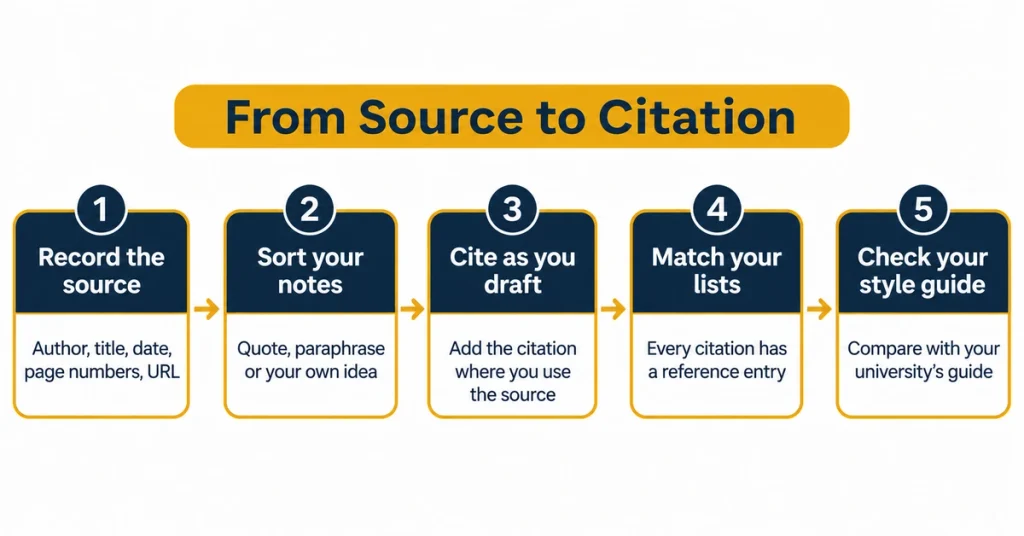
- Confirm your style first. Check the module handbook before you start reading, so you collect the right details from the outset.
- Capture the source details immediately. For most sources, note the author (which may be an organisation), title and date. For books, add the edition, place of publication and publisher. For journal articles, record the journal title, volume, issue and DOI. Always note page numbers for direct quotations. For websites, save the URL and access date. A browser bookmark is not enough, because links can break.
- Sort your notes into three types. Keep direct quotes, ideas you plan to paraphrase and your own reflections apart, with page numbers on the first two. Sheffield recommends this split because it stops other people’s words drifting into your draft unmarked.
- Cite as you draft. Bradford advises citing while you write rather than at the end, and allowing more time than you expect for finding, reading and writing up sources. A realistic schedule helps, so plan your dissertation timeline with referencing time built in.
- Reconcile before you submit. Compare every in-text citation with the reference list, then spot-check several entries against your university’s style guide.
The workflow starts before step one, with the search itself. If you search for sources systematically, you can log each result the moment you decide to keep it. The same habit feeds directly into writing your literature review, where you cite the most sources at once.
Reference management software: Zotero, Mendeley and EndNote
Reference management software stores your source details and formats citations and reference lists automatically. Three tools dominate UK university guidance, and their main differences are cost and licensing:
| Tool | Cost model | Worth knowing |
|---|---|---|
| Zotero | Free and open source, with paid extra storage | Zotero Bib, a lighter web version, creates references without an account |
| Mendeley | Free, with paid extra storage | Uses open citation style files, like Zotero |
| EndNote | Commercial licence, often supplied by universities | Some universities, including Oxford Brookes, provide it free to all students |
Ask your library which tool it supports and trains students on, because a supported tool means help when something breaks. Whichever you use, remember that the software formats what it imports. Details pulled automatically from databases and search engines sometimes contain errors, so confirm them against the original source.
Using an online reference generator safely
Online generators are useful but imperfect. Oxford Brookes finds they handle books and journal articles reasonably well but often produce odd references for other source types, sometimes pulling details from login pages. Pick the correct local version of your style, then check the output against your guide.
Our free reference generator runs in your browser and covers Harvard, APA, MLA, Chicago, OSCOLA, Vancouver and IEEE. It formats exactly what you type, so accurate input gives accurate references. Compare a few entries with your university’s guide, especially for legislation, datasets or social media.
Quoting, paraphrasing and summarising to avoid plagiarism
All three techniques need a citation. They differ in how much of the source’s wording you keep, and in what you must show the reader.
| Technique | What it is | What to show |
|---|---|---|
| Quoting | Reproducing the exact words of a source | Quotation marks or a block indent, plus a citation with a page number |
| Paraphrasing | Restating one specific idea in your own words and sentence structure | A citation, with a page number where your style asks for one |
| Summarising | Condensing a source’s main points into your own words | A citation to the source |
Swapping a few words does not count as paraphrasing. Oxford suggests summarising the author’s overall argument in your own words instead of working through their sentences one by one.
Disciplines also differ on quoting. Bradford notes that direct quotation is strongly discouraged in science and engineering, and that copied charts, diagrams, photographs and code count as direct quotes, so they need acknowledging too.
A worked paraphrase example
The passage below is invented for illustration. It is not from a real source, and the citations use placeholders.
Source text: “Students who spread their revision across several weeks tend to remember more than students who revise in a single block.”
Too close, even with a citation: Students who space their revision over several weeks tend to remember more than those who revise in one block (Surname, Year, p. 00).
Acceptable: Spreading revision over several weeks appears to support retention better than one concentrated session (Surname, Year, p. 00), which shapes the timetable proposed in this study.
The first version keeps the source’s structure and most of its vocabulary. The second expresses the idea in a new sentence and connects it to the writer’s own argument, which is where your voice should appear.
What your Turnitin similarity score means
Is there an acceptable Turnitin percentage?
No. According to Turnitin’s help centre, there is no single acceptable or perfect score, and the percentage is a similarity score, not a plagiarism score. It shows how much of a paper matches text found elsewhere in Turnitin’s database. Your institution or tutor may set its own expectations, so ask what applies to your module.
Rules of thumb such as “under 20 per cent is safe” circulate widely on forums and in student guides. They are not Turnitin’s own position. A low score does not prove originality either, since Turnitin cannot check diagrams or images, and a human reviewer still has to read the highlighted passages.
Why does Turnitin highlight my references?
Because it matches text, not intent. Turnitin highlights correctly cited quotations, bibliography entries and common phrases as well as copied passages, which is why a human review is always needed. Instructors can often filter quotations, bibliographies and small matches out of the report, but you cannot assume yours have.
When you see the report, check the following:
- Long matched passages with no quotation marks.
- Paraphrases that follow one source’s structure closely.
- Quotations that are marked but lack a citation or page number.
- Material you reused from your own earlier submission.
Should you try to lower the percentage?
Aim for correct, not low. Turnitin’s own instructor guidance points out that some similarity is expected when students use sources, and that demanding zero would mean no source-based evidence at all. Rewording sentences with a paraphrasing tool purely to shift the matches leaves the real problem untouched, because the ideas still need attributing and a close derivation is still close.
AI tools, plagiarism and Turnitin’s AI report
Does using ChatGPT count as plagiarism?
It depends on your module and your university’s rules. Some permit specific uses, such as brainstorming or checking grammar, while others restrict AI altogether. Where use is permitted, you are expected to acknowledge it, and UCL and Oxford Brookes both publish student guidance on doing so. Cite Them Right also has guidance for generative AI across several styles.
Formats vary by style. In Harvard, AI output that only you can access is often cited in a way similar to personal communication, following the pattern of tool owner, year, “tool response to” your name and the date. Check how your own guide handles it, because Loughborough tells students that school or department guidance takes precedence, and Greenwich advises asking the module leader whether an appendix of your AI conversation is required.
One further caution applies: verify every source an AI tool suggests. Open it, confirm it exists and check that it says what the tool claims before it goes anywhere near your reference list.
Can Turnitin detect ChatGPT?
Turnitin has a separate AI writing detection model, independent of the similarity score. Its highlights do not appear in the Similarity Report. Turnitin’s guidance says the model may misidentify human-written, AI-generated and AI-paraphrased text, so it should not be the sole basis for action against a student. Results in the 1 to 19 per cent range show an asterisk instead of a number, because of the risk of false positives.
Availability depends on your institution’s licence, and the AI report is often not visible to students at all. Keeping your notes, drafts and version history is sensible whatever the tools show, since they let you demonstrate how your work developed if anyone asks.
Position correct as of November 2026. AI policies and Turnitin features change often, so check your university’s current guidance and the Turnitin help centre.
Common referencing mistakes and how to fix them
| Mistake | Why it causes trouble | Fix |
|---|---|---|
| No page number on a quotation | Readers cannot trace the exact words | Record page numbers in your notes at the moment you copy |
| Citing a source you only saw quoted elsewhere | It presents second-hand reading as first-hand | Use your style’s secondary citation format, or read the original |
| Reference list that does not match the text | Missing or extra entries signal careless work | Cross-check both directions before submitting |
| Saving only a web bookmark | Links can break, leaving no record of the source | Store the author, title, URL and access date |
| Uncredited image, chart or code | These count as direct quotes | Credit the original in your caption and reference list |
| Reusing earlier coursework | Duplication counts as self-plagiarism | Ask your module leader whether and how you may build on it |
| Trusting generated references unchecked | Tools often mishandle non-book sources | Check against your university’s style guide |
Checklist to avoid plagiarism before you submit
- Every quotation has quotation marks (or a block indent), a citation and a page number.
- Every paraphrase changes the structure as well as the words.
- Citations and reference list match in both directions.
- One style is used throughout, in the version your department specifies.
- Images, charts, tables and code are credited.
- Reused material from your own earlier work is cleared with your tutor.
- Any permitted AI use is acknowledged as your university requires.
- Highlighted Turnitin matches (if you can see them) have been checked passage by passage.
For the wider picture, work through our dissertation checklist, which covers structure, formatting and submission as well as sources.
Referencing and plagiarism FAQs
Can I check my own draft in Turnitin before submitting?
Only if your institution allows it. Some universities provide draft submission points, and some licence Turnitin Draft Coach, a tool designed to help students check their citations before final submission. Ask your module team what is available rather than guessing.
Can I submit to Turnitin more than once?
That depends on how your tutor configured the submission point. Some allow resubmission until the deadline, while others accept a single upload. Check the instructions on your virtual learning environment, or ask before you upload.
What happens if my university suspects plagiarism?
Procedures differ between institutions, so read your academic misconduct regulations. Oxford’s published process is one example: for exams, the Proctors investigate and may interview the student, no action follows if no breach is found, and intentional or reckless breaches go to a disciplinary panel, with penalties that can include failing the degree. If you are called to a meeting, answer honestly and consider contacting your students’ union advice service first.
Your next step
Start with the habit that does the most work: build every citation while the source is open in front of you. The same reference generator that formats the entry can be your quick check at the end. If you would like a second pair of eyes on how your sources are used in context, our literature review help is one route. Any support material should be used for reference and learning, in line with your institution’s policy.