
How to Plan Your Dissertation Timeline: Work Backwards From Your Deadline

A dissertation timeline is a dated plan that starts at your submission deadline and works backwards, giving every stage from proposal to final proofread its own start and finish date. The reliable way to build one is to fix the deadline first, list the stages in order, and then add the waits you cannot control, such as ethics approval and supervisor feedback, plus a buffer at the end.
If you are asking “How many weeks does the literature review really need?” or “When must my ethics form go in?”, the honest answer sits in your own handbook, not in a universal formula. Turning those handbook dates into a schedule you can actually follow takes six steps. The examples suit final-year and taught master’s projects, with a shorter section for PhD milestones. Your department’s dates always override any example here.
What a Good Dissertation Schedule Contains
A workable plan has four parts, and most failed plans are missing the last one.
- Fixed dates: the submission deadline, the proposal or title deadline, ethics cut-offs, and any interim review or presentation.
- Stages: reading, design, data collection or source gathering, analysis, writing and revision.
- Milestones: a concrete finished output at the end of each stage, such as an approved ethics application or a complete chapter draft.
- Buffer: spare time held back for illness, data problems and revision requests.
Universities organise the early stages differently. The University of Edinburgh’s Study Hub, for example, notes that dissertation preparation starts at different points depending on programme and level: some students write a research proposal in semester 1, while others submit only a tentative title at the start of semester 2. So check where your own programme begins before you copy anyone else’s calendar.
How to Plan a Dissertation Timeline Step by Step
Six steps cover the whole job, and each one depends on the one before.
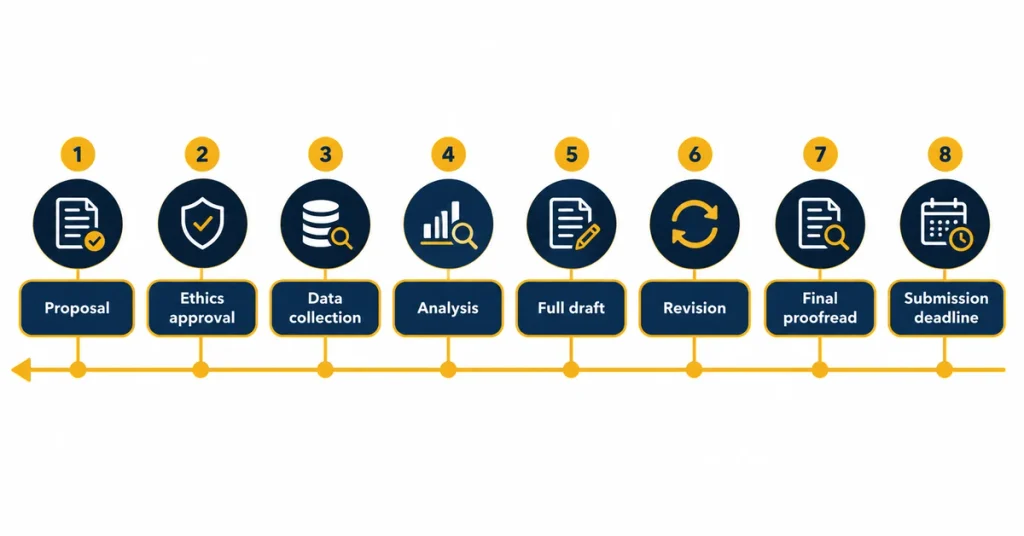
1. Fix the deadline and every date your department has set
Start with the dates you cannot move. Write down the final submission date, the proposal deadline, any ethics cut-off and any interim review. Your module handbook and the programme page on your virtual learning environment usually hold all of them, so read both before you draw anything.
2. Work backwards from the submission date
Edinburgh’s Study Hub recommends a project-management approach that works backward from the deadline, because a dissertation is large and several tasks run at the same time. Put the submission date at the end of your calendar. Then place the final proofread, the full revision and the complete first draft in front of it, in that order.
3. Break the project into stages and weigh them honestly
Next, list the stages: topic and question, proposal, literature review, methodology and ethics, data collection, analysis, discussion, introduction and conclusion, then revision. The weight of each stage depends on your method. A project built on interviews or surveys spends longer on data collection, while a library-based study spends longer reading and writing. A clear dissertation outline makes these weights much easier to judge, and well-defined aims and research questions stop the scope from growing halfway through.
4. Overlap the stages that can run together
Overlap is where a timeline gains real time. For instance, you can keep reading for your literature review while an ethics application is under review, and you can draft the methodology chapter as soon as your design is settled instead of saving it for the end. Writing as you go also spreads the heaviest work across the whole schedule.
5. Add supervisor checkpoints
At your first meeting, ask how many meetings you can expect, how long feedback usually takes, and in what format drafts should arrive. Then put those meetings and chapter hand-in dates into the plan. An Edinburgh MSc graduate quoted in the Study Hub blog set personal deadlines for every chapter and shared them with their supervisor, which left the dissertation nearly complete in May for a July deadline. Sharing dates makes them harder to drift past.
6. Protect a buffer before the deadline
Finally, hold back the last stretch before submission. Treat it as buffer, not as extra working time. If a data collection round fails or your supervisor asks for a rewrite, the buffer absorbs the damage instead of pushing you past the deadline. The dissertation checklist is useful for the final days, when formatting and referencing take longer than most students expect.
Dissertation Timeline Example: A 16-Week Plan
A 16-week project that needs ethics approval makes a useful illustration. Treat it as an example, not a rule, and swap the week numbers for the dates in your handbook. Note that the ethics wait sits inside weeks that are already busy with reading and drafting.
| Weeks | Stage | Milestone to reach |
|---|---|---|
| 1 to 2 | Research question, proposal, first supervisor meeting | Question agreed; ethics application submitted by the end of week 2 |
| 2 to 6 | Literature review | Complete draft of the review |
| 3 to 7 | Methodology drafted while ethics review runs | Methodology chapter drafted; approval received |
| 8 to 10 | Data collection or source gathering | Data ready for analysis |
| 10 to 12 | Analysis and results | Results chapter drafted |
| 12 to 13 | Discussion, introduction and conclusion | Complete first draft |
| 14 | Supervisor feedback on the full draft | Feedback received and revision list written |
| 15 | Revision, referencing, formatting, proofreading | Final version ready |
| 16 | Buffer | Submit, with spare time in hand |
Ethics is shown going in by the end of week 2 so that approval arrives around week 8 even if the review takes about six weeks. A project that uses only published data may not need ethics approval at all, so confirm that with your supervisor before you remove the step.
Ethics Approval and Supervisor Feedback: The Delays That Break Schedules
Two waits cause most timeline failures: the ethics review and the feedback on your drafts. Both sit outside your control, so both need dated slots in the plan.
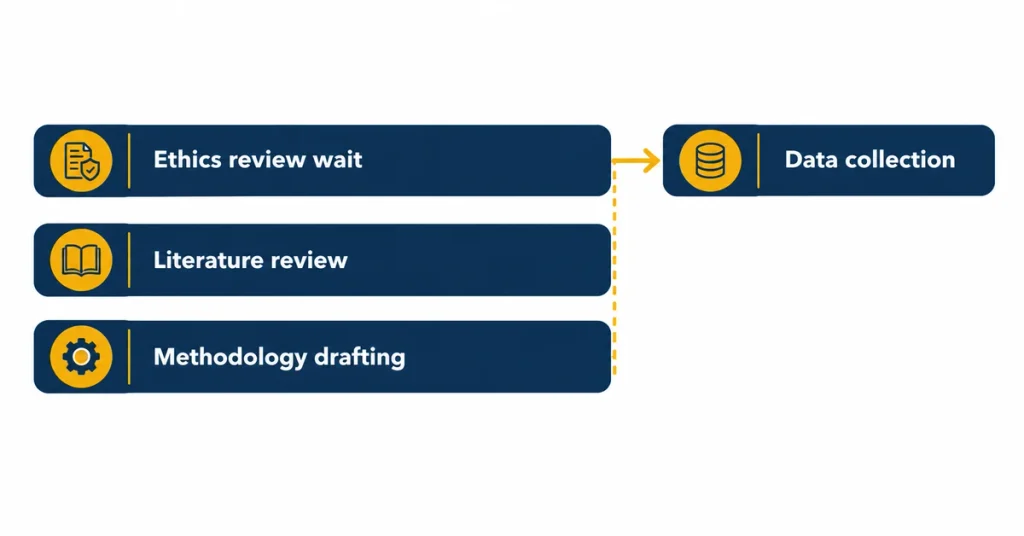
Published turnaround times show how long the first wait can be. Northumbria University recommends allowing up to 25 working days (roughly four to five weeks) to secure approval, notes that reviewers can take 20 working days to return a decision, and states that the clock is paused if an application comes back with revision requests. At UCL, initial feedback on a low-risk application comes within 20 working days and applicants are advised to allow six weeks, while high-risk applications are normally submitted around four weeks before the committee meeting. See Northumbria’s ethics FAQs for the full wording.
These are two universities’ own figures, and yours may be quicker or slower. Position correct as of October 2026; check your department’s ethics pages for the current turnaround. The guide to getting ethics approval explains what the application needs, which helps you avoid a returned form and a restarted clock.
Supervisor feedback has no standard turnaround, so ask for yours and plan around it. If your supervisor needs time to read a full draft, schedule the hand-in with that gap in mind and keep working on other sections meanwhile.
Gantt Chart, Table or Planner: Which Format Works Best
The best format is the one you will still be updating in week ten. A Gantt chart shows overlaps and dependencies clearly, which suits a project with an ethics wait and several parallel chapters. A simple table or a wall calendar is enough for a short project with few moving parts. Whichever you pick, review it every week and move dates when reality changes, rather than letting the plan quietly become fiction. The free dissertation timeline planner is a quick place to start a draft schedule from your own dates, and the word count calculator helps you set chapter targets once the stages are in place.
Master’s, Undergraduate and Part-Time Timelines: What Changes
The stages stay the same, but the calendar around them varies by institution. As one example, Edinburgh Napier University’s MSc project timeline runs a 12-week project phase after the proposal is approved and a supervisor is allocated. It expects at least six supervision meetings, an initial report covering the literature review and methodology at week 6, an optional draft at week 11 and final submission at week 12. Other universities set very different lengths, so treat this as a model of how milestones can be placed, not as a standard.
Part-time students should plan in months rather than weeks and confirm their own deadlines with the programme team, because part-time routes usually stretch the same milestones over a longer period. A longer calendar also makes the buffer more valuable, since work and family commitments rarely stay constant.
PhD Timeline: Plan by Milestones, Not by Weeks
A doctoral project is too long to plan week by week, so universities set review milestones instead. Imperial College London shows one pattern. Its Early Stage Assessment, a written report and oral examination, is due by 12 months for full-time students and 24 months for part-time students. The Late Stage Review is due by 24 months full-time or 48 months part-time, and students are typically expected to submit a research plan by 24 months showing how they will finish by 36 months and begin writing up. A Progress Review at 36 months checks that anyone not yet submitted has a realistic plan to submit within 48 months. The full list is on Imperial’s PhD journey and milestones page.
Other universities use different months and different names for the same checkpoints. Take your own milestones from your research degree regulations, place them first, and fill the gaps between them with reading, fieldwork and chapter drafts. Starting to write early gives you material for each review, as well as a head start on the thesis.
What to Do If You Fall Behind on Your Dissertation Schedule
Falling behind is common and recoverable if you respond early. Work through these steps in order.
- Tell your supervisor now. Bring a revised plan, not just the problem.
- Re-plan backwards. Count the weeks left before the deadline and rebuild the stage dates from the end again.
- Narrow the scope with your supervisor. Cutting a research question or a data source is better than rushing every chapter.
- Protect the essentials. A complete draft, correct referencing and the required word count matter more than a perfect middle chapter.
- Check your extension rules. Your university’s policy on extensions and mitigating circumstances decides what is possible, so read it before you assume.
Your Next Step
Open your handbook, copy every fixed date into a blank calendar, and work backwards from the submission day using the six steps above. If the schedule has already slipped and you want a second pair of eyes on structure and planning, master’s dissertation support is available for students who want guidance and feedback while they keep the work their own.