
How to Choose a Research Methodology: Quantitative, Qualitative or Mixed Methods

Knowing how to choose a research methodology saves weeks of rework later, because every chapter of a dissertation leans on that decision. Before you commit to quantitative, qualitative or mixed methods, settle these questions for yourself:
- Is my research question asking how much, how often or whether something works, or why and how it happens?
- Can I reach enough participants, or find enough existing data, to answer it?
- Do I have the skills, and the weeks, to analyse numbers, interview transcripts or both?
- Will my supervisor and department accept the approach I have in mind?
- If I combine methods, how do I stop the project doubling in size?
Short answers come first, with the detail underneath. The focus is the three-way choice between quantitative, qualitative and mixed approaches. Techniques that follow that choice, such as sampling or specific statistical tests, have their own guides. Research methods also vary a lot between subjects, so your course handbook and supervisor have the final say.
The short answer: let your research question choose
Pick the approach that lets you answer your research question with evidence you can realistically collect, analyse and defend. In practice that gives three starting rules:
- Go quantitative when you need to measure, compare or test a hypothesis, for example whether one variable affects another.
- Go qualitative when you need to explore ideas, experiences and meanings, especially when you do not yet know which variables matter.
- Go mixed only when one strand would leave the question half answered and you have time to connect both.
Everything else, from sample size to the philosophy section of your methodology chapter, follows from that match.
Methodology or methods: what are you actually choosing?
The two words get swapped constantly, and examiners notice. Methods are the tools you use to collect and analyse data, such as a questionnaire, interviews or a statistical test. Methodology is the reasoning behind those tools: why they suit this question and what they assume about knowledge.
Library guidance from the University of Southampton draws the same line, describing methodology as the part concerned with the philosophical underpinning of the research process. That is why a convincing methodology chapter justifies choices instead of listing procedures. You choose the broad approach first, then the methods inside it.
How to decide which research method to use: six checks
Work through these in order. Each check removes some options, so by the sixth you should be left with one clear choice, or at most two to discuss with your supervisor.
1. Read your research question as a clue
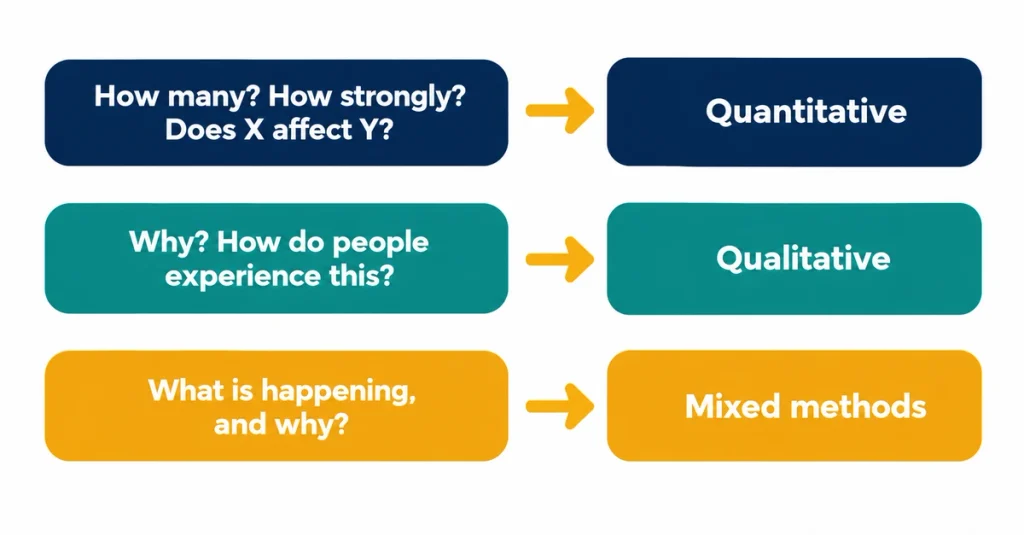
The wording of your question often points to the approach. Treat the patterns below as signals, not rules.
| Question wording | Usually points to | Typical evidence |
|---|---|---|
| Does X affect Y? How much? To what extent? | Quantitative | Survey scores, experimental measures, existing datasets |
| How do people experience X? Why do they do Y? | Qualitative | Interviews, focus groups, observation, documents |
| How common is X, and why does it happen? | Mixed | A survey plus interviews, in sequence or side by side |
If your question is still loose, work on writing a clear research question first, because every later decision depends on it.
2. Ask what kind of problem you are solving
John and David Creswell’s Research Design, summarised by the Sage Research Methods Community, links problem types to approaches. Questions about the factors that influence an outcome, whether an intervention works, or which variables best predict a result suit quantitative work, as does testing a theory. Topics with little existing research, or groups that current theories may not fit, suit qualitative work, because the researcher cannot yet say which variables matter. Mixed methods fit when either approach alone leaves the problem only partly understood.
3. Learn from studies like yours
Sheffield’s study skills team recommends studying the designs other researchers in your subject have used, including the limitations they admit, and checking course materials or asking tutors about conventions in your field. Your reading is the natural place to start. Note the method, sample and stated limits of each study while building your literature review, and a pattern usually appears.
4. Decide between new data and existing data
Primary data are collected by you, so you control how they are produced and can match them to your question. Secondary data already exist, and suit projects that analyse a large amount of ready-made information. Scribbr’s UK guidance frames the choice this way. Secondary data can save months in a quantitative project, but only if an available dataset really measures what your question asks. Check any restrictions on use as well, including ethics and data protection rules.
5. Test feasibility: time, access, skills and ethics
A strong design on paper can fail in practice. Check four things honestly:
- Time: interviews and observation take long to arrange, transcribe and analyse, and a longitudinal design may outlast your deadline.
- Access: can you reach the participants, organisation or dataset, and will the sample or data be good enough for the analysis you plan?
- Skills: statistical analysis and qualitative coding need different training, and your own background naturally pulls you towards one of them.
- Ethics: find out early whether your project needs formal approval, because that can limit what you are allowed to collect.
Ethics is easier with a clear route, so read up on getting ethics approval before you finalise the design.
6. Check the fit with your supervisor, department and research philosophy
Your readers include the people who mark the work. The Creswells point out that advisers’ and committees’ familiarity with an approach affects how readily it is accepted, so talk your choice through with your supervisor early.
Research philosophy sits behind this decision too. In simple terms, positivism usually leads to quantitative designs and interpretivism to qualitative ones, while pragmatism chooses whatever combination answers the problem, which is why it often underpins mixed methods. Grad Coach’s explainer sets this out clearly. Some programmes expect a philosophy section, whereas many lab-based and quantitative dissertations never mention one. Check your handbook, and if you do name a philosophy, tie it to your research question.
Quantitative vs qualitative research: which one fits your question?
Quantitative research deals with numbers and statistical patterns, so it answers questions of measurement and comparison. Qualitative research deals mainly with words, and sometimes images, to explore meaning and context. Neither is superior. They answer different kinds of question.
| Feature | Quantitative | Qualitative |
|---|---|---|
| Core question | How much, how often, does X affect Y? | How do people experience X, and why? |
| Typical methods | Surveys, experiments, correlational, cross-sectional and longitudinal designs | Interviews, focus groups, ethnography, case studies, content analysis |
| Sample logic | Larger samples that support statistical patterns | Often smaller, for depth, though a large survey with open questions is possible |
| Analysis | Statistical techniques | Coding data into themes or categories |
| Main strength | Tests hypotheses and can generalise | Rich context and the reasons behind behaviour |
| Main risk | Shallow answers, and correlation does not prove cause | Time-consuming, open to researcher bias, conclusions need caution |
If you lean quantitative, decide early which analysis your data will need, because that shapes your questionnaire or dataset. A guide to choosing a statistical test walks through the options. A dissertation sample size calculator then gives a first idea of how many responses you may need.
If you lean qualitative, plan the analysis before the first interview. Sheffield’s guidance adds that conclusions drawn from qualitative data should stay cautious, with limits and possible bias stated openly. Coding for themes is a common route, and a walk-through of thematic analysis for a dissertation shows how it works in practice.
How to tell whether a study is quantitative, qualitative or mixed
Look at the data and how they were analysed, not only at the method label. Numbers handled with statistical tests mean quantitative. Words or images coded into themes mean qualitative. A study with both strands, plus a stated point where the two were connected, is mixed. Labels can mislead: a survey with closed questions produces numbers, whereas open-ended survey answers are usually coded like interview data.
Mixed methods research: when it helps and when it only adds work
What is mixed methods research, and what else is it called?
Mixed methods research deliberately collects and analyses both quantitative and qualitative data in one study, then integrates them at a planned point for a stated reason, such as cross-checking a finding or building one strand from the other. The integration is the defining feature. A study that runs a survey and some unrelated interviews and reports them separately is two studies in one document, not mixed methods.
The approach goes by other names. Johnson, Onwuegbuzie and Turner, in a widely cited definitional paper, use mixed research and mixed methodology alongside mixed methods. Multi-method research is different. It combines two methods of the same kind, such as interviews plus document analysis, rather than one quantitative and one qualitative strand.
The three core designs, and how to choose one
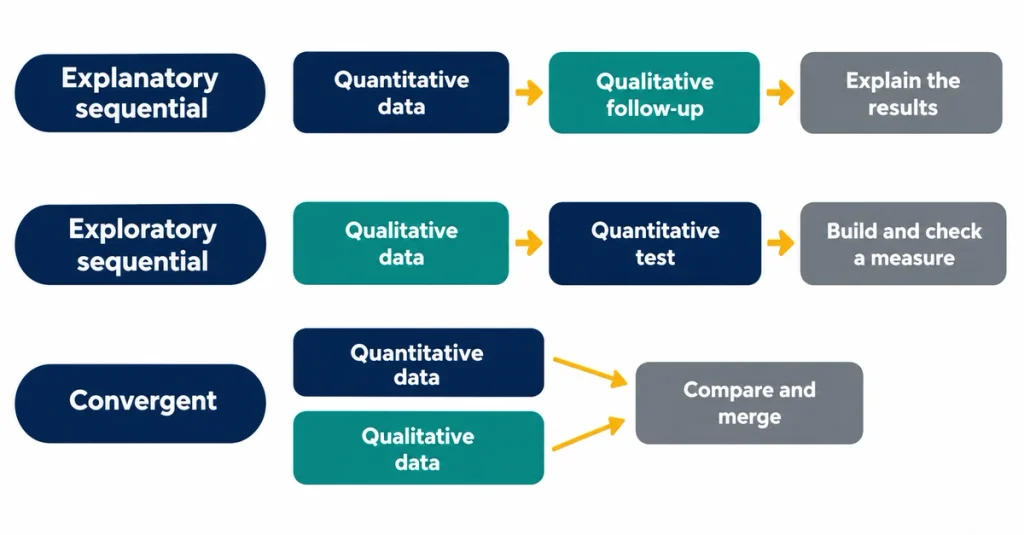
Creswell and Plano Clark’s typology, which the CASRAI research-administration dictionary calls the field’s most widely adopted, starts from three designs. Choose between them by asking what is missing from your project.
| Design | Order | Choose it when | Illustrative example |
|---|---|---|---|
| Explanatory sequential | Quantitative, then qualitative | You already have numbers that need explaining, such as an unexpected pattern or a group that stands out | Attendance figures show one cohort engaging far less, so interviews with that cohort explore why |
| Exploratory sequential | Qualitative, then quantitative | The topic is unfamiliar, or no suitable measuring tool exists yet | Interviews reveal the main concerns, which become the items in a survey tested on a larger sample |
| Convergent | Both at the same time, merged during interpretation | The strands can run independently, both add evidence on the same question, and time is short | A questionnaire and interviews on one topic, compared side by side |
The deciding question is which piece is missing: an explanation for a number you already hold, or a way to measure something nobody has measured well. Embedded, transformative and multiphase designs exist as well, but they build on these three. So the best research design for mixed methods is the one that matches what you already have and what you still need, not a fixed favourite.
Is mixed methods research better? The disadvantages to weigh
Not automatically. It is better only when your question needs both depth and scale, and when you can integrate the strands. Nielsen Norman Group warns against running both kinds of method for the sake of variety, and the costs are real:
- More time: two rounds of data collection and analysis, plus time to connect the results.
- Skills in both traditions: Sheffield notes that you need qualitative and quantitative skills, and suggests that a single-method project may be easier if you are new to research.
- Integration: you must decide how two kinds of evidence will be combined, otherwise the study reads as two disconnected halves.
- Coordination: separate samples, phases and instruments all need managing within one deadline.
Mapping both strands onto a calendar makes the extra weeks visible before you commit, and a dissertation timeline planner helps with that.
How to justify mixed methods in writing
Good reporting practice asks for a stated reason for mixing, a description of the purpose, priority and sequence of the methods, the point where integration happens, and any limits created by combining them. These criteria, known as GRAMMS, are summarised in NIH’s best practice guidance for mixed methods research. Use them as a checklist when you write up your design.
Choosing a methodology in practice: three illustrative scenarios
These examples are invented to show the reasoning. They are not taken from real studies.
A nursing student exploring a new handover routine
The question asks how ward nurses experience a new handover routine. That is about experience and meaning, so a qualitative design fits, probably semi-structured interviews with a small purposive sample and a thematic analysis. The watch points are permission to recruit staff, the ethics route, and protecting anonymity in a small team where people are easy to identify.
A business student testing advertising spend against sales
The question asks whether monthly online advertising spend predicts online sales for one retailer. It is about measurement and prediction, so quantitative methods suit it, and secondary data may work if the retailer shares spend and sales records. Check that the dataset covers enough months for the analysis, and keep association separate from cause. The statistical test selector can narrow the analysis once the variables are defined.
An education student following up an unexpected pattern
Anonymised attendance records for a study-skills programme show that one group attends far less than the rest. The numbers reveal the pattern but not the reason, so an explanatory sequential design fits: analyse the records first, then interview a sample from the low-attendance group. Budget time for the second phase, and make sure your ethics approval covers both.
Common mistakes when choosing a research methodology
- Choosing the method first. Objectives come first and the design follows. Check that your methods line up with your aims, objectives and research questions before you collect anything.
- Choosing for convenience. A survey is easy to send out, yet it cannot always explain why people behave as they do.
- Treating mixed methods as a safety net. Two weakly planned strands are worse than one well-run strand.
- Leaving ethics until last. A design that needs approval you cannot obtain in time has to be rebuilt.
- Listing methods without reasons. Examiners look for justification, so say why each choice suits your question.
- Hiding limitations. All research is imperfect. Naming the limits and what you did about them shows control, not weakness.
How to justify your research methodology in the dissertation
A methodology chapter that convinces examiners does five things:
- Names the approach and the methods inside it.
- Connects each choice to a specific aim or question.
- Explains why the main alternatives were set aside.
- States the limitations and what you did to reduce them.
- Shows the plan was feasible and ethical.
Chapter layout, tense and structure are covered in a separate walk-through of writing the methodology chapter. Support with the chapter itself is available through dissertation methodology help.
Quick answers about choosing research methods
What are the seven steps for choosing a research topic?
Different seven-step lists circulate, and departments often set their own process, so follow yours. The common thread is to start broad, read around the field, narrow towards a question you can answer with accessible evidence, and test it for feasibility and ethics before committing. A fuller walk-through sits in this guide to choosing research topics.
How many types of research method are there?
There is no fixed number. Lists of seven types or five common methodologies depend on who is counting. A practical grouping is by data: quantitative methods such as surveys, experiments and correlational studies; qualitative methods such as interviews, focus groups, ethnography and case studies; and mixed designs that combine the two. Sheffield also lists archival research and critical theory as further routes.
Can I change my methodology after I start?
Sometimes, if you can justify the change. Academic supervision guidance stresses staying flexible while documenting why a choice changed. Speak to your supervisor first, and check that any ethics approval still covers what you now plan.
Your next step
Write your research question as one sentence, run it through the six checks, and take the result to your supervisor. If the wording still feels loose, a research question generator offers starting points you can refine.