
Dissertation Checklist: What to Check in the Final Week Before You Submit

A dissertation checklist earns its place in the last week, when the same five questions keep coming back:
- Which jobs come first, and which can wait until the content is final?
- Does my word count follow my university’s counting rules, including references and appendices?
- Do I need an extension, and when does asking become too late?
- Will a Turnitin similarity check use up my only draft attempt?
- What should I open, check and save before I press submit?
Work in the order that stops one job undoing another: argument first, then chapter gaps, references, proofreading, formatting and the upload. The steps assume every chapter already exists in draft for a UK undergraduate or Master’s project. If you are still writing, finish the chapters first. Universities set their own rules, so your course handbook overrules any general list.
Dissertation Submission Checklist at a Glance
Before you submit, confirm these ten things, in this order:
- The handbook rules on length, layout, referencing, file type and anonymity match what you have built.
- Your introduction, aims and conclusion agree with each other.
- Every chapter passes its own test, from literature review to appendices.
- Every in-text citation appears in the reference list, and every reference appears in the text.
- Proofreading happened after your last content change.
- The title page, contents list, figures, tables and appendices are correct.
- The word count follows your university’s counting rules.
- You have checked a similarity report, if your university allows a draft check.
- The exported file opens correctly, carries the right name and shows no name if marking is anonymous.
- You submitted early and saved the receipt.
How to Build Your Own Checklist From Your Handbook
A general list misses the rules that cost marks, because those rules are local. A personal version takes about an hour to build:
- Open the dissertation handbook or module guide and copy out every rule about length, layout, referencing style, file type, anonymity and declarations.
- Add the marking criteria. Turn each one into a question, such as “Where does my discussion compare my findings with the literature?”
- Add feedback you already have, including supervisor comments on earlier drafts and the aims in your proposal.
- Give every item a day and a tick box. Put dependent items in order, so proofreading comes after the last edit.
- Send your supervisor or programme office any unclear rule now, not on deadline day.
Once the items exist, a planning tool such as the free dissertation timeline planner can help you attach dates to them. The day-by-day plan below gives a sensible order to start from.
Final Week Dissertation Checklist: A Day-by-Day Plan
Count backwards from your deadline and give each day one job. Later jobs depend on earlier ones, so a late content change can break references, figures and word count. If you have fewer than seven days, merge neighbouring days but keep the order.
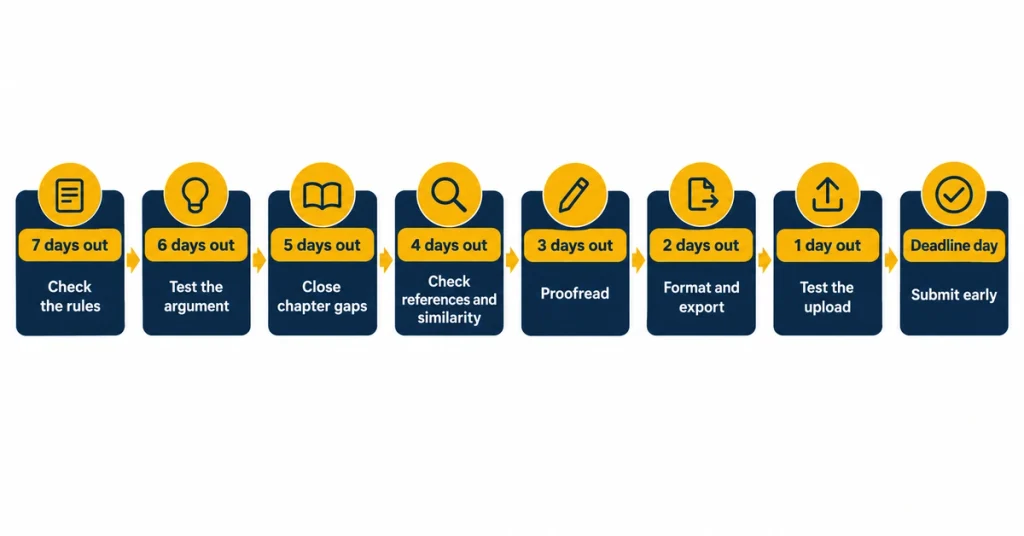
Seven days out: confirm the rules and your options
Start with the rules, because they decide everything else. Reread the handbook and write down the word limit and how it is counted, the layout rules, the referencing style, the file type and size limit, whether marking is anonymous, and any cover sheet or declaration. Note the exact deadline time as well as the date. Also check whether your university asks for a statement about generative AI use next to the usual originality declaration. Finally, decide today whether you need an extension, because most requests must arrive before the deadline.
Six days out: test the argument end to end
Write your answer to the research question in two sentences, then read your conclusion and check that it says the same thing. Next, take every aim, objective and research question from the introduction and find where each one is answered. If one has no answer, reword it to match what you actually did, or add the missing evidence. A quick reread of how to keep aims, objectives and research questions consistent helps here. Do not start new chapters now. Fix structure only.
Five days out: close the chapter gaps
Run the chapter tests in the next section. Treat today as the last day for new content. From here on, make corrections only, because every new paragraph needs its own citations, figure numbers and word count.
Four days out: check references and run a similarity draft
Check references in both directions. Every in-text citation must appear in the reference list, and every reference must be cited in the text. Then confirm that one referencing style runs throughout, that direct quotes carry page numbers where your style requires them, and that the list follows the right order and indentation. Even with reference software, scan the output, since one mistyped source or outdated style file can repeat across many entries. For a stubborn single entry, a free reference generator can format it correctly before you paste it in.
Once the references are right, submit a draft to the similarity checker if your university provides one, following the draft rules covered in the Turnitin section below. Doing this now, not on deadline day, leaves time to rewrite any passage that sits too close to its source.
Three days out: proofread after the content freeze
Proofread only now, because any edit made after proofreading can introduce fresh errors. First, rewrite the passages flagged in your similarity draft. Then leave the text alone for a few hours, since your brain starts to see what you meant to write. Use several passes with one focus each: spelling and typos, punctuation and grammar, then consistency of headings, terms and tense. Reading aloud exposes missing words, and reading backwards sentence by sentence stops you following the story so typos stand out. Writing centres commonly recommend both methods. Spellcheck helps, but it misses real words used wrongly, such as “principle” for “principal”. Before you ask anyone else to read your work, check your university’s rules on proofreading by other people.
Two days out: format, update the contents and export
- Title page: every required detail present, and no page number on it if your rules say so.
- Declaration or cover sheet: completed, and signed where required.
- Contents list: updated last, after every edit, together with any list of figures and tables.
- Headings and figures: no heading stranded at the foot of a page, and every figure and table number matching the text.
- Appendices: labelled, referred to in the text and anonymised where needed.
- Word count: taken one last time under your university’s counting rules.
- Export: save in the required file type, usually PDF, then open the exported file and scan every page, because layouts can shift during conversion.
One day out: rehearse the upload and rest
Log in to the submission system and find the correct submission point for your module, since uploading to the wrong one can cause problems later. Check the file size and type limits, and make sure the file name follows your rules. Keep a backup copy in two places. After that, stop. Tired people make late mistakes, and the checklist is finished.
Deadline day: submit early, then confirm
Submit hours before the deadline, not minutes, so a slow connection or a portal error does not decide your result. Afterwards, wait for the confirmation receipt or email and save it with a screenshot. If the portal lets you open the submitted file, check that it is the right version. If something fails, contact your department’s support team straight away with the time and a screenshot, rather than trying repeated uploads.
Chapter by Chapter: What Each Section Must Prove
Use these tests on day five. Each one is a yes or no question that a marker could ask.
Front matter and abstract
- Does the title match the research question and the cover requirements?
- Does the abstract state the aim, method, main findings and conclusion within the stated limit, and does it match the final chapters because you wrote it last?
- Do the contents entries and page numbers match the final headings?
Introduction and literature review
- Do the research question, aims and objectives use the same wording in every chapter?
- Does the review compare and evaluate sources instead of describing them one by one? A step-by-step approach to the literature review shows what that looks like, and the review should end on the gap or question your study addresses.
- Is every theory or framework named in the review used later in the analysis or discussion? A framework that disappears after chapter two is a marker’s first question.
Methodology, results and discussion
- Does the methodology justify each choice (why this sample, why this method, why this test), state ethics approval and name the limitations honestly? The guide to writing a dissertation methodology covers the justification step by step.
- Does every method in the methodology produce a result, and is every table and figure numbered, captioned and mentioned in the text? Reporting findings without interpretation is the job of the results chapter, so keep the explanation for the discussion.
- Does the discussion compare each finding with the literature, explain any unexpected result and state what the evidence cannot show?
Conclusion, references and appendices
- Does the conclusion answer the research question directly, add no new evidence and make recommendations that follow from your findings? The conclusion-writing guide gives a test for this.
- Does the reference list pass the two-way check from day four?
- Do the appendices hold supporting material, such as questionnaires, consent forms and extra tables, rather than arguments a marker needs to read?
Undergraduate and Master’s Dissertation Checklist Differences
The final-week steps are the same at both levels. What changes is how much justification and criticism markers expect to see in the text.
At undergraduate level, check that the project is focused, that the method is applied correctly and explained, and that referencing stays consistent from first page to last. A clear line from question to evidence to conclusion matters more than ambitious scope. If one chapter is still weak with days to go, targeted bachelor dissertation help can focus on that chapter while you finish the other checks.
At Master’s level, check that you evaluate sources instead of summarising them, defend each methodological choice, state limitations plainly and say what your study adds. Explain ethics approval and data handling explicitly. When time is short, Master’s dissertation help can give feedback on a methodology or discussion chapter while you keep control of the argument.
Any support work is for reference and learning, and should be used in line with your institution’s policy.
Subject-Specific Checks for Science, Social Science and Law
Departments add their own items to the standard list. Three published examples show how far they can differ:
- Science and technical projects: Newcastle University’s academic skills checklist for science dissertations asks for a title and legend on every figure and table, an abstract within its word limit, stated aims, and methods and results in the past tense with no contractions.
- Social science and education projects using APA: a 2019 checklist from Marjon University asks for a page number on every direct quote, an alphabetical reference list with a hanging indent, and a copy of the ethical clearance form in the appendices.
- Law projects using OSCOLA: in one university’s law modules, footnotes, including OSCOLA citations, count towards the word count, while the bibliography does not.
If your department publishes a checklist like these, add its items to your own list before day seven.
Dissertation Word Count Rules to Check Before Submitting
Word limits cause avoidable penalties because counting rules vary. Some universities count headings, tables, in-text citations and footnotes but exclude the reference list and appendices, and others differ. For example, one Kent law module policy allows a 10 percent margin over the maximum before penalties apply and counts footnotes, while a Warwick history department states that a 9,000-word dissertation loses one mark for each 100 words, or part of 100, over the limit. Some universities also treat a false statement of word count as academic misconduct.
So find the rule in your handbook, count with your word processor, and subtract only what the rule excludes. State the count wherever the cover sheet asks for it, and leave a safety margin, because small edits shift the total. When you are over, cut repeated definitions, repeated summaries at the end of chapters and signposting that restates the previous paragraph. Do not shrink the font or move arguments into appendices to dodge the limit. If you are re-planning, the free dissertation word count calculator can help you set a word budget for each chapter.
Position correct as of October 2026; check your own handbook for the current rule.
Late Submission Penalties and Extension Requests
Penalties and extension routes differ widely, so read yours before the final week starts. Durham University’s Common Awards guidance caps work submitted within five working days of the deadline, without an extension, at the module pass mark. St Mary’s University accepts a single submission up to 48 hours late with a 10 percentage-point deduction, capped at the pass mark, which is 40 percent for undergraduate and 50 percent for postgraduate programmes. Those are two models only. Your university may deduct marks by the day or record a zero after a set number of working days.
Extensions run on a different clock. The University of Manchester’s mitigating circumstances and extension guidance states that an extension request goes in on or before the coursework deadline, and that after the deadline you must use the mitigating circumstances route with supporting evidence. The University of Worcester sets the cut-off for dissertation extension requests at up to two weeks before the submission date, and caps a dissertation handed in within seven days of the deadline at the minimum pass mark unless a mitigating circumstances claim is upheld. Loughborough University requires documentary evidence for postgraduate taught dissertation extensions and treats fabricated evidence as a disciplinary matter.
The practical lesson is to look up the extension cut-off today, apply before it passes and keep working while you wait. One university’s guidance tells students waiting on a mitigating circumstances decision to submit as much as they can, so that non-submission does not default to zero.
Position correct as of October 2026; check your own university’s current policy.
Turnitin Similarity Report: Use Your Draft Attempt Wisely
A similarity report highlights text that matches other sources. It does not decide whether anything is wrong, because correctly quoted and referenced passages, and your reference list, can match too. Use it to find passages that sit too close to a source, then rewrite them in your own words and cite the source.
Rules for drafts vary, and the differences can cost you your only attempt:
- Canterbury Christ Church University’s guidance on similarity reports says its academic integrity policy lets students self-check at least one draft for each assessed piece, and warns that uploading to the wrong module, even as a draft, can produce a very high similarity score.
- At the University of Suffolk, Levels 3 to 5 get unlimited draft attempts, but Levels 6 and 7 get one. Submitting the final work before the draft makes the draft read as a 100 percent match.
- The University of Worcester advises against submitting drafts within 24 hours of the deadline, because such a draft can be taken as the final submission.
So check how many attempts you have, use one when the text is near final but at least a day or two before the deadline, and upload to the module your handbook names. If you are unsure, ask your department before you use the attempt.
Dissertation Checklist FAQs
How many days before the deadline should I stop adding new content?
Aim for about five days if you can. After that, make corrections only, because each new paragraph needs citations, figure numbers and word count changes, and it reaches the proofreading stage unchecked.
What if I find a mistake after I have submitted?
First check whether the portal lets you replace the file before the deadline, and what the rules say about resubmitting. If the deadline has passed, contact your department promptly and ask what is allowed. Do not send a corrected copy to your supervisor unless you are told to.
Can someone else proofread my dissertation?
Rules on proofreading by other people differ between universities, so check your handbook or ask your supervisor before you share your text.
What if I only have 48 hours left?
Keep the same order but shorten each step. Check the rules and word count first, then the argument, then references in both directions, then proofread the abstract, introduction and conclusion, then format and test the upload. Drop anything cosmetic.
Turn the Checklist Into Dated Tasks Today
Copy the eight day headings into a calendar against your real deadline, add the rules from your handbook, and email your supervisor about anything unclear today. The full set of free tools for dissertation students covers planning, word counts and referencing in one place, so you can tick items off as you go.