
Primary vs Secondary Research: How to Choose the Right Approach for Your Dissertation

- Do I have to collect my own data to earn a good mark?
- Does the data I need already exist, and can I actually get it?
- Will ethics approval and recruitment fit before my deadline?
- Would my supervisor accept a project built only on existing sources?
Primary vs secondary research is the choice between gathering new data yourself and analysing data that other people or organisations have already collected. Neither route is better by default. The right one is the route that your research question, your access to data, your deadline and your department’s rules can all support. Five questions settle the decision for most projects, and your answers also give you the reasoning your methodology chapter needs.
The focus here is the university dissertation or research project, so product-launch and market-sizing advice from business research is left out. The decision also sits inside your wider research methodology, so settle it alongside the rest of your design.
Primary vs Secondary Research: What Is the Difference?
Primary research means collecting new data yourself, for example through surveys, interviews, experiments, case studies or observation. Secondary research means using data that someone else has already collected, such as books, journal articles, reports and statistics. The University of Portsmouth Library draws the line in the same place, and it adds that most research projects use both.
Whether data counts as primary or secondary depends on your relationship to it, not on the data itself. A national survey is primary data for the team that ran it. When you reanalyse it for a dissertation, it becomes secondary data for you. Likewise, an interview transcript is primary for the student who recorded it and secondary for anyone who reuses it later.
Where data comes from is also a separate decision from whether it is numeric. The table shows how the two choices combine.
| Primary data (you collect it) | Secondary data (others collected it) | |
|---|---|---|
| Quantitative (numeric) | A questionnaire you design and run | Official statistics or datasets published by others |
| Qualitative (non-numeric) | Interviews or observations you carry out | Published case studies or archived interview transcripts |
Primary Sources and Primary Research Are Not the Same Thing
In history, English and some law work, a “primary source” means an original document or text, such as a letter, a statute, a speech or a case report. Using one is still analysis of material that already exists, so in research-methods terms it sits closer to secondary research than to collecting new data. However, departments word this differently. Check how your handbook uses the terms before you write your methodology.
How to Choose Between Primary and Secondary Research: Five Questions
Work through these in order. Each one narrows the options, and the early ones usually matter most.
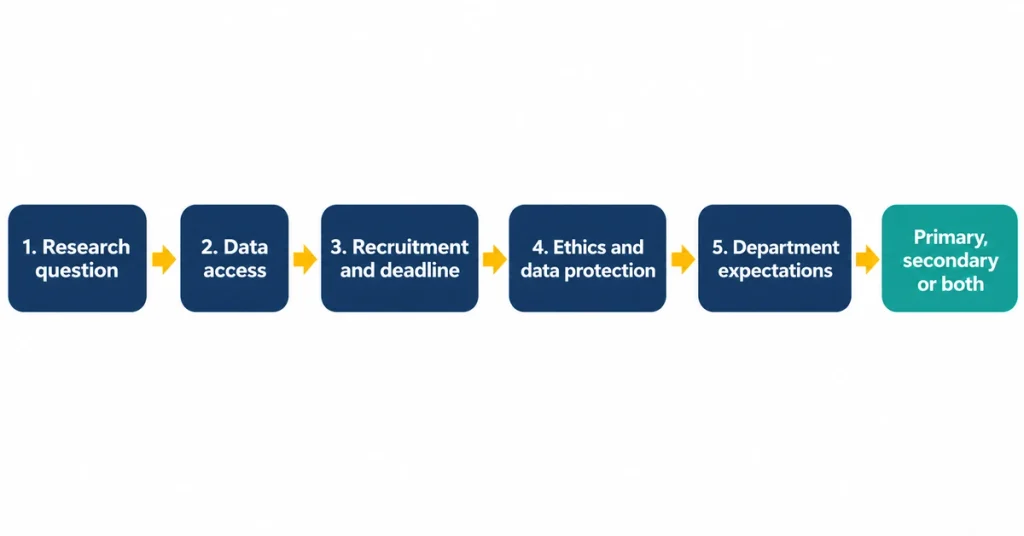
1. What Does Your Research Question Need to Find Out?
Start with the verbs and with the people or cases involved. Questions about how a particular group experiences something, or why its members act as they do, usually need data gathered from those people. Questions about patterns across a whole population, or about change over several years, are often better served by existing datasets that already cover many people and several time points. The UK Data Service points out that many social surveys repeat regularly, which lets students compare different points in time. It also notes that large national surveys such as the Crime Survey for England and Wales can be used to explore experiences of crime and attitudes towards the police and the criminal justice system.
If your wording is still loose, tighten it before you commit to a route. A clear question makes the data choice far easier, and a step-by-step method for writing a research question helps you get there.
2. Does the Data You Need Already Exist, and Can You Reach It?
Portsmouth’s guidance suggests three checks. Does the data already exist, or must you collect it? Can you access the participants, documents or data sources you need? Do you have enough time to collect primary data? If the data exists and is reliable, secondary research may be sufficient. If it does not exist, primary research becomes necessary.
Search before you decide. Students can reach most UK Data Service datasets through their university or college login, but access depends on the dataset. The service sets out its open, safeguarded and controlled access levels. Open data needs no registration. Safeguarded data needs registration and acceptance of an end user licence. Controlled data is available only through its SecureLab, and only to registered researchers. Some safeguarded datasets add further conditions, so read them before you build a plan around a dataset.
Allow time for the work that follows. The UK Data Service notes that students often struggle to find suitable data, to make sense of complex documentation and to prepare files for analysis. If you will reanalyse numeric data, settle on choosing a statistical test early too, because the variables available can limit the options.
3. Can You Recruit Participants and Finish Before the Deadline?
Primary research has more steps: designing the instrument, gaining ethics approval, recruiting, collecting, processing and analysing. Each step can slip. The UK Data Service observes that students running their own survey can struggle with sample size and bias, so test a survey plan with a sample size calculator before you rely on it. Then work backwards from your submission date, and use a dissertation timeline planner to see whether the fieldwork window is realistic.
If you plan interviews, decide early how you will analyse them, for example through thematic analysis. Transcribing and coding take time as well.
4. What Will Ethics and Data Protection Require?
Primary research with people needs ethical approval before any data is collected, according to Portsmouth’s guidance. It also needs informed consent, confidentiality and the right to stop taking part at any time. Some universities state the consequence bluntly: St Andrews treats the inclusion of unapproved data in an assessment as a breach of its Research Misconduct Policy. Start early, and use a guide to applying for ethics approval to plan the application.
Secondary research is not automatically exempt. Loughborough says ethical review may not be required where the data is fully anonymous or already in the public domain, but non-public data needs the data owner’s permission. The University of Surrey’s secondary data checklist asks whether the original consent covers your proposed use, and it has the supervisor confirm that the criteria are met. St Andrews says an ethics application can apply to secondary data too, especially data from studies with human participants, but it asks students to read its secondary data guidance and talk to their supervisor first, because an application may not be required. Rules differ between universities and sometimes between schools, so follow your own.
Personal data also brings data protection law into play. The ICO’s research provisions guidance explains safeguards such as data minimisation and pseudonymisation, and the ICO says that guidance is under review because of changes made by the Data (Use and Access) Act. Position correct as of October 2026; check the ICO for the current status.
5. What Does Your Department Expect?
Handbooks and marking criteria carry more weight than general advice. Read them for words such as ‘original’, ‘critical’ and ‘justified’, and ask your supervisor which designs are acceptable on your course. Many students fear that using existing data will cost them marks. One lecturer in the UK Data Service’s consultation described that fear as misplaced, and the service reports that its dissertation award singles out students who explain clearly why their chosen data was the best option.
Which Route Fits? A Quick Decision Table for Primary vs Secondary Research
Use the table as a starting point, then check each row against your handbook and your supervisor’s advice.
| If your project looks like this | Lean towards | Check first |
|---|---|---|
| You want to understand how a specific group experiences a service, course or workplace | Primary (interviews, focus groups or observation) | The ethics route, and whether you can reach enough participants in time |
| You want to test a pattern across the UK population, such as attitudes or experiences of crime | Secondary (existing national survey data) | Access level, variable definitions and documentation |
| You want to compare change over several years | Secondary (repeated surveys or time series) | Whether definitions and measures stayed consistent between releases |
| You want to interpret laws, cases, texts or historical documents | Existing material (closer to secondary research) | How your department labels this kind of work |
| You want to evaluate something recent that nobody has studied yet | Primary | Whether you can recruit participants and finish before the deadline |
| You want to explain why a pattern in published data exists | Both: secondary for the pattern, primary for the explanation | Whether your timetable can carry two strands |
Primary and Secondary Research Examples by Subject
The same question types appear across disciplines, but the realistic route differs.
- Psychology: a questionnaire or experiment you run is primary research, and it brings participant ethics with it. Reanalysing a published dataset is secondary research and moves the effort into analysis.
- Criminology: interviews with practitioners are primary. Analysing survey data such as the Crime Survey for England and Wales is secondary, and it can address national patterns that a single-site study could not.
- Business and marketing: a customer survey is primary. Company reports and published market data are secondary, and their quality varies, so source checks matter.
- Law: doctrinal work analyses statutes, cases and commentary that already exist, so it sits closer to secondary research. Socio-legal projects may add interviews or surveys of practitioners, which are primary.
- History and English: archives, texts and criticism are the evidence. They are primary sources in the library sense, yet they are existing material rather than new data you collected.
- Geography and sociology: aggregate census data lets you study the characteristics of areas, as the UK Data Service explains, without collecting anything yourself.
Can a Dissertation Use Only Secondary Research?
Often yes, if your department allows it. Portsmouth notes that some projects rely entirely on secondary research, and the UK Data Service has run a dissertation award since 2016 for projects built on secondary analysis.
A secondary-only project still needs a method. Say how you found and selected your sources or datasets, which criteria you applied, how you judged quality and how you analysed what you found. That differs from a chapter that merely frames the topic. Confirm with your supervisor whether you are expected to deliver a structured review, a critical literature-based argument or an analysis of an existing dataset. A well-built literature review supports every one of those routes.
Combining Primary and Secondary Research
Most projects blend the two. Portsmouth points out that even projects collecting primary data still use existing literature to support and inform the work. A common sequence starts with secondary research to see what is already known and to shape the question. It then adds a small primary study that targets one gap the existing evidence leaves open.
Add the second strand only when it answers a part of the question that the first cannot. Otherwise, the extra strand adds workload without strengthening the argument.
How to Judge Secondary Sources Before You Rely on Them
Quality varies, so appraise before you use. Portsmouth’s source guide rates peer-reviewed journals and academic books as high value, and it calls official statistics reliable but descriptive. It treats grey literature, such as government, NGO and company reports, as fair value because it may reflect the producer’s interests. It also advises caution with general websites, and it says to avoid essay websites and AI-generated content as sources.
For statistics, ask who produced them, for which audience, and whether the choice of publication could have introduced bias. If a source quotes a figure from somewhere else, trace it back to the original, as the University of Nottingham and Glasgow Caledonian University both advise. Checklists such as the CRAAP test, the PROMPT tool and CASP checklists can structure the appraisal.
How to Justify Your Choice in the Methodology Chapter
Every dissertation, including a literature-based one, involves explaining and justifying the methods you chose, as the University of York’s dissertation guide makes clear. Four moves usually cover it:
- State your route: primary, secondary or both.
- Tie that route to your research question.
- Describe the participants or sources, and explain how you selected them.
- Acknowledge the main limitation and say how you managed it.
Here is that reasoning in miniature, using a hypothetical project: “This study analyses Crime Survey for England and Wales data instead of collecting new data, because the question concerns national patterns over several years that a single-site survey could not cover. The main limitation is that the survey variables were not designed for this study, so the analysis uses only the measures available.” Adapt the logic, not the wording, to your own design.
A step-by-step approach to writing the dissertation methodology covers the rest of the chapter.
Common Mistakes When Choosing Between Primary and Secondary Research
- Choosing primary research because it feels more impressive. The UK Data Service reports that students sometimes want their own data even when existing data would answer the question better.
- Assuming secondary data skips ethics. Check anonymity, access conditions and your university’s rules.
- Treating a literature review chapter as a complete secondary method. A method also needs selection criteria and an analytical approach.
- Planning around a dataset before checking it. Confirm its access level and documentation first.
- Leaving the justification until the end. By then the design can no longer change.
- Using both approaches by default rather than by need. Each strand should earn its place.
Primary vs Secondary Research: Quick Answers
Is a literature review primary or secondary research?
Secondary. You analyse and interpret what others have published. It works best as a method when you explain how you searched, selected and appraised the sources instead of summarising them one by one.
Can I use AI-generated summaries as secondary sources?
Portsmouth advises against treating AI-generated content as a source, although it says AI tools can support study in other ways. Read the original source behind any summary and cite that, and follow your own university’s AI policy.
How many participants do I need for primary research?
There is no single figure. The number depends on your design, your analysis and what your department accepts, so agree it with your supervisor and justify it in the methodology.
What if recruitment fails and I need to switch to secondary research?
Speak to your supervisor straight away. A change of design may need your project plan or ethics approval to be amended under your university’s rules, and the earlier you ask, the more options you keep.
Turn the Decision Into a Plan
Once the route is clear, fix the question and the timetable. The free research question generator can turn a rough topic into a question you can test. If you want a second pair of eyes on the design and its justification, dissertation methodology support is available. Any support is for guidance and learning, and submitted work should follow your institution’s policy.