
Ethics Approval for Dissertation Research: How to Apply, What to Submit and How Long It Takes

Before you send a survey or book an interview, a few questions need clear answers:
- Does my dissertation need ethics approval at all, or does my project count as low risk?
- Who signs it off: my supervisor, a university committee or an NHS committee?
- When should I apply, and how long will I wait?
- Which documents do I have to submit?
- What happens if I collect data too early?
Ethics approval for dissertation research is an independent check, made before you collect any data, that your project protects participants and handles their information properly. Most UK universities run this check themselves. The NHS route applies only to certain kinds of health and social care research.
The examples below come from published guidance at several UK universities and from the Health Research Authority (HRA). However, each university sets its own forms, risk tiers and deadlines, and NHS arrangements differ slightly across the four nations. Your supervisor and your university’s ethics guidance always have the final say.
In short: work out whether your project involves people, their personal data or sensitive material. Next, complete your university’s ethics checklist, get your supervisor’s sign-off and submit your documents before the deadline. Then wait for written approval before you recruit anyone.
What is ethical approval in a dissertation?
Ethical approval is formal clearance from an independent committee, or from a reviewer the committee has delegated to, to begin research involving people or their personal data. According to UKRI’s Medical Research Council, the review exists to protect the rights, safety, dignity and wellbeing of participants. Reviewers look at matters such as whether the study population is fair, how much burden the study places on participants and how you will protect confidentiality.
Committees do not rate how original your topic is, so a favourable decision says nothing about academic quality. It also does not settle data protection. The University of Edinburgh’s School of Literatures, Languages and Cultures states that a favourable opinion does not mean the research complies with UK GDPR, and that compliance stays with the applicant.
Skipping the process carries real costs. City St George’s, University of London says you cannot use data collected before approval, and that the university’s indemnity insurance will not cover you. Edinburgh’s school adds that, for students, failing to meet ethical obligations may be treated as research misconduct and referred to academic misconduct procedures.
Do I need ethics approval for dissertation research?
Usually yes, if your project involves people or their personal data. The University of Cambridge’s Psychology Research Ethics Committee says projects with more than minimal risk need review, and it lists these examples:
- findings you intend to publish, present or submit as coursework
- data that could identify participants, including email addresses or other contact details
- physical contact with participants
- any risk of discomfort or inconvenience
- any risk of psychological distress to participants or their families
- vulnerable groups, such as children or people whose capacity to consent may be in doubt
- data collection overseas
Online studies can need review even when they store no identifiable data. Reviewers still check that participants give informed consent, that safeguards stop children taking part where that matters, and that data storage meets data protection rules.
Universities handle the question differently. Edinburgh’s school expects students to self-evaluate with a checklist and requires formal review only when the checklist flags an issue. Stirling states that all undergraduate and taught postgraduate dissertations are considered for ethical implications. Either way, complete the checklist yourself rather than deciding that your project is exempt.
What research is exempt from ethics approval?
For university review, your institution decides what counts as exempt. For NHS review, the HRA sets national rules, and many projects fall outside them. The table shows how published guidance treats common dissertation designs.
| Project type | Usual outcome | Where the rule comes from |
|---|---|---|
| Published, public-domain material such as biographies or newspaper accounts | Often no review | Cambridge’s Psychology committee lists it among studies that do not usually need review |
| Open or shared datasets that are properly anonymised, where consent was obtained at the original collection | Often no review | Same Cambridge guidance |
| Literature, rapid, scoping or systematic reviews | No NHS ethics review | The HRA names these as secondary research that avoids REC review |
| Clinical audit or service evaluation | Not classed as research, so no NHS REC review | The HRA advises speaking to the organisation’s clinical governance or R&D office about local arrangements |
| Surveys of NHS or social care staff recruited because of their job | Normally no NHS REC review, but university review still applies | The HRA’s decision algorithm gives a Master’s student’s questionnaire to occupational therapists as an example |
| Online data collection | May still need review | Cambridge says online studies can need review even without identifiable data |
Even when no review is needed, research with human participants still normally requires valid consent, according to Cambridge’s guidance. If you use secondary data, read the dataset’s access conditions as well. Finally, treat “exempt” as a decision to confirm, not to assume. Ask your supervisor or ethics contact to confirm in writing that your project needs no review, and keep that reply with your project records.
Who approves ethics for a dissertation in the UK?
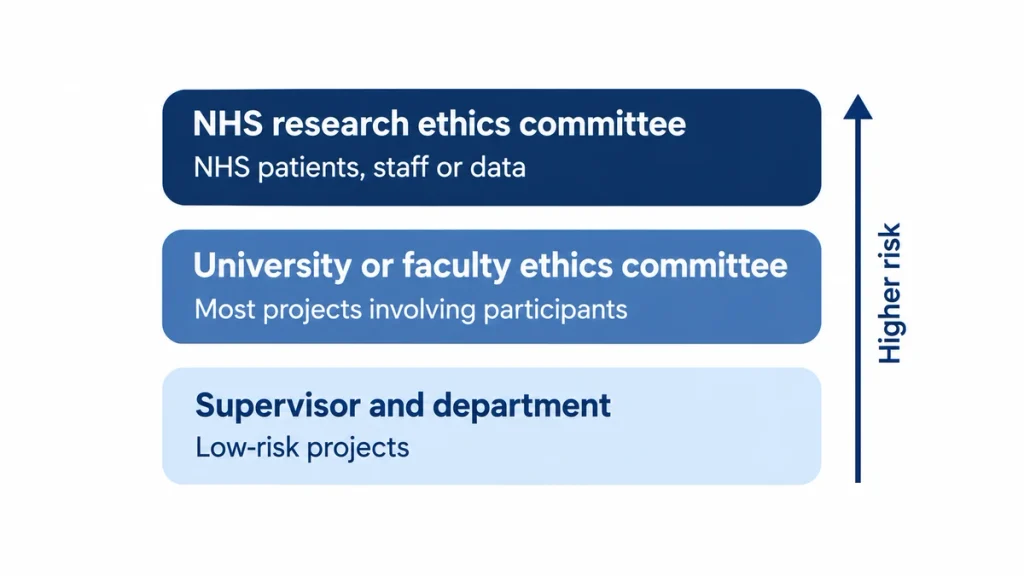
Up to three layers of approval can apply, and many projects need only the first or second.
Your supervisor and department
At many universities, the application starts with your supervisor. Cambridge tells students to consult their supervisor first and says most applications are decided at department or faculty level. At City St George’s, the online system sends student applications to the supervisor for review, and projects judged low risk go to a proportionate committee in the department.
University or faculty ethics committees
Medium and high-risk projects go to a committee. City routes medium-risk applications to a full meeting in the student’s department or school, and sends every high-risk application to its Senate Research Ethics Committee. At the Tooting campus of City St George’s, high-risk studies go to the full committee as well. Cambridge refers complex or high-risk projects up to its university-level committee, along with projects involving vulnerable participants where departmental rules require escalation.
NHS research ethics committees
NHS RECs sit within the HRA’s Research Ethics Service in England, with equivalent services in Scotland, Wales and Northern Ireland. You need one only for certain research. The HRA’s decision algorithm lists legal triggers, such as clinical trials of medicines, certain medical device studies, exposure to ionising radiation, adults who lack capacity to consent, and some uses of human tissue or confidential patient information without consent. It also lists policy triggers, such as recruiting participants through their use of NHS or adult social care services, recruiting their relatives or carers, or collecting tissue or information from service users.
Some universities add an internal step first. Stirling, for example, asks students planning an NHS application to complete the IRAS form, save it without submitting, and send it to the university’s NHS, Invasive or Clinical Research panel. Only after that panel approves should the application go into IRAS.
Other bodies and permissions
- Armed forces research: projects recruiting through the UK Armed Forces go to the Ministry of Defence Research Ethics Committee, according to the HRA.
- Host organisations: NHS England’s library guidance says you need to negotiate with research governance at NHS sites, whether or not full ethical approval applies. St George’s guidance calls written consent from any organisation hosting your study good practice.
- Recruiting a school’s own staff or students: City requires approval from the relevant School before you contact its staff or students.
- Discipline codes: committees expect you to follow the codes of your field, such as the British Psychological Society’s Code of Human Research Ethics (2021) or the British Educational Research Association’s Ethical Guidelines for Educational Research, fifth edition (2024).
Researchers without a university face a different position. The UK Research Integrity Office (UKRIO) says a researcher with no organisational sponsor also acts as sponsor and is personally liable for managing the research. It adds that a favourable ethics opinion is not permission to proceed. Independent opinions are available from bodies such as the Social Research Association and the Association of Research Managers and Administrators, although UKRIO does not endorse any provider. The BPS says it is not best practice for A-level or undergraduate students to run research without supervision and ethics review in place.
Can undergraduates and Master’s students get NHS ethical approval?
Rarely, and not at undergraduate level. Since 1 September 2021, the HRA no longer accepts standalone undergraduate health and social care research that needs NHS ethics review or HRA approval. Master’s students must complete the HRA’s student research toolkit first, and some Master’s projects are no longer accepted. Doctoral students remain eligible, subject to the relevant approvals. For undergraduate and Master’s projects, the supervisor should always act as chief investigator.
The HRA guidance on student research suggests alternatives that avoid NHS review:
- research in areas other than health or social care
- health or social care research with no patients, service users, NHS staff, identifiable samples or identifiable data
- secondary research such as literature, rapid, scoping or systematic reviews
- a project protocol or proposal developed to the point of submission, without submitting it
Review-based projects suit these limits, and you can learn to write a strong literature review before committing to a design. Nursing students weighing that route can also compare ideas in nursing dissertation topics.
Position correct as of October 2026; check the HRA for the current eligibility rules.
How do I get ethical approval for a dissertation, step by step?
The route varies by university, but the sequence is similar almost everywhere.
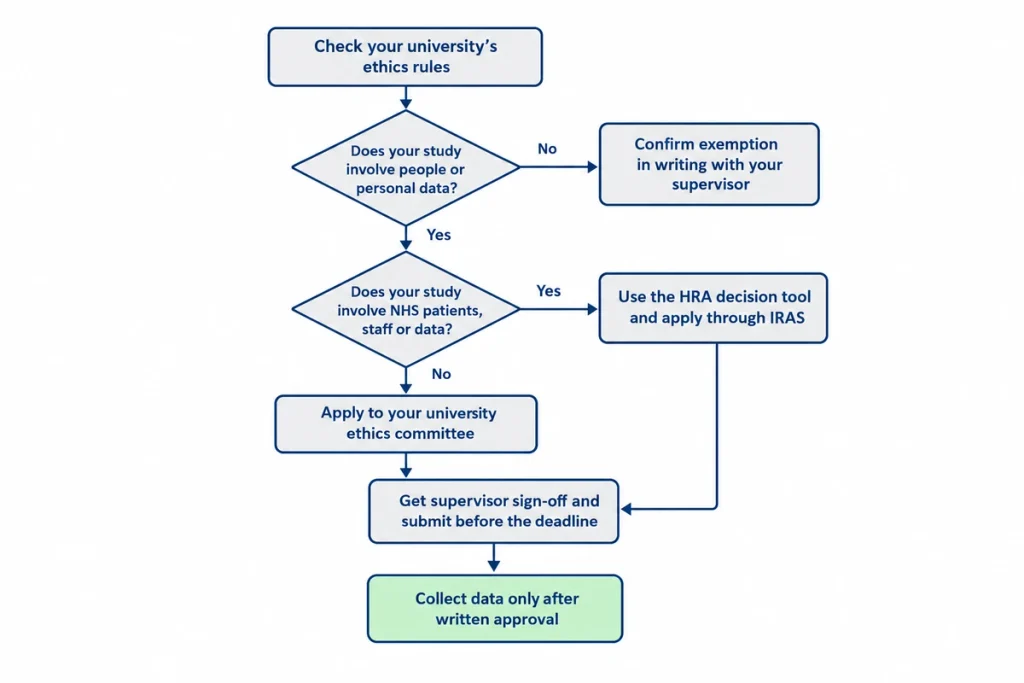
- Settle your question and method first. Edinburgh’s school advises applying once you have a clear topic, research question and approach. Sharpen the question with this advice on how to write a clear research question. Then turn it into a plan by learning to write a dissertation proposal.
- Run your university’s checklist. Edinburgh uses a research ethics checklist, the Tooting campus of City St George’s uses a self-assessment form, and City’s Clerkenwell system sets the risk level automatically. Whichever tool your university uses, keep the result.
- Check for an NHS route. If your project touches NHS patients, service users or identifiable NHS data, use the HRA decision tool before you do anything else.
- Prepare your documents. The next sections list what reviewers usually expect.
- Get supervisor sign-off. City’s system sends student applications to the supervisor first. At the Tooting campus, the supervisor must sign the self-assessment form.
- Submit before the deadline. Use the system your university names, such as City Research Ethics Online or Stirling’s Ethical Review Manager. NHS applications go through IRAS.
- Answer reviewers’ comments. Cambridge notes that its committee may require revisions before approval. A University of Salford student guide calls requests for amendments very common.
- Wait for written approval, then recruit. Edinburgh’s school lets you identify materials and possible participants beforehand, but not collect data or analyse materials systematically.
When should you apply for ethical approval of a study?
Apply as soon as your question and method are settled, and always before any recruitment or data collection. Published deadlines show how early that can be:
- Cambridge’s Humanities and Social Sciences committee asks for applications as early as possible, and no later than one month before the proposed start date.
- Edinburgh’s school expects undergraduate dissertations that need formal review to be submitted by the last working day of November, with a favourable opinion secured at least three months before the submission deadline.
- The same Edinburgh rule sets three months for taught postgraduate dissertations and 15,000-word MScR dissertations, and six months for 30,000-word MScR dissertations.
Edinburgh also states that if approval is not secured by the deadline, the student must switch to a low-risk project that needs no review. Work backwards from your data-collection window, add time for revisions, and map the whole schedule with the dissertation timeline planner.
How long does ethics approval take for a dissertation?
It ranges from about a week for a low-risk project to several weeks where a full committee meets monthly or only a few times a year. The table collects published timings, so check your own university’s current figures.
| Where | Published timing |
|---|---|
| University of Cambridge, Humanities and Social Sciences committee (referred cases) | Aims to decide in seven working days, with no guarantee; revisions can add time |
| City St George’s, Tooting campus | Initial response in five to seven working days; full-committee studies go to a monthly meeting, with a decision letter within five working days of it |
| City St George’s, Clerkenwell campus (high risk) | Senate committee meets six times a year; applications due about two weeks before; outcome within 10 working days of the meeting |
| University of Surrey, final-year sociology dissertation module | Up to four working weeks for faculty committee review |
| University of Salford, undergraduate student guide | About three weeks from submission |
| NHS REC through the HRA | Decision usually notified within 10 working days of the meeting, after booking and validation |
Three things stretch these figures. First, committees often ask for changes. Second, an invalid application restarts the clock; the HRA publishes a checklist of what most often makes NHS applications invalid. Third, the University of Surrey’s module guidance notes that NHS approval is lengthy and would not usually fit an undergraduate dissertation timetable.
What documents do you need for ethics approval?
University committees vary, but published requirements overlap heavily:
- the application form or self-assessment form
- a research protocol or short project description
- a participant information sheet
- a consent form, or a consent statement built into an online survey
- your questionnaire, survey or interview schedule
- recruitment materials, such as adverts and draft emails
- written agreement from any host organisation or gatekeeper
- a risk assessment, where you will do fieldwork (Stirling publishes a form for this)
- your data plan: where you will store data, how long you will keep it and how you will anonymise it
For an NHS application, UKRI lists the usual extras beyond the IRAS form: a research protocol, participant information sheets and consent forms, a summary CV for the chief investigator, and evidence of insurance or indemnity where the sponsor is not an NHS body. IRAS shows which further documents are mandatory for your study.
Two details save time. The Tooting campus of City St George’s returns documents that lack a version number and date, and it expects the first submission to be version 1. Also, at least one third of an NHS REC’s members are lay people, so UKRI advises writing in plain language. Plain wording helps at university committees too.
What a participant information sheet should cover
The Tooting campus’s online survey template gives a useful checklist of headings:
- who you are and what the research is about
- what taking part involves and why the person was asked
- what data you will collect
- possible benefits and risks
- what happens to the data afterwards
- that taking part is voluntary and they can change their mind
- where to get more information
How do you write an ethics approval application? An example
Strong applications show the committee that you have thought about participants first. NHS England’s library guidance summarises the ESRC framework in six principles: maximise benefit and minimise harm, respect rights and dignity, make participation voluntary and informed, act with integrity and transparency, define who is responsible, and keep the research independent, declaring any conflict of interest.
Cover these points in your statement:
- who your participants are and how you will recruit them
- how you will obtain consent, and how participants can withdraw
- the risks to participants and the steps that reduce them
- how you will protect confidentiality and anonymity
- where you will store data, for how long, and how you will delete it
- any conflict of interest and any permission from host organisations
Here is an illustration for a fictional project. It shows the level of detail reviewers look for. Adapt the structure to your own university’s form and do not copy the wording.
This study will interview 12 retail store managers, all aged 18 or over, about how scheduling software affects staff rotas. Participants will be recruited through a post on a professional networking site and will receive an information sheet at least one week before the interview. Each participant will sign a consent form and may withdraw until the transcripts are anonymised, two weeks after the interview. Interviews will take place online, last about 30 minutes and be audio-recorded only with permission. The main risk is that managers may criticise their employers. To reduce this, the study will not collect employer names, will remove identifying details from transcripts and will report findings as themes. Recordings will be stored on the university’s secure drive and deleted after transcription. Anonymised transcripts will be kept for the period set by the university’s retention policy. The researcher has no conflict of interest to declare.
Your ethics statement must match the sampling and data collection described in your methodology, so it helps to know how to write the methodology chapter before you submit. If you want an expert to check that the two fit together, dissertation methodology help covers it.
What if the committee asks for changes or says no?
Treat a request for changes as normal. NHS RECs issue one of four outcomes: favourable opinion, favourable opinion with conditions, provisional opinion or unfavourable opinion. The HRA stresses that an unfavourable opinion does not mean the research can never go ahead. You can revise the application to address the reasons given, and an appeal is possible if you cannot make the required changes. University outcomes vary, so read your committee’s published procedure.
After approval, stick to the approved plan. City lists changes that need an amendment first, including new participant groups, a changed method or instrument, changed study documents and a change of supervisor. It also requires you to report adverse events and breaches of confidentiality, and it says to report confidentiality breaches and safeguarding issues immediately.
Can I collect data before ethics approval?
No. NHS England’s library guidance says you should not begin collecting data until you have approval, and City says data gathered earlier cannot be used. Retrospective approval is rarely an option. City says it cannot be given for research protocols, and Edinburgh’s school does not permit it for completed projects. Edinburgh allows it for projects already under way only in exceptional cases, such as when new materials surface during a previously reviewed project. The Independent Research Ethics Committee (IREC), which describes itself as an independent committee, states that it offers no retrospective review or exemption certificates.
While you wait, you can still work on your literature review, refine your instruments and identify possible sources of data. Do not begin interviews, surveys or participant observation.
Does ethics approval cover data protection?
No, and your application will still ask how you protect personal data. UK GDPR and the Data Protection Act 2018 apply to personal data in dissertations. The Data (Use and Access) Act 2025 amended that framework, including the meaning of research for data protection purposes. The Information Commissioner’s Office announced that most of the Act’s remaining provisions came into force on 5 February 2026, and its detailed research guidance is under review because of those changes.
Position correct as of October 2026; check the Information Commissioner’s Office for the current status of its research guidance.
Whatever the legal detail, plan storage, anonymisation and deletion early. Reviewers ask about them in almost every form listed above.
Common mistakes that delay ethical approval
- Missing version numbers and dates. The Tooting campus returns documents without them.
- Specialist wording in the information sheet. Lay reviewers sit on NHS committees, and plain language helps everywhere.
- Contacting staff or students before the school agrees. City asks researchers to seek the relevant School’s approval first.
- Recruiting through an NHS ward without checking HRA rules. The Tooting campus says recruiting through an NHS working team such as a ward needs HRA approval, while recruiting through a professional organisation’s website does not, though university review still applies.
- Treating online consent as an afterthought. The Tooting campus expects a consent tick box on every page of an online survey.
- Choosing a committee for convenience. City will not accept applications sent to its Senate committee only because the deadline suits better.
Where to start this week
Open your department’s ethics guidance, find the checklist and note the next deadline. Then book a short meeting with your supervisor to agree which route your project takes. If your proposal still needs shaping before you submit, research proposal support can help you tighten the question, method and sample. Support of this kind is for learning and reference, so use it within your institution’s policy.