
Nursing Dissertation Topics for 2026
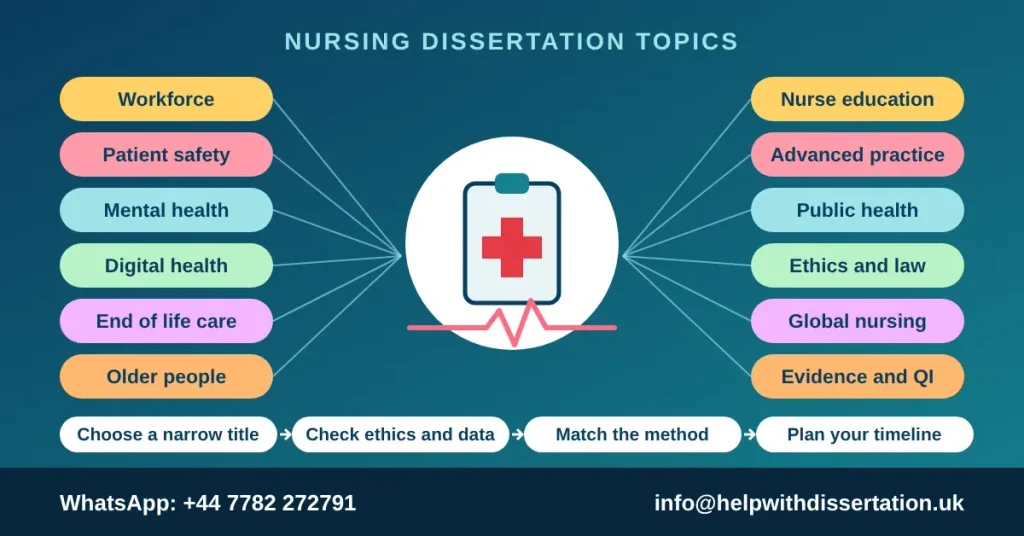
Looking for nursing dissertation topics that your supervisor will actually approve? Here are over 120 free nursing dissertation ideas, written for UK students, with international angles where they help. You can use, adapt or combine any title.
You probably have a few questions before you start. Which idea fits my timeline? Do I need NHS ethics approval? Can I choose something without placement access? I answer each one first, then the topics follow.
Quick answers before you choose nursing dissertation topics
Which topic suits a tight timeline? Choose a desk-based design, such as a literature review, a policy analysis or a secondary analysis of public data. Because you collect no new data, you avoid the slowest part of a nursing project.
Do I need NHS ethics approval? Research involving NHS patients usually needs NHS research ethics review through the Health Research Authority. Most undergraduate and master’s projects avoid that route by using published evidence, public datasets, or staff and student participants under university ethics. However, your university makes the final call, so confirm it with your supervisor before you commit to a title.
Can I choose a topic if I have no placement access? Yes. In that case, pick a review-based or document-based design. The desk-based group near the end of the topic list was written for exactly this situation.
What makes a nursing dissertation title narrow enough? A good title names a population, a setting and a question. For example, “nursing” is far too broad, but “preceptorship and early retention of newly registered nurses in one NHS trust” is workable. Also, check that your title can be answered in the word count and time you have.
Nursing workforce, retention and staffing
Workforce is the most active area for nursing research in the UK right now. Because the evidence base is large, it also suits review-based projects. Start with these nursing dissertation topics.
1. How staffing levels relate to missed care on adult inpatient wards: a scoping review
2. Safe staffing law in Wales and Scotland compared with England’s guidance-led approach A strong policy analysis, because the legal frameworks differ in each nation.
3. Why newly registered nurses leave the NHS early: a thematic synthesis of qualitative studies
4. Preceptorship quality and early retention of newly registered nurses in one NHS trust: a service evaluation design
5. Belonging and team cohesion among internationally recruited nurses in UK hospitals
6. Experiences of internationally educated nurses preparing for the NMC Test of Competence
7. Bank and agency staffing and continuity of care: ward nurses’ perspectives
8. Flexible working and the retention of nurses aged over 50
9. Moral injury among nurses after the pandemic: a narrative literature review
10. Reporting of workplace violence and aggression towards nurses: barriers and enablers
11. What published NHS Staff Survey results show about nurses’ intention to leave: a secondary data analysis Staff Survey results are public, so no ethics route is needed for the data itself.
12. Regional variation in published NHS nursing vacancy statistics: a descriptive analysis
13. The nursing associate role: career progression and team integration
Patient safety and quality of care
14. Martha’s Rule and escalation of concern: family experiences of requesting an urgent clinical review
15. Nurses’ views of Martha’s Rule in acute trusts: a qualitative evaluation
16. Recognising deterioration with NEWS2 on general wards: why do nurses sometimes override scores?
17. Learning from patient safety events: how nurses use the LFPSE service
18. Speaking up and a just culture among student nurses on placement
19. Medication administration errors and interruptions: a systematic review
20. Falls prevention in older inpatients: effectiveness of nurse-led multifactorial interventions
21. Adherence to repositioning schedules for pressure ulcer prevention: an audit design
22. Hand hygiene compliance and hospital-acquired infection: a nurse-led audit
23. Nurses’ role in the first hour of sepsis care: recognition, escalation and delay
24. Structured handover tools such as SBAR: effects on information loss between shifts
25. Alarm fatigue in high dependency settings: nurses’ coping and response
26. Nurse-led discharge planning and emergency readmission: a rapid review
Mental health nursing and the Mental Health Act
Mental health law is changing in England, and the reforms are being brought in in phases. As a result, this area gives you a live policy question. Always check the current stage of each reform before you write.
27. What Mental Health Act reform means for nurses on inpatient wards: a documentary and policy analysis
28. Reducing restrictive practice on acute mental health wards: nurses’ perspectives
29. Trauma-informed care in adult acute mental health settings: a scoping review
30. Suicide risk assessment: structured tools versus clinical judgement in nursing practice
31. Peer support workers and registered nurses: how do they share the work?
32. Help-seeking for mental health among student nurses
33. Compassion fatigue among community mental health nurses
34. Mental health patients waiting in emergency departments: the nurse’s experience
35. Physical health monitoring for people with severe mental illness: the nurse’s role
36. Transition from child to adult mental health services: nurse-led transition models
37. Perinatal mental health: how health visitors identify and respond to need
Digital health and artificial intelligence in nursing
38. Ambient voice technology (AI scribes) and the nurse-patient relationship NHS England has published guidance on ambient scribing, which gives you a policy anchor.
39. Nurses’ trust in AI decision support: a mixed-methods survey design
40. Documentation burden and electronic patient records: a review of nurse experiences
41. Virtual wards and remote monitoring: the nurse’s role in safe escalation
42. Digital literacy among nursing students and newly registered nurses
43. Wearables and remote monitoring in heart failure: nurse perspectives
44. Confidentiality risks when nurses use messaging apps for clinical communication
45. Virtual reality and simulation in pre-registration nurse education: a systematic review
46. Generative AI in nursing education: learning gains and academic integrity
47. Digital exclusion and older patients’ use of the NHS App
48. Pulse oximetry accuracy across skin tones: implications for nursing observation
End of life, palliative care and assisted dying
Assisted dying legislation has been debated in Parliament. Its stage can change quickly, so check its current status on the Parliament website before you finalise a title.
49. Nurses’ attitudes towards assisted dying legislation: a survey design
50. Conscientious objection and professional duty in end-of-life nursing
51. Advance care planning conversations led by community nurses
52. Nurses’ experiences of the last days of life in care homes
53. Bereavement support for staff after patient death
54. Spiritual care by nurses in a secular health service
55. Anticipatory medicines and syringe drivers: community nurses’ confidence
56. Moral distress among intensive care nurses when treatment is prolonged
57. Parents’ experiences of children’s palliative care: a qualitative evidence synthesis
Older people, dementia and frailty
58. Delirium prevention bundles on orthopaedic wards: nurse implementation
59. Dementia-friendly ward environments and nurse-led interventions: a literature review
60. Frailty identification in emergency departments: nurse-led screening
61. The care home nurse role: recruitment, retention and professional identity
62. Antipsychotic prescribing for people with dementia: the nurse’s role in medication review
63. Loneliness in older people and nurse-supported social prescribing
64. Continence care and dignity in older adult wards
65. Nutrition and hydration in older inpatients: do red tray schemes work?
66. Polypharmacy reviews led by nurse prescribers: a systematic review
Nurse education and placements
67. Experiences of racism among student nurses from minority ethnic backgrounds on placement
68. Practice supervisors and practice assessors under the NMC student supervision and assessment standards: role clarity
69. Student views on proposed changes to practice learning The NMC has put forward proposals on practice learning, so confirm their current stage first.
70. Simulated practice learning and its equivalence to clinical placement hours
71. Attrition among first-year nursing students: causes and support
72. Financial hardship and caring responsibilities among student nurses
73. Nursing degree apprenticeships: learner and employer experiences
74. Learning disability awareness in the curriculum and Oliver McGowan training: student confidence
75. Reflective accounts for revalidation: how do registered nurses experience them?
76. Nursing associate to registered nurse top-up pathways: learner experiences
77. Dyslexia and academic writing support in pre-registration nursing
78. Support for international nursing students on UK placements
Advanced practice, professional roles and leadership
79. Role clarity among advanced clinical practitioners and the NMC Principles for Advanced Practice
80. Public understanding of the title “nurse”: views on title protection The Department of Health and Social Care has run a call for evidence on this topic.
81. Independent and supplementary nurse prescribing: confidence and barriers
82. Role boundaries between advanced practice nurses and other new clinical roles
83. Nurse-led clinics for long-term conditions: patient outcomes and experience
84. Nurse consultants and service leadership: impact and visibility
85. Nurse representation at board level: influence on safety and strategy
86. Shared governance and clinical leadership on hospital wards
87. Building clinical academic careers for nurses: barriers to research capacity
Public health, primary and community nursing
88. Health visiting caseloads and early childhood outcomes: a literature review
89. School nurses and child mental health: referral pathways and barriers
90. Vaccine hesitancy: nurse communication strategies in primary care
91. Nurses’ role in inclusion health: care for people experiencing homelessness
92. Tobacco dependence treatment delivered by nurses in hospital settings
93. Weight stigma in nursing practice: attitudes and patient impact
94. Nurse-led remote care for type 2 diabetes
95. Interpreter use and cultural competence in nurse consultations
96. Routine enquiry about domestic abuse by nurses: confidence and barriers
97. Menopause support for nurses in the workforce: policy and practice
98. Health literacy and the design of patient information leaflets
99. District nursing workforce and growing demand for home care
100. Hospital at home: nurse experiences of delivering acute care in the community
Ethics, law and global nursing
101. Duty of candour in nursing practice: barriers to open disclosure
102. Mental Capacity Act best-interests decisions: a documentation audit design
103. Consent and decision-making for adults with a learning disability
104. Freedom to Speak Up guardians: how nurses use the route
105. Ethical recruitment of nurses and the WHO Health Workforce Support and Safeguards List
106. Global nursing workforce shortages: a country comparison using WHO State of the World’s Nursing data
107. Task-shifting in nursing in low-resource settings: a systematic review
108. Climate change and sustainable nursing practice: a scoping review
109. Nurse regulation compared across the UK, Ireland and Australia
Evidence-based practice and quality improvement
110. Clinical audit, service evaluation and research: how nurses choose the right design
111. Barriers to evidence-based practice among ward nurses: a systematic review
112. Normalisation process theory and the adoption of a new nursing intervention
113. Patient and public involvement in nursing research: impact on study design
114. PDSA cycles in ward-based quality improvement: a critical appraisal
115. A rapid review of nurse-led interventions to reduce avoidable hospital admissions
116. A qualitative evidence synthesis of patients’ experiences of nursing care
Nursing dissertation topics without primary data
These nursing dissertation topics need no patient recruitment. Therefore, they suit students without placement access or a short timeline.
117. Content analysis of published NMC fitness to practise outcomes involving nurses
118. Analysis of published CQC inspection reports on leadership in community hospitals
119. Discourse analysis of NHS England policy documents on nursing roles
120. Thematic analysis of Parliamentary debates on the nursing workforce
121. Secondary analysis of Healthwatch reports on patient experience of nursing care
122. A systematic review of nurse-led education for self-management of long-term conditions
Find a nursing dissertation topic by specialism
The topics above cut across specialisms. If you already know your branch, however, go straight to a narrower set of nursing dissertation ideas.
- Adult branch: adult nursing dissertation topics
- Mental health: mental health nursing dissertation topics
- Children and young people: child health nursing dissertation topics
- Midwifery: midwifery dissertation ideas
- Critical care: critical care nursing dissertation topics
- Emergency care: emergency nursing dissertation topics
- Palliative care: palliative care nursing dissertation topics
- Cancer care: oncology nursing dissertation topics
- Newborn care: neonatal nursing dissertation topics
- Dementia: dementia nursing dissertation topics
- Older people: geriatric nursing dissertation topics
- Wounds: wound care nursing dissertation topics
- Pain: pain management nursing dissertation topics
- Community and public health: community health nursing dissertation topics and public health nursing dissertation topics
- School settings: school nursing dissertation topics
- Management: leadership and management dissertation topics
- Practice change: evidence-based practice dissertation topics
How to turn a nursing topic into a workable title
Start with one population, one setting and one question
First, pick a title from the lists above. Next, name who you will study, where they work and what you want to know. For example, “nurse-led discharge planning” becomes “nurse-led discharge planning for older adults on one medical ward”. As a result, your question becomes easier to answer well. You can then test the wording with the research question generator or read how to write a research question.
Match the design to your level
Undergraduate projects usually work best as literature reviews or small, low-risk studies. Master’s students can add a service evaluation, a mixed-methods survey or a systematic review. PhD candidates need an original contribution, so they should test a gap in the evidence before they commit. If you are unsure where to begin, the dissertation topic finder narrows ideas quickly, and this walkthrough on how to choose a research topic explains the logic.
Check ethics and data access early
Research with NHS patients usually goes through IRAS, the Integrated Research Application System, and this takes months. Therefore, if your deadline is close, choose a desk-based design or use staff and student participants under university ethics. Also remember the NMC Code, because nurses must respect confidentiality and honesty in research just as in practice. You can read the NMC Code for the exact wording.
Pick the method before you fall in love with the title
A qualitative question needs interviews or focus groups. A comparison needs numbers and a sensible sample, which you can check with the sample size calculator. If you plan to analyse numbers, the statistical test selector helps you match test to data. For design choices, the guidance on dissertation methodology covers the main options.
Plan the time you really have
A nursing dissertation often sits beside placements and shifts. Therefore, work backwards from your deadline. The dissertation timeline planner turns your submission date into a weekly plan, and a clear literature review plan stops that chapter from taking over.
Frequently asked questions about nursing dissertation topics
What is a good nursing dissertation topic for beginners?
A good starting point is a literature review on a focused clinical or workforce question. For instance, “barriers to evidence-based practice among ward nurses” needs no ethics approval for patients. Moreover, published research is easy to find.
Can I use the same nursing topic for a master’s and a PhD?
You can build on it, but the level of originality must rise. A master’s project may review the evidence, while a PhD must add something new. Therefore, treat your master’s topic as a base and find a gap before you extend it.
How current should my nursing dissertation topic be?
Choose a live issue, such as staffing law, digital tools or mental health reform. However, policy moves fast. Because of that, state the stage of each development in your introduction and explain how you checked it.
Where can I get help refining my nursing dissertation title?
Your supervisor should be your first stop. After that, you can ask for custom dissertation topics matched to your university and level, or turn your chosen idea into a research proposal. Also, the research aims and objectives generator gives you a draft structure.
Get expert support with your nursing dissertation
If you want a specialist to shape or write your project, our nursing dissertation help covers every stage. We also offer an adult nursing dissertation writing service and support across healthcare dissertations. Free revisions and a free plagiarism report are included, and you can pay in instalments.
Position correct as of October 2026. Policy and legislation referred to in these nursing dissertation topics may have moved on, so confirm each current stage with the official body before you submit.