
How to Write a Research Proposal for a PhD or MSc: Structure, Length and a Worked Outline

How long should it be if the university gives no word count? Should you contact a supervisor first, or write first? And how original does a Master’s by research proposal need to be compared with a PhD? Almost every applicant asks these questions, and the answers change from one department to the next. Knowing how to write a research proposal that suits your target department starts with understanding what its readers are deciding.
A research proposal is a short, structured plan for the project you want to carry out as a research degree. It states your question, why it matters, how you will answer it and when. Admissions staff use it to judge whether you suit the degree and whether the department can supervise you. Funders may read it too.
The advice below covers applications for a PhD, MPhil, MRes or MSc by research. If you are writing the proposal that sits inside a taught Master’s, follow the guide to the taught Master’s dissertation proposal instead. That document is usually marked as part of a module, so its readers and its rules differ.
What a Research Proposal for a PhD or MSc Is, and What Readers Look For
Panels read a proposal with three questions in mind. Is the project worthwhile? Can it be finished in the time and with the resources available? And can this applicant do it in this department? FindAPhD frames the task in almost the same way: worthwhile, feasible and doable at the university you chose.
The weight of each question depends on the degree. A PhD must add something new, so originality carries the most weight. Shorter research Master’s degrees ask more about focus and method. The comparison below shows the difference.
| Degree | What the proposal must show | Length examples from UK universities |
|---|---|---|
| PhD or MPhil | An original project that has not been done before (Salford), realistic within a typical three-to-four-year PhD (FindAPhD), and a good fit with a supervisor | Lincoln asks for 3,000 to 5,000 words; many others sit between 1,000 and 2,000 |
| MRes or MSc by research | A clear, answerable question and a method that suits it. Gloucestershire notes that Master’s by research proposals need not always promise an original outcome | Lincoln asks for 1,000 to 2,000 words; Edinburgh Business School asks for 1,000 to 1,500 |
| Taught MSc dissertation | A project you can finish within a module. This is a different document with a different reader | Set by your module guide |
How Long Should a PhD or MSc Research Proposal Be?
Follow the university’s own limit first. Where there is none, FindAPhD suggests roughly 1,000 to 2,000 words, and it says arts, humanities and social science proposals tend to run longer than STEM ones. The limits below come from published guidance and show how much they vary.
| University or department | Programme | Stated length |
|---|---|---|
| University of Birmingham (Arts and Law, Social Sciences, Medical and Dental Sciences) | PhD, MPhil, MLitt, LLM and similar | 1,000 to 1,500 words |
| Edinburgh Business School | PhD with Integrated Study, MSc by Research in Management | 1,000 to 1,500 words, excluding references and appendices |
| LSE Department of Management | MRes and PhD in Management | 1,500 words maximum, bibliography excluded |
| University of Sheffield, School of Sociological Studies, Politics and International Relations | PhD | About 1,500 to 2,000 words |
| University of Sunderland | PhD, MPhil, Professional Doctorate | Around 1,500 to 2,000 words |
| Queen Mary University of London, Sociology, Politics and International Relations | PhD | No more than 2,000 words including references to existing research; about 1,000 for a short version |
| University of Lincoln | PhD; Master’s by Research | 3,000 to 5,000 words; 1,000 to 2,000 words |
| University of Gloucestershire | Research degrees | 1,000 words |
| Leeds Beckett University | MRes Education | 2,000 words |
| University of South Wales | Master’s by Research, MPhil, PhD | No word count; up to two single-spaced A4 pages |
Position correct as of November 2026. Limits change, so confirm the figure in the programme details or the applicant portal before you start drafting.
Check what counts towards the limit, too. Cambridge tells applicants to look at whether footnotes are included, and Edinburgh Business School’s guide warns that funders may also set font size and page limits, with non-compliant applications rejected at screening. York’s English department adds that you cannot edit a proposal once the application is submitted. A free word counter keeps the running total honest as you trim.
Before You Write: Topic Fit, Supervisor and Reading
Check That the Department Can Supervise Your Topic
A strong idea still fails if nobody can supervise it. Cambridge says it may be unable to admit an applicant when no supervisors work in the area, when the topic cannot be covered in the time allowed, or when the resources are missing. Salford gives the same warning about choosing a topic without a suitable supervisor.
Read staff profiles and recent publications before you commit. If your idea is still wide, a few sessions spent learning to narrow a broad idea will save rewriting later, and the dissertation topic finder can suggest sharper angles within a field.
Contact Supervisors Before You Submit
Some programmes want the proposal before you contact anyone, and others do not. Edinburgh points applicants to the degree finder for each programme’s process, and it adds that supervisors may help you refine a proposal even when they cannot supervise you. Queen Mary suggests a short version of about 1,000 words for approaching a potential supervisor.
Be selective and honest when you write. Edinburgh Business School’s guide advises contacting supervisors early, showing that you know their work, and being open if you send similar drafts to several people. It also reminds applicants that the proposal must be their own, so do not expect the supervisor to build it.
Read Widely Before You Draft
South Wales advises reading as much as possible first, including publications, working papers and abstracts, and surveying the relevant methodologies before choosing one. A structured approach helps here, so it is worth learning to run a structured literature search and to keep notes on how each study tested its claims.
Research Proposal Structure: The Sections to Include
Universities count the parts differently. Birmingham lists seven required sections: topic, literature review, objectives, strategy, anticipated results, schedule and budget, and references. Sheffield, Sunderland and Salford group similar content under their own headings. The sections below cover what those lists ask for, so trim to match your own brief.
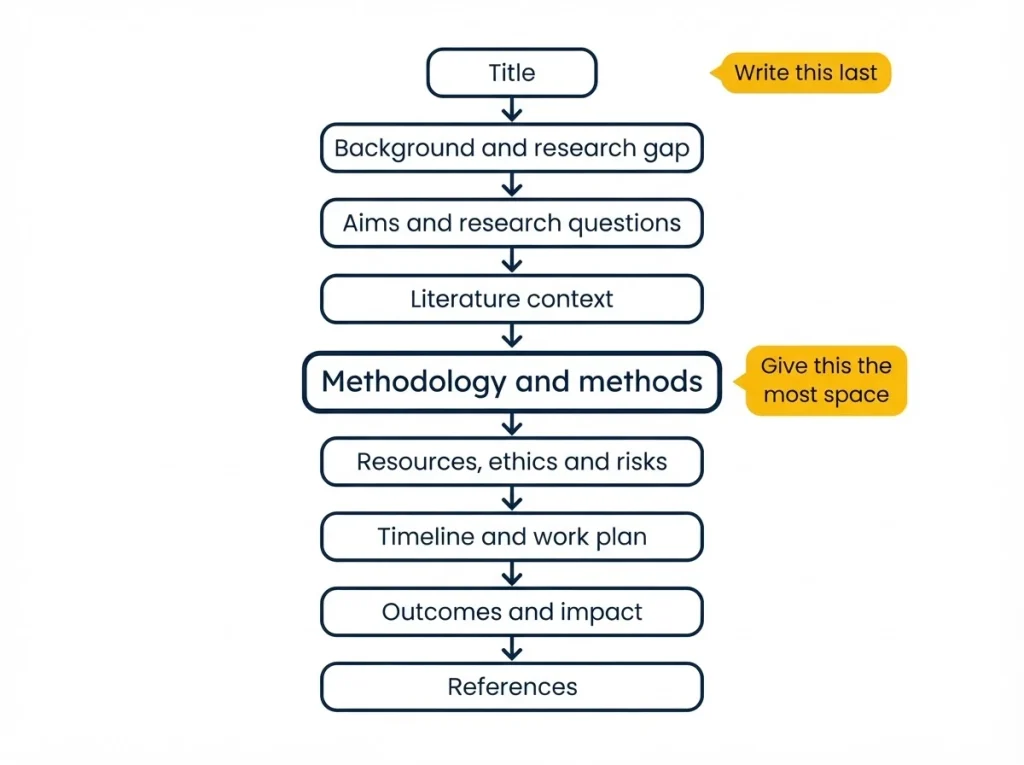
Title: Descriptive, Specific and Free of Puns
A good title tells the reader the topic and the approach. FindAPhD adds that it should also help the reader see which supervisor to contact. Sunderland recommends key words that place the work in its field and warns against witty, emotive or pun-based titles. Sheffield notes that a title can be negotiated with your supervisor if you succeed, so treat it as a working label.
Background and Rationale: State the Research Gap
Start with what is at stake, not a sweeping statement about the modern world. Edinburgh asks applicants to show a clear gap so the project is original. Birmingham lists ways to show originality: pointing out inconsistencies in existing analysis, discussing neglected texts, combining disciplines that have not been combined, comparing countries or systems, applying a new perspective, or studying the effect of a policy or event.
Whichever route you take, evidence must support the gap. Edinburgh Business School’s guide lists unsupported gap claims and the justification “because it is interesting” among common mistakes. Explain instead why the question matters and for whom.
Aims, Objectives and Research Questions
Sheffield describes aims as a short list of what the PhD will do, broader than the questions or hypotheses beneath them. Birmingham allows hypotheses, propositions, objectives or research questions, depending on the field. Whichever you use, make each item something you can finish and mark. The guide to aims, objectives and research questions explains how the three fit together, and the research question generator gives a quick first draft to refine with a supervisor.
Literature Context Without a Full Review
Here the aim is to place your project, not to survey everything. Sheffield asks for a short note that identifies key texts and says whether they support, extend or challenge your work. FindAPhD warns against a comprehensive review at this stage. For technique, see how to write a short, critical literature review that points to a gap instead of listing studies.
Methodology and Methods: Show the Design Fits the Question
Queen Mary tells applicants to give methods more space than background and theory. Sheffield calls the section particularly important. State what data you will collect, how you will collect and analyse it, and why that route beats the alternatives. Sunderland adds a useful distinction: methodology is your overall approach, while methods are the practical tools. It also advises keeping discussion of research philosophy brief, because you will study it during the degree.
Detail should match the project. South Wales asks scientific projects to explain how a measurement will be made and why it matters. Questionnaire projects should give the number of respondents and the expected response rate, and creative projects should indicate how many artefacts are planned and how complex they are. If you are weighing designs, see how to choose a research methodology, and test an intended survey size with the sample size calculator.
Some social science departments also expect a theoretical framework. Queen Mary’s politics guidance lists one as a separate section, so check whether yours does.
Resources, Ethics and Practical Risks
List what the project needs: archives, specialist libraries, field sites, software, datasets or training. Sheffield asks for a brief note on how each resource strengthens the work. Queen Mary adds practical questions: where and for how long any fieldwork will take place, whether outside organisations will grant access, and how you will pay significant running costs. Cambridge expects ethical issues or risk factors to be addressed where they apply, so plan your ethics approval route early.
Timeline and Work Plan
Sheffield asks for three years, or three and a half for some scholarship routes, with clear time for preparation, research and writing up. Queen Mary suggests starting from your intended finishing date and working backwards. Edinburgh Business School’s guide recommends milestones at six-month intervals across the years. South Wales also asks MPhil/PhD applicants to say when transfer is expected.
A visual plan helps. The timeline planner turns dates into a draft schedule, and you can adapt it into a table or Gantt chart.
Outcomes, Impact and Dissemination
FindAPhD says specific outcomes are not required, but you should think about what the research could produce beyond a thesis. Birmingham asks who might benefit and how, and it wants beneficiaries beyond your own professional circle, such as other disciplines, companies, public bodies or policymakers. Queen Mary adds that naming expected publications and likely journals matters most if you plan an academic career.
Why This University, and Why You
FindAPhD asks applicants to show relevant experience, such as modules or a Master’s dissertation, to name skills still to build, and to cite specific staff, facilities or resources that make the university the right place. Edinburgh Business School’s guide includes preparedness, supervisory provision and training needs in its suggested structure. The same advice rules out one generic proposal sent everywhere: tailor each version.
References and Formatting
Sunderland wants one consistent system, such as Harvard or Vancouver, across the whole proposal, with full and correct references. Salford usually expects Harvard. Rely on journal articles, books, theses and official reports instead of unreviewed websites, as Edinburgh Business School advises. Pick one referencing system and stick to it from the first draft.
How to Write a Research Proposal Step by Step
You read a proposal from title to references, but writing it in that order often backfires. The sequence below works for most applicants.
- Read around the area and note where studies disagree or leave questions open.
- Write the research question and aims in one or two sentences each, then test them with a supervisor or academic contact.
- Choose the method and check feasibility: access, data, ethics and the skills you still need.
- Build the timetable backwards from the finish date.
- Write the background and rationale once the method is settled. Newcastle University student advice on Master’s proposals makes the same point about leaving the motivation section until the theory is clear.
- Cut to the word limit, write the title last, and ask someone outside your field to read it. Edinburgh Business School’s guide suggests peers, friends and family as readers for clarity.
How the Proposal Changes by Subject, Degree and Funding
Sciences, Social Sciences and Humanities
Expectations vary by discipline. Birmingham’s science schools that recruit into existing research groups ask for your research interests, the areas you want to work in and potential supervisors, not a detailed proposal. In the arts and humanities, South Wales says the final submission may be a performance, script or film, so say what form your output is likely to take. Always follow your department’s guidance over any general advice.
Funded PhD Applications
Funded places add a second audience. Salford says the overview must show how your topic fits the disciplines the funder supports. Edinburgh notes that a funder’s format may force you to rewrite the proposal. Edinburgh Business School’s guide advises starting funding applications about a year before your intended start date and writing a lay summary a general reader can follow, since some Research Councils suggest a reading level suited to a 14-year-old. Look for funding at the same time as you draft, as Edinburgh recommends.
MRes and MSc by Research
Scope matters most here. St Andrews’ School of Computer Science notes that its MSc(Res) is a one-year programme, so there is unlikely to be time to change the proposal after admission. A narrow, answerable question with a clear method usually serves a research Master’s better than a broad ambition.
Research Proposal Example: An Illustrative Outline
The outline below is invented to show format. It makes no claim about what the literature says, and the bracketed prompts mark where you must add cited evidence. For real examples, Sheffield publishes five example PhD proposals as PDFs alongside its guidance, and FindAPhD recommends asking a supervisor for a previous student’s proposal in your subject.
| Section | Illustration |
|---|---|
| Title | Peer mentoring and first-year retention in UK universities: a mixed-methods study |
| Research question | How do first-year students experience peer mentoring, and is taking part associated with their intention to continue? |
| Aims and objectives | To review published evidence on peer mentoring in higher education. To survey first-year students about participation and intention to continue. To interview a subsample about their experience. To compare the survey and interview findings and recommend practice. |
| Gap | [One or two sentences on what existing studies have not done, backed by three to five cited sources] |
| Methods | A questionnaire of [number] students with an expected response rate of [percentage], then semi-structured interviews with a purposive subsample. Descriptive and inferential tests for the survey; thematic analysis for the interviews |
| Ethics and access | University ethics approval; permission from [named gatekeeper]; informed consent and anonymity |
| Timeline | Year 1: literature review, ethics, pilot. Year 2: data collection. Year 3: analysis and writing up, with milestones every six months |
| Outcomes | A thesis, one or more journal articles and a short briefing for [named audience] |
Common Research Proposal Mistakes and How to Fix Them
- Topic too broad or over-ambitious. Salford warns that vagueness suggests the project is not fully thought through. Narrow it until a single question can be answered in the time you have.
- A gap with no evidence. Cite the studies that show the gap exists.
- Writing a mini-thesis. FindAPhD advises against findings, in-depth analysis or a full literature review. Make the case for the research you intend to do.
- Vague methods and logistics. Birmingham expects fieldwork location, timing, duration and resources to be specified.
- One proposal sent everywhere. Tailor each version to the department and its staff.
- Ignoring rules and deadlines. Edinburgh Business School’s guide lists ignoring funder or school rules, eligibility criteria and firm deadlines among common mistakes.
- Heavy jargon. Lincoln advises avoiding unnecessary discipline-specific terms, and Salford asks for writing that someone outside your specialism can follow.
- Typos and unchecked references. Sunderland says spelling and grammar errors may count against you in a competitive process, so proofread twice.
Using AI Tools When You Write a Research Proposal
Position correct as of November 2026. Check the university’s current policy before you use any AI tool, because rules differ and keep changing.
Cambridge permits appropriate use of AI tools to support the preparation of research proposals. It says AI-generated content should be acknowledged and warns that heavy reliance may produce poor-quality output. Read Cambridge’s guidance on AI and postgraduate applications for the full wording. Edinburgh Business School’s guide lists unacknowledged generative AI content among common mistakes, and St Andrews’ School of Computer Science says the proposal must be your own work.
In practice, keep the thinking yours: the gap, the question and the design. Verify every source an AI tool mentions by finding it yourself, and learn how to manage sources and avoid plagiarism before you draft.
Research Proposal Checklist Before You Submit
- Does the proposal meet the word or page limit, and does it follow any template the school provides?
- Is there a named supervisor or research group that could realistically supervise it?
- Does the gap rest on cited evidence rather than assertion?
- Do the aims, questions and methods line up, with every method tied to a question?
- Is the project feasible within three to four years for a PhD, or the shorter programme length for a Master’s?
- Do the timeline, resources and ethics routes cover the whole project?
- Is the writing clear to someone outside your specialism?
- Is referencing consistent, and have spelling and grammar been checked by someone else?
- Have you declared any AI use the university requires you to declare?
Research Proposal FAQs for PhD and MSc Applicants
How long is a typical PhD research proposal?
There is no single figure. Many UK examples above fall between 1,000 and 2,000 words, while Lincoln asks for 3,000 to 5,000 for a PhD. Follow the limit for your programme, and ask a prospective supervisor if none is given.
What are the parts of a research proposal?
Counts differ by university. Birmingham lists seven: topic, literature review, objectives, strategy, anticipated results, schedule and budget, and references. Sheffield names title, question or hypothesis, aims, value, literature, resources, methods and timetable.
Can ChatGPT write a research proposal?
A tool can help you organise ideas, but it cannot supply your gap, your reading or your fit with a supervisor. Policies vary: Cambridge allows appropriate use with acknowledgement, while other departments require the proposal to be wholly your own. Check before you use one.
Do I need a supervisor before I apply?
It depends on the programme. Edinburgh says some applicants write the proposal before contacting supervisors and others do not, so check the degree finder entry. Contacting a supervisor early is still wise, because Cambridge says it may not admit applicants whose topics lack supervisors.
Can I change my research topic after I get an offer?
Possibly not. Cambridge says you may be unable to change it, and that its Degree Committee usually decides whether a revised topic is feasible. If your funding is tied to a specific topic, there is little room to move.
Is a research proposal the same as a dissertation proposal?
The two documents share a logic, but their readers differ. Admissions panels read the first, while module markers read the second. For taught courses, see the guide to writing a dissertation proposal.
How to write a research proposal for a Master’s degree?
For a research Master’s, use the structure above with a tighter scope and a shorter timeline. The same steps for how to write a research proposal apply, only with less room for ambition. For a taught Master’s, follow your module brief and your supervisor’s template, because the department sets the format.
What to Do With Your Draft
Put the draft aside for a day, then read it as an admissions tutor would: is the question clear, original and doable, and does the department have someone to supervise it? Send it to a prospective supervisor early, because feedback shapes the final version more than any amount of polishing.
Still struggling to shape the idea or structure the draft? Students can get research proposal support with planning, structure and feedback. Any model work is meant for reference and learning, and should be used according to your institution’s policy.