
How to Write Dissertation Acknowledgements, a Glossary and a List of Abbreviations

Dissertation acknowledgements, a glossary and a list of abbreviations all sit in the front matter, before your introduction begins. None of them carries marks on its own, but each one makes your work easier to read and shows you have followed your university’s conventions. Your module handbook decides which of the three you need, so read it before you write a word.
- Acknowledgements: a short thank-you to the people and organisations who supported the project, usually your supervisor first.
- List of abbreviations: an alphabetical key to the short forms and acronyms you use in the body of the work.
- Glossary: plain-English definitions of specialist terms your reader may not know.
Where do acknowledgements, a glossary and a list of abbreviations go in a dissertation?
There is no single order across UK universities. A common sequence runs from the title page to acknowledgements, abstract, contents, lists of figures and tables, list of abbreviations, glossary and then the introduction. Some departments move the glossary to the end, after the appendices, and others place the acknowledgements elsewhere in the front matter. Your handbook or thesis template overrides any general pattern.
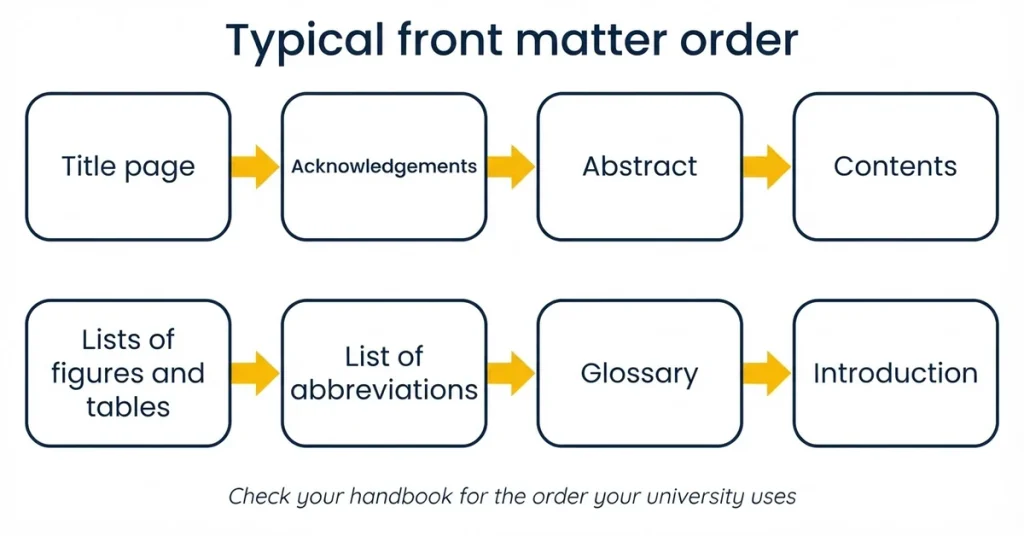
Practice also differs on whether the contents page lists these sections. One University of York department asks students to list every section except the title page and the contents itself, which includes the acknowledgements. Other guides tell students to leave the acknowledgements and abstract out. Follow your department, and ask your supervisor if the handbook is silent.
Front matter is often numbered with Roman numerals, with Arabic numbers starting at the introduction, but confirm this locally. The full formatting guide for your whole dissertation covers margins, fonts and numbering, and you can build the contents page in Word once the front matter is settled.
Do you need acknowledgements in a dissertation?
Usually not. Many universities treat acknowledgements as optional, although some require specific wording for items such as funding, copyright material or editorial help. If you are unsure, check the handbook and the marking criteria for presentation requirements.
Whether front matter counts towards your word limit is also set locally. If your limit is tight, check before you trim anything, and track your body text with a dissertation word count calculator.
Who should you thank in your acknowledgements, and in what order?
Move from the most academic support to the most personal. If your university specifies an order, use that instead.
- Your supervisor, usually first.
- Other academic and professional helpers, such as module staff, librarians, statisticians or laboratory technicians.
- Funders or sponsors, with grant details if the funder requires them.
- Research participants and the organisations that gave you access, thanked as a group.
- Peers and colleagues who offered ideas or feedback.
- Family and friends.
How do you thank your supervisor in a dissertation?
Say what they actually did. “Thank you for your support” is easy to write and tells the reader nothing, whereas naming their feedback on your draft chapters or their help narrowing the research question is specific and sincere. Leaving your supervisor out can look like a snub, even when the working relationship was difficult.
How do you thank research participants without breaking confidentiality?
Thank them as a group, for example “the nurses who gave their time to be interviewed”, rather than by name. If you promised anonymity, naming individuals or a small organisation could identify them. Review the conditions of your ethics approval before you name anyone.
Should you acknowledge a proofreader or an AI tool?
It depends on your university’s policy, and the acknowledgements may not be the right place. Loughborough University, for instance, requires students to state which generative AI tools they used and how, and treats failure to do so as academic misconduct, according to its student guidance on acknowledging generative AI use. UCL’s doctoral guidance likewise asks researchers to declare AI use and other support, with a thesis declaration form for the purpose.
Many universities use a separate declaration rather than the acknowledgements, and rules on third-party proofreading vary. Ask your supervisor or the academic integrity team where your statement belongs. Position correct as of November 2026; check your university’s current policy before you submit.
How long should dissertation acknowledgements be, and what tone works?
Aim for between one short paragraph and one page. One University of York department, for example, expects no more than about half a side of A4, and there is no minimum length. A few sincere sentences beat a long list of names, because a long list dilutes the thanks.
Write in the first person, in warm but professional language. A little lightness is usually fine if your university allows it, but avoid slang, nicknames, sarcasm and any grumbling about how hard the project was. Do not copy another student’s text, because it can name the wrong people and include details that do not apply to you.
Dissertation acknowledgements example you can adapt
This original example suits an undergraduate dissertation. Replace everything in square brackets with your real details and cut anything that does not apply.
I would like to thank my supervisor, [Dr Surname], for clear, practical feedback on every draft and for helping me turn a broad interest in [topic] into a workable research question. Thank you also to [Name], the module leader, whose methods workshops shaped my questionnaire design, and to the library staff at [University] who helped me trace hard-to-find sources. I am grateful to everyone who took the time to complete my survey. Finally, thank you to my family and friends for their patience and encouragement throughout the year.
A funded Master’s or doctoral project needs one extra sentence, kept as its own short paragraph: “This research was supported by [funder name], grant reference [number].” Check the exact wording against your award letter.
Which acknowledgements mistakes cost you credibility?
- Forgetting your supervisor.
- Thanking people without saying what they did.
- Naming minor contributors until the thanks lose meaning.
- Running past one page.
- Using a template sentence that does not match your experience.
- Ignoring your university’s rules on order, length or wording.
How to write a list of abbreviations in a dissertation
A list of abbreviations is an alphabetical key that tells the reader what each short form means. It helps when your work uses many acronyms or when your readers may not know them, and you can usually skip it if you use only a few. Your department may still require one, so check first.
How do you introduce abbreviations in the main text?
Write the full term the first time, put the short form in brackets straight after it, then use the short form consistently. For example: “The Office for National Statistics (ONS) publishes regional labour market data. The ONS figures used here cover…” Very common forms such as UK or DNA can appear from the first mention, but if you are unsure, spell it out.
Do not switch between the full term and the abbreviation once you have introduced it, and avoid starting a sentence with an abbreviation. If a term appears only once or twice, spell it out each time and keep it off the list. One common rule of thumb is to create a list only when you use at least three abbreviations.
What should you leave out of the list?
Leave out everyday dictionary abbreviations such as e.g., i.e., etc. and approx., bibliographic shortenings such as ed., eds. and pp., and file extensions such as pdf or jpg, unless your department asks for them. Only include abbreviations that actually appear in your text, and keep the list to roughly one page. A longer list suggests you are using too many.
How do you create the list in Word?
For a short list, type each abbreviation and its meaning, then align them with a tab stop or a borderless two-column table. For a long list, use Word’s index tool. Select an abbreviation, choose Mark Entry on the References tab, type the full meaning in the Cross-reference box and click Mark. Repeat for each one, place your cursor where the list belongs, choose Insert Index and set it to one column. Menu labels vary slightly between Word versions.
Build the list near the end of the project. If you add abbreviations later, right-click the list and choose Update Field. Here is how the finished list looks:
| Abbreviation | Meaning |
|---|---|
| GDPR | General Data Protection Regulation |
| NHS | National Health Service |
| ONS | Office for National Statistics |
| SPSS | Statistical Package for the Social Sciences |
| UKRI | UK Research and Innovation |
How to write a dissertation glossary
A dissertation glossary defines the specialist or technical terms your reader may not know. It is optional in most programmes, but it helps when your topic uses a lot of field-specific language, and some departments require one. The aim is to help the reader understand your work, not to show how many terms you know.
What is the difference between a glossary and a list of abbreviations?
| List of abbreviations | Glossary | |
|---|---|---|
| What it does | Expands short forms | Explains the meaning of terms |
| Typical entry | SPSS: Statistical Package for the Social Sciences | Triangulation: using more than one source or method to check findings |
| Order | Alphabetical | Alphabetical |
| Usual position | After the contents and any lists of figures and tables | After the abbreviations list, or at the end in some departments |
Some departments combine the two into one alphabetical list, so the glossary also acts as a key to the abbreviations. If yours does, follow that format.
How do you write glossary entries?
Keep each entry to one or two plain sentences, define the term in the sense you use it, and list entries alphabetically. Include only terms your reader may not know, and make sure each one appears in your text. If a definition comes from a particular author, cite it properly, for instance in Harvard referencing style, and check how to manage references and avoid plagiarism if you are unsure when a citation is needed.
For example, a social science dissertation might include entries like these:
- Purposive sampling: a non-probability method in which participants are chosen because they have characteristics relevant to the research question.
- Thematic analysis: a method for identifying, organising and interpreting patterns of meaning, called themes, across qualitative data.
- Triangulation: the use of more than one data source, method or researcher to check and strengthen findings.
Final front matter check before you submit
- The order of sections matches your handbook or template.
- Every name and title in the acknowledgements is spelled correctly.
- Funder wording matches your award letter, and no participant can be identified.
- Every abbreviation on the list appears in the text, and every abbreviation in the text is on the list.
- Glossary entries are alphabetical, short and cited where needed.
- Page numbers and contents entries follow your department’s rules.
Frequently asked questions about acknowledgements, glossaries and abbreviations
Can I thank God or add humour to my acknowledgements?
Yes, if it reflects your own beliefs and your university’s conventions allow it. Still thank the supervisors, colleagues, family and friends who helped, and keep any joke to a single light clause.
Is a one-sentence acknowledgement acceptable?
Yes. There is no minimum length, so a single sincere sentence thanking your supervisor is perfectly acceptable. Do not pad it to look longer.
Can I use a sample acknowledgement as a template?
Use samples to see the structure, then write your own sentences. Copied wording can thank people who did not help you or leave out those who did.
Ready for a last read-through? Work through the final dissertation checklist before you submit. If you would like a second pair of eyes on your front matter and formatting, our proofreading and feedback support for Master’s dissertations can help.