
How to Write a Dissertation in 4 Weeks: A Realistic Plan That Protects Your Marks

Can you write a dissertation in 4 weeks? For some projects, yes. For others, no. It depends on your word count, how much reading and data you already have, and whether you still need ethics approval. No method guarantees a particular grade, and none of the advice below promises one. What follows is a plan built on the arithmetic of the deadline and on research into how people plan, so you can judge quickly whether your project fits in 28 days.
The plan suits undergraduate and taught Master’s dissertations of roughly 8,000 to 15,000 words. It does not cover a PhD thesis, which runs over years, not weeks.
Is 4 Weeks Enough Time to Write a Dissertation?
Four weeks is workable when most of the thinking is already done and the remaining job is reading with a purpose, drafting and revising. It is risky when you still wait on something outside your control. The table gives a rule of thumb. It is our judgement, not a research finding, so confirm the details with your supervisor.
| Your situation | Realistic in 4 weeks? | What to do first |
|---|---|---|
| Library-based or secondary-data project, question already agreed | Tight but possible | Start the outline on day 1 |
| Primary data already collected, analysis still to do | Possible if the analysis is simple | Book a supervisor meeting for week 2 |
| Primary data still to collect, ethics approved | Very tight | Agree a smaller sample with your supervisor |
| Primary data still to collect, ethics not yet approved | Rarely realistic | Ask about a smaller or desk-based design |
Ethics approval is the waiting step that most often breaks a compressed schedule. Approval can take time, and some universities publish their turnaround times, so read your department’s ethics pages before you plan anything else. The guide to getting ethics approval for a dissertation explains what an application needs, and the dissertation timeline guide shows how to plan a longer project from the deadline backwards.
What Research Says About Writing a Dissertation Fast
There is no solid evidence that any specific method produces a given grade in a given number of days. Stories of week-long dissertations with a first-class mark are anecdotes, and nobody can check them. Three findings are worth using, though, and each is stated with its limits.
Your own time estimate is probably too optimistic
Buehler, Griffin and Ross (1994, Journal of Personality and Social Psychology) asked honours thesis students how long they would need. The students predicted about 33.9 days on average and took about 55.5. Only 29.7 percent finished by their own best estimate. This was one set of studies of honours students, so treat the exact figures with care. The lesson still holds: build a buffer into any short plan, because the first estimate usually runs short.
If-then plans help you start
A meta-analysis by Gollwitzer and Sheeran (2006) pooled 94 tests of implementation intentions, which are plans written as “if situation X happens, then I will do Y”. It found a medium-to-large positive effect on reaching goals (d = .65). These studies were not mostly about dissertations, so the result supports the habit rather than a promise. A usable example is: “If it is 9am on a weekday, then I open the draft and write before I check messages.”
Short daily sessions keep a draft moving
Joan Bolker’s Writing Your Dissertation in Fifteen Minutes a Day (1998) argues for a small, fixed daily commitment. It is an experienced practitioner’s method, not a controlled trial. In a 4-week plan, a 15-minute start is a way to begin each block, not a limit on how much you write.
How Many Words a Day Do You Need to Write a Dissertation in a Month?
Divide your word count by the number of days you will actually draft. The figures below are plain arithmetic. They show the daily output needed if you set aside the first week for reading and planning, so you draft over 21 days or fewer.
| Word count | Over 15 drafting days | Over 20 drafting days |
|---|---|---|
| 8,000 | about 533 a day | 400 a day |
| 10,000 | about 667 a day | 500 a day |
| 12,000 | 800 a day | 600 a day |
| 15,000 | 1,000 a day | 750 a day |
Writing speed differs from person to person, so test yours. On day 1, write for one hour without editing and count the words. That number tells you how many hours a day your target needs. The University of Bath’s academic skills blog suggests leaving two or more weeks for editing and proofreading and treats a page as about 500 words. Four weeks cannot hold that much revision, so you will have to shorten the editing stage and accept a lighter polish.
The dissertation word count calculator turns your total into chapter targets, and the dissertation timeline planner lays the 28 days on a calendar. As a starting split for 10,000 words, you might aim for about 800 in the introduction, 2,600 in the literature review, 1,300 in the methodology, 2,400 in the findings, 2,100 in the discussion and 800 in the conclusion. Your marking criteria and department rules override this, so adjust it to match them.
A Week-by-Week Plan for Writing a Dissertation in 4 Weeks
This is a structure to adapt, not a rule. Draft the body chapters first and write the introduction, conclusion and abstract last, because you then know what the dissertation actually argues.
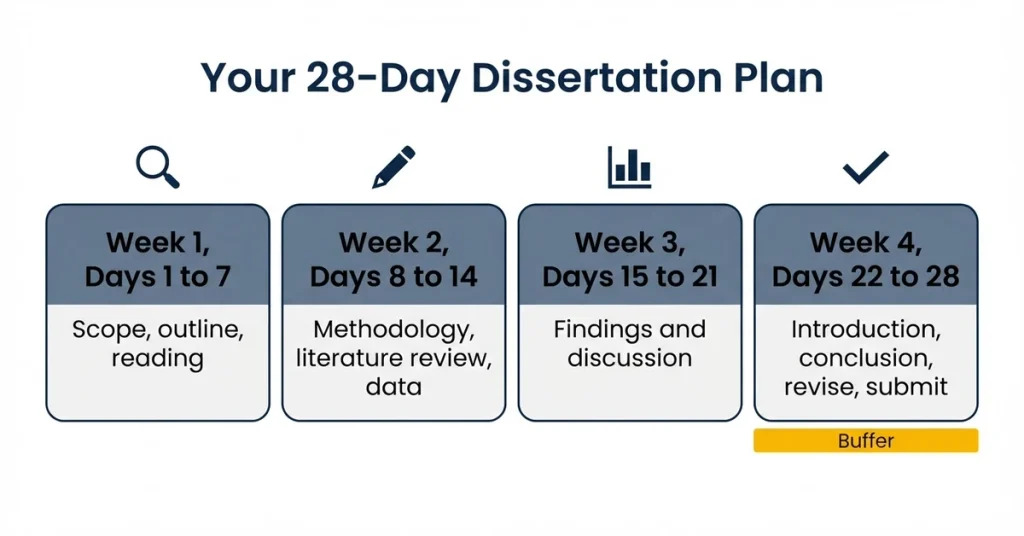
Week 1: Fix the scope, outline and reading (days 1 to 7)
- Reread the brief, word limit and marking criteria on day 1. Note the submission format and any tolerance on word count.
- Email your supervisor with your timetable and ask what feedback they can give and when.
- Write your research question in one sentence. The guide to writing a research question shows how.
- Build a full dissertation outline with a target word count for every section.
- Run a focused search using your module reading list and one or two databases. Read abstracts before full texts, and add each source to your reference list the moment you use it. The literature search guide covers the steps.
Week 2: Methodology, literature review and data (days 8 to 14)
Write the methodology chapter first, since your design is settled and it is the easiest chapter to draft quickly. Then draft the literature review by theme, not source by source. If you have data to collect or analyse, run that work in the same week and keep notes as you go. Send your supervisor a short draft or outline for one round of feedback.
Week 3: Findings and discussion (days 15 to 21)
Present your findings plainly, then move to interpretation. The guides to the results chapter and the discussion chapter keep the two separate. Aim to finish a complete rough draft of every body chapter by the end of day 21, even if some paragraphs are thin.
Week 4: Frame, revise and submit (days 22 to 28)
Write the introduction, the conclusion and the abstract. Read the whole dissertation in one sitting and mark gaps in the argument or claims with no evidence. Then format, check references and proofread. The formatting guide and the dissertation checklist cover the final details. Keep the last two days free as a buffer, since the planning research above shows that plans often run over.
Daily Habits That Make a Short Deadline Manageable
- Draft first, edit later. Switching between writing and correcting slows you down. Leave spelling and grammar for the revision pass.
- Work in blocks. Spend two or three focused blocks a day on one task each, such as drafting, then referencing.
- Keep the references as you go. Rebuilding a bibliography at the end costs hours. The guide to managing references and avoiding plagiarism explains a simple system.
- Back up every day. Save to two places after each writing session.
- Set a daily stop time. With 28 days, there is no need for all-night sessions.
What to Cut When Time Is Short, and What Never to Cut
Cut things that cost time but earn few marks. Examples are extra sources beyond what your criteria expect, a second research question, and polishing sentences in a first draft. If the scope is too big, ask your supervisor to narrow it rather than rushing every chapter.
Never cut ethics compliance, accurate referencing, the word limit, or a clear answer to your research question in the conclusion. Never invent data or sources to fill a gap. Reading other students’ dissertations to see how chapters are laid out is sensible. Copying their wording or ideas is plagiarism.
Can You Use AI Tools to Write a Dissertation Faster?
It depends on your university. The Russell Group principles on generative AI in education commit its universities to clear policies for students, so rules differ between institutions and sometimes between modules. Some allow limited uses such as explaining a concept, while others restrict or ban AI-generated text in assessed work. Read your own policy before you use any tool, and declare use where the policy asks. Position correct as of November 2026; check your university’s current academic integrity rules.
When to Ask for a Dissertation Extension
Ask before the deadline, and start with your supervisor. Rules vary by university. The University of Manchester, for example, requires no evidence for an extension request made before the deadline, but a request made after it must go through mitigating circumstances with evidence (see the University of Manchester mitigating circumstances page). The University of Stirling lists a standard dissertation extension of 7 days, with longer requests handled as extenuating circumstances. Loughborough runs a separate written process for postgraduate taught dissertations.
Extension policies are written for circumstances such as illness or other unforeseen events. Imperial College London, for instance, describes extension requests as suited to short-term, unforeseeable and unavoidable problems. Check whether your reason qualifies under your own regulations before you rely on one. Position correct as of November 2026.
Writing a Dissertation Quickly: Questions Students Ask
Is 3 weeks enough to write a dissertation?
The arithmetic allows it for a short, library-based project: 10,000 words over 15 drafting days is about 667 words a day. It leaves almost no room for revision or delay. Talk to your supervisor about trimming the scope first.
Can you write 10,000 words in 2 weeks?
Over 14 days, 10,000 words is about 715 words a day with no days off. That figure assumes your reading, data and outline are finished, and the draft will need a separate revision pass. Whether the result earns a good mark depends on the quality of the analysis, which no schedule can promise.
How many hours a day should I write?
Work it out from your own speed. Divide your daily word target by the words you wrote in your day 1 test hour. If the answer is more than about four or five hours of drafting, lower the target or reduce the scope.
Should I start with the introduction?
Write a rough one-paragraph version on day 1 to fix your aim, then rewrite it in week 4. By then it can describe what the dissertation actually found.
Your Next Step Today
Open your brief, count the days to submission and work out your daily word target from the table above. If you want a second opinion on structure, planning or draft feedback while you keep the work your own, help with dissertation planning and feedback is available.
Any support or reference material should be used according to your institution’s academic integrity policy.