
How to Choose Research Topics: A Complete Dissertation Guide for Students
Choosing a dissertation topic often feels overwhelming. You may be asking yourself:
What if my topic is too broad? What if it’s too difficult? What if I lose interest halfway through?
These concerns are common and valid. Learning how to choose research topics is not about finding a “perfect” idea. It is about selecting a topic that is interesting, feasible, academically valuable, and aligned with your degree requirements. Whether you are figuring out how to choose a dissertation topic for undergraduate, Masters, or how to choose research topic for PhD, the decision directly affects your grades, motivation, and research success.
This complete guide walks you through the principles, steps, rules, and best practices for choosing a strong dissertation topic. It is designed to help you make a confident, informed decision without guesswork.
Why Choosing the Right Research Topic Is So Important?
Your research topic shapes every stage of your dissertation. It determines:
- the research methods you will use,
- the data you need to collect,
- the literature you must review,
- and how manageable the project will be.
A well-chosen topic makes the research process structured and rewarding. A poorly chosen one often leads to delays, stress, and weak outcomes.
Academic libraries and universities consistently emphasise that topic selection should balance interest, originality, relevance, and feasibility. Students who choose topics aligned with these factors are more likely to complete their dissertations successfully and on time.
Understanding What a Research Topic Really Is
A research topic is not just a title or a subject area. It is a clearly defined focus that identifies:
- what you are studying,
- who or what it involves,
- where or in what context it applies,
- and why it matters academically.
For example:
- Too broad: “Social media”
- Still unclear: “Social media and education”
- Researchable topic: “The impact of social media use on academic engagement among undergraduate students”
This clarity is essential when learning how to select a research topic effectively.
Key Characteristics of a Strong Dissertation Topic
Before moving into steps, it helps to know what examiners and supervisors look for.
1. Academic Relevance
Your topic must connect clearly to your discipline. A psychology dissertation must answer a psychological question. A business dissertation must contribute to management, finance, marketing, or strategy literature.
2. Personal Interest
Research consistently shows that students perform better when they are genuinely interested in their topic. Motivation matters, especially during long writing phases.
3. Feasibility
A topic must fit within:
- your time frame,
- word count,
- access to data or participants,
- ethical approval limits,
- and your current research skills.
4. Research Gap
Your topic should contribute something new, even if small. This could be:
- a new population,
- a different method,
- an updated dataset,
- or a new theoretical perspective.
5. Clear Scope
A strong topic is neither too broad nor too narrow. It allows for depth without becoming unmanageable.
How to Choose a Research Idea Based on Your Academic Level?
The way you choose a topic depends heavily on your degree level.
How to Choose a Dissertation Topic for Undergraduate Study?
At undergraduate level, your goal is to show:
- understanding of core concepts,
- ability to apply theory,
- basic research and writing skills.
Best approach:
- Choose a topic closely linked to your coursework.
- Focus on well-established theories.
- Avoid highly complex data collection.
Example:
“Factors influencing online learning satisfaction among undergraduate students”
This shows understanding without unnecessary complexity.
How to Choose a Dissertation Topic for Masters Degree
At Masters level, expectations are higher. You are expected to:
- demonstrate critical thinking,
- engage deeply with literature,
- apply appropriate research methods.
Best approach:
- Choose a topic linked to your career interests.
- Identify a clear research gap.
- Use advanced but manageable methods.
Example:
“Leadership styles and employee engagement in remote working environments”
This topic allows critical analysis and real-world relevance.
How to Choose a Research Topic for PhD
For PhD research, originality is essential. Your topic must:
- address a clear gap in knowledge,
- contribute new theoretical or empirical insight,
- be viable over several years.
Best approach:
- Start with a broad research area.
- Narrow it through extensive literature review.
- Align closely with supervisor expertise and funding scope.
Example:
“Algorithmic bias in AI-driven recruitment systems: implications for organisational equality”
The 7 Steps for Choosing a Research Topic
If you are unsure how to decide on a dissertation topic, follow this proven step-by-step process.
Step 1: Review Your Course Requirements
Always begin with your university guidelines. Check:
- word count,
- methodology expectations,
- assessment criteria,
- ethical approval requirements.
Ignoring these often leads to topic rejection later.
Step 2: Identify Broad Areas of Interest
Write down topics you enjoyed in lectures, seminars, or readings. Ask:
- Which topics made me curious?
- Which assignments did I enjoy researching?
This step is crucial when learning how to choose a research idea that sustains motivation.
Step 3: Conduct Preliminary Reading
Search academic databases and Google Scholar. At this stage:
- skim abstracts,
- read introductions and conclusions,
- note recurring themes and gaps.
You are not doing a full literature review yet. You are exploring what is possible.
Step 4: Narrow the Focus
Turn broad interests into specific angles by asking:
- Who is affected?
- In what context?
- Over what time frame?
Example narrowing process:
- Education
- Online education
- Online education in universities
- Student engagement in online university education
Step 5: Check Feasibility
Ask practical questions:
- Can I access participants or data?
- Do I have the skills needed?
- Is this ethical and realistic?
A feasible topic is more valuable than an overly ambitious one.
Step 6: Draft a Working Research Title
This helps clarify your thinking. At this stage, the title does not need to be final.
Good working titles are:
- clear,
- descriptive,
- focused.
This step directly addresses how to choose research title effectively.
Step 7: Discuss With Your Supervisor
Supervisors help refine scope, theory, and methods. Early feedback prevents major revisions later.
Most universities strongly recommend topic approval before proceeding further.
What Are the 5 Rules in Choosing a Research Topic?
These five rules are widely taught across universities and research guides.
- Choose a topic you can sustain interest in
- Ensure enough academic sources exist
- Keep the scope realistic
- Align with academic requirements
- Confirm supervisor approval early
Following these rules significantly reduces the risk of topic rejection or later changes.
Common Mistakes Students Make When Choosing Topics
Avoid these frequent errors:
- Choosing topics that are too broad
- Selecting topics only because data seems easy
- Ignoring ethical or access issues
- Copying popular topics without originality
- Finalising topics without supervisor feedback
Recognising these mistakes early helps you make a stronger decision.
Turning a Topic into a Strong Research Question
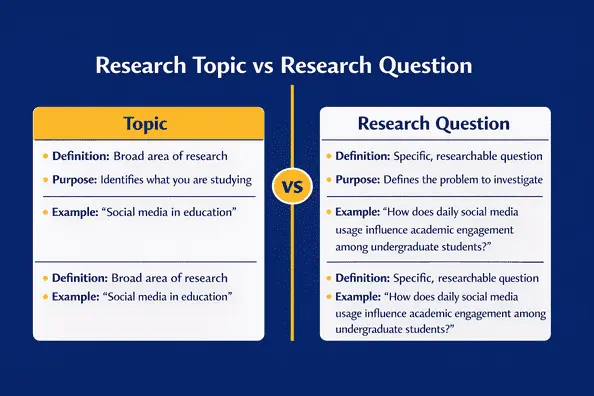
Once you have a general topic, the next challenge is turning it into a clear, researchable question. Many students struggle here because a topic and a research question are not the same thing.
A topic identifies the area.
A research question defines the problem you will investigate.
Why Research Questions Matter
Examiners assess dissertations based on how clearly the research problem is defined. A strong research question:
- guides your literature review,
- determines your methodology,
- keeps your analysis focused.
Without a clear question, dissertations often become descriptive rather than analytical.
Characteristics of a Good Research Question
A high-quality research question should be:
- Focused: addresses one main problem
- Researchable: can be answered using data or literature
- Relevant: contributes to your academic field
- Clear: easily understood without extra explanation
Weak question:
“How does social media affect students?”
Strong question:
“How does daily social media usage influence academic concentration among undergraduate students?”
Common Research Question Formats
You can structure your question in several proven ways:
- Descriptive
- What is happening?
- Example: “What factors influence employee motivation in remote teams?”
- Comparative
- What differs between groups?
- Example: “How does online learning satisfaction differ between undergraduate and postgraduate students?”
- Relational
- How are variables connected?
- Example: “What is the relationship between leadership style and employee turnover?”
- Causal
- Does one factor influence another?
- Example: “How does flexible working policy impact productivity in SMEs?”
Choosing the right format strengthens clarity and feasibility.
How to Identify a Research Gap Effectively?
Understanding how to select a research topic requires knowing how to identify what has not been sufficiently studied.
What Is a Research Gap?
A research gap is an area where:
- findings are inconsistent,
- populations are under-researched,
- methods are outdated,
- or theories lack application in specific contexts.
You do not need to “reinvent the field”. Even small gaps are valuable in academic research.
Practical Ways to Find Research Gaps
Use these strategies during preliminary reading:
- Review limitations and future research sections of journal articles
- Look for conflicting results across studies
- Identify new trends not yet fully explored
- Focus on different populations, regions, or industries
Example gap:
Many studies examine remote work in large organisations, but fewer focus on small and medium enterprises.
Aligning Your Topic with Research Methodology
One of the most overlooked steps in learning how to decide on a dissertation topic is checking whether the topic aligns with feasible research methods.
Common Research Method Types
| Method Type | Best For |
| Qualitative | Interviews, experiences, perceptions |
| Quantitative | Surveys, experiments, statistical analysis |
| Mixed Methods | Combining depth and measurement |
| Systematic Review | Analysing existing research |
Matching Topic to Method
Ask these key questions:
- Can I realistically collect this data?
- Do I have access to participants or datasets?
- Does my degree allow this methodology?
Example mismatch:
Choosing an experimental neuroscience topic without lab access.
Example alignment:
Survey-based analysis of student learning experiences using online questionnaires.
How to Choose a Research Title That Works?
Your research title is the first thing supervisors and examiners read. Learning how to choose research title effectively improves clarity and approval chances.
Characteristics of an Effective Research Title
A strong title is:
- clear and descriptive,
- free from unnecessary jargon,
- specific rather than vague.
Weak title:
“Technology and Education”
Strong title:
“The impact of digital learning platforms on student engagement in higher education”
Simple Formula for Writing Research Titles
Use this structure:
Key concept + context + focus
Example:
“Work-life balance policies and employee retention in the hospitality industry”
Titles can evolve, but starting strong saves time later.
Discipline-Specific Topic Selection Strategies
Different fields value different research approaches.
Business and Management
- Focus on real-world relevance
- Use case studies, surveys, or secondary data
- Align topics with current industry challenges
Social Sciences
- Emphasise theory and context
- Consider ethical approval early
- Use qualitative or mixed methods carefully
Engineering and Technology
- Ensure technical feasibility
- Define problem-solving outcomes
- Avoid overly ambitious system designs
Health and Psychology
- Ethics approval is critical
- Use validated instruments
- Ensure participant safety and consent
When You Still Can’t Decide on a Topic
Many students reach a point where several ideas seem equally viable. This is normal.
Decision-Making Techniques That Help
- Pros and cons list for each topic
- Feasibility scoring (time, data, complexity)
- Supervisor preference alignment
- Career relevance evaluation
Often, the “best” topic is the one that scores consistently well across all factors.
Real-World Examples of Topic Refinement
Initial idea:
“Artificial intelligence in business”
Refined topic:
“The impact of AI-driven customer service tools on customer satisfaction in retail companies”
Initial idea:
“Mental health in students”
Refined topic:
“Academic stress and coping strategies among postgraduate students during remote learning”
Refinement transforms vague ideas into researchable topics.
Final Validation: Is Your Research Topic Ready?
Before officially submitting or registering your dissertation topic, it is essential to validate it against academic, practical, and ethical standards. This final check ensures your topic is strong, defensible, and manageable.
Dissertation Topic Validation Checklist
Use this checklist to confirm readiness:
- Does the topic clearly address a specific research problem?
- Is the topic aligned with your academic discipline?
- Can it be completed within the given timeframe?
- Are sufficient academic sources available?
- Does the topic match your methodological skills?
- Has your supervisor approved or encouraged it?
If you can confidently answer “yes” to most of these questions, your topic is ready to move forward.
Ethical Considerations When Choosing a Research Topic
Ethics play a critical role in academic research. Many students overlook this when learning how to choose research topics, which can delay or block approval later.
Common Ethical Issues to Consider
- Research involving human participants
- Use of sensitive or personal data
- Studies involving minors or vulnerable groups
- Confidentiality and informed consent
- Potential psychological or social harm
Universities require ethical approval for such studies. Choosing a topic that complies with ethical standards simplifies this process significantly.
Tip: If ethical approval seems complex, consider secondary data analysis or systematic literature reviews.
How to Future-Proof Your Dissertation Topic
A future-proof topic remains relevant beyond submission. This is especially valuable for students planning further study or academic publication.
Strategies for Long-Term Relevance
- Align topics with emerging trends in your field
- Use current datasets or contemporary issues
- Connect research to policy, industry, or practice
- Choose adaptable research questions that allow refinement
Future-proofing also helps if you plan to turn your dissertation into a journal article or PhD proposal.
Common Signs You Chose the Wrong Topic
Recognising warning signs early can save significant time.
Red Flags to Watch For
- You struggle to find academic sources
- The topic feels boring or overwhelming
- Your supervisor repeatedly questions feasibility
- Data access is unclear or unrealistic
- The scope keeps expanding uncontrollably
If these appear, revisiting your topic is a smart academic decision, not a failure.
Summary: How to Choose the Right Dissertation Topic
Choosing the right dissertation topic is a structured decision, not a guess. The most successful students:
- start with genuine academic interest,
- conduct early literature exploration,
- evaluate feasibility carefully,
- refine topics into clear research questions,
- seek supervisor guidance early.
Whether you are learning how to choose a dissertation topic for undergraduate, how to choose a dissertation topic for Masters, or how to choose research topic for PhD, the same principles apply. Clarity, relevance, and feasibility lead to strong research outcomes.
A well-chosen topic sets the foundation for confident research, stronger analysis, and academic success.
Frequently Asked Questions (FAQs)
How do I choose a research topic if I am completely confused?
Start with your coursework and reading lists. Identify subjects you enjoyed and explore recent journal articles to see where research gaps exist. Discuss early ideas with your supervisor for direction.
What are the 7 steps for choosing a research topic?
- Review academic requirements
- Identify personal interests
- Conduct preliminary reading
- Narrow the topic
- Check feasibility
- Draft a working title
- Seek supervisor approval
What are the 5 rules in choosing a research topic?
- Choose a topic that interests you
- Ensure sufficient academic sources exist
- Keep the scope manageable
- Align with degree requirements
- Confirm supervisor approval
How long should it take to choose a dissertation topic?
Most students spend two to four weeks refining a topic. Rushing this stage often leads to major revisions later.
Can I change my dissertation topic after approval?
Yes, but changes usually require formal approval. Minor refinements are common, but major changes may affect timelines.
How specific should my research topic be?
Your topic should be narrow enough to allow in-depth analysis but broad enough to find sufficient data and literature.