
How to Write a Theoretical Framework or Conceptual Framework: A Step-by-Step Dissertation Guide

Most students reach the framework section with the same handful of worries. Learning how to write a theoretical framework, or a conceptual one, starts with settling them:
- Do I need a theoretical framework, a conceptual framework, or both?
- Which theory fits my research questions, and how do I defend that choice against the alternatives?
- What goes into a conceptual framework diagram, and what is a moderator or a mediator?
- Where does the framework sit in my dissertation, and how long should it be?
- How do I keep it in play through my methodology, results and discussion?
In short, a theoretical framework is borrowed and a conceptual framework is built. You borrow an established theory, explain why it suits your problem, and show how it shapes your methods and your reading of the findings. You build a conceptual framework yourself, usually as a diagram of the concepts or variables in your study and the relationships you expect between them. The sections below show how to write each one, how they work together, and how markers tend to read them.
One caution first: universities do not use the two terms consistently. Some handbooks treat them as synonyms and others ask for separate sections, so confirm what your department means before you start drafting.
Theoretical Framework vs Conceptual Framework: What Is the Difference?
A theoretical framework names an established theory, or a small set of theories, and explains why that lens suits your research questions. A conceptual framework maps the concepts or variables in your own study and the relationships you expect (Jansen, 2023; Federation University, 2025). Grant and Osanloo (2014) compare the theoretical framework to the blueprint for a whole dissertation inquiry, which is why a weak choice shows up in every later chapter.
| Theoretical framework | Conceptual framework | |
|---|---|---|
| Where it comes from | Existing, published theory | Your own synthesis of theory and prior studies |
| Usual form | A written argument | Often a diagram plus a written explanation |
| Question it answers | Which lens am I looking through? | What do I expect to find, and how do the parts connect? |
| Usual home | The literature review, or a section after it | Alongside or just after the theory |
| Common weakness | Describing the theory without defending the choice | Drawing arrows nobody has argued for |
In practice the two often nest. The theory explains why certain concepts matter, and the conceptual framework turns those concepts into variables you can measure and relationships you can test (Jansen, 2023).
Why Universities Use the Terms Differently
Walden University’s academic guides note that the terms are often used interchangeably, and some programmes define a theoretical framework as a single formal theory. Lærd Dissertation treats conceptual frameworks as a tool more common in qualitative work and theoretical models as the quantitative equivalent, while accepting that the two overlap. Federation University’s research skills team makes a similar point: the vocabulary is frequently conflated.
Three quick checks settle the question. Read the module or programme handbook for the exact term. Skim two or three past dissertations from your department. Then ask your supervisor which they expect, and write to that definition.
Where an Analytical Framework Fits
Some programmes add a third term. An analytical framework explains how the analysis will be carried out, so it belongs in the methodology and draws on the theory you chose (Federation University, 2025). Think of it as the working instructions for your lens.
Theory, Paradigm and Hypothesis Are Different Things
A paradigm such as positivism or interpretivism is your stance on knowledge. A theoretical framework is the theory you study through. Each needs its own treatment (Jansen, 2023). A hypothesis is a testable prediction, and it should follow from the framework rather than replace it (Researcher.Life, n.d.).
Do You Need a Theoretical Framework, a Conceptual Framework or Both?
Often one is enough. Jansen (2023) points out that many studies work with a single framework, while some programmes insist on both as separate sections. Your design usually points to the likely answer:
- One established theory clearly fits. You plan to apply or test it, so a theoretical framework leads (The Dissertation Coach, 2025).
- No single theory covers the problem. The study is exploratory or crosses disciplines, so a conceptual framework built from several sources suits better (Federation University, 2025; The Dissertation Coach, 2025).
- A quantitative study tests relationships. Expect both: the theory justifies the logic, and the diagram turns it into hypotheses (Jansen, 2023).
- A qualitative study uses an interpretive lens. A theoretical lens may be all you need, without a variable diagram (Jansen, 2023).
If you are still unsure, show your supervisor a half-page sketch of your problem, your key concepts and one or two candidate theories. That conversation usually resolves the terminology faster than more reading.
What If the Theory Emerges From Your Data?
Some qualitative designs, grounded theory in particular, build theory from the data. Methodological purists in that tradition delay reading the related literature so that preconceived ideas do not shape the analysis, although the advice remains debated (SAGE Research Methods, n.d.). Grant and Osanloo (2014, cited in Jansen, 2023) note that in less structured qualitative designs the framework can emerge during analysis. That is legitimate when you say so and explain why.
The difference that matters is planning. A framework that emerges by design is a methodological choice. A theory attached after the analysis, only because the handbook asks for one, fits theory to results instead of guiding the study (Paperguide, 2026). Nguyen and colleagues (2022) add that theory in qualitative research is often under-used, over-relied upon or applied inappropriately, and they propose a framework for deciding how theory should operate in a qualitative study.
How to Write a Theoretical Framework in Six Steps
In a 12,000-word master’s dissertation, the theoretical framework usually takes up part of Chapter 2 rather than a chapter of its own (Open University, 2026). That is room for a tight argument, not a survey of every theory. Six steps keep it focused.
Step 1: Start From Your Problem and Research Questions, Not a Favourite Theory
Restate your aims before drafting anything. The framework exists to address them, and a theory chosen first tends to be retrofitted onto questions that do not need it. Write the problem in one sentence, then ask what kind of explanation it calls for: how people behave, how they make sense of events, or how a system performs. That narrows hundreds of possible theories to a handful. If the aims are still loose, work through aims, objectives and research questions first.
Step 2: Define the Key Concepts From Scholarly Sources
Pick the three or four terms that carry the study, such as service quality, burnout or engagement. Define each one from the literature, not from everyday usage. Authors often define the same term differently, so compare the competing definitions and state which one you adopt and why (Open University, 2026).
Step 3: Shortlist the Theories Your Field Already Uses
Read three or four recent empirical papers on your topic and note which framework each one adopts. Where the same theory appears in most of them, you have found your field’s default. Departing from it is allowed, but the departure needs a reason (Open University, 2026). Sheffield Hallam University’s research projects guide pictures the framework as a toolbox: theories, models, concepts and assumptions are the tools, and the methodology is the instruction manual. Journal articles keep the shortlist in touch with current debates, which textbooks rarely do.
Step 4: Choose an Anchor Theory and Defend It Against the Alternatives
Choose the theory that makes your analysis easiest to explain, then argue for it. Name the strongest rival, say what it would miss, and show what your choice captures instead. Two or three paragraphs of comparison are usually enough (Open University, 2026). This is where marks are won, because UK assessment criteria separate analysing, critically evaluating and justifying, and a framework section is usually read against all three at once (Open University, 2026).
A simple sentence frame keeps the argument honest: “This study adopts [theory] because it explains [feature of the problem], which [alternative] would not capture.” If you borrow an unusual idea from outside your field, justify it and show how it works alongside your other tools (Sheffield Hallam University Library, n.d.). Combining theories is also acceptable, provided they are compatible and each gets the same depth of treatment (The PhD People, 2026).
Step 5: Use Only the Parts of the Theory You Need, and Name Its Limits
Nobody expects a full history of the theory. Take the elements that do the job, say which ones, and explain any adaptation of the original purpose (Federation University, 2025). The Theory of Planned Behaviour (Ajzen, 1991), for example, offers attitudes, subjective norms and perceived behavioural control. A study of one workplace habit might use only some of them, and it should say so.
Close the step with the limits. Every theory fails to account for something. A theory built around incentives, for instance, may say little about emotion, so a study of morale needs to explain how it handles that gap.
Step 6: Build the Bridge From Theory to Methods, Analysis and Discussion
A framework earns its place only if the rest of the dissertation uses it. Run an alignment check: the theory should still fit your problem, research questions, methodology and analysis plan, because drafts drift between month two and month six (Open University, 2026).
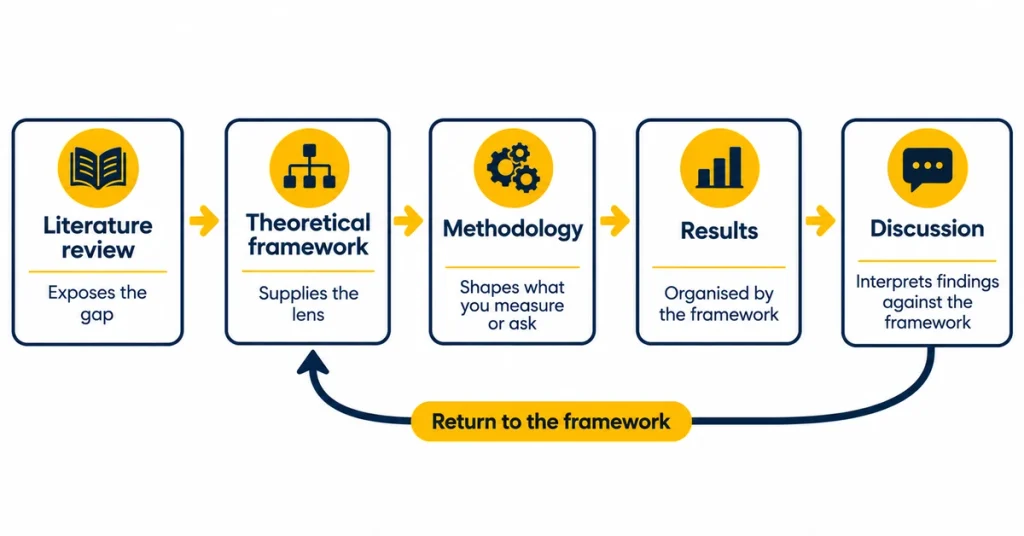
In a quantitative study, the concepts become variables and measures. In a qualitative study, the framework informs your interview topics and starting codes without dictating them. If every question and code comes straight from the theory, the study has become deductive whether you meant it to or not (Jansen, 2023). The methodology chapter is where that choice gets explained, and a guide on how to choose a research methodology helps if the design is not yet settled.
Lynch and colleagues (2020) show the payoff in a nursing education project on plagiarism, where deterrence theory supplied categories for organising the analysis and the presentation of findings. For coded interview data, thematic analysis gives those categories a practical route. Return to the framework again in the discussion chapter, where you interpret your findings against it.
For a second opinion on how the framework feeds the methods, dissertation methodology support covers that stage.
A Worked Example: A Framework Paragraph for a Hospital Technology Study
The paragraph below is an illustration written for this example. It is not an extract from a real dissertation.
This study examines why ward nurses in one NHS trust adopt a new electronic patient record at different rates. The Technology Acceptance Model (Davis, 1989) is adopted as the guiding theoretical framework because it isolates two beliefs, perceived usefulness and perceived ease of use, which map directly onto the second and third research questions. The Theory of Planned Behaviour (Ajzen, 1991) was considered, since attitudes, subjective norms and perceived behavioural control could also explain adoption. It was set aside because the study concerns beliefs about the system itself, whereas that theory would foreground social pressure from colleagues. The limits of the chosen model are discussed in Section 2.6.
Notice the pattern. The theory, the reason, the rejected rival and the limit all appear within a few sentences.
How to Write a Conceptual Framework in Five Steps
Build the conceptual framework before you collect data, because it decides which variables you measure and how you expect them to relate (Swaen and George, 2024). Write the argument first and draw the diagram second. A diagram drawn first often ends up as a neat picture that does not match the reasoning behind it (MAAS Education Technology, 2026).
Step 1: State the Question the Framework Must Answer
Write the research question at the top of a blank sheet. Everything on the diagram must help to answer it, so anything that does not belongs in your notes, not in the model.
Step 2: List the Concepts and Give Each One a Source
Write down every concept the question implies, then note where each one comes from: a theory, a prior study or a stated assumption. A concept with no source is the first thing an examiner is likely to challenge. Add the boundaries too, meaning what the framework deliberately leaves out (MAAS Education Technology, 2026).
Step 3: Draw the Relationships and Give Every Arrow a Direction
Put each concept in a box and each relationship in a labelled arrow. Inputs usually sit on the left, the outcome on the right, and mediating concepts between them. Keep the diagram to one page, and explain every box and arrow in the text. Use two-way arrows sparingly, because each one claims mutual causation, which your design may be unable to test.
Step 4: Add Moderators, Mediators and Controls Only When You Can Justify Them
Three kinds of extra variable appear most often (Swaen and George, 2024). Take a study of whether more frequent manager feedback raises employee engagement:
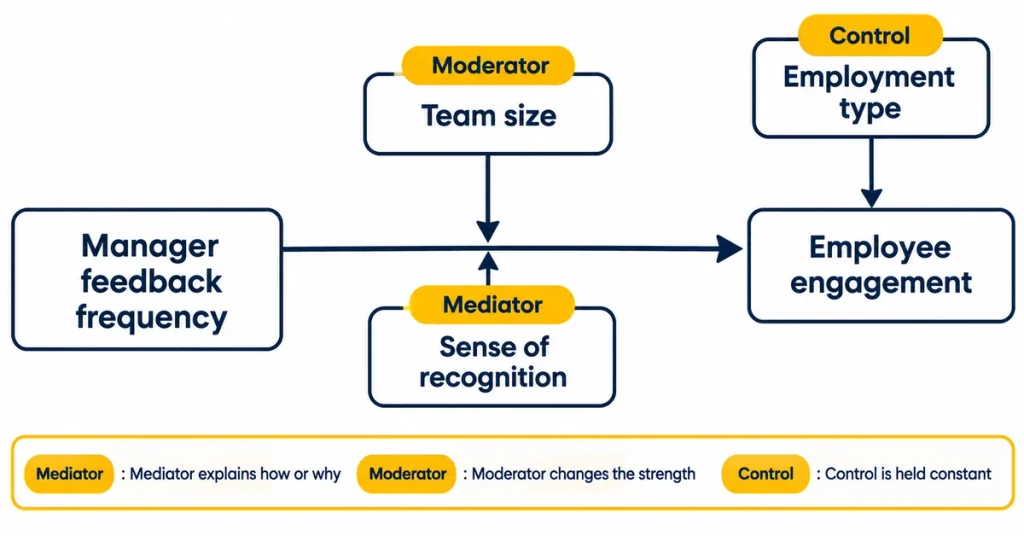
- Moderator: changes the strength or direction of the relationship. Team size could moderate the effect if feedback works differently in small and large teams.
- Mediator: explains how or why the relationship exists. A sense of recognition could mediate it: feedback raises recognition, and recognition in turn raises engagement.
- Control: a variable held constant or accounted for so that it does not distort the results. Employment type, full-time or part-time, is a candidate.
A simple test separates the first two. The independent variable does not change a moderator, but it does change a mediator (Swaen and George, 2024). Mediators are also harder to interpret than they look, so be cautious about the conclusions you draw from them.
Step 5: Write the Argument, Then Turn Each Arrow Into a Hypothesis or Sub-Question
Write one short paragraph per relationship explaining why you expect it and citing the source. In a quantitative study each arrow usually becomes a hypothesis (Jansen, 2023), a process covered in developing hypotheses from the literature. In a qualitative study each one can become a research sub-question. If an arrow is never tested or explored, remove it. Likewise, trace every hypothesis back to a specific arrow.
From Theory to Model: How the Two Frameworks Connect in One Study
Return to the hospital example. The Technology Acceptance Model supplies the theory: perceived usefulness and perceived ease of use are the key beliefs (Davis, 1989). The conceptual framework applies that logic to one setting. It might connect ease of use to usefulness, both to the intention to use the new system, and add years of nursing experience as a moderator. Davis’s own regression results suggested that ease of use may be a cause of usefulness rather than a parallel influence, which is why the model draws an arrow between the two.
The theory explains why these concepts matter. The model shows how they connect in this study and gives each arrow a hypothesis to test.
Conceptual Frameworks in Qualitative Research
A qualitative conceptual framework sets out the concepts expected to matter and how they might connect, without predictions to test (Jansen, 2023). Straughair (2019) describes a three-part approach used in a constructivist grounded theory study in nursing: clarify your personal interest in the topic, review the topical literature, and state the theoretical perspectives that shape your worldview. Federation University (2025) adds that a conceptual framework often suits qualitative work when no single theory explains the phenomenon.
Where Does the Theoretical Framework Go in a Dissertation, and How Long Should It Be?
No single rule exists, and programmes differ. Three patterns are common:
- Inside the literature review, usually towards the end (McCombes, 2022; The PhD People, 2026).
- As its own section or chapter between the review and the methodology (The PhD People, 2026).
- Introduced briefly in Chapter 1 and developed in the review (Jansen, 2023).
Lærd Dissertation describes a related pattern for replication-based quantitative projects: the model works as a roadmap at the end of the literature review, pulling together hypotheses, theories and constructs. Whichever pattern applies, marking the framework as a labelled section in your dissertation outline avoids a late scramble over where it belongs.
Length depends on level and handbook. One mentoring provider suggests roughly 1,500 to 3,000 words plus a one-page diagram for a master’s conceptual framework (MAAS Education Technology, 2026), but treat that as a rule of thumb, not a requirement. Ask your supervisor for a range.
A Skeleton You Can Adapt
- Restate the aims the framework must address.
- Name the theory and the parts of it you use.
- Justify the choice against at least one alternative.
- Note any schools of thought within the theory and say which one you follow.
- Define the key concepts and show how they relate to each other.
- State the philosophical position the framework implies, if your programme expects it.
- Acknowledge the limits of the theory.
- Explain how the framework will shape data collection and analysis.
The skeleton is adapted from questions set out by Federation University (2025) and The PhD People (2026).
How the Framework Differs From Your Literature Review
The literature review exposes the gap. The framework shows the reader which conceptual tools you will use to address it (Federation University, 2025). The review critically evaluates existing research on your topic, while the framework describes the theoretical underpinnings of your own study, and you will likely need both (McCombes, 2022). It is not a repeat of the review either: it zooms in on one theory and explains how it has been adapted to your context (The PhD People, 2026).
Draft the framework after a completed literature review, since the gap decides which theory earns a place. If the review itself is still unfinished, support with the literature review chapter is available.
Examples of Theoretical Frameworks by Discipline
Examples show what a framework looks like in practice. They are not a menu: the right choice comes from the literature in your own field.
| Field | Framework | What it lets you examine |
|---|---|---|
| Business and information systems | Technology Acceptance Model (Davis, 1989) | How perceived usefulness and perceived ease of use shape acceptance of a technology |
| Psychology, marketing and health | Theory of Planned Behaviour (Ajzen, 1991) | How attitudes, subjective norms and perceived behavioural control relate to intentions and behaviour |
| Services management | SERVQUAL (Parasuraman, Zeithaml and Berry, 1988) | Service quality, measured through a 22-item scale of customer perceptions |
| Health and implementation research | Theoretical Domains Framework (Cane, O’Connor and Michie, 2012) | Influences on behaviour; it synthesised 33 theories and 128 constructs, then was refined into 14 domains |
| Nursing education | Deterrence theory (Lynch et al., 2020) | Plagiarism in nursing education |
| Education and psychology | Piaget’s cognitive development, or Maslow’s hierarchy of needs (Federation University, 2025) | Concepts such as assimilation and accommodation, or self-actualisation, safety and esteem |
In every row, the framework gives the study a set of named concepts. That is what lets a marker see which lens you are using.
Common Mistakes in a Theoretical or Conceptual Framework
- Describing instead of arguing. A summary of what others said has not yet started its job. Add the comparison with a rival theory (Open University, 2026).
- Touring every theory you read. Choose one or two, give each a job, and show how it shapes the study (Jansen, 2023).
- Mixing up the terms. If the handbook asks for one and the draft delivers the other, the section does the wrong job (Open University, 2026).
- Drawing unsupported or untested arrows. Each relationship needs a reason, and your analysis must examine it (Jansen, 2023).
- Letting the framework vanish after Chapter 2. Grant and Osanloo (2014) describe students who mention a framework early and never return to it. Bring it back in the methodology, results and discussion.
- Confusing paradigm with theory. Your stance on knowledge and the theory you study through need separate treatment (Jansen, 2023).
- Choosing the theory after the analysis. Selecting a framework once the study is finished fits theory to results (Paperguide, 2026).
A Final Check Before You Submit
- Does the handbook ask for a theoretical framework, a conceptual framework or both?
- Does every key concept have a definition and a source?
- Is the chosen theory defended against at least one alternative?
- Does every arrow map to a hypothesis or research sub-question?
- Do the aims, questions, methods, analysis and discussion all point back to the framework?
- Are the limits of the theory acknowledged?
Frequently Asked Questions About Writing a Theoretical or Conceptual Framework
Can I use more than one theory in my theoretical framework?
Yes. Combining theories is legitimate if they are epistemologically compatible, each is explained in comparable depth, and you can say what the combination adds (The PhD People, 2026). Some universities call a combination of this kind a conceptual framework, so check the term your department uses.
What if no theory fits my topic?
Build a conceptual framework from concepts and prior studies, and justify each part. Alternatively, choose an inductive design and say so. Be open about limitations either way (Sheffield Hallam University Library, n.d.).
Can I add a theory after collecting my data?
Only if the design is inductive by intention and you explain it. Attaching a theory afterwards to satisfy the handbook fits theory to results, which markers tend to notice (Paperguide, 2026).
Do undergraduate dissertations need a framework?
Requirements vary by module, so check the handbook and ask your supervisor. Lynch and colleagues (2020) note that students often see a framework as laborious or unnecessary, yet it brings cohesion by connecting the research questions and organising the analysis.
Can I present my framework as a diagram?
Yes. A diagram is expected for most conceptual frameworks, and a visual summary of a theoretical framework is also acceptable. In both cases, explain every element in the text.
Next Steps: Turn the Framework Into Questions and Hypotheses
With the framework settled, sharpen what it generates. The research question generator helps turn concepts into focused questions, and the hypothesis builder helps you phrase each arrow as a testable statement. Whatever support you use, keep the framework in your own voice and follow your university’s policy on assistance.
References
Ajzen, I. (1991) ‘The theory of planned behavior’, Organizational Behavior and Human Decision Processes, 50(2), pp. 179-211.
Cane, J., O’Connor, D. and Michie, S. (2012) ‘Validation of the theoretical domains framework for use in behaviour change and implementation research’, Implementation Science, 7, article 37.
Davis, F.D. (1989) ‘Perceived usefulness, perceived ease of use, and user acceptance of information technology’, MIS Quarterly, 13(3), pp. 319-340.
Federation University Australia (2025) Research frameworks: HDR [study skills helpsheet].
Grant, C. and Osanloo, A. (2014) ‘Understanding, selecting, and integrating a theoretical framework in dissertation research: creating the blueprint for your “house”‘, Administrative Issues Journal, 4(2), pp. 12-26.
Jansen, D. (2023) Theoretical framework vs conceptual framework. Grad Coach. Updated 2026.
Lynch, J., Ramjan, L.M., Glew, P.J. and Salamonson, Y. (2020) ‘How to embed a conceptual or theoretical framework into a dissertation study design’, Nurse Researcher, 28(3).
MAAS Education Technology (2026) How do you write a conceptual framework, step by step?
McCombes, S. (2022) What is a theoretical framework? A step-by-step guide. Scribbr.
Nguyen, T.N.M., Whitehead, L., Dermody, G. and Saunders, R. (2022) ‘The use of theory in qualitative research: challenges, development of a framework and exemplar’, Journal of Advanced Nursing, 78(1), pp. e21-e28.
Open University (2026) Unit 1: How to write a theoretical framework. OpenLearn Create.
Paperguide (2026) Theoretical framework [research glossary].
Parasuraman, A., Zeithaml, V.A. and Berry, L.L. (1988) ‘SERVQUAL: a multiple-item scale for measuring consumer perceptions of service quality’, Journal of Retailing, 64(1), pp. 12-40.
Researcher.Life (n.d.) What is a theoretical framework? How to write it.
SAGE Research Methods (n.d.) ‘Grounded theory’, in The SAGE Encyclopedia of Research Design.
Sheffield Hallam University Library (n.d.) Developing a theoretical framework. Dissertations and research projects guide.
Straughair, C. (2019) ‘Reflections on developing a conceptual framework to support a constructivist grounded theory study on compassion in nursing’, Nurse Researcher, 27(1), pp. 22-26.
Swaen, B. and George, T. (2024) What is a conceptual framework? Scribbr.
The Dissertation Coach (2025) Making sense of theoretical and conceptual frameworks: a guide for dissertation writers.
The PhD People (2026) PhD theoretical framework: how to write it.