
How to Do Thematic Analysis for a Dissertation: A Step-by-Step Guide

“I have 12 interview transcripts and no idea what to do with them.” “Do I need NVivo, or can I just use Word?” “What is the difference between a code and a theme?” If those questions sound familiar, you are in the right place. Knowing how to do thematic analysis for a dissertation comes down to six repeatable phases, a clear decision about which version of the method you are using, and an honest write-up of what you did.
Short answer: thematic analysis is a way of reading qualitative data closely, labelling meaningful parts (codes), then building patterns of shared meaning (themes) that answer your research question. Most UK dissertations use the reflexive version developed by Virginia Braun and Victoria Clarke, which is what the steps below follow.
What Is Thematic Analysis in a Dissertation?
Thematic analysis is a flexible method for identifying, analysing and reporting patterns of meaning in qualitative data such as interviews, focus groups, open-ended survey answers and documents. It is not tied to one theory, which is why it suits students working in psychology, nursing, education, business and the social sciences.
Your marker will not only ask whether you found themes. They will ask whether your method fits your research question and your philosophical stance, and whether you can show how you moved from raw data to your claims. If you are still shaping the question itself, the guide on how to write a research question is a good place to start.
What Are the Three Types of Thematic Analysis?
Braun and Clarke describe three families of approaches, and naming the one you use is one of the quickest ways to make your methodology credible.
- Coding reliability: a codebook is fixed early, often with more than one coder checking agreement. It leans towards a scientific, measurement-style logic.
- Codebook: a structured framework (for example template or framework analysis) guides coding. It is practical for applied and team-based work.
- Reflexive: the researcher actively interprets the data, and coding is open and evolving. Subjectivity is treated as a resource rather than a bias to remove.
Reflexive thematic analysis is the most common choice for dissertations built on interviews or focus groups. You can read the full distinction on Braun and Clarke’s own thematic analysis resource. Whichever you pick, say so in your methodology chapter and cite it correctly.
How to Do Thematic Analysis Step by Step
The phases below follow Braun and Clarke’s reflexive approach. They are not a conveyor belt. Expect to move back and forth, especially between coding and theme development.
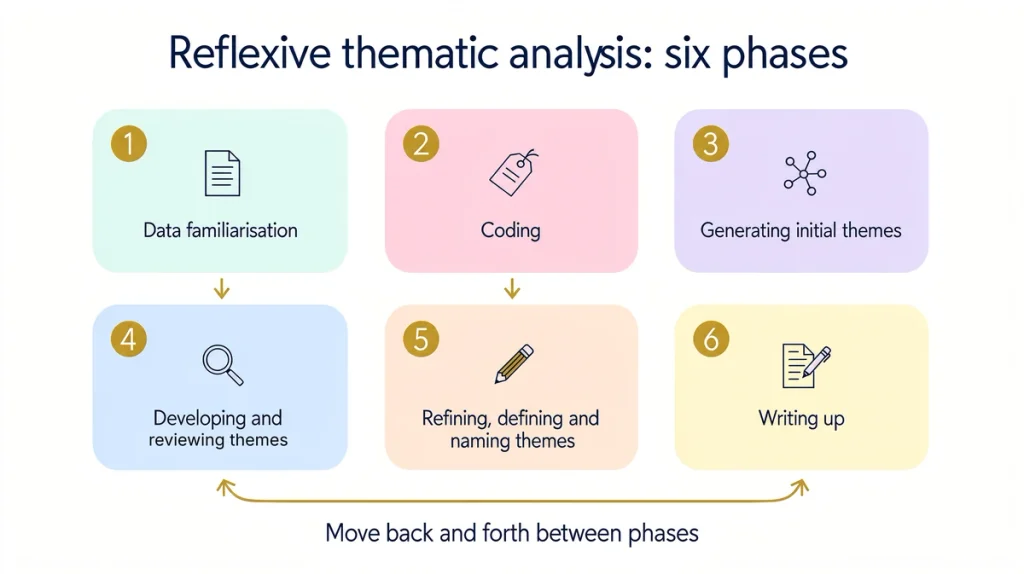
Step 1: Get to Know Your Data
Read and reread your transcripts or responses, ideally while listening to the recordings. Jot down early impressions and anything that surprises you. If you transcribe yourself, you are already doing part of this step. Keep a short research diary from day one, because it feeds your reflexivity statement later.
Step 2: Code Your Qualitative Data
Coding means attaching short labels to segments that matter for your research question. You can code inductively (from the data up), deductively (using a framework or theory you brought with you), or a mix of both. Codes can be semantic, staying close to what participants said, or latent, capturing underlying assumptions or meanings.
Code the whole dataset, not just the exciting parts, and keep each code attached to the extract that supports it. A spreadsheet, sticky notes or software all work, as long as you can trace every code back to the data.
Step 3: Generate Initial Themes
Now look across your codes for shared meaning. A theme is a pattern built around a central idea. It is something you construct through analysis, not something that sits in the data waiting to be found, which is why Braun and Clarke advise against saying themes “emerged”.
Step 4: Develop and Review Your Themes
Test each candidate theme against your coded extracts and then against the full dataset. Ask whether it has enough data behind it, whether it overlaps with another theme, and whether it speaks to your research question. Some themes will merge, split or be dropped. A simple thematic map (boxes and arrows on one page) helps you see how themes relate.
Step 5: Refine, Define and Name Your Themes
Write two or three sentences for each theme explaining what it is about and why it matters. Then give it a name that tells the reader something. “Barriers” is a topic. “Feeling like an imposter in a system built for someone else” is closer to a theme.
Step 6: Write Up Your Analysis
Writing is part of the analysis, not the end of it. Each theme should combine your interpretation with carefully chosen extracts, and the whole narrative should answer the research question. More on this in the write-up section below.
Codes, Topic Summaries and Themes: What Is the Difference?
This is where many dissertations lose marks. A code is a label for one idea in a data segment. A topic summary collects everything participants said about a subject. A theme goes further by showing a pattern of meaning with a central organising idea.
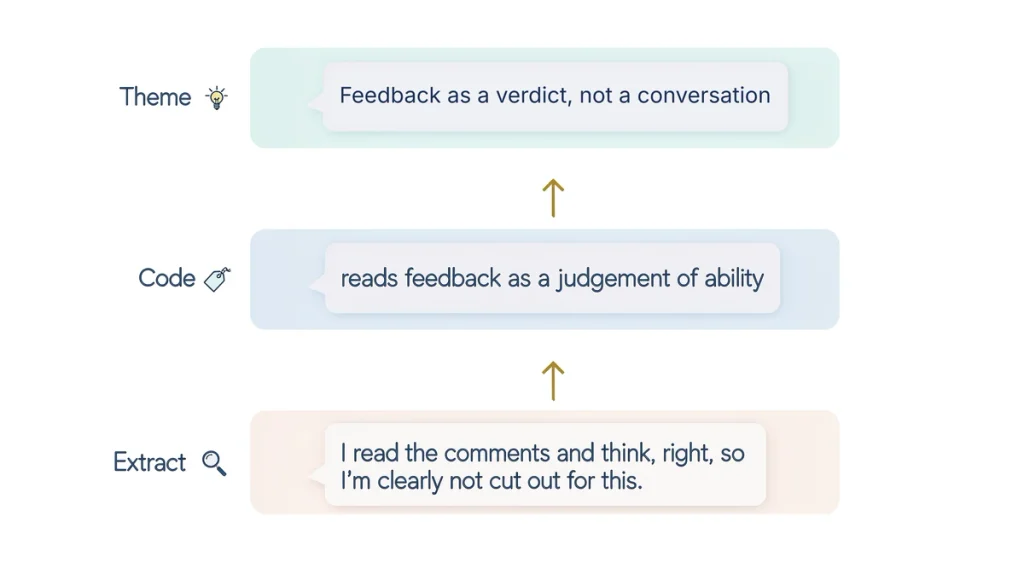
- Code: “worried about being judged by tutors”.
- Topic summary: “Student concerns about feedback”.
- Theme: “Feedback as a verdict, not a conversation”.
If you can swap your theme title for a category label such as “Challenges” or “Support”, you probably have a topic summary. Push it into a statement that carries an argument.
Thematic Analysis Example: From Extract to Theme
The extract below is invented to show the process and is not real participant data.
- Extract: “I read the comments and just think, right, so I’m clearly not cut out for this. I don’t ask anyone because everyone else seems to get it.”
- Codes: reads feedback as a judgement of ability; avoids asking for help; assumes others cope better.
- Possible theme: “Feedback as a verdict, not a conversation”, supported by codes from several participants about silence, comparison and self-doubt.
In your write-up you would quote this extract, explain what you interpret from it, and link it to the wider literature. Keep your own claims modest. The theme tells readers how this group made sense of feedback, not how all students feel.
How Many Themes and Participants Do You Need?
There is no fixed number of themes. Many dissertations present three to five well-developed themes, but quality matters more than count, and your word limit and dataset size will guide you. For sample size in reflexive work, Braun and Clarke caution against relying on data saturation, because themes are interpreted rather than counted. Many researchers instead justify their sample using the idea of information power. Whatever you choose, give a reason and cite it, and check what your supervisor and ethics committee expect.
How to Write Up Thematic Analysis in Your Dissertation
Your methodology chapter explains what you did and why. Your analysis or findings chapter shows what you found. Keep the two apart. For the methodology side, the walkthrough on how to write a dissertation methodology covers the full structure.
- In the methodology: name your approach (for example reflexive thematic analysis), state your epistemological position, describe how you coded (inductive, deductive or hybrid), and say whether you used software.
- Reflexivity: include a short statement on how your background and assumptions shaped the analysis.
- In the analysis chapter: introduce the themes with a map or table, then present each one with description, extracts and interpretation.
- Avoid: long lists of quotes with no commentary, and themes that only repeat your interview questions.
Your results and discussion may be separate or combined depending on your department. If you are unsure how to structure them, see the guides on writing a dissertation results chapter and writing a dissertation discussion chapter.
If your study mixes interviews with numerical data, you may also need quantitative methods. The explainer on how to choose a statistical test can help with that side.
What Is the Best Tool for Thematic Analysis?
There is no single best tool. The right choice depends on your dataset size, budget and what your university provides.
- Manual or spreadsheet coding: free, transparent and perfectly acceptable for small datasets.
- NVivo, MAXQDA and ATLAS.ti: established qualitative analysis software with coding, querying and visual tools. Many universities hold licences, so check before paying.
- Delve: a web-based tool built for qualitative coding.
- Taguette and QualCoder: free, open-source options for students who need no-cost software.
Software organises your data. It does not do the thinking, so your interpretation still has to come from you. Position correct as of October 2026; check each vendor’s website for current pricing and trial terms.
Can I Use NVivo for Free?
Sometimes. NVivo has offered limited trial access, and many universities provide licences through their IT or library services, so ask there first. Terms change, so check the Lumivero website for the current position before you rely on it. If you cannot get access, the free tools above are a sound alternative.
Is NVivo Better Than ChatGPT?
They do different jobs. NVivo is qualitative analysis software built to help you manage and code data you read yourself. ChatGPT is a general-purpose chatbot. Neither replaces your own interpretation, and whether either is allowed in your dissertation is a decision for your university.
Can ChatGPT Do Thematic Analysis?
It can produce something that looks like a thematic analysis, but that is not the same as doing one. Jowsey, Braun, Clarke, Lupton and Fine (2025) argue that generative AI is methodologically incongruent with reflexive qualitative research, because that approach relies on a positioned, reflexive human researcher. Other studies have explored AI-assisted coding and report mixed results, with concerns about accuracy, ethics and data privacy.
- Check your university’s policy on generative AI before using it anywhere in your analysis.
- Never upload identifiable participant data to a public tool, because this can breach your ethics approval and data protection duties.
- If you use any AI tool, say exactly how and why in your methodology.
Position correct as of October 2026; check your university’s current academic integrity and AI guidance, as it changes quickly.
What Is the Hardest Part of a Dissertation?
It varies, but in qualitative projects many students find the move from coded data to well-argued themes the hardest part. It is slow, it cannot be rushed, and it is easy to stop at a tidy list of topics. Planning backwards from your deadline helps, and the dissertation timeline planner gives you a realistic schedule for coding and writing.
Common Thematic Analysis Mistakes to Avoid
- Calling a topic summary a theme.
- Saying themes “emerged” without acknowledging your own role in building them.
- Using Braun and Clarke’s name but running a codebook method, or the reverse.
- Adding a second coder and inter-rater reliability checks to a reflexive study, where they do not fit the logic of the method.
- Quoting participants without analysing the quotes.
- Leaving out how you coded, which makes the analysis hard to trust.
Getting Help With Your Qualitative Analysis
If you are stuck on methodology choices or on shaping themes, your supervisor should be your first stop. For extra guidance on planning and structuring your analysis, dissertation methodology help is available, and the research question generator is a free way to test whether your question suits a thematic approach.
Frequently Asked Questions
How do I conduct a thematic analysis in my dissertation?
Choose your approach (reflexive, codebook or coding reliability), familiarise yourself with the data, code it, build and review themes, define and name them, then write up with extracts and interpretation. Explain each decision in your methodology.
How to do a thematic analysis step by step?
Follow the six phases: data familiarisation, coding, generating initial themes, developing and reviewing themes, refining and naming themes, and writing up. Expect to loop back between phases.
Can you give me an example of thematic analysis?
Yes. Take an interview extract, label its meaning with codes, group related codes across participants, and name the pattern as a theme. The worked example above shows this with an invented extract.