
How to Develop Hypotheses From Your Literature Review: A Step-by-Step Dissertation Guide
Before you commit to a hypothesis, it helps to settle four things:
- Do I actually need a hypothesis, or will research questions do?
- How do I know my gap is real and not just something I have not read yet?
- How do I turn that gap into a prediction I can test?
- Which statistical test belongs with which hypothesis?
You develop hypotheses from a literature review by mapping what earlier studies found, locating a gap you can defend, naming your variables, and stating the expected relationship before you collect any data. The steps below follow that order.
They suit quantitative and mixed-methods dissertations that test a relationship or a difference. Qualitative and exploratory projects usually work from research questions instead, and the first section helps you decide which route you are on.
Do You Need a Hypothesis in Your Dissertation?
Usually yes, if you collect numerical data to test whether one thing affects, predicts or differs from another. Usually no, if you explore experiences, meanings or interpretations. In that case, well-built research questions do the job a hypothesis would do.
Some mixed-methods projects sit in between. For example, a survey strand may need hypotheses while the interview strand runs on questions. Your module handbook and supervisor have the final say, so ask early rather than after you have written your methodology.
If you are on the question route, start with turning an idea into a research question and come back here only if your supervisor asks for testable predictions.
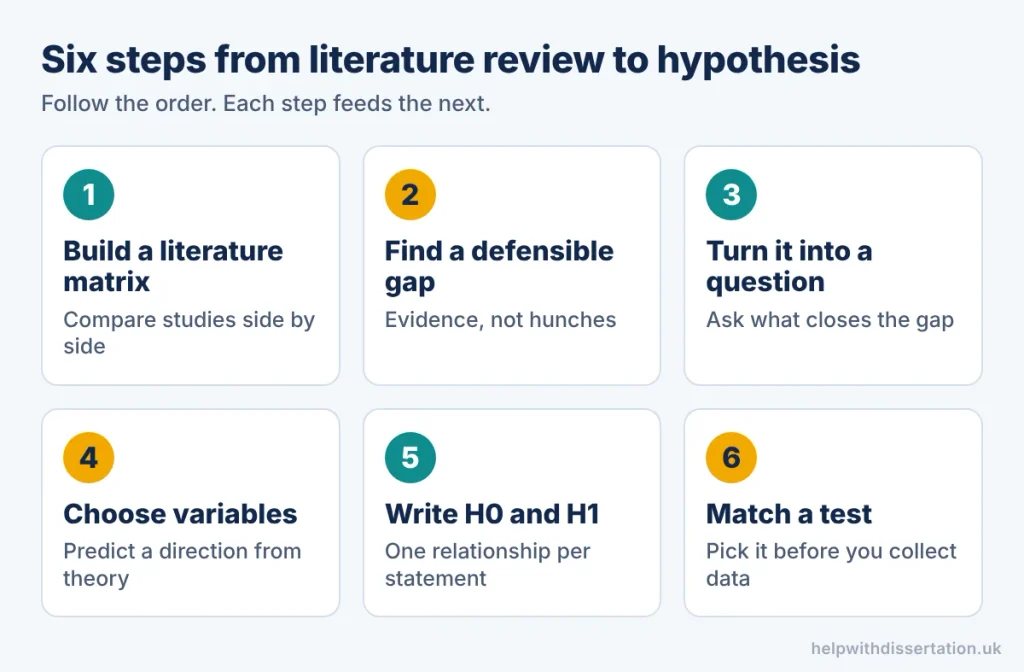
Step 1: Build a Literature Matrix Before You Look for a Gap
Gaps rarely show up while you read one paper at a time. They show up when you compare papers side by side. A literature matrix makes that comparison possible.
Create one row per source and use the same columns every time:
- The research question the authors asked
- The sample and context (who, where, when)
- The method and the measures used
- The main finding
- The limitation the authors admit
- How the source relates to your own question
Then group the rows by theme, by context or by method. Patterns appear quickly once the fields are consistent. You will see which findings repeat, which methods dominate, and where studies disagree.
Step 2: Find a Research Gap You Can Defend
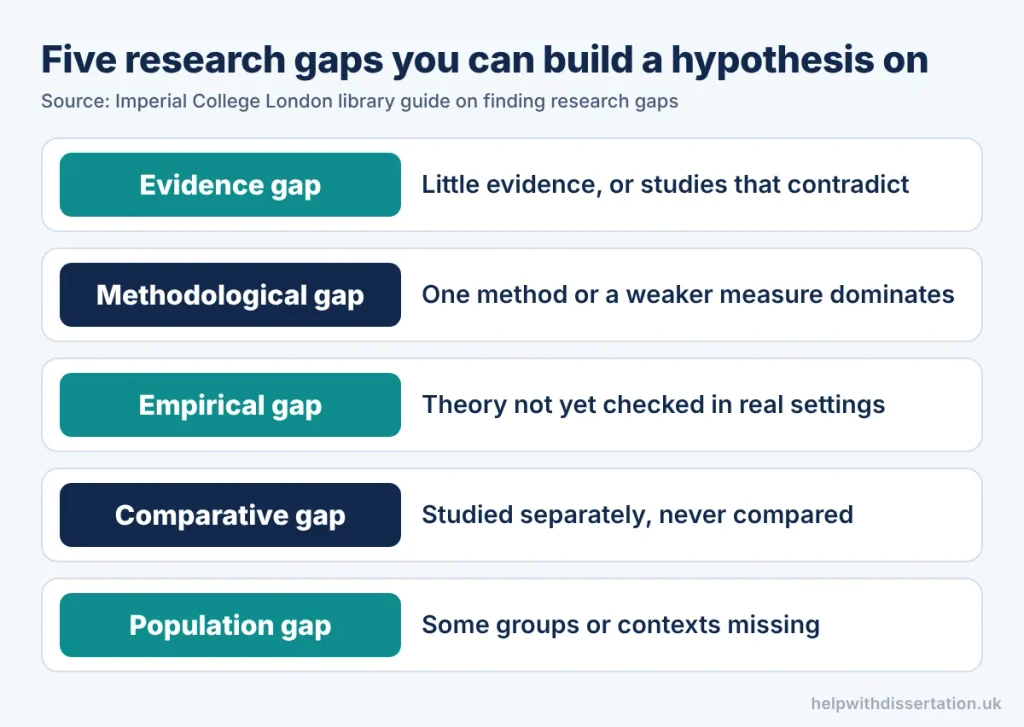
A research gap is a specific, evidenced limit in what the literature can currently tell you. It is not a topic nobody has mentioned. Imperial College London’s library guide on finding a research gap lists five common types, and each one points towards a different kind of hypothesis.
| Type of gap | What it looks like | What it can lead to |
|---|---|---|
| Evidence gap | Little evidence, or studies that contradict each other | A hypothesis that tests which finding holds, or under what condition |
| Methodological gap | The topic is studied with one method or a weaker measure | A hypothesis re-tested with a different design or measure |
| Empirical gap | A theory that has not been checked in real settings | A hypothesis drawn from the theory and tested with your data |
| Comparative gap | Aspects studied separately but never compared directly | A hypothesis about the difference between them |
| Population gap | Some groups or contexts have not been studied | A hypothesis that a known relationship holds in a new group |
Authors seldom write the word “gap”. Instead, look for phrases such as “most studies assume”, “existing research ignores” and “findings change when the context changes”. They tend to sit in the discussion, limitations and further-research sections.
One author’s limitation is only a hint. If the same limitation appears across several recent articles, however, you have a pattern worth building on.
Verify before you claim anything. Avoid writing that “no research exists” unless you have searched several databases, recent review articles and preprints. A softer and safer claim, such as “limited evidence exists for X among Y”, is easier to defend in a viva.
Step 3: Turn the Gap Into a Research Question
A hypothesis is a testable answer to a question, so the question comes first. State the gap in one sentence, then ask what you need to find out to close it.
Structured frameworks can sharpen the wording. PICO (population, intervention, comparison, outcome) suits clinical and health questions. Outside health, SPICE and SPIDER are common alternatives.
If you are stuck on phrasing, the research question generator gives you draft wordings to react to. Treat them as starting points, not final answers.
Step 4: Choose Variables and Predict a Direction From Theory
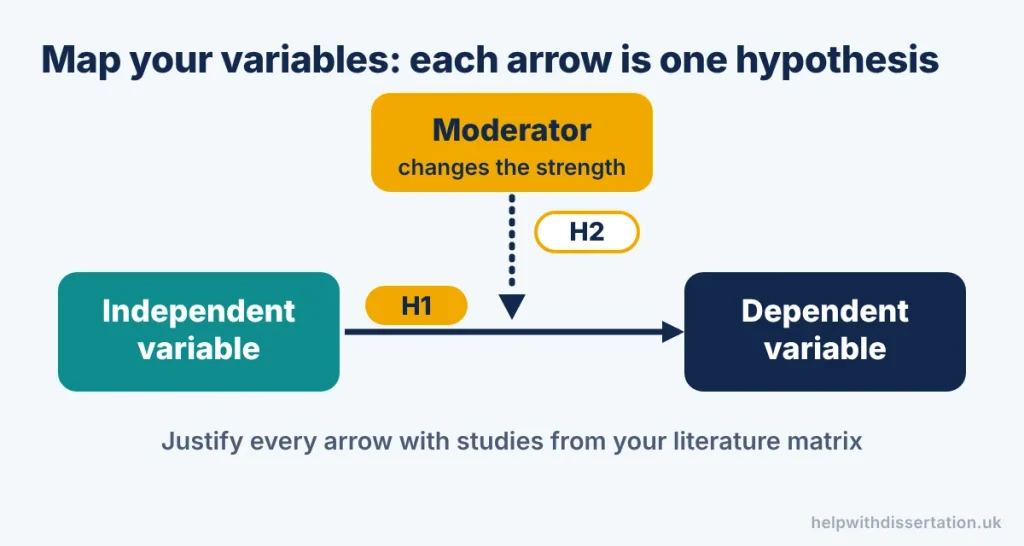
Every hypothesis links at least two variables. The independent variable is the factor you expect to influence something. The dependent variable is the outcome you measure.
Next, decide how each variable will be measured. Check how earlier studies measured it and reuse an established scale where you can. Vague constructs such as “engagement” or “performance” cannot be tested until you define them as something countable.
Your prediction about direction must come from the literature, not from instinct. Where studies agree, a directional hypothesis is justified. Where they conflict, consider a non-directional hypothesis, or one that names a condition under which the relationship changes.
A simple framework diagram helps here. Draw the variables as boxes and the expected relationships as arrows. Each arrow becomes one hypothesis, and each needs a short justification built from the studies in your matrix. The same reasoning is what examiners look for when they read your dissertation methodology chapter.
Step 5: Write Your Hypotheses (H0 and H1)
Use one sentence per relationship, with the variables, the group and the predicted direction all visible:
- Template: [Independent variable] has a [positive / negative] effect on [dependent variable] among [population].
- Alternative hypothesis (H1): your prediction, stated as above.
- Null hypothesis (H0): the same relationship stated as no effect or no difference.
It also helps to know that a research hypothesis and a statistical hypothesis are not the same thing. The research hypothesis is your predicted answer to the question, usually with a reason attached. The statistical hypotheses, H0 and H1, are the paired statements your test actually evaluates.
When you report results, say that a hypothesis was supported or not supported. Avoid saying it was proved. The hypothesis builder lets you check that each statement names its variables and direction.
Step 6: Match Each Hypothesis to a Statistical Test
Choose the test while you write the hypothesis, not after you collect data. Otherwise you risk gathering data your hypothesis cannot be tested with. The table shows common pairings.
| Your hypothesis compares or tests | Common test |
|---|---|
| The means of two groups | Independent-samples t-test |
| The means of three or more groups | One-way ANOVA |
| The strength of association between two continuous variables | Correlation |
| An outcome predicted from one or more variables | Regression |
| The association between two categorical variables | Chi-square test |
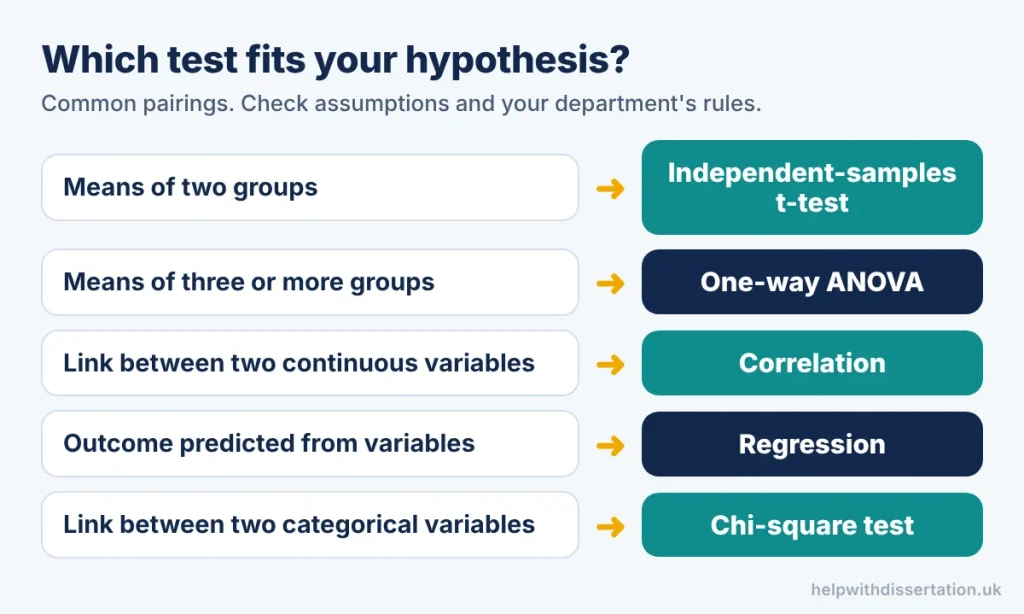
Each test has assumptions, and Likert-scale data in particular needs care, so confirm with your supervisor which approach your department accepts. The statistical test selector narrows the options from your variable types.
Then check feasibility. A test that needs more participants than you can recruit means the hypothesis has to change. The dissertation sample size calculator gives you a rough target before you commit.
A Worked Example: From Literature Matrix to Hypotheses
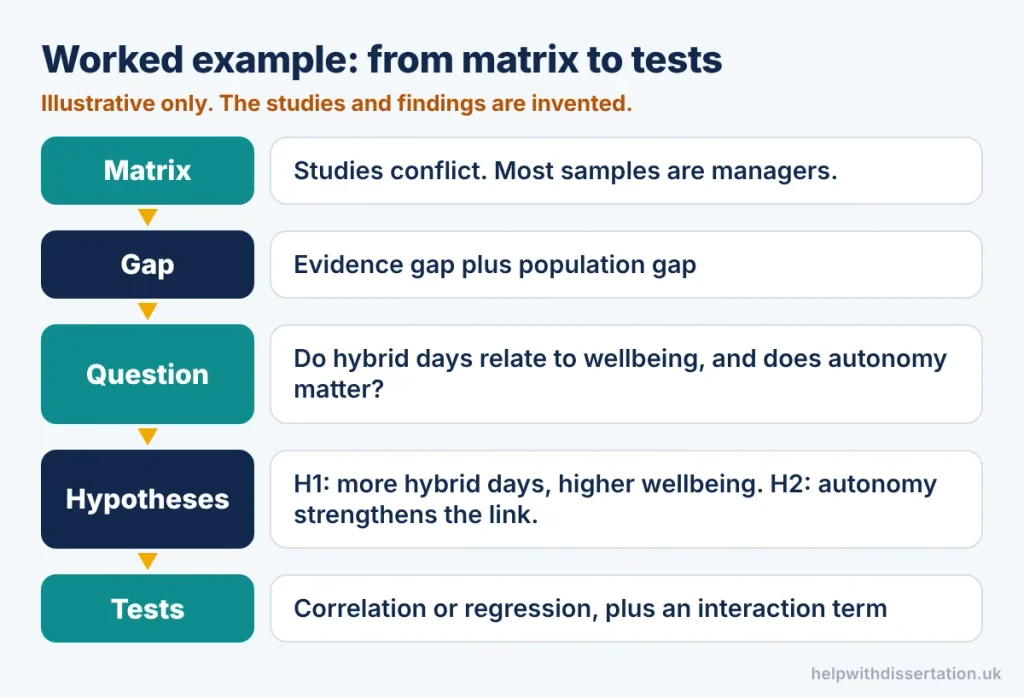
Everything in this example is invented to show the process. The studies and findings are not real, so do not cite them.
Imagine a business student studying hybrid working and employee wellbeing. Three rows of their matrix might read as follows.
| Source | Sample | Method | Finding | Stated limitation |
|---|---|---|---|---|
| Study A (invented) | Managers, one sector | Survey | Higher wellbeing with more remote days | Managers only |
| Study B (invented) | Mixed staff, one firm | Survey, same scale | No clear difference | Single employer |
| Study C (invented) | Managers, two sectors | Survey | Higher wellbeing where staff control their schedule | Autonomy not measured directly |
The gap. Findings conflict, which is an evidence gap. Moreover, most of the evidence comes from managers, which is a population gap. Study C hints that schedule control might explain the conflict.
The question. Among non-managerial UK office staff, is the number of hybrid days related to wellbeing, and does job autonomy change that relationship?
The variables. Hybrid days per week is the independent variable. Wellbeing, measured with an established scale, is the dependent variable. Job autonomy is a moderator.
The hypotheses.
- H1: Among non-managerial office staff, more hybrid days per week are associated with higher wellbeing scores. H0: There is no association.
- H2: Job autonomy strengthens the association between hybrid days and wellbeing. H0: Autonomy does not change the association.
The tests. H1 points to correlation or regression. H2 points to a regression that includes an interaction term between hybrid days and autonomy. Because the second hypothesis depends on a condition rather than a bare effect, it directly reflects the conflict found in the matrix.
Common Mistakes That Weaken a Hypothesis
- Writing the hypothesis first. Starting from a hunch and then hunting for support makes the literature review look reverse-engineered.
- Claiming a gap you have not verified. Examiners can search too, so check databases and recent reviews first.
- Using undefined variables. If you cannot say how a variable will be measured, the hypothesis cannot be tested.
- Packing several relationships into one statement. Split them so each can be supported or not on its own.
- Ignoring contradictory studies. Conflicting findings are often the best raw material for a hypothesis, so address them directly.
- Forcing a hypothesis onto a qualitative study. If your design explores rather than tests, research questions are the honest choice.
- Rewriting hypotheses after seeing the results. If a change is genuinely needed, agree it with your supervisor and report it transparently in your methodology.
Can AI Tools Suggest Hypotheses From the Literature?
They can help you brainstorm, but they cannot replace your reading. The University of Edinburgh’s Behavioural Research UK learning resource on hypothesis generation notes that AI tools can suggest hypotheses and underexplored areas. It also points to a study that compared six AI tools on identifying research gaps, where some tools returned accurate references and others produced fabricated ones.
Therefore, treat any suggestion as unverified until you have found and read the underlying paper yourself. Universities also set their own rules on AI use and change them often. Position correct as of October 2026; check your university’s current academic integrity policy before you use any tool.
Frequently Asked Questions
How many hypotheses should a dissertation have?
One for each distinct relationship you test. No universal number applies, and departments differ, so check your handbook. A few focused hypotheses with strong justification usually read better than many thin ones.
Can I change my hypothesis after I start?
Yes, before you collect data, with your supervisor’s agreement. After you see the results, avoid rewording hypotheses to fit them. Report any unplanned finding as exploratory instead.
Is a hypothesis the same as a thesis statement?
No. A thesis statement is the central argument of an essay, supported by reasoning and sources. A hypothesis is a prediction that you test with data you collect or analyse.
Once your matrix, gap and variables are on paper, the rest follows quickly. If the matrix is where you are stuck, literature review support can help you structure it, and the aims and objectives generator can turn your finished hypotheses into matching objectives. Any model material is for reference and learning, so use it in line with your institution’s policy.