
Fashion Design Dissertation Topics: Narrow, Researchable Ideas From Pattern Cutting to Digital Fashion
These fashion design dissertation topics are written as near-ready proposal titles, so you can test one against your own brief, your access to materials and your level. All of them are free to use and adapt.
Before you pick one, settle these questions:
- Can I get the fabrics, equipment or archive this topic depends on before my proposal deadline?
- Is my project practice-led, or does it study how others design, buy or regulate clothes?
- Which framework, such as Frayling’s research through design or Prown’s object analysis, will structure my argument?
- Do I need ethics approval for fittings, wear trials or interviews?
- Will my sample, whether garments, images or participants, be large enough to support the claim I want to make?
This page covers design, pattern cutting, textiles, circular design, digital fashion, law and education. For business-side work, see the fashion marketing topics, fashion branding ideas, fashion business titles or fashion management topics. Fabric-science projects can also draw on textiles dissertation ideas, while a wider scan is on the general fashion topics page.
Position correct as of October 2026. Regulations and cases named below were still developing, so check their current status before you rely on them in your proposal.
A. Pattern Cutting, Fit and Garment Construction Dissertation Topics
Construction topics suit students who can make and test garments. Keep samples small, record every measurement, and say how you controlled the fit assessor.
- Zero-waste trouser cutting: fabric yield compared with a conventional marker for the same size range (Undergraduate). Draft a conventional block and a zero-waste layout in the spirit of Rissanen and McQuillan’s cutting work, then compare fabric used and fit on three or four wearers. The pitfall is judging fit by eye only, so agree a fit checklist first.
- Bias-cut drape in silk crepe: how cutting angle changes hang and fit on the body (Undergraduate). Cut the same bodice at several grain angles and photograph each on a stand and on a wearer. Rate hang with a simple scored rubric and, if your department owns one, a drape tester.
- Grading versus direct drafting for UK size 22 to 28 womenswear: which gives the better fit? (Master’s). Compare a graded block with blocks drafted from individual measurements on 8 to 10 volunteers. Ethics approval for body measurement and photographs is the main hurdle, so plan it early.
- Virtual prototype versus calico toile: does a CLO3D fitting predict a real fitting for a fitted dress? (Master’s). Use one pattern in both routes and score fit at a fixed set of points. Software licence access and avatar set-up decide whether this is realistic.
- Sleeve cap ease and arm mobility in tailored jackets: a movement trial (Undergraduate). Make three sleeve variants and measure how far wearers can raise the arm before the jacket body lifts. Write the protocol so that someone else could repeat it.
- Flatlock or overlocked seams in base layers: wear trial of comfort and seam durability (Undergraduate). Two seam types, one fabric, repeated wash and wear over a few weeks, with a short comfort diary. Keep the wearer group small and the diary prompts fixed.
- An adaptable maternity trouser block that works across trimesters (Master’s). A practice-led project with fitting sessions at set intervals. Recruiting pregnant participants raises ethics and safeguarding issues, so a fit model you already know may be the safer route.
- Negative ease in knit leggings: what stretch ratio do wearers perceive as a good fit? (Undergraduate). Make leggings at several negative-ease levels from one fabric and ask wearers to rate them blind. Measure fabric stretch yourself rather than relying on the supplier’s figure.
- Hand canvassing versus fused interlinings in men’s jackets: shape retention after wear and cleaning (Master’s). Pair maker interviews with a before-and-after comparison of two constructed jackets. Access to a bespoke tailor is the feasibility test.
- Petite womenswear grading: proportional scaling or body-measure-based adjustment? (Master’s). Use publicly available anthropometric survey data to test whether proportional grading matches real petite body proportions. State which dataset you used and its age.
- Women’s trouser pockets and phone size: measuring pocket depth across high-street ranges (Undergraduate). Measure pocket openings and depths on a sample of garments against current phone dimensions. A tidy measurement method and a clear sampling rule matter more than sample size.
- Draping or flat pattern cutting for a structured dress: time, accuracy and designer control (Undergraduate). Make one design by both routes and log time and adjustments. Reflective journals, in the Schön tradition, give you the qualitative layer.
B. Textile and Garment Performance Testing Dissertation Topics
These topics need lab access or a university testing partner. If your department has no equipment, check that before you commit, and name the standard you will follow.
- Pilling of recycled-wool blends under ISO 12945-2 (modified Martindale) testing (Undergraduate). Compare three blend ratios and report pilling grades after fixed cycles. Say how many specimens you tested per fabric.
- Abrasion resistance of rigid and stretch denim using ISO 12947 Martindale testing (Master’s). Does elastane content change the number of cycles to yarn break? Include a fabric-weight control, since weight confounds the result.
- Colourfastness to washing of madder- and weld-dyed cotton under ISO 105-C06 with different mordants (Undergraduate). A practice-and-test project: dye, mordant, wash, grade. Keep dye recipes exact so another student could repeat them.
- Light fastness of plant-dyed silk under ISO 105-B02 exposure (Master’s). Compare natural dyes and a synthetic control. Xenon-arc access is the limiting factor, so confirm it first.
- Microfibre shedding from polyester and recycled-polyester fleece: a replication in the style of Napper and Thompson (2016) (Master’s). Replicate the domestic-wash approach used in the original study on new garments, with filtration and counting. Contamination control is the make-or-break skill here.
- Do care labels match real garment behaviour? Testing 30-degree labelled garments against ISO 3758 symbols (Undergraduate). Wash garments to their stated label and measure shrinkage and colour change. Report only what you measured.
- Fabric handle: do Kawabata Evaluation System results match expert hand-feel ratings? (PhD). Needs access to KES equipment and a trained panel, so treat it as a doctoral or well-resourced Master’s project.
- Cusick drape coefficient of lyocell versus viscose woven fabrics (Undergraduate). A clean physical test with a clear independent variable. Test in a conditioned room and repeat each fabric several times.
- Seam strength and stitch density in stretch woven shirting (Undergraduate). Vary stitches per inch and measure seam failure load. Report the thread and needle used.
- Layered clothing and thermal comfort: wear trial with skin-temperature loggers (Master’s). Small participant numbers are normal, but the protocol, room conditions and ethics sign-off need to be tight.
C. Circular and Sustainable Fashion Design Dissertation Topics
Sustainability claims are policed far more tightly than they were a few years ago, so ground any topic here in a named framework, regulation or measured result. Students in related fields often find ideas in our architectural design research topic ideas, especially when a first idea feels too broad.
- Design for disassembly in a mono-material jacket: how recyclable is the finished garment? (Master’s). Design and make the jacket, then assess every trim, thread and lining against a recycling route. Interview a recycler if you can reach one.
- Scoring ten jeans against the Ellen MacArthur Foundation’s Jeans Redesign Guidelines (Undergraduate). Build a scoring sheet from the published guideline criteria and apply it to ten pairs from different price points. State plainly which criteria you could not check from the product.
- Emotional durability in practice: testing Chapman’s (2005) ideas on a redesigned shirt through wardrobe interviews (Master’s). Give participants the redesigned garment, then interview them after several weeks about attachment. Conduct interviews with a written consent process.
- Fletcher’s craft of use: how mending workshops change attachment to worn garments (Master’s). Action research with a community mending group. Write up your own role as facilitator and as researcher.
- Repairability scoring of fifteen outerwear jackets (Undergraduate). Define repairability criteria (access to seams, spare parts, fastener type), score each jacket, and justify the weights.
- How the EU textile EPR directive (Directive (EU) 2025/1892) may change design choices at UK brands that export to the EU (Master’s). Interview designers and sustainability managers and read the directive text and national implementation plans. Check which obligations apply to which businesses before you frame the question.
- Unsold stock and the ESPR destruction ban: what do designers do with surplus apparel? (Master’s). Document analysis plus interviews. Confirm the current dates and the types of company covered before drafting your question.
- Life cycle assessment of a cotton T-shirt under ISO 14040 and 14044: how functional-unit choices change the result (Master’s). Run the same product with different assumptions about wears and washes using open datasets. The topic is the method sensitivity, not a claim about cotton.
- An upcycled capsule from post-consumer garments: cost, time and quality compared with new production (Undergraduate). Practice-based. Keep a time and cost log from the first day.
- Designing for resale: which garment features hold their value on second-hand platforms? (Master’s). Collect listing data in line with each platform’s terms of use and code the garment features. Check scraping rules and ethics first.
- Deadstock fabric for graduate collections: how reliable is the supply? (Undergraduate). A small case study of sourcing attempts, minimum quantities and fabric information. Record who could not supply and why.
- Designer views on recycled-fibre content limits: handle, strength and brand expectations (Master’s). Semi-structured interviews with designers who have used recycled fibres, coded thematically.
- Using the UK Textiles Pact EPR blueprint to model design-stage fee incentives for a small label (PhD). Policy analysis of the WRAP blueprint alongside the EU approach. Treat it as a scenario study and say where figures are assumptions.
Stuck between two circular design ideas? The dissertation topic finder can help you compare angles, and the environmental topics page covers wider sustainability questions.
D. Fashion Design Process and Creativity Dissertation Topics
Process topics are about how designers think and work. They often rely on journals, sketchbooks and interviews, so show how you will analyse them.
- Research into, through and for design: applying Frayling’s model to a practice-led collection (Master’s). Use the three categories to structure your own project and say which sections count as research through design.
- Reflection-in-action in sketchbooks: coding how designers move from drawing to toile (Master’s). Collect sketchbooks with consent and code them with a stated scheme drawn from Schön. Agree how you will treat unfinished or private pages.
- Applying the Lamb and Kallal (1992) FEA model to garden-workwear design for women (Undergraduate). Take the functional, expressive and aesthetic categories and use them to build a design brief with user interviews.
- Do mood boards change design outcomes? A small experiment with student designers (Undergraduate). Two groups, same brief, with and without a mood board. Have independent raters score originality using a rubric.
- Hand sketching versus digital illustration: effect on ideation fluency in the first hour (Undergraduate). Count distinct concepts produced under timed conditions. Keep briefs and time limits identical.
- Co-designing with older adults: how participants reshape a garment brief (Master’s). Run design workshops and report which of the participants’ changes you adopted and why.
- Sketchbooks as evidence in portfolio assessment: what do assessors look for? (Master’s). Interview assessors and analyse marking criteria. Document analysis of assessment briefs is a lower-risk route.
- A Delphi study of trend forecasters on how forecasts are built (PhD). Two or three rounds with a panel of practising forecasters. Panel recruitment and attrition are the main risks.
- How designers use colour forecasts when building a season palette (Master’s). Interviews with design teams, supported by a short document analysis of palette briefs.
- Constraint as a creative driver: a 33-piece capsule collection designed under a fixed brief (Undergraduate). Use a fixed item cap, in the spirit of Project 333, as the design constraint and reflect on what it did to your decisions.
- Design fixation: does a reference image narrow student sketching? (Master’s). Controlled task with and without an example image, scoring similarity between sketches.
- Tech pack errors between designer and pattern cutter: a communication study (Master’s). Audit anonymised tech packs for missing information and interview the people who receive them.
E. Digital Fashion, 3D Design and Technology Dissertation Topics
Technology topics date quickly. Name the software version you used and keep your claims to what you tested.
- CLO3D simulation and Cusick drape: how closely do virtual fabrics match measured drape? (Master’s). Measure physical drape for a set of fabrics, run the same fabrics in simulation, and compare coefficients.
- Default avatars in 3D fashion software: what body assumptions do they carry? (Master’s). An audit of the avatars supplied in CLO3D, VStitcher or Browzwear, measured against published anthropometric data. State the version tested.
- Digital-only fashion houses: a design process comparison with physical studios (Master’s). Content analysis of public interviews and making-of material. Keep to what is publicly documented.
- Whole-garment knitting and cutting waste: yarn use compared with cut-and-sew (Master’s). Needs machine access or a manufacturer partner. If you lack both, a secondary-data comparison is the fallback.
- Designers’ views on generative AI image tools in early ideation (Master’s). Interview designers about when they use such tools and what they discard. Cover consent, and avoid uploading others’ work.
- Digital product passports for apparel: what information would a designer have to supply? (Master’s). Read the ESPR textile delegated act material as it stands and map the data fields to design decisions. State the position as of your reading date.
- Laser finishing as an alternative to stone washing on denim: appearance and fabric strength (Undergraduate). Needs laser access. Compare strength loss and visual match to a conventional finish.
- 3D-printed textile structures: flexibility and wear after repeated flexing (Master’s). Print the same structure in two materials and test flex endurance.
- Washability of e-textile garments: conductive thread after repeated laundering (Master’s). Build a simple circuit garment, log failures after set washes, and report the failure points.
- Parametric pattern generation in Python or Grasshopper for made-to-measure shirts (Master’s). A computational design project. Show your code, the measurement inputs and a fit check.
- Which garment attributes cluster in the H&M personalised fashion dataset? (Master’s). Secondary data analysis of article metadata (colour group, pattern, product type) from the public Kaggle competition. Check the competition’s data-use rules and keep the study descriptive.
- Visual coding of silhouette change using open-access Costume Institute images from the Met (Undergraduate). Select images from the Met’s CC0 open-access set, code silhouette features by decade, and report your coding rules.
F. Heritage, Craft and Cultural Fashion Design Dissertation Topics
Archive and craft topics need access to collections or makers. Contact the museum, archive or workshop before you fix your title.
- A Prown-method object analysis of a single garment in the V&A collections (Undergraduate). Describe, deduce and speculate in Prown’s three stages using one catalogued garment. Pick an object with enough published context.
- Reverse-engineering a late Victorian bodice pattern from museum images and measurements (Master’s). Reconstruct the pattern, make a toile, and write up your uncertainty about every inferred measurement.
- Barthes’ Fashion System applied to the captions of one magazine issue (Undergraduate). Semiotic analysis of written fashion language. Keep the sample to one title and a defined period.
- Testing Simmel’s trickle-down idea with runway and street-style images (Master’s). Content analysis of design features across the two image sets. Define a feature list before you start coding.
- Harris Tweed Act 1993 and designers’ use of the Orb mark in collections (Master’s). Doctrinal reading of the Act with interviews. Check the Act’s wording yourself before relying on any summary.
- Attribution in collaborations with embroidery artisans: how do designers credit makers? (Master’s). Content analysis of brand statements plus interviews. Treat artisan participation carefully and pay for people’s time where you can.
- Cultural appropriation or appreciation? A content analysis of how labels respond to criticism (Master’s). Code public statements from several cases using a stated framework. Avoid judging intent; analyse what was said.
- Designer-artisan collaboration in South Asian embroidery clusters: what makes a fair brief? (PhD). Fieldwork-heavy. Ethics, language and travel mean this suits a funded project.
- Costume design and character in one named film: reading dress as narrative (Undergraduate). Close visual analysis of costume choices at key scenes, supported by designer interviews or published commentary.
- DIY construction in punk dress: archive and oral-history sources (Master’s). Combine museum holdings with interviews. Respect consent and storage rules for recordings.
- Changing British Asian wedding wear: what do designers say about modern cut and traditional embellishment? (Master’s). Interviews with bridal designers in two or three UK cities.
- Rational dress and women’s clothing design in the 1880s: archival evidence from the Rational Dress Society (Master’s). Historical study using periodicals and surviving garments. Separate what the sources say from what later writers claim.
Law-based design projects also overlap with intellectual property law topics and artificial intelligence topics.
G. Fashion Design Law, Intellectual Property and Regulation Dissertation Topics
Law-based design topics are doctrinal. Name the statute or case, state the date of the law, and stay inside one jurisdiction unless you are comparing deliberately.
- Unregistered design right and garment shape after section 51 of the Copyright, Designs and Patents Act 1988 (Master’s). Doctrinal analysis of what section 51 leaves protectable in clothing, using Lambretta Clothing v Teddy Smith as one of the cases.
- Copyright in fabric prints after Response Clothing v Edinburgh Woollen Mill (Master’s). Doctrinal reading of the judgment and what it implies for textile designers. Note what the court did and did not decide.
- Generative AI, print design and UK copyright: reading Getty Images v Stability AI alongside the March 2026 UK report (Master’s). Doctrinal and policy analysis. The position is moving, so date your reading.
- Traditional cultural expressions in fashion: what do the WIPO IGC draft articles offer designers? (PhD). Comparative treaty analysis. The draft text is not final law, and your work must say so.
- Substantiating ‘sustainable collection’ claims: the CMA Green Claims Code, the DMCC Act and Directive 2024/825 (Master’s). Compare how each regime treats generic environmental claims, using brand claims as illustrative examples.
- The CMA’s March 2024 undertakings with fashion retailers: what changed in how brands describe collections? (Master’s). Read the undertakings and compare before-and-after claims. Keep your analysis to what the documents show.
- Fibre composition labelling under the UK Textile Products Regulations 2012: an audit of thirty garments (Undergraduate). Check each label against the regulations’ content requirements and report the compliance pattern. Photograph labels as evidence.
- France’s 2026 ultra-fast-fashion law: what does it mean for design briefs and pricing? (Master’s). Policy analysis with a UK comparison. Confirm the current status of the law before you frame the question.
- Design ‘dupes’ and the limits of UK law: copying versus inspiration (Master’s). Doctrinal study using decided cases on clothing designs. Avoid naming current brand disputes unless you rely on court documents.
- Artistic craftsmanship in clothing: could hand-made couture qualify for copyright? (PhD). Doctrinal and theoretical. Review how courts have treated artistic craftsmanship in other design fields.
H. Inclusive, Adaptive and Functional Fashion Design Dissertation Topics
Work with real wearers only with ethics approval, and involve disabled participants as partners, not test subjects, where your design depends on their experience.
- Seated-posture fit in adaptive trousers for wheelchair users: a co-design project (Master’s). Co-design workshops, toile fittings in a seated position, and a clear route for participants to change the brief.
- Sensory-friendly seam and label design: adult wearers’ accounts (Master’s). Interview autistic adults and report which construction features they choose to avoid. Work with an autistic advisory contact if you can.
- Garment design for people living with dementia: carer interviews and a secondary review (Master’s). Because of capacity and consent issues, a literature and carer-interview design is safer than recruiting residents.
- Post-mastectomy garment design: what do support-group members say they need? (Master’s). Interviews with a support group. Treat accounts as sensitive and offer support signposting.
- Modest fashion design: pattern, fabric and layering choices designers describe (Master’s). Designer interviews and a visual analysis of collections. Include designers from different faith and cultural backgrounds.
- Fit problems for women over 65: what do wearers report and how do blocks respond? (Master’s). Questionnaire plus fit sessions with a small group. Keep participation low-burden.
- A unisex shirt block: can one block fit a wide range of bodies? (Undergraduate). Develop a block and test it on volunteers of different shapes, scoring fit at set landmarks.
- Designer attitudes to extended size ranges: barriers named in interviews (Master’s). Semi-structured interviews with small-label designers, coded for cost, pattern and market barriers.
- Prosthesis-compatible clothing: design features that reduce adjustment and discomfort (Master’s). Co-design with users, with an advisory contact from a user organisation.
- PPE and workwear sizing for women in construction: what do wearers report? (Master’s). Survey and interviews, then a design response. Check any standards that apply to the garment type.
I. Colour, Style Rules and Consumer Perception Dissertation Topics
These topics test widely repeated styling advice rather than accepting it. Treat any rule as a claim to examine, not a fact.
- Do two colours really clash? A randomised image survey of commonly cited bad pairings (Undergraduate). Show participants identical outfits in different colour pairings and compare ratings. Use a large enough sample and report the pairings you tested.
- The three-colour outfit guideline: does it raise perceived cohesion? (Undergraduate). Randomised images with two, three and five colours, rated for cohesion and appeal.
- Which design cues make clothing look expensive? A rating experiment on fabric, fit and logo (Master’s). Manipulate one cue at a time and measure perceived price. Report your participants’ backgrounds.
- Enclothed cognition revisited: does garment design change task performance? A replication of Adam and Galinsky (2012) (Master’s). Replicate the lab-coat design with a different garment feature. Preregister your hypotheses if your department allows.
- Gen Z garment customisation: what do young adults change, and what does that tell designers? (Master’s). Photo-elicitation with participants’ customised garments. Collect images with clear consent.
- The capsule wardrobe in practice: a wear diary under Project 333 rules (Undergraduate). Participants wear 33 items for a set period and keep a diary. Report drop-outs honestly.
- Print scale and perceived body size: an eye-tracking or rating study (Master’s). Show the same silhouette in small and large prints and measure perceived size ratings.
- Black clothing and perceived formality across age groups (Undergraduate). Online survey with randomised images and a short formality scale.
- Colour meaning in wedding wear: how white and red are read by different groups (Master’s). Cross-cultural survey with interviews. Describe each participant group in plain terms and avoid over-generalising.
- Tactile description and expectations: how fabric words shape judgement before touch (Master’s). Participants rate swatches after reading different descriptions, then touching them.
J. Fashion Design Education, Careers and Industry Dissertation Topics
Education and industry topics use surveys, document analysis and public statistics. They are often the most feasible choice for students without studio or lab access.
- HESA Graduate Outcomes for design subjects: what do the published figures show? (Undergraduate). Secondary analysis of published HESA Graduate Outcomes tables. State the survey year and the subject groupings used.
- The studio crit and student confidence: a qualitative study of one department (Master’s). Observation and interviews with consent. Anonymise staff and students carefully.
- Portfolio assessment criteria across UK fashion courses: a document analysis (Undergraduate). Collect publicly available assessment criteria and code them. Do not mix levels without saying so.
- Placement years and design skill development: graduate interviews (Master’s). Compare accounts from graduates with and without placements, coded thematically.
- 3D and CAD skills employers say they want: a survey of UK small and mid-size labels (Master’s). Short employer survey, with a stated sampling frame and response rate.
- Sustainability in fashion design curricula: a content analysis of module descriptors (Undergraduate). Sample publicly listed modules and code how sustainability is taught.
- Working conditions in small design studios: a wellbeing study (Master’s). Sensitive topic with ethics review. Offer signposting and avoid identifying individual employers.
- Local manufacturing for small labels: cost and lead time against overseas production (Master’s). Collect quotes under the same specification and compare. CFIN and trade bodies such as UKFT may help you locate sources.
- Making a living as an independent designer: income routes described in interviews (Master’s). Interview independent designers about revenue streams, without asking for exact financial figures if they prefer not to give them.
- Teaching pattern cutting online: what works in video-led instruction? (Master’s). Compare learner outcomes or reflections between video-led and in-person teaching on one technique.
How to Narrow Your Fashion Design Dissertation Topic to One Researchable Question
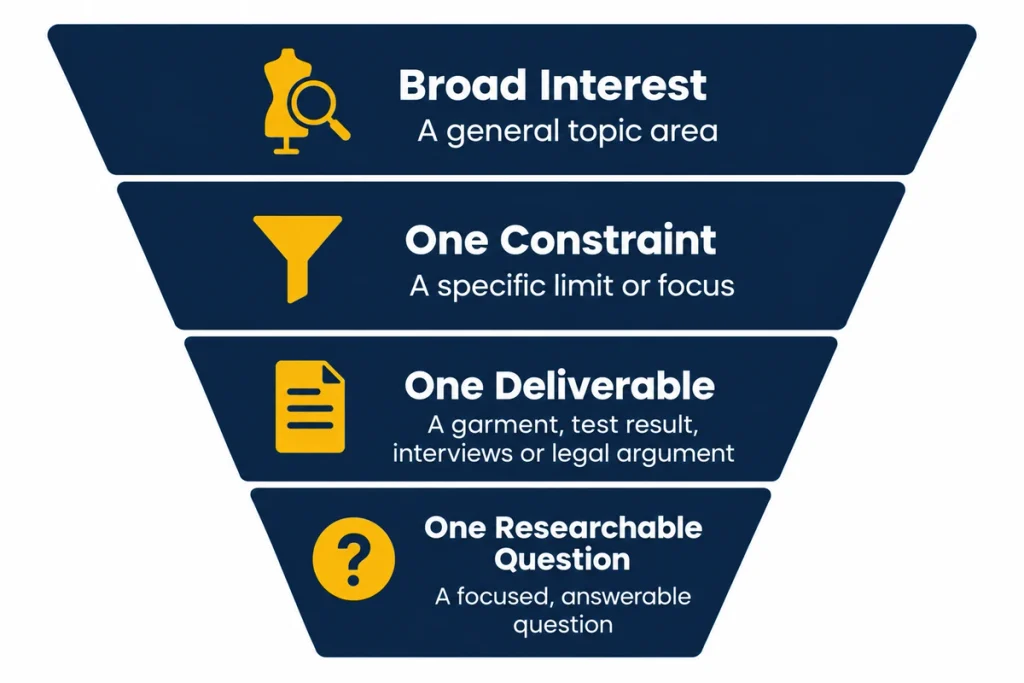
First, choose the thing you will actually produce: a garment, a test result, a set of interviews or a legal argument. Next, add one constraint for material, group or time. For example, “sustainable fashion” becomes “mono-material jackets,” which then becomes “how recyclable is one mono-material jacket I design and make.” Finally, write the question and check that you can answer it with the access you already have. The guide to choosing research topics and the research question guide walk through that step by step, and the research question generator gives you wording to adapt.
Worked Examples of Aims and Objectives for Fashion Design Dissertations
These three show how a title becomes an aim with testable objectives. Use them as a pattern rather than copying them.
Example 1: Zero-waste trousers (topic 1)
Aim: to compare fabric yield and fit of zero-waste and conventionally cut trousers in one UK size. Objectives: (1) measure fabric used in each layout at a fixed fabric width; (2) assess fit on three wearers using one agreed checklist; (3) record construction time for both versions.
Example 2: Label audit (topic 78)
Aim: to assess whether fibre composition labels on thirty garments meet the content requirements of the Textile Products Regulations 2012. Objectives: (1) sample thirty garments from three named price tiers; (2) code each label against the regulations’ requirements; (3) compare compliance patterns across price tiers.
Example 3: Colour pairings (topic 92)
Aim: to test whether commonly cited clashing colour pairings are rated as less appealing than neutral pairings. Objectives: (1) create matched outfit images that differ only in colour pairing; (2) collect appeal ratings from a defined participant group; (3) compare mean ratings and report effect sizes. The aims and objectives generator helps you draft your own set, and the aims, objectives and questions guide explains how they connect.
Research Methods for Fashion Design Dissertations: What Fits Which Question
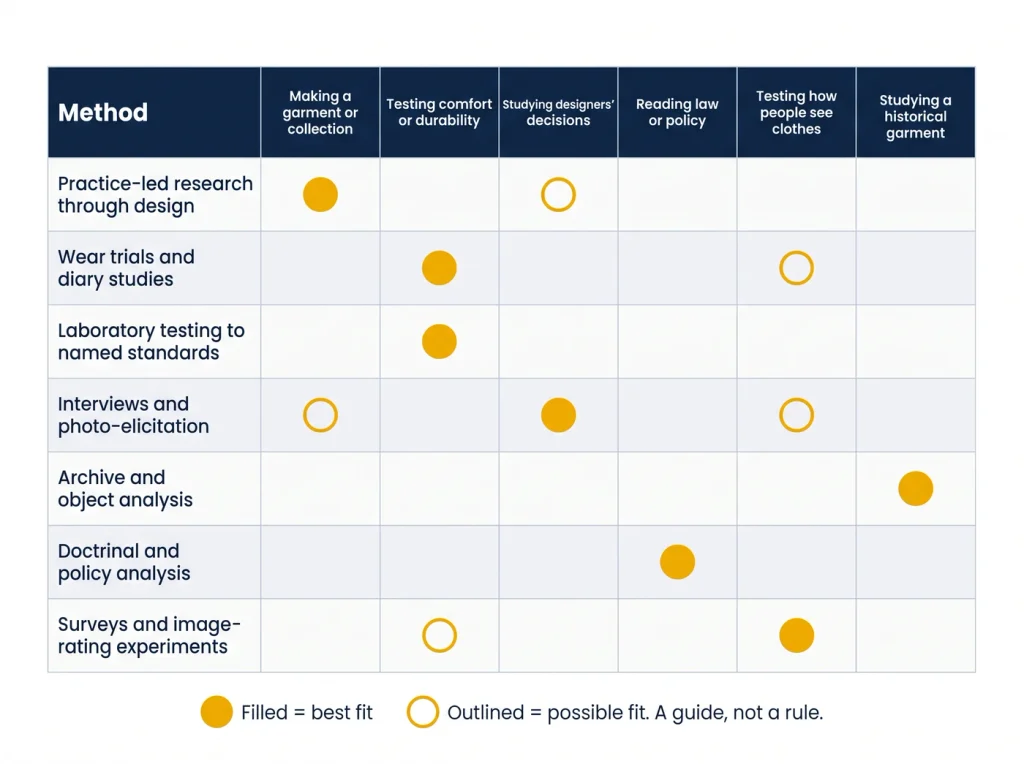
- Practice-led research through design. Suits collection or garment projects, provided you keep a reflective journal and state what counts as evidence.
- Wear trials and diary studies. Suit comfort, durability and use questions. Therefore, they need a fixed protocol and an ethics decision.
- Laboratory testing to named standards. Suits performance topics, but you need equipment access and enough repeat specimens.
- Interviews and photo-elicitation. Suit questions about attachment, craft and designer decisions. However, they require consent and careful anonymising of images.
- Archive and object analysis. Suit history and heritage topics through methods such as Prown’s object analysis.
- Doctrinal and policy analysis. Suits law and regulation topics, where you read statutes, cases and official documents.
- Surveys and image-rating experiments. Suit colour and perception topics. The sample size calculator helps you plan numbers, and the methodology guide covers how to justify your choice.
If you need help shaping a design project into a proposal, the fashion dissertation help page explains the support available, and the proposal guide sets out what a supervisor expects.
Common Mistakes When Choosing Fashion Design Dissertation Topics
- Choosing a practice project without a research question, so the written work reads like a diary.
- Relying on a trend article as evidence. Instead, use measurements, archives, standards or published research.
- Promising a sustainability result you cannot measure. For instance, a recycled fabric does not prove a lower footprint without a method.
- Planning fittings or wear trials with real people but no ethics approval.
- Picking a law topic without checking the date and status of the statute, case or directive.
- Treating styling “rules” as facts rather than claims to test.
Where current UK textile waste is part of your argument, the UKFT’s CFIN source gives the figure of over 1.3 million tonnes of post-consumer textile waste, so quote that wording and say where you read it.
Quick Answers: Common Fashion Design Questions Students Ask
What are the elements and principles of fashion design?
Textbooks do not agree on a single list. A common list of elements is line, shape, form, space, colour, texture and pattern, though some sources use four to six. The principles are usually balance, proportion, emphasis, rhythm and harmony or unity. As a result, always cite the textbook your course uses.
What is the 3-3-3 rule in fashion?
It has more than one meaning. One is Project 333, a capsule wardrobe idea that limits you to 33 items for three months. Another is a styling shorthand of three tops, three bottoms and three pairs of shoes. Say which version you mean in any dissertation.
Is fashion design hard to learn?
It combines drawing, pattern cutting, sewing and technical documentation, so it takes practice rather than one talent. Although some skills are quicker to pick up than others, a dissertation project can be scoped to what you can do well.
Are there golden rules about colours that should not be worn together?
Style guides offer rules of thumb, but they are conventions, not laws. Consequently, they make good test material for a perception study rather than something to cite as fact. See topics 92 and 93.
Where to Find Data and Archives for Fashion Design Dissertation Topics
- Museum collections, including the V&A and the Met’s CC0 open-access images, for object and image analysis.
- The Fashion Transparency Index datasets, published through Fashion Revolution, for supply-chain disclosure topics.
- The public H&M personalised fashion dataset on Kaggle for article-attribute analysis, subject to its terms.
- HESA Graduate Outcomes published tables for education and career topics.
- Your university library’s access to standards such as ISO 12947 and ISO 14040, so check before you design a testing project.
Next, choose three topics, test each against your access and ethics route, and draft a one-paragraph proposal for the one that survives. If you want a custom title built around your own brief, see the custom dissertation topics service.