
Construction Dissertation Topics: Free, Narrow and Researchable Ideas

I need construction dissertation topics that are narrow enough to finish and current enough to matter. Before I commit to one, I want to settle these questions:
- Does my topic rest on law or guidance that is still moving, such as the Commercial Payments Bill or the Future Homes Standard?
- Can I get project, contract or site data, or should I build the study on documents and published datasets?
- Does my question sit in building safety, contracts, carbon, digital delivery, housing or the workforce, and does that area have enough published evidence?
- Will I need ethics approval to interview site managers, subcontractors or residents?
- Which method, doctrinal, modelling, case study or survey, actually fits my question?
- How narrow should a construction topic be at undergraduate, Master’s or PhD level?
Construction covers building and infrastructure delivery: regulation, contracts, carbon, digital tools, housing, safety and people. The ideas below follow that range. Subfields with their own full lists, such as construction management dissertation topics, construction health and safety topics, quantity surveying topics and building surveying topics, go deeper than this overview does. Every topic here is free to use, and you can adapt each one to your own country by swapping in the matching rules and datasets. Please check your university’s rules on ethics, referencing and marking before you commit.
Position correct as of October 2026. Several topics below involve law and policy that is still changing, including the Commercial Payments Bill, the Building Safety Levy regulations, the Single Construction Regulator and the Future Homes Standard. Each topic states the stage reached. Before you cite any of them, check the official source for the current position.
Construction Dissertation Topics on Building Safety and Regulation
Building safety is the most active regulatory area in construction research. The Grenfell Tower Inquiry Phase 2 report, published on 4 September 2024, set a long reform programme, and government’s own annual report in February 2026 tracks progress against it. These topics suit students who are comfortable with policy documents, case law and interviews with professionals.
- How effectively have Gateway 2 and Gateway 3 under the Building Safety Act 2022 balanced safety scrutiny against delivery delay for higher-risk residential buildings? Higher-risk buildings are generally residential buildings of at least 18 metres or seven storeys. Gateway 2 applies at design stage before work starts, and Gateway 3 is the final approval before occupation. Law firm commentary in early 2026 describes better Gateway 2 performance alongside a growing Gateway 3 backlog. A Master’s study could combine published regulator performance data with interviews of principal designers. Fix a clear data window, because backlogs change quickly.
- Whether a licensing scheme for principal contractors on higher-risk buildings can raise competence without squeezing out smaller contractors. Government accepted the Inquiry’s licensing recommendation in February 2025, but the scheme design is not final. Frame the question around the design choices rather than a prediction. Policy analysis plus a comparison with builder licensing in other countries would work at Master’s level.
- To what extent does the proposed Single Construction Regulator resolve the fragmentation between the Building Safety Regulator and the National Regulator for Construction Products? Government published its consultation response on 9 July 2026 and does not expect implementation before 2028. Document analysis of the December 2025 prospectus and the response gives a solid evidence base. State the stage reached and check for later announcements.
- How far can a risk-based general safety requirement for currently unregulated construction products, proposed in the February 2026 Construction Products Reform White Paper, control product risk? The related consultation closed on 20 May 2026. Pick two or three product categories and test whether a general requirement would catch the failures the Inquiry described. This is policy analysis, so no ethics approval is usually needed.
- What do the Inquiry’s findings on misleading product marketing and manipulated test data mean for how specifiers verify fire performance claims in practice? Interview six to ten specifiers or fire engineers about the checks they run before approving a product. Record anonymously and secure ethics approval first, because participants may discuss live projects.
- How should the Building Safety Levy, charged on building control applications from 1 October 2026 at local authority rates, be priced into residential viability appraisals? The levy aims to raise about £3.4 billion over ten years for remediation. Rates differ by authority and by whether land was previously developed. Build a simple appraisal for three schemes in different authorities, using the published rates table. Check that the regulations were made as drafted before you rely on any figure.
- Whether the 30-year retrospective limitation period in section 135 of the Building Safety Act 2022 has changed how design risk is allocated in professional appointments. Section 135 extended Defective Premises Act 1972 limitation from six to 30 years for past work. A doctrinal study with a review of standard appointment and warranty terms suits an LLM or a law-led construction Master’s.
- How far did URS Corporation Ltd v BDW Trading Ltd [2025] UKSC 21 widen developers’ routes to recover remediation costs from design consultants, and what does it leave open for contractors? The Supreme Court unanimously rejected a general “voluntariness” bar, held that a developer can be owed a duty under section 1 of the 1972 Act, and allowed contribution without a prior claim. Examine how later cases apply it. Doctrinal method, Master’s level.
- What limits the dutyholder regime for higher-risk building work, given government’s commitment to review its impact and publish findings by autumn 2026? Because the findings were due this autumn, state clearly whether they have appeared. Compare the regime’s stated aims with practitioner accounts gathered through interviews with principal designers or contractors.
- Which competence routes for fire safety design and assessment, including mandatory fire risk assessor certification, could close skills gaps in the building safety system? Government’s formal response on mandatory certification was expected in autumn 2026. A Delphi study with fire engineers and building control professionals would give structured evidence.
- How consistently do designers and building control approvers apply the Part O overheating requirements to new homes? Part O applies to new homes, and the CIBSE TM59 method is a common route to demonstrate compliance. Model two or three house types under both the simplified and dynamic approaches and compare outcomes. Check that your university licenses suitable software before you commit. An undergraduate version could compare published compliance reports instead.
- How should evacuation planning for disabled residents in high-rise buildings be costed under the government’s Residential Personal Emergency Evacuation Plan commitment? Costing data are thin, so a Master’s study could build a transparent cost model from fire and rescue guidance and landlord interviews. Residents are a vulnerable group, so consider interviewing building managers instead.
Construction Dissertation Topics on Contracts, Payment and Disputes
Payment law is changing, and cash flow drives insolvency in construction. Government estimates that late payment costs the UK economy about £11 billion a year, and commentary reports that construction accounted for 17.1% of insolvencies in England and Wales in January 2026. These topics suit doctrinal, contract analysis and survey methods. Students interested in the commercial side of delivery can also read the procurement dissertation topics resource.
- Can parties recreate the commercial effect of a retention after the Commercial Payments Bill (HL), and where should the line fall between a prohibited retention and legitimate payment security? The Bill was introduced in the Lords on 19 May 2026, finished report stage on 15 September, and had its Lords third reading scheduled for 20 October 2026 before moving to the Commons. It would insert sections 113A to 113F into the Construction Act, and commentary describes a “last retention day” three years after commencement. Reports note it does not currently extend to Northern Ireland. It had not received Royal Assent when this was written, so check Parliament’s Bills website for the stage reached. Compare the Bill’s definitions with retention and security wording in JCT and NEC forms.
- How strong is the empirical evidence used to justify a retention ban, and what primary data could subcontractors supply to test it? Commentary on the Lords debate reports that around 65% of retention payments are paid late and almost 25% are never repaid. Treat these as claims to test, not facts to repeat. Design a short subcontractor survey, calculate a defensible sample with the sample size calculator, and report the limits of self-selected responses.
- To what extent did Carillion’s 2018 collapse, which commentary links to roughly £800 million of unpaid retentions, expose weaknesses in supply chain payment security? Use the 2018 parliamentary inquiry report and insolvency documents as primary sources. A case study of this size suits a Master’s dissertation. Stay with documents and avoid claims about individuals.
- How well do the payment notice and pay less notice rules in the Housing Grants, Construction and Regeneration Act 1996 protect subcontractors compared with the Scheme for Construction Contracts defaults? Search BAILII for Technology and Construction Court decisions on defective notices and map how often notice failures decide outcomes. Doctrinal method, Master’s level.
- Why do insolvent contractors struggle to enforce adjudication wins even after Bresco Electrical Services v Michael J Lonsdale [2020] UKSC 25 confirmed their right to adjudicate? Bresco allowed liquidators to adjudicate despite cross-claims, but later decisions such as John Doyle Construction v Erith Contractors [2020] EWHC 2451 (TCC) set out hurdles at the enforcement stage. Review how courts have applied both since 2020.
- Which features of NEC4 early warning and compensation event procedures are associated with fewer formal disputes on public sector schemes? Contract administration records are confidential, so plan a single project case study or practitioner interviews with a clear confidentiality agreement. Cut the study to one procedure if access is thin.
- How do bespoke amendments to JCT and NEC forms allocate Building Safety Act risk between employers, contractors and subcontractors? Public tender documents on Find a Tender sometimes include contract particulars and amendments. Sample a defined set and code the risk allocation clauses.
- How effectively have pipeline notices and market engagement notices under the Procurement Act 2023 improved small contractors’ visibility of public works above the £2 million pipeline guidance level? Authorities expecting to spend more than £100 million under relevant contracts in a year must publish pipeline notices, and guidance encourages including procurements above £2 million. Content analysis of notices in one sector, for example local authority highways, gives a manageable dataset.
- Whether the exclusion and debarment powers in the Procurement Act 2023 are likely to change contractor behaviour on public construction frameworks. Government said it would use these powers to investigate the seven organisations criticised in the Grenfell Inquiry report. Examine how far deterrence depends on enforcement in practice. Keep to published documents.
- What does a fitness for purpose obligation mean for contractors in design and build contracts when designs rely on novel low-carbon materials? A doctrinal question linking contract law and materials practice. Use reported cases on fitness for purpose and explain why unproven materials raise the risk.
- How do liquidated damages and extension of time clauses treat delay caused by regulator gateway approvals outside the contractor’s control? Compare relevant event wording in JCT with compensation event wording in NEC4, then test the wording against a hypothetical Gateway 2 delay. This is a clear doctrinal study at Master’s level.
- Which delay analysis method, as-planned versus as-built, time impact or windows analysis, do courts and tribunals treat as most persuasive under the Society of Construction Law Delay and Disruption Protocol? Review reported Technology and Construction Court delay judgments and record which method each side used and who won. Be careful not to claim causation from a small sample.
- To what extent do project bank accounts protect subcontractors compared with retentions, and how much evidence from public sector use exists? Evidence is limited, so this works well as a structured literature review with a clear search protocol. It also suits students who cannot get site access.
- How might mandatory interest and a 60-day payment term cap for large firms paying smaller suppliers, as described in commentary on the Commercial Payments Bill, change cash flow in multi-tier construction supply chains? Build a simple cash flow model for a three-tier chain under current and proposed terms. State assumptions openly and check the Bill’s final text.
Sustainable Construction Dissertation Topics: Carbon, Energy and Nature
Carbon and energy rules are tightening, and measurement choices decide the answers. Students who like numbers will find modelling topics here, while policy-minded students can analyse planning and building regulations. For wider environmental angles, see the guides on climate change dissertation topics and waste management.
- How reliably do design-stage whole life carbon assessments, prepared under the RICS professional standard, predict as-built embodied carbon on housing schemes? The second edition of the standard has been mandatory for RICS members since 1 July 2024, and RICS runs the Built Environment Carbon Database. Planning applications that include a post-construction assessment, as the London Plan requires for referable schemes, let you compare design and as-built figures. Master’s level.
- Whether a mandatory embodied carbon limit under an industry-proposed Part Z of the Building Regulations would cut emissions more cost-effectively than reporting alone. Part Z is a proposal, not law. Model two typologies against assumed limits using an open embodied carbon dataset, and be explicit about the assumptions behind each limit.
- How do local plan embodied carbon policies differ from the London Plan’s whole life-cycle carbon requirement in enforceability? Some draft policies require assessments that follow BS EN 15978 and the RICS standard. Code ten plans for trigger thresholds, methods and post-construction checks. Because it uses documents only, this suits undergraduates.
- What does the Future Homes Standard, delivered through S.I. 2026/335 and in force from 24 March 2027, require of housebuilders in heating, solar generation and ventilation, and where do early compliance costs concentrate? Government published the regulations and new Approved Documents L and F on 24 March 2026. Sources describe heat pump based heating, a legal requirement for on-site renewable electricity mostly from solar, and a transitional route for older applications. Cost one house type and interview two or three small builders about practical barriers.
- How closely does the Home Energy Model agree with the Standard Assessment Procedure when both predict energy use in new homes? Sources report that the Home Energy Model replaces SAP under the new standard. Compare outputs for a small set of modelled dwellings. You will need software access, so confirm that early.
- Which transitional route, application before 24 March 2027 with construction starting before 24 March 2028, will large and small housebuilders choose, and what does the choice show about phasing? Review planning pipelines and building control submissions for a sample of schemes. Frame the study around observed behaviour and avoid forecasts you cannot support.
- How far can 10% biodiversity net gain be met on site on small urban housing schemes, and what does reliance on statutory credits do to viability? Apply the statutory biodiversity metric to three small sites and compare on-site enhancement against credit purchase. The Nature Restoration Levy does not remove net gain duties, so keep the two separate.
- What effect might the Nature Restoration Fund and Environmental Delivery Plans created by the Planning and Infrastructure Act 2025 have on programme certainty for housing schemes affected by protected species rules? The Act received Royal Assent on 18 December 2025, and secondary legislation was expected in summer 2026. Interview ecologists and planners, and state which regulations had been made when you wrote.
- How should embodied carbon be compared fairly between timber, steel and concrete frames in mid-rise housing when biogenic carbon is treated differently? Fix a functional unit, apply BS EN 15978 stages consistently, and run sensitivity tests on biogenic assumptions. Use university-licensed life cycle tools or open data.
- To what extent can structural steel reuse scale in UK buildings, given testing, certification and warranty barriers? Interview fabricators, engineers and warranty providers about what stops reuse in practice. Reuse is a practice problem, so a small expert interview study is realistic.
- How do slag, calcined clay and other cement substitutes change the carbon and durability profile of structural concrete for UK exposure classes? A literature-based comparison suits a Master’s student without lab access. Laboratory work suits a PhD with supervisor support.
- Whether PAS 2080 carbon management in infrastructure has changed design decisions on highway and rail schemes or mainly changed reporting. Read published scheme carbon reports, then interview carbon leads about decisions that cost more but cut carbon.
- How effectively do BREEAM New Construction assessments predict in-use energy performance, compared with Display Energy Certificate ratings for public buildings? Match rated buildings to Display Energy Certificate data from the national register and test the association. Explain why a match is imperfect.
- How do small suppliers cope with large contractors’ requests for carbon data when they sit outside mandatory reporting? A qualitative study of eight to twelve small firms can show the practical gap between client demand and capability. Anonymise participants and firms.
- How should recovery and reuse of construction and demolition waste be measured on urban regeneration schemes, and which data sources are reliable? Defra publishes UK statistics on waste. Compare those with site-level records and explain mismatches in definitions. An undergraduate project can stay with one scheme.
- Can adaptive reuse of vacant commercial buildings deliver lower whole life carbon than demolition and rebuild, and under what assumptions does the answer reverse? Run both options for one building with a sensitivity analysis on structural condition and future energy use.
Digital Construction and BIM Dissertation Topics
The UK BIM Framework implements the ISO 19650 information management standards, and it sits beside wider work on digital twins. Topics below test claims about adoption, security and productivity. Because project data can be sensitive, choose a design that needs little confidential access, or plan the permissions early.
- How far has ISO 19650 adoption changed the way clients write employer’s information requirements? Collect publicly available employer’s information requirements and BIM execution plans, then code them for specificity and measurable deliverables. Add three interviews for context.
- Why do smaller firms adopt BIM and ISO 19650 processes less often than large contractors? A survey of subcontractors can compare cost, skills and client demand. Use the statistical test selector to match your comparison to your data. Suited to undergraduate level.
- How should a digital twin of an operational building be validated, and how can the Gemini Principles help judge whether a twin serves the public good? The Gemini Principles come from the Centre for Digital Built Britain and include evolution as one of nine principles. Apply them to two published twin case studies. Master’s or PhD level.
- What evidence supports the claim that a common data environment reduces rework on multi-contractor projects, and how could a student test it? Rework logs are confidential. If access fails, review published case studies and state the limits of the evidence.
- To what extent can machine learning improve schedule risk analysis compared with Monte Carlo simulation? Programme data are hard to obtain, so test on any open dataset you can verify. Define your accuracy measure before you run models.
- Which governance controls should apply when artificial intelligence drafts specifications, tender evaluations or site reports, given professional liability for errors? Review professional body guidance and insurer expectations, then interview two or three professionals about how they check outputs.
- How secure is information shared in common data environments against supply chain cyber attacks, and what does the security-minded approach in ISO 19650-5 expect? Map a typical exchange against the standard’s expectations and identify weak points. Avoid testing live systems.
- Can drone photogrammetry or LiDAR replace manual progress measurement in interim payment valuations without raising disputes? Compare measured quantities for one site against surveyor valuations. Check Civil Aviation Authority rules and get site permission before flying anything.
- Does robotic total station layout improve first-time-right setting out on repetitive floors, and how should productivity be measured fairly? A small field trial on a repetitive floor plate can compare error counts and time. Agree the measures with the site team beforehand.
- When is 3D printing of structural elements cost-effective compared with conventional formwork, and which standards limit adoption? Cost two or three element types and read the standards position. Many published examples are demonstration projects, so be cautious about generalising.
- How do automated quantities from BIM models compare with manual measurement under the RICS New Rules of Measurement? Measure a sample building both ways and compare variances. See the quantity surveying resource for related ideas.
- How far can a shared information management framework, as developed through the National Digital Twin programme, resolve data sharing barriers between infrastructure owners? HM Treasury launched the programme in 2018. Check its current status before you start, because programme structures change.
Modern Methods of Construction and Housing Delivery Topics
Housing targets, factory production and workforce limits meet in this area. The MHCLG working group’s MMC definition framework sets out seven categories of modern methods, which gives students a common vocabulary. For property and planning angles, see urban planning dissertation topics and real estate management topics.
- How do the seven categories of the MMC definition framework change the way lenders, insurers and valuers assess offsite housing risk? The framework was developed partly to help mortgage finance, insurance and valuation communities. Interview professionals in each group and compare how they use the categories.
- Which MMC categories reduce programme duration most for social housing, using local authority framework outcomes? Frameworks such as LHC’s NH3 separate volumetric modular and panelised systems. Compare published programmes and ask landlords about outcomes.
- How does demand aggregation by councils and housing associations affect the viability of offsite factories? Councils such as Bristol have discussed combining pipelines. Build a simple factory utilisation model and test how pipeline stability changes break-even output.
- How far does the Farmer Review’s “Modernise or Die” diagnosis of low productivity, weak investment and fragmentation still describe UK construction? Mark Farmer’s 2016 review gives clear claims to test against current CITB and ONS data. An undergraduate can focus on two claims, and a Master’s student can test five.
- Does the CITB workforce outlook make a 1.5 million homes target feasible, or can productivity growth close the gap? CITB’s 2026 to 2030 outlook estimates an average of 41,200 extra workers a year. Combine it with output assumptions in a simple scenario model. Check the wording of the current government target.
- Which delays hurt high-density residential delivery more, planning decisions or regulator gateway timescales? Combine MHCLG planning statistics with published gateway timings for a sample of schemes. Be clear about the difference between statutory targets and actual durations.
- How much of the gap between permission and completion on large sites reflects construction capacity rather than market absorption, as the Letwin Review debated? Use site-level permission and completion data from a few councils. Be cautious about attributing causes from numbers alone.
- Can self-build and custom-build registers under the Self-build and Custom Housebuilding Act 2015 deliver meaningful supply for small builders? Many councils publish register data. Request figures from a handful and compare demand with permissions granted.
- How do the cumulative costs of biodiversity net gain, the Future Homes Standard and the Building Safety Levy compare for small housebuilders, and which hits viability first? The levy applies to residential schemes in England only. Build a viability model with scenarios and interview two or three small developers.
- How do component replacement cycles differ between volumetric modular and traditional masonry social housing in landlord asset records? Asset registers are rarely open, so plan access early or reduce the study to published lifecycle guidance.
- How effective are warranty providers’ technical audits of offsite systems, such as those under the Build Offsite Property Assurance Scheme, at reducing defects reported at completion? Data are commercially sensitive. Interview audit and warranty staff, and avoid claims about specific products.
- How should embodied carbon of factory-built homes be reported when transport distances and factory energy sources vary? The Future Homes Hub updated its whole life carbon assessment tool in August 2026 to include sector-specific assumptions. Test whether those assumptions suit factory-built homes.
Construction Project Management, Cost and Productivity Topics
Cost and delivery topics have the strongest data trail for undergraduates. The fuller project management dissertation topics and risk management dissertation topics resources cover general methods, so the ideas below stay specific to building and infrastructure delivery.
- How well does earned value management predict final cost on UK infrastructure projects when baselines are rebaselined mid-project? Use annual government major project portfolio data where available. Define how you treat rebaselining before you analyse, and report what the data cannot show.
- To what extent do optimism bias uplifts in HM Treasury’s Green Book match actual cost outturn on public building projects? Collect outturn and uplift for a defined group of projects, such as school builds. Data collection is the hardest step, so cut the sample before you cut quality.
- How effective is the Last Planner System at cutting waiting and rework on repetitive housing sites, and how should percent plan complete be validated? A field case study with weekly plan data can show whether the measure tracks real progress. Needs site access and a gatekeeper’s agreement.
- Does early contractor involvement reduce cost growth on public sector schemes, and how can researchers separate its effect from project size? A regression design with size and complexity as controls fits a Master’s study. Be honest about unobserved differences.
- How does the NEC4 Alliance Contract allocate risk and pain-share differently from traditional lump sum forms? Compare clauses side by side, then test the differences against one or two published alliance case studies.
- When quality weightings rise under the Social Value Model, does the winning contractor change? Analyse published award notices from Find a Tender and Contracts Finder for one sector and compare weightings with winners.
- What role does volatility in the BCIS Tender Price Index play when bid prices fall below cost estimates? BCIS data may require subscription access through your library. Confirm access first, because the topic depends on it.
- How should price fluctuation clauses be drafted for fixed-price contracts in volatile materials markets? Test sample clauses against historic price movements for steel or timber and show who bears the loss under each draft.
- How do ONS construction output figures compare with industry survey indicators such as the construction PMI as early signals of activity, and which lags matter? Both sources are free to access. Compare the series with a lag analysis and select a test with the statistical test selector. Undergraduate friendly.
- How much of construction’s measured productivity gap reflects the way output is measured rather than performance? Review ONS productivity methods and explain which parts of construction output are hard to value. Master’s level.
- Which front-end decisions, such as scope freeze, procurement route or design maturity at tender, best explain cost growth on road schemes? Use published scheme data from National Highways and compare early and late decisions.
- How accurate are cost plans at RIBA Stage 2 compared with Stage 4 on university buildings, and what drives the drift? Compare stage estimates with final accounts for a handful of projects, and track change reasons.
- How do small construction firms manage cash flow when payment terms and interest regimes shift? A short survey on working capital tools and delayed payments gives undergraduate students a manageable fieldwork project.
- How reliable are Insolvency Service statistics as a signal of construction sector stress? Commentary reports that construction made up 17.1% of insolvencies in January 2026. Examine how definitions, seasonality and firm size change that picture.
Health, Safety and Wellbeing Topics for a Construction Dissertation
HSE data are free and detailed. Construction recorded 25 worker deaths in 2025/26, the highest of any sector by count, and 126 worker deaths across all industries. Falls from height caused 31 deaths across all sectors. HSE also publishes construction-specific statistics on work-related ill health and fatal injuries in construction. If you want a dedicated list, see construction health and safety dissertation topics.
- Which leading indicators of safety performance, rather than injury counts, can be collected consistently on UK sites? Compare near-miss, inspection and observation measures across several contractors. Agree definitions before collecting data.
- How should falls from height, which caused 31 worker deaths across all sectors in 2025/26, be analysed to separate construction-specific causes from sector-wide ones? Use HSE fatal injury tables and compare construction against other sectors. Secondary data only, so ethics are light.
- Why did construction record 25 worker deaths in 2025/26 against 35 the year before, and how much of such a change counts as signal rather than random variation? HSE says fatal injuries are rare events and vary year to year. Collect ten years of counts and test the change with a Poisson-based approach. Suitable for a statistics-confident undergraduate.
- How do the principal designer duties under the Construction (Design and Management) Regulations 2015 work in practice on small domestic projects? Interview designers and small builders about who actually holds the duties. Check the university’s ethics rules for professionals as participants.
- What controls do contractors apply to respirable crystalline silica, and how do they compare with HSE’s published expectations? Review a sample of risk assessments and method statements, then interview two or three site managers.
- How effective are workplace mental health programmes in construction at changing help-seeking among site workers? This is a sensitive area. Review published evaluations or interview managers instead of questioning workers directly, and include support signposting in your ethics plan.
- How should older workers be protected on small sites, given that HSE reports 32% of worker fatal injuries across all industries involved people over 65? Compare the age profile of construction fatalities with the workforce profile and review control measures.
- How should heat stress risk assessment for outdoor construction be designed, and what thresholds do UK contractors use when no fixed legal maximum applies? Collect company heat policies and compare triggers and controls.
- How has asbestos management in refurbishment changed, given that HSE reports 2,146 mesothelioma deaths in its latest annual figures? Those deaths reflect past exposure, so be clear about what the statistic can and cannot say. Review current survey guidance and contractor practice.
- Do Safety Schemes in Procurement prequalification schemes change subcontractor site safety outcomes, or mainly paperwork? Interview procurement and safety managers about the checks they run beyond accreditation.
Workforce and Skills Dissertation Topics in Construction
CITB’s Construction Workforce Outlook 2026 to 2030, available through the CITB outlook tool, projects employment growing from about 2.6 million in 2025 to around 2.68 million by 2030, with output growth of negative 0.2% in 2026 followed by recovery. These topics use that data, plus interviews. See also the human resource management dissertation topics resource for people-management ideas.
- How sensitive is CITB’s estimate of 41,200 extra workers a year to assumptions about output growth and productivity? Use CITB’s interactive tool to vary assumptions, then explain which variables move the result most.
- Which routes into construction, apprenticeships, T Levels or career change, retain workers longest? Use published apprenticeship and training statistics. Describe what the data cannot tell you about individual reasons.
- What obstacles do women face when moving from professional roles into site-based leadership? Interview eight to twelve women in different firms. Anonymise carefully, because the sector is small.
- How does reliance on self-employed labour under the Construction Industry Scheme affect training investment by contractors? Interview training managers and review policy documents on levy and grant use.
- Does the CITB levy and grant system distribute training funding fairly between large contractors and micro firms? Analyse published CITB data on levy payments and grants by firm size.
- Is there a skills cliff in specific trades as experienced workers retire, using CITB age profile data? CITB says too many experienced workers are leaving. Test that for two trades and show how sensitive the answer is to the retirement age you assume.
- Do chartership routes at professional bodies keep pace with digital and carbon skills? Compare competence frameworks from two or three bodies against current job advertisements.
- How do induction practices for workers with limited English relate to incident records on multi-employer sites? A qualitative study with safety managers is realistic. Avoid collecting health information about individual workers.
Infrastructure and Civil Works Topics
Civil and infrastructure delivery connects planning law, ground risk and climate adaptation. For the engineering side, see civil engineering dissertation topics.
- How have the Planning and Infrastructure Act 2025 changes to nationally significant infrastructure consenting affected timelines for linear schemes compared with earlier development consent orders? Use Planning Inspectorate timelines and compare examination durations. Master’s level.
- How should unforeseen ground conditions risk be allocated in NEC4 contracts, and does ground investigation quality change disputes? Review contract clauses and case summaries on ground risk.
- Which drainage measures best fit the Environment Agency’s climate change allowances for new developments? Design drainage for one site under central and higher allowances and compare storage needs. Undergraduate friendly.
- Do adoption and maintenance arrangements deter developers from using sustainable drainage systems on constrained urban sites? Interview developers and drainage engineers about the choices they make.
- How much do utility diversion delays contribute to programme overruns on urban highway schemes? Use open street works data where available and add two case examples.
- How well do bridge condition indicators predict maintenance spending on highway structures? Compare published condition ratings with spend for a defined asset group.
- How much traffic do construction consolidation centres remove from urban sites, and how should avoided trips be measured? A single case study with delivery logs is enough for a strong undergraduate project.
Retrofit, Existing Buildings and Facilities Topics
Existing buildings are a major construction workload. The asset management dissertation topics list gives wider management angles.
- Does PAS 2035 retrofit coordination reduce the performance gap in social housing retrofits? Compare monitoring data where landlords allow access, or review published evaluations.
- How do landlords respond to Minimum Energy Efficiency Standards, and does the response favour fabric measures or heating upgrades? Check current rules before you begin because they change.
- How do conservation officers and building control reconcile energy upgrades with significance in listed buildings? Interview officers and review decisions.
- What drives moisture and mould risk after airtightness upgrades in older homes, and how can ventilation design reduce it? Use monitoring literature and one case study. Home visits need ethics approval.
- How far does post-occupancy evaluation feed back into design briefs for new schools? Interview client teams and review briefs from before and after evaluation.
- How should facilities managers prioritise planned maintenance under budget limits using condition data and risk scores? Build a scoring model for one portfolio and test it against past failures.
Materials and Building Performance Topics
Laboratory or modelling routes appear here, so check facilities and supervisor skills before you choose.
- How do hempcrete walls perform hygrothermally in UK climates compared with cavity masonry? Use published monitoring data or hygrothermal simulation.
- How well do chloride ingress models based on Fick’s second law predict deterioration in marine splash zones? Compare model outputs with published field data. PhD or advanced Master’s work.
- How well do standard thermal bridge calculation approaches capture heat loss at balcony and slab edge details? Compare conventions with detailed modelling for two details.
- How reliable are rebound hammer and ultrasonic pulse velocity tests for estimating in-situ concrete strength in older buildings? Compare with core test results from published surveys or a university laboratory.
- How do cross-laminated timber floors behave under vibration compared with concrete floors, and which design criteria matter most? Finite element modelling with validation against published test data.
- How do bio-based insulation materials perform under moisture cycling compared with mineral wool? Review standards for moisture testing and published results.
- How closely do design-stage acoustic predictions match pre-completion test results under Approved Document E? Compare predictions with test results for a sample of dwellings.
How to Turn Construction Dissertation Ideas Into a Proposal
A strong topic names a context, a variable and an outcome. Start broad, cut to one mechanism, then write the title as a question. For example, “payment in construction” becomes “retentions on subcontracts”, which becomes “Could parties recreate retentions after the Commercial Payments Bill ban?” The guide to aims, objectives and research questions shows how to write each part.
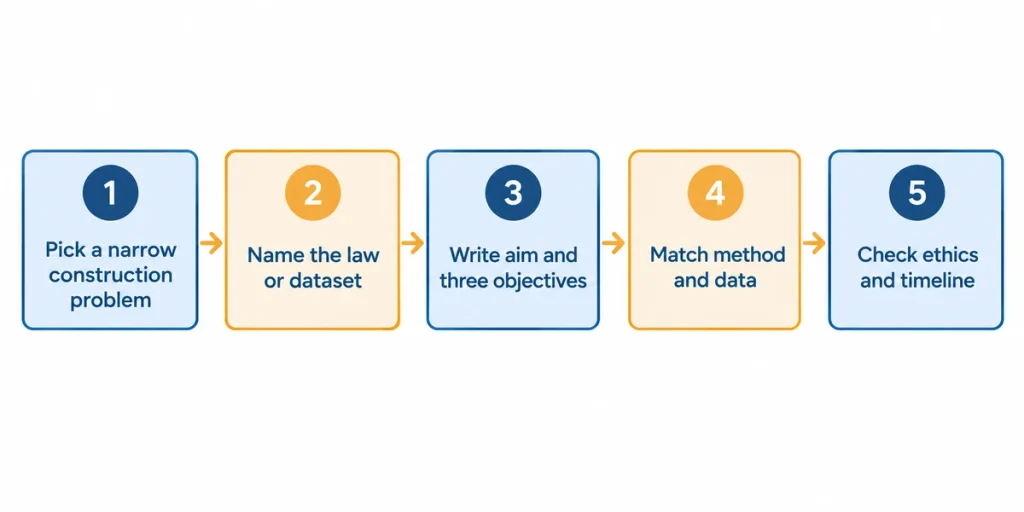
Example 1: Retentions after the proposed ban
Title: Could parties recreate retentions after the Commercial Payments Bill ban? A doctrinal analysis of JCT and NEC payment mechanisms.
Aim: To assess whether payment security mechanisms in JCT and NEC forms could reproduce the commercial effect of retention once the proposed ban takes effect.
- To identify retention and security provisions in the current JCT and NEC forms.
- To compare those provisions with the Bill’s definition of prohibited retention practices.
- To evaluate enforcement risks for subcontractors using reported payment disputes.
Example 2: Biodiversity net gain on small urban sites
Title: Meeting 10% biodiversity net gain on constrained urban housing sites: on-site delivery versus statutory credits.
Aim: To compare the cost and feasibility of on-site enhancement with credit purchase for three small urban housing schemes.
- To calculate baseline and post-development habitat units for each site with the statutory biodiversity metric.
- To estimate on-site enhancement costs against credit costs for each scheme.
- To explore how ecologists and developers weigh viability, risk and delivery time.
Example 3: Signal or noise in construction fatal injuries
Title: Signal or noise? Interpreting year-to-year change in construction worker deaths using HSE data.
Aim: To test whether the fall in construction worker deaths from 35 in 2024/25 to 25 in 2025/26 exceeds expected random variation.
- To collect ten years of HSE construction fatal injury counts and employment figures.
- To apply a Poisson-based test or control chart to the series.
- To discuss what the result means for how safety performance is reported.
Example 4: Sensitivity of the CITB workforce estimate
Title: How sensitive is the CITB estimate of 41,200 extra workers a year to output and productivity assumptions?
Aim: To identify which assumptions drive the CITB 2026 to 2030 workforce estimate most.
- To summarise how the estimate combines growth, replacement and workforce change.
- To vary growth and productivity assumptions with the published tool.
- To rank assumptions by the size of their effect on the estimate.
Research Methods That Fit Construction Dissertation Topics
Pick the method from your question. Then check access, time and ethics. The statistical test selector helps with quantitative designs, and the guide to ethics approval explains what committees ask for.
| Method | Suits | Watch for |
|---|---|---|
| Doctrinal legal analysis | Contract, payment and building safety questions | Law moving between writing and submission |
| Document and policy analysis | Regulator plans, consultations, planning policies | Choosing a clear coding frame |
| Semi-structured interviews | Practice questions with few published data | Ethics approval and confidentiality on live projects |
| Survey | Adoption, attitude and cash flow questions | Small, self-selected samples |
| Case study | Single schemes, contracts or buildings | Access and generalising from one case |
| Secondary data analysis | HSE, ONS, CITB and open notice data | Definitions that change between years |
| Modelling and simulation | Carbon, energy, cost and thermal questions | Software licences and unstated assumptions |
Where to Find Data for Construction Research Topics
Real data make a topic safer. Strong starting points include HSE statistics, ONS construction output, CITB’s outlook, planning statistics from MHCLG, public procurement notices and the Cambridge Laing O’Rourke Centre dissertation directory, which lists abstracts of Master’s dissertations grouped by theme and explains how to request full copies. For carbon work, read the RICS whole life carbon assessment standard. For regulatory change, use the government’s Grenfell Inquiry annual progress report and the Future Homes and Buildings Standards circular. For procurement, the Procurement Act 2023 sets out the notice duties, and for payment cases, the Bresco Supreme Court case summary is a clean starting point.
Choosing Construction Topics for Undergraduate, Master’s and PhD Level
Undergraduate projects work best with one site, one document set or one public dataset, and a clear comparison. Master’s projects usually need a defended method, a framework from the literature and a deeper analysis. PhD work needs an original contribution, so choose a question where evidence is thin and a new dataset, model or theory adds something. Therefore, if a topic above feels too large, narrow the context. If it feels too small, add a comparison or a second dataset.
Common Mistakes When Choosing Construction Dissertation Ideas
- Treating a Bill or draft regulation as settled law. State the stage and the date.
- Planning fieldwork without a gatekeeper. Site access can take weeks.
- Choosing a topic that needs paid data your library does not hold.
- Comparing carbon figures that use different system boundaries.
- Repeating a statistic from a law firm article without checking the primary source.
- Writing a vague title. Name the Act, dataset, contract form or method.
Construction Dissertation Topics: Common Questions
Can I write a construction dissertation using only secondary data?
Often yes. HSE, ONS, CITB, planning and procurement data support strong projects without fieldwork. However, check your programme’s rules, because some require primary data. Explain your sampling and limits clearly.
How do I handle law that changes while I write?
State the stage reached and the date, cite the official source, and add a short note on what could change. Then re-check before you submit.
Do I need ethics approval to interview people on construction sites?
Usually yes. Interviews with professionals still involve confidentiality and consent, and site owners often need to agree to access. Plan this before you set a timeline with the dissertation timeline planner.
Can I use these topics if I study outside the UK?
Yes. Keep the question and swap in your own country’s regulator, contract forms and datasets. Tell your supervisor which UK-specific rules you replaced.
Next Steps
Shortlist three topics, then test each against data access, method and ethics. The dissertation topic finder and research question generator can help you sharpen the wording, and the guide to choosing research topics explains the selection logic. If you want a second pair of eyes on a shortlist or a plan, construction dissertation support and research proposal help are available. Use any support in line with your institution’s policy.