
How to Write a Dissertation Questionnaire: A Step-by-Step Guide for UK Students

You have a research question, a deadline and a supervisor who wants to see your instrument before ethics review. Learning how to write a dissertation questionnaire matters at exactly this point, because weak questions cannot be rescued by clever statistics later. One confusing item, one loaded phrase or one missing response option distorts every answer that follows.
The advice below covers self-completion questionnaires, online or on paper, that collect mostly numerical answers plus a few open-text responses. Interview schedules and focus-group guides follow different rules, so they are not covered here.
In short: a sound instrument links every question to a research objective, uses neutral single-idea wording, offers labelled and complete response options, gains ethics approval before launch, and is tested on a small group first.
Five questions to settle before you write item one
- Does a questionnaire answer my research question, or would interviews, existing datasets or documents do it better?
- Who exactly can answer, and how will I reach enough of them?
- For each question I ask, what claim will the answers let me make?
- How will I analyse the data, and does each question’s format allow that test?
- Which survey tool and consent wording does my university approve?
Answer these on paper first. Each one shapes a step below, and your supervisor will probably ask all five.
Survey vs questionnaire: what is the difference for your dissertation?
A questionnaire is the instrument: the set of questions respondents answer. A survey is the whole method that uses it, covering sampling, administration, data collection and analysis. A survey almost always contains a questionnaire, and a questionnaire only becomes survey research once its answers are gathered and compared across a defined group.
In practice, many students use the two words interchangeably and markers rarely penalise that. Still, your methodology chapter should describe the survey (who, how many, how recruited) and place the questionnaire itself in an appendix.
Is a questionnaire the right method for your dissertation?
Questionnaires suit questions about attitudes, behaviours, experiences or perceptions across many people, especially when you want to compare groups or test relationships. They are less suited to exploring why something happens in depth, to topics where respondents will struggle to answer honestly, or to groups you cannot realistically reach.
Before committing, weigh primary against secondary research, because an existing dataset may answer your question without a new survey. If you are still deciding between approaches, the guide on choosing your overall methodology helps you justify the choice.
Examiners tend to probe survey work in predictable ways. In his advice for postgraduate students, Martyn Denscombe, author of The Good Research Guide, lists the questions a marker may ask: who the respondents are and how they were selected, how representative they are, what response rate you achieved, whether the questions suit the topic and respondents, and how likely honest answers were. Build your design so you can answer all five.
How to write a dissertation questionnaire in nine steps
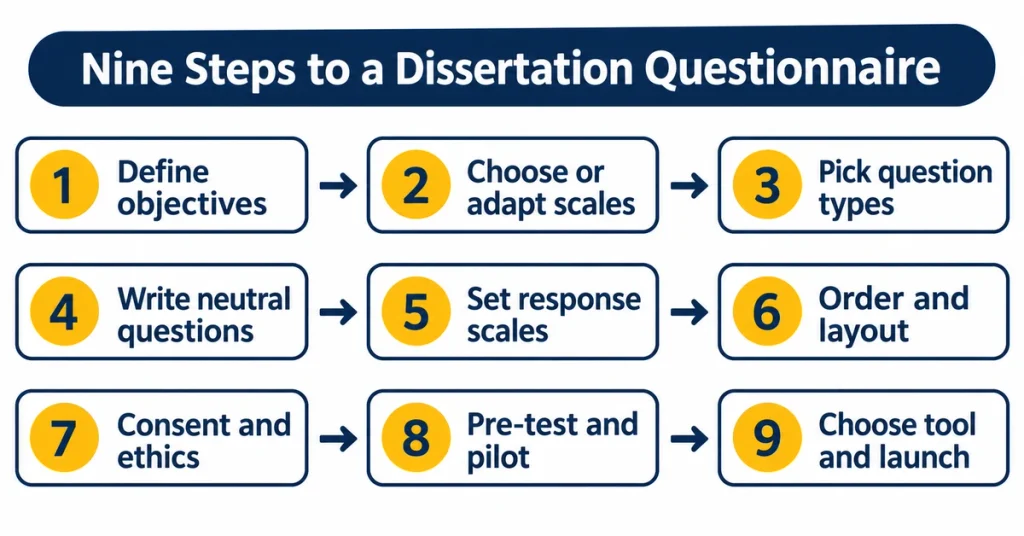
Step 1: Turn your research objectives into measurable constructs
Every question needs a job. Start from your aims, objectives and research questions, then list the concept each objective needs measured. If a draft question does not feed an objective, delete it. Respondents lose patience quickly, and unused data still has to be explained.
A simple planning matrix keeps this honest. Build one before you write any items, and it doubles as evidence of rigour in your methodology.
| Research objective | Construct | Draft item | Response format | Planned analysis |
|---|---|---|---|---|
| Examine whether hybrid working relates to employee engagement | Days worked at home; engagement | “In a typical week over the past month, how many days did you work from home?” and “How often do you feel energised by your work?” | Whole number 0 to 5; five labelled frequency points | Spearman rank correlation |
| Explore barriers to using campus support services | Perceived barriers | “What, if anything, makes it hard to use support services at your university?” | Open text | Thematic analysis |
Stuck turning a broad topic into a testable question? The research question generator gives you wording to react to.
Step 2: Decide whether to adapt a validated scale or write new items
Published scales arrive with evidence that they measure what they claim to, and they let you compare your results with earlier studies. Pew Research Center makes the same point about survey trends: keep wording identical when you want to compare with earlier results, because even small changes can shift answers.
Check whether the scale needs permission or a licence, cite the original authors, and avoid reworking items casually. Changed wording, a new language or a different population can undermine the original validation, so report reliability for your own sample. Write new items only when no suitable scale exists, and expect to spend more time on testing if you do.
Step 3: Choose question types that match your analysis
Choose each format for the analysis it allows, not for convenience. Medical research guidance groups questionnaires by how they are administered (self-completed or interviewer-led) and by question format (structured or open), and most dissertation questionnaires are structured, self-completed instruments with a few open items.
| Question type | Works well for | Watch out for |
|---|---|---|
| Yes/no | Screening and factual items | Hides nuance |
| Single-answer multiple choice | Categories and behaviours | Options must cover every reasonable answer without overlapping |
| Rating or Likert-type | Attitudes, perceptions, frequency | Produces ordinal data, so plan the test first |
| Ranking | Priorities | Hard work for respondents when the list is long |
| Select all that apply | Quick lists of options | Pew found forced-choice items yield more accurate answers, especially on sensitive topics |
| Open-ended | Exploring unknowns and collecting quotes | Slow to code; plan thematic analysis before you rely on them |
Open and closed formats also produce different answers. In a Pew experiment after the 2008 US presidential election, 58% of people picked the economy as the issue that mattered most when it appeared in a list, but only 35% mentioned it unprompted. If you are unsure which options to offer, pilot an open version first, then build closed options from the most common answers.
Step 4: Write clear, neutral dissertation survey questions
Wording does most of the damage in weak questionnaires. Guidance from Pew and from Imperial College London converges on a short set of habits:
- Ask about one idea at a time, so respondents never answer only half a question.
- Use simple, concrete language, and avoid jargon, unexplained abbreviations and double negatives.
- Keep wording neutral, because word choice alone can shift answers. Pew found support differs when a policy is called “welfare” rather than “assistance to the poor”.
- Phrase items positively where you can, since negative wording takes longer to process and causes more misreading.
- Make sure every respondent can answer every item, or add a “not applicable” route.
- Set a specific time frame (“in the past four weeks”) instead of vague words like “often”.
- Offer response options that are complete and do not overlap.
Category definitions matter too. When Pew narrowed “foreign policy” to “the war on terrorism” in a 2002 question, the share choosing it rose from 34% to 52%. Sensitive topics add another risk: people tend to understate behaviours such as drinking and overstate behaviours such as voting, so offer wording and options that make honest answers easier.
| Weak question | Problem | Stronger version |
|---|---|---|
| How satisfied are you with the pay and working conditions at your company? | Double-barrelled: two ideas in one | Ask two questions, one on pay and one on working conditions |
| Don’t you agree that remote working harms team spirit? | Leading, and invites agreement | How has remote working affected team spirit? (much worse to much better, each point labelled) |
| How often do you use the library? Never / Sometimes / Often | Vague options, no time frame | In the past four weeks, how many times did you visit a university library building? 0 / 1 to 2 / 3 to 5 / 6 or more |
| Do you not disagree with removing the attendance policy? | Double negative | Should the attendance policy be kept or removed? |
| Do you always check your sources? | Absolute word, and a socially desirable answer | How often do you trace a statistic back to its original source before using it? Never / Rarely / Sometimes / Often / Always |
| What is your income? | Open, intrusive and possibly unnecessary | Ask only if your objectives need it, use bands, and include “Prefer not to say” |
Step 5: Choose response scales and Likert options
Imperial College London’s questionnaire design best practice, based on Gehlbach and Artino (2018), recommends labelling every response option with words, using at least five options per scale, and spacing options equally. It also advises placing “not applicable” slightly apart from the scale, and avoiding reverse-worded items because respondents misread them.
The same guidance steers away from agree-disagree formats. Those formats invite acquiescence bias, the pull towards agreeing whatever the statement says, and they demand more mental effort. Pew reports that less educated and less informed respondents show the effect more strongly. Instead, ask a question and label the answers by the thing you are measuring, such as “How often…?” with Never to Always.
Sources differ slightly on length. Pew keeps lists of answer choices to four or five, mainly for phone surveys, while Imperial suggests at least five for rating scales. For a self-completed rating scale, five labelled points satisfies both, and you can justify it in one sentence.
Analysis needs a decision at this stage too. Sullivan and Artino (2013) explain that Likert-type items produce ordinal data, and that researchers disagree about parametric tests, though evidence cited in their paper suggests those tests are often robust. Many authors distinguish a single Likert-type item from a composite Likert scale built from several items, and treat the two differently. Ask your supervisor which approach your department expects, then use the guide to pick the right statistical test before you finalise the format.
Step 6: Order the questions and design the layout
Order shapes answers as well as wording does. Group questions by topic, open with simple and engaging items, and avoid stacking several hard questions back to back. Imperial adds that important items should come early, while respondents still have energy.
Earlier questions can colour later ones. Pew documents a pattern where asking a specific question before a general one changes the general answer, because people avoid repeating themselves. In your own study, rating satisfaction with individual modules before overall course satisfaction may therefore shift the overall score, so decide the order deliberately and mention it in your methodology.
Keep demographic and sensitive questions towards the end, unless you need them to screen eligibility or route respondents. Both Pew and Imperial recommend this because people share personal details more readily once they are engaged. For lists of unordered options in an online tool, randomise the order. Pew notes that self-completing respondents lean towards options at the top of a list, and randomising spreads that bias. Leave ordinal scales in their natural order, and keep the layout consistent throughout.
Step 7: Write the participant information and consent form
Your university will require ethics approval before you collect data, and the committee will review the questionnaire, participant information and consent wording together. The ethics approval process usually takes longer than students expect, so submit early. Education researchers should also consult BERA’s Ethical Guidelines for Educational Research (fifth edition, 2024), which cover consent, transparency and the right to withdraw.
Participant information should state:
- who you are, your university and your supervisor’s contact details;
- the topic, the purpose, and roughly how long completion takes (use your pilot timing);
- that taking part is voluntary, and how withdrawal works, including that anonymous answers cannot be pulled back after submission;
- what personal data you collect (including emails or IP addresses if your tool records them), where it is stored, who sees it and how long you keep it;
- whether responses are anonymous or only confidential, because they are not the same thing;
- your ethics approval reference, followed by a tick-box that respondents must complete before the first question.
Data protection adds a second layer. The Information Commissioner’s Office (ICO) separates consent to take part in research from consent as a lawful basis under UK GDPR, and notes that consent is often not the most suitable lawful basis for research processing. Universities usually name their own basis in participant privacy notices. The University of Kent, for example, cites a task carried out in the public interest. Follow your institution’s template, collect only the personal data your objectives require, and take extra care with special category data such as health, ethnicity, religion or sexual orientation. If participants are under 18 or vulnerable, expect additional safeguards.
Position correct as of October 2026: the ICO marks its research provisions guidance as under review following changes made by the Data (Use and Access) Act, so check the ICO site for the current version.
Step 8: Pre-test and pilot your questionnaire
Pew calls pretesting an essential step, particularly for new questions. Three checks work together, and each catches a different problem.
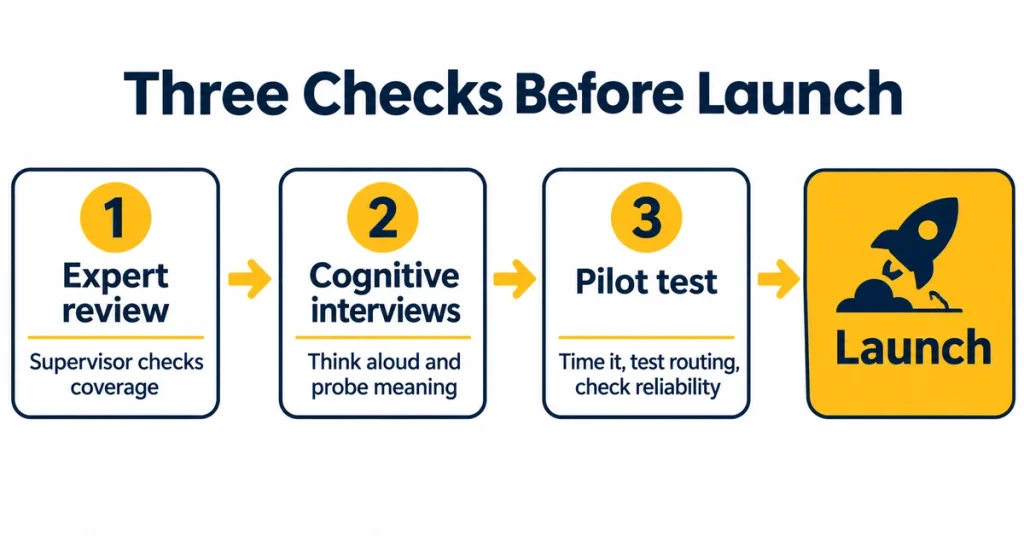
- Expert review. Your supervisor or a subject specialist checks that the items cover each construct and match your objectives.
- Cognitive interviews. A few people from your target group think aloud as they answer, and you probe what each question meant to them. The method is most useful for complex or sensitive items.
- Pilot test. You run the full questionnaire as it will be delivered, then check completion time, flow, broken routing and the data export. Evaluators note that cognitive testing finds how questions are interpreted, whereas a pilot examines length, flow and administration.
Recruit pilot participants who resemble your real respondents, and ask whether your department expects them to be excluded from the final sample. Keep a change log with the version, the problem found, the fix and the reason. It becomes ready-made methodology evidence.
If you build multi-item scales, pilot data also lets you check reliability with Cronbach’s alpha. Tavakol and Dennick (2011) explain that alpha runs from 0 to 1, and it should be calculated for each construct rather than the whole questionnaire. A very high value (above 0.90) can signal redundant items rather than quality. Alpha also rises with the number of items and falls if a scale measures more than one dimension, so read it alongside your design. A common rule of thumb treats about 0.70 as acceptable, but it is only a rule of thumb. In SPSS, use Analyze, then Scale, then Reliability Analysis, and report the value from your own data, not from the original authors.
Pilots and ethics approval both eat calendar time, so put them in your plan with the dissertation timeline planner.
Step 9: Choose an approved survey tool and launch
Tool choice is often decided for you. Many UK universities license a specific platform and restrict others because of where data is stored. The University of Huddersfield’s library guide lists Microsoft 365 Forms and Qualtrics, and tells students not to use free platforms such as Google Forms or SurveyMonkey. At the University of Edinburgh, students request access to Jisc Online Surveys through their supervisor. Check your own university’s approved list before you build anything.
Before launch, preview the questionnaire on a phone, test every routing rule, and check the tool’s settings for IP address and email collection so your anonymity promise stays true. Decide how many responses you need with the sample size calculator, then plan how you will reach them. Track who responds as well as how many, since examiners ask how representative your sample is.
How many questions should a dissertation questionnaire have?
There is no fixed number. Include as many questions as your objectives need, and no more. Length still matters, though. A 2025 experiment in Survey Research Methods (Hanson et al.) reviewed earlier work showing lower response rates and higher break-off for longer self-completion surveys, while noting that results across studies are not always consistent. One web study it cites found a 19% response rate for a 359-item version against 31% for a 91-item version.
Studies that ask respondents about ideal online survey length point to roughly 10 to 20 minutes, according to a summary from the UK’s National Centre for Research Methods. Treat that as a planning target, not a rule. Use your pilot to time completion, tell participants the honest figure in the information sheet, and cut any item that does not feed an objective. Some online guides suggest 25 to 30 minutes is acceptable, but the evidence above argues for shorter.
Dissertation questionnaire template and worked example
A section-by-section template
- Title and a two-sentence purpose statement
- Participant information, including ethics approval reference
- Consent statements with required tick-boxes
- Screening questions, only if eligibility must be checked
- Easy warm-up questions on the topic
- Core sections, one construct per block, with consistent scales
- Open-ended questions after the core items
- Demographics, limited to what the analysis needs
- Thank-you message, researcher contact details and, for sensitive topics, signposting to support
Example block: hybrid working and engagement
This short sample shows the habits above in action for a study of UK office staff.
- Do you currently work for an organisation based in the UK? Yes / No (screening: “No” ends the survey politely)
- In a typical week over the past month, how many days did you work from home? 0 / 1 / 2 / 3 / 4 / 5
- How often do you feel energised by your work? Never / Rarely / Sometimes / Often / Always
- How often do you feel you can focus without interruption? Never / Rarely / Sometimes / Often / Always
- How satisfied are you with the support you receive from your line manager? Not at all / Slightly / Somewhat / Quite / Extremely satisfied
- What one change would most improve how you work with your team? (open text)
- Which age band applies to you? 18 to 24 / 25 to 34 / 35 to 44 / 45 to 54 / 55 or over / Prefer not to say
Notice that items 3 and 4 are worded as questions with construct-specific labels, each asks about one idea, and the demographic item comes last with an opt-out.
How to write up your questionnaire in the methodology and appendices
Marks depend on how well you justify design decisions, not only on the instrument. When you write up the methodology chapter, cover these points:
- why a questionnaire suits your research question, and what you considered instead;
- the source of each scale, any adaptation, and why;
- how you chose response formats and ordered sections;
- the pilot process, changes made and reliability results;
- sampling, recruitment, response rate and limits on representativeness;
- ethics approval, consent and data protection steps.
Put the full questionnaire, participant information sheet and consent form in the appendices. Later, your results chapter should follow the same order and constructs, so readers can trace each finding back to a question.
Dissertation questionnaire FAQs
Can I use Google Forms for my dissertation questionnaire?
Only if your university allows it. Policies vary, and some institutions direct students to specific platforms because of data storage and security. Ask your supervisor or ethics committee, and name the tool in your ethics application.
Do I need a consent form if my questionnaire is anonymous?
Most ethics committees still expect participants to read information about the study and actively agree before starting, even when no names are collected. Follow your university’s template, and remember that anonymous data cannot be withdrawn after submission.
Is a Cronbach’s alpha of 0.7 good enough?
It is a widely quoted threshold, but not a guarantee of quality. Alpha depends on the number of items and whether the scale is one-dimensional, and very high values can mean repetition. Report your own value per construct and explain your reasoning.
Can I use parametric tests on Likert data?
Researchers disagree. Single Likert-type items are ordinal, which points towards non-parametric tests, while composite scales are often analysed parametrically. The statistical test selector narrows your options, and your supervisor has the final say on what your department accepts.
Can AI help me draft survey questions?
It can suggest wording to react to, but it cannot tell you whether your respondents will understand an item. Check every question against your objectives and the wording rules in Step 4, test it with real people, and follow your university’s AI policy on declaring any use.
What if my response rate is low?
Report it honestly, describe who did respond, and discuss the effect on representativeness as a limitation. Avoid generalising beyond your sample. Examiners respect a candid account more than inflated claims.
From draft questionnaire to defensible methodology
Once your instrument is tested and approved, the remaining job is explaining it convincingly. If you want a second pair of eyes on how you justify your design, dissertation methodology help offers guidance and feedback on that chapter. Any model work or editing support is for reference and learning, and should be used according to your institution’s policy.
References
- BERA (2024) Ethical Guidelines for Educational Research, fifth edition. British Educational Research Association.
- Denscombe, M. The Good Research Guide, 6th edition (advice on questionnaire surveys for postgraduate dissertations).
- Gehlbach, H. and Artino Jr, A.R. (2018) The survey checklist (manifesto). Academic Medicine, 93(3), pp. 360-366.
- Hanson, T., Aizpurua, E., Fitzgerald, R. and Vukovic, M. (2025) Surely shorter is better? A questionnaire length experiment in a self-completion survey. Survey Research Methods, 19(2), pp. 139-152.
- Pew Research Center, Writing Survey Questions.
- Sullivan, G.M. and Artino Jr, A.R. (2013) Analyzing and interpreting data from Likert-type scales. Journal of Graduate Medical Education, 5(4), pp. 541-542.
- Tavakol, M. and Dennick, R. (2011) Making sense of Cronbach’s alpha. International Journal of Medical Education, 2, pp. 53-55.
- Willis, G.B. Cognitive Interviewing: A Tool for Improving Questionnaire Design. Sage.