
Semi-Structured Interviews for Your Dissertation: How to Design, Run and Analyse Them

Before you book a single participant, it helps to settle a few things:
- Can a handful of open questions answer my research question, or do I need a survey instead?
- How do I write an interview guide that stays flexible but still gives me comparable data?
- How many people do I need to interview, and how do I defend that number?
- What must my ethics application cover before I contact anyone?
- How do I keep my own opinions out of the conversation?
Here is the short answer. Semi-structured interviews use a prepared guide of topics and open questions, but you adapt the order and wording to each conversation. You build the guide from your research questions and the literature, pilot it, interview until you hold enough relevant information, and analyse the transcripts in a systematic way. The sections below take you through each stage with the evidence behind it.
What is a semi-structured interview, and how does it differ from other interview types?
A semi-structured interview collects data by asking questions inside a planned thematic framework, while leaving the exact order and phrasing open. The framework lives in an interview guide: a short list of topics, core questions and follow-up prompts. You use it as a roadmap, not a script.
That middle position is what makes the method useful. A fixed script gives you comparable answers but limited depth. A free conversation gives you depth but makes comparison hard. A guide gives you both, as long as you keep to the same core issues in every interview.
| Feature | Structured | Semi-structured | Unstructured |
|---|---|---|---|
| Questions planned in advance | All of them | Core topics and key questions | None fixed |
| Order and wording fixed | Yes | No | No |
| Extra follow-up questions | No | Yes | Yes |
| Main strength | Consistent, comparable answers | Comparable answers with room for depth | Open exploration led by the participant |
Focus groups are a different case again, because you put the questions to a group, not one person. If you are still deciding between these routes, the overview of how to choose a research methodology helps you place interviews alongside your other options.
When should you use semi-structured interviews in a dissertation?
Use them when your research question asks about experiences, perspectives or how people make decisions, and when you want to hear explanations in participants’ own words. They suit exploratory questions especially well, because answers can point you towards issues you had not planned for. They also work after a survey, where interviews can explain patterns the numbers only hint at.
Be honest about the limits, because your methodology chapter will need to discuss them. Flexibility can weaken comparability if you drift far from the guide. Open questions invite leading phrasing, and participants may tell you what they think you want to hear, which is known as social desirability bias. Good questions are also harder to write than they look. Spontaneous follow-ups take practice, so some sources advise that this method suits researchers who already have a little interviewing experience, or who practise first.
If you need to measure how many people hold a view, interviews are the wrong tool. A questionnaire answers that better. If you are weighing fresh data against existing sources, the explainer on primary versus secondary research covers the trade-offs.
How to design a semi-structured interview guide
The guide shapes everything that follows, so treat it as a piece of research design, not a to-do list. A systematic methodological review by Kallio and colleagues in the Journal of Advanced Nursing examined ten methodological papers and identified five phases for developing a guide. Following them gives you a ready-made justification for your methodology chapter.
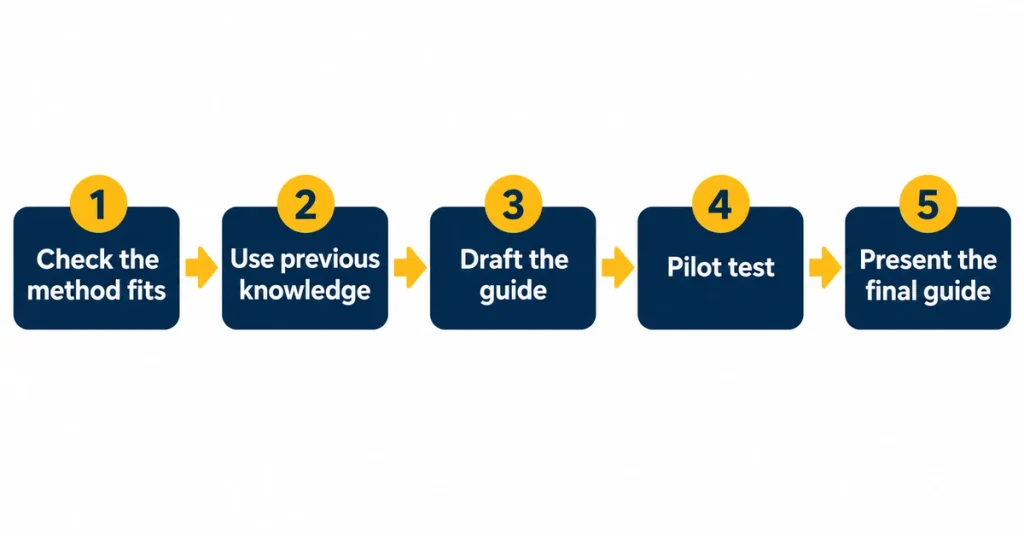
- Check that semi-structured interviews suit your aim and your participants.
- Retrieve and use previous knowledge, such as the literature and earlier studies.
- Formulate a preliminary guide.
- Pilot test the guide.
- Present the complete guide, with your reasons for each decision.
Start from your research questions and the literature
Your research questions decide the topics. Your participants need to be able to answer in everyday language, so you translate each research question into questions that mean something to them. A conceptual question such as “how do students construct belonging?” becomes “tell me about a recent module where you felt part of the group.”
The literature helps you spot topics you would otherwise miss. If earlier studies stress a particular factor, add a question about it. If you are still shaping the question itself, the guide on how to write a research question is the place to start, and the free research question generator can give you drafts to refine.
Write open questions and put them in a sensible order
Open questions begin with phrases such as “tell me about” or “describe”, so participants cannot answer with a single word. Patton’s classification, summarised in the MAXQDA research guide, names six kinds of question you can draw on: experience and behaviour, opinion and values, feeling, knowledge, sensory, and background.
Order matters as much as wording. Imperial College London’s interview protocol advice, adapted from Jacob and Furgerson’s 2012 article, recommends easy, concrete questions first, ideally about recent or ongoing experience. Abstract questions come later, and you avoid reading your research question aloud at the start, because it is usually too conceptual. A typical flow looks like this:
- Background and warm-up questions that build rapport.
- Broad, open questions about concrete experiences.
- More specific and sensitive questions, once trust exists.
- A reflective question that asks for the participant’s overall view.
- A closing question inviting anything you missed.
Keep the guide short. Sources differ slightly: Imperial suggests six to ten well-written questions can fill about an hour, while Quirkos describes guides of around a dozen questions that fit on one side of paper. Both agree that a guide is a prompt, not an encyclopaedia.
Add probes and prompts for the “semi” part
Probes are optional follow-ups you ask when an answer is thin or interesting. Typical examples are “can you give me an example?”, “what happened next?” and “tell me more about that.” Write likely probes under each main question, or use short prompt words as reminders. Anticipating them in advance means you can listen during the interview instead of searching for your next sentence.
Avoid leading, double-barrelled and unhelpful “why” questions
Three habits quietly damage interview data. Leading questions signal the answer you want: “Don’t you think the feedback was useful?” Double-barrelled questions ask about two things at once, so participants answer only one. “Why” questions can sound accusatory and ask people to explain causes they may not know. The MAXQDA guide suggests turning them into invitations, such as “walk me through what led up to that decision.”
Compare these two versions of the same question:
- Leading: “Do you think weak supervision harms student progress?”
- Open: “What has supervision meant for your progress so far?”
An example interview guide you can adapt
The example below is an original illustration for a study of postgraduate students’ experiences of dissertation supervision. Swap in your own topic and keep the structure.
- Warm-up: “Tell me a little about your course and where you are with your dissertation.” Probe: “How did you choose your topic?”
- Recent experience: “Describe your most recent supervision meeting.” Probes: “What was discussed?” “How did you feel afterwards?”
- Helpful moments: “Can you think of a time when supervision really moved your work forward?” Probe: “What made the difference?”
- Difficult moments: “Tell me about a time when supervision did not work as you hoped.” Probe: “What did you do next?”
- Reflection: “If you could change one thing about how supervision works, what would it be?”
- Closing: “Is there anything else you would like to add that I have not asked about?”
Pilot the guide and keep a record of changes
Run one or two trial interviews with people who resemble your participants, or at least with a colleague. A pilot shows you which questions confuse people, how long the interview really takes, and whether your recording setup works. Ask your supervisor to read the draft guide too, because it is far better to fix gaps before fieldwork than to discover them afterwards.
Revising the guide during data collection is acceptable in many qualitative designs, particularly inductive ones. If you do, keep every version and note which participants were interviewed with which one. That record protects you when a marker asks how consistent your data collection was.
How many semi-structured interviews do you need?
There is no single correct number, and your justification matters more than the figure. Four ideas help you build one.
- Saturation. Interviewing stops adding value once new interviews bring no new themes. Hennink and Kaiser’s 2022 systematic review of 23 empirical and modelling studies found that studies using real data reached saturation within 9 to 17 interviews, mostly with fairly homogeneous samples and narrow aims. Studies with broader aims, such as multi-country work, needed larger samples.
- Early patterns. In Guest, Bunce and Johnson’s well-known 2006 experiment, drawn from 60 interviews, saturation occurred within the first twelve, and the basic elements of the main themes appeared as early as six.
- Information power. Malterud, Siersma and Guassora argue that the more relevant information your sample holds, the fewer participants you need. They link that to five factors: the aim of the study, how specific the sample is, use of established theory, quality of dialogue, and analysis strategy.
- Small, focused projects. DeJonckheere and Vaughn note in a primary care methods article that a meaningful project can rest on as few as 8 to 12 participants.
Two cautions apply. First, saturation can only be judged while you collect and analyse data, yet ethics forms ask for a number in advance. State a planned range, explain your reasoning, and say you will review it as analysis proceeds. Second, some qualitative researchers, including Braun and Clarke, argue that fixed pre-set sample sizes sit awkwardly with reflexive approaches to analysis. Read your programme’s expectations and your chosen method before you commit to a figure. Hennink and Kaiser’s full abstract is on PubMed.
Ethics, consent and data protection for interview research in the UK
Interviews often touch personal experience, so ethical review comes first. The British Educational Research Association’s fifth edition of its ethical guidelines, published in 2024, notes that researchers working under an educational institution must seek ethical review and clearance from that institution. Most UK universities apply the same expectation across disciplines. Your ethics approval guide walks through the application itself.
For interviews, your application usually needs to show the following:
- Informed consent: a participant information sheet and a consent form, read and signed before the interview. Imperial’s guidance describes this as the usual and encouraged route, and Scribbr advises written consent over verbal.
- Right to withdraw: participants must understand they can stop or decline any question.
- Confidentiality: anonymise or pseudonymise names and identifying details, and store recordings and transcripts securely.
- Distress plan: know what you will do if a topic upsets someone, and where you can direct them for support.
- Power dynamics: acknowledge any imbalance, for example if you interview your own tutor, employer or patients.
- Honest data use: say clearly how the data will be used and avoid promising outcomes you cannot deliver.
One UK-specific point trips students up. The Information Commissioner’s Office (ICO) separates consent to take part in a research study from consent as a lawful basis under UK GDPR. Its guidance states that in most cases consent is not the most appropriate lawful basis for research processing, and that public task or legitimate interests is more likely, depending on the organisation. Your university’s privacy notice will say which basis it relies on, so copy its wording and templates instead of inventing your own.
This area has also been moving. The Data (Use and Access) Act 2025 received Royal Assent on 19 June 2025 and introduced a statutory definition of scientific research into UK GDPR, and the ICO has since published draft updated guidance on its research provisions. Position correct as of November 2026; check the ICO website for the current status of its research guidance.
How to conduct a semi-structured interview, step by step
Before the interview
Choose the format first. In-person interviews can feel natural but may make some participants nervous, and videoconferencing can feel stilted, so weigh both against your sample. Whichever you choose, pick a private, quiet space. For online interviews, check that the participant has a stable connection and a private place to talk.
Test your recording equipment, and bring a backup recorder or enable a second recording method, because technology fails at the worst moment. Print your guide with space for notes. Confirm the time, place and length of the interview in advance, and agree it with the participant.
Opening the interview
A short opening script keeps you consistent. Introduce yourself and your study, explain how the data will be used, confirm consent and permission to record, and invite questions. Then begin with small talk or background questions to settle both of you. Attentive eye contact and brief verbal acknowledgements help, as long as you do not signal approval or disapproval of what is said.
During the conversation
- Listen more than you talk, and resist filling every silence.
- Follow relevant tangents, because they often carry the richest material, but steer back when they stray from your topic.
- Use probes when answers are short, and skip questions a participant has already answered.
- Jot key words and timestamps, plus notes on tone or hesitation, to supplement the recording.
- Keep to the agreed time, and finish by asking if there is anything the participant would like to add.
Straight after
Expand your notes while the conversation is fresh, and write a short reflective memo on what surprised you, what you might have led, and what to change next time. Store the recording and notes securely straight away. DeJonckheere and Vaughn list memoing and reflection as a distinct step in the process, and it feeds directly into your analysis.
Common problems with semi-structured interviews and how to fix them
Interviewer bias. Nodding at the wrong moment, or paraphrasing in a way that signals approval, can steer answers. Practise neutral wording, reflect regularly on your own position, and keep a short journal after each interview. Your pilot interviews help you notice habits you cannot see yourself.
Interviews that wander. Acknowledge the point, then return gently, for example: “That is interesting, and going back to what you said earlier about supervision meetings…” If a topic is clearly irrelevant, thank the participant and move on.
Short or guarded answers. Use a probe such as “tell me more about that”, ask for a concrete example, or return to an easier topic and revisit later. Do not rush to fill the pause.
Rapport and power gaps. Age, status, culture and role all affect what people feel safe saying. A student interviewing a lecturer, or a clinician interviewing patients, needs to acknowledge the gap openly, explain confidentiality clearly, and make it easy to decline a question.
Social desirability. Participants may give answers they think suit you. Ask about specific recent events instead of general opinions, and make clear that there are no right answers.
From recordings to findings: transcription and thematic analysis
Give each participant a number or pseudonym, then transcribe the recordings. Decide whether you need verbatim transcription, which keeps pauses, laughter and filler words, or intelligent verbatim, which removes them and tidies grammar. Choose verbatim only when those features affect your analysis. If you use transcription software, check the output against the audio before you start coding.
Most dissertation interview studies then use thematic analysis. Braun and Clarke’s reflexive approach describes six phases: familiarising yourself with the data, coding, generating initial themes, developing and reviewing themes, refining, defining and naming themes, and writing up. They stress that these are recursive phases, not a strict ladder, so you will loop back. Your codes can come from your interview guide (deductive), from the data (inductive), or from both, which suits semi-structured data well. The full walk-through in our guide to thematic analysis for a dissertation covers coding in detail.
One method point deserves care. Reflexive thematic analysis does not treat inter-coder agreement as a quality measure, so avoid reporting reliability scores while claiming that approach. Name the version of thematic analysis you used and keep your reasoning consistent.
How to write up your interview method in the methodology chapter
A strong method section lets a reader judge the quality of your data collection. Cover these points, in roughly this order:
- Why semi-structured interviews fit your research questions, and why alternatives did not.
- How you developed the guide, including the literature used and your pilot.
- Who you recruited, how, and how many, with your reasoning for the number.
- Ethics approval, consent and data protection steps.
- How and where interviews took place, their length, and how you recorded them.
- Your transcription choices and your analytic approach.
- Your reflexive stance and the limitations you accept.
Put the full guide, consent form and information sheet in your appendices if your department allows it. The chapter-level advice in how to write a dissertation methodology shows how this section fits the wider structure.
When you present findings, tie each quotation to an interpretive point. Introduce the participant by pseudonym, state the point you are making, give the quotation as evidence, then explain what it shows. Remove details that could identify anyone, even indirectly. The same habit improves your results chapter.
Frequently asked questions about semi-structured interviews
How long should a semi-structured interview last?
Most last between 30 and 90 minutes, according to the MAXQDA guide. Your pilot tells you how long your own guide takes. Agree the length with participants in advance, and prioritise your questions so you can drop the lower-priority ones if time runs short.
Can I run semi-structured interviews online?
Yes. Platforms such as Zoom or Teams are commonly used. Check consent for recording, confirm the participant has a stable connection and a private space, and test your own setup first. Note in your methodology chapter that online delivery can feel more stilted than meeting face to face.
Do I have to transcribe the interviews myself?
No rule forces you to, but transcribing is a useful way to get close to your data. If you use software or a transcription service, check every transcript against the audio, fix errors, and make sure any identifying details are removed before analysis.
Can I change my interview guide during data collection?
Often, yes, particularly in inductive designs where early interviews reveal topics you missed. Keep each version, note which participants saw which, and explain the changes in your methodology chapter. Check with your supervisor first if your ethics approval named specific questions.
Should I take notes as well as record?
Notes are optional but valuable. They capture tone, body language and context that audio misses, and they help you track which questions you have already covered.
Your next step
Draft your guide this week, then book a pilot before you contact real participants. Mapping the stages with the dissertation timeline planner helps you fit recruitment, interviewing and transcription into your deadline. If you want a second pair of eyes on your guide or your method write-up, dissertation methodology help gives you feedback and structure support. Treat any support as reference and learning material, and use it in line with your institution’s policy.