
Innovation Management Dissertation Topics: Specific Titles With Data Routes

Every title below names a framework, rule, dataset or programme, so you can judge feasibility before you meet your supervisor. These innovation management dissertation topics cover open innovation, R&D management, AI and digital change, sustainability, culture, measurement and policy. All of them are free to use, adapt and combine. Check your own university’s rules on ethics, referencing and marking, because they differ by country and institution.
Questions to Settle Before Choosing Innovation Management Research Topics
You have already chosen management, business or a related degree and you are close to committing to a topic. These questions help you pick a direction that fits your access, skills and level.
- Am I studying how an established organisation finds, funds and scales new ideas, or how a founder builds a new venture?
- Which stage interests me most: sourcing ideas, selecting projects, developing and testing, or spreading what already works?
- What can I realistically reach: managers for interviews, official statistics such as the UK Innovation Survey, or patent and funding data?
- Do I want to measure innovation through surveys, R&D spend or patents, or explain how decisions are made through interviews and cases?
- Which framework will I test or extend: open innovation, dynamic capabilities, absorptive capacity, ambidexterity or responsible innovation?
- Does my idea depend on a rule or programme that is still changing?
Innovation management here means how established organisations generate, select, fund and diffuse new products, services and processes. Founder-led ventures sit in entrepreneurship dissertation topics, leadership styles in leadership and management ideas, and delivery of innovation projects in project management research titles. For the wider field, start from management dissertation topics.
Position correct as of October 2026. Several areas move quickly. The EU AI Act’s high-risk dates were changed by Regulation (EU) 2026/1744, in force since 27 July 2026. ISO 56002 is under revision. Innovate UK paused Smart Grants in 2025. The ONS business R&D release for 2025 is provisionally scheduled for 27 November 2026. The CMA’s work on Apple and Google app stores is still running. Check the official source named beside any topic that touches these areas before you fix a title.
Open Innovation, Collaboration and Ecosystem Dissertation Topics
Chesbrough defined open innovation as the purposive use of knowledge inflows and outflows, and it remains the most common frame for collaboration questions. The titles below move from simple coding exercises to policy and network studies.
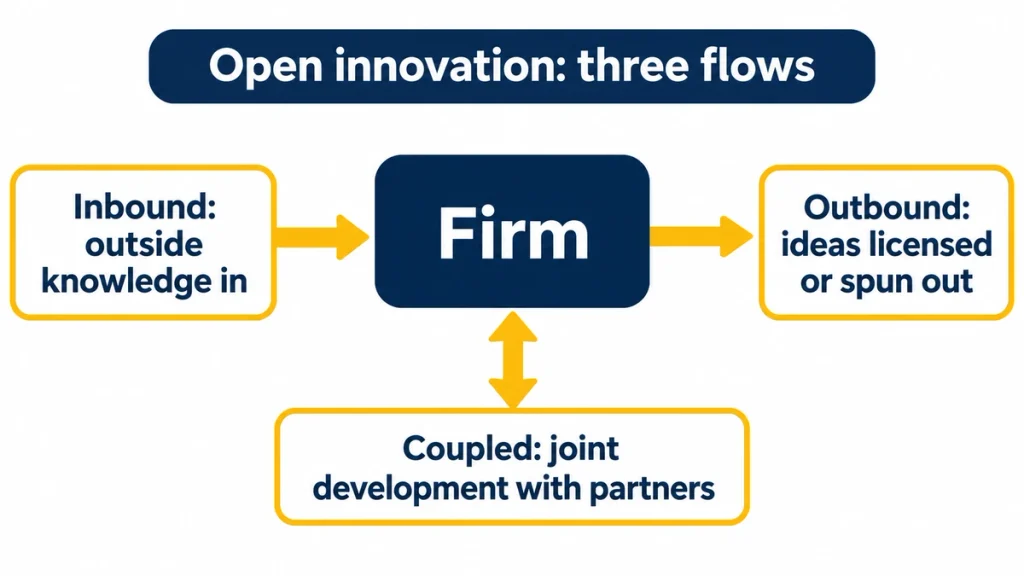
1. Inbound, outbound or coupled? Coding the open innovation practices of ten listed firms against the Chesbrough and Bogers (2014) typology
The 2014 chapter sorts practice into outside-in, inside-out and coupled types. Annual reports and press releases give enough evidence for an undergraduate content analysis. Write coding rules before reading any document, because the usual pitfall is labelling every supplier contract as open innovation.
2. Does R&D intensity build absorptive capacity? A test of Cohen and Levinthal (1990) on the EU 800 firms in the 2025 Scoreboard
Cohen and Levinthal argued that firms use outside knowledge more effectively when they invest in their own R&D. The EU Industrial R&D Investment Scoreboard database is public, so a Master’s regression can pair R&D intensity with backward patent citations as a proxy for knowledge inflow. A PhD version would add an instrument for R&D.
3. Potential versus realised absorptive capacity in UK SMEs: validating a survey scale built on Zahra and George (2002)
The framework separates acquiring and assimilating knowledge from transforming and exploiting it. A Master’s survey needs a realistic sample, so use the sample size calculator early and plan recruitment through trade bodies. Low SME response rates are the main risk.
4. What stays after the associate leaves? Capability change in SMEs that hosted a Knowledge Transfer Partnership
Knowledge Transfer Partnerships link a business, a university and a graduate associate on one project. Compare three partnerships in different sectors through interviews with the firm and the academic supervisor, and focus on routines that survived rather than outputs delivered. Suits Master’s.
5. Do public buyers that state a problem instead of a specification attract more novel bids? Reading Contracts for Innovation briefs against awarded projects
Innovate UK treats Contracts for Innovation as procurement rather than grants. Competition briefs and published funded-project records give a document-based design, so no participants are needed at the start. Define “novel” with a coding scheme before you collect anything.
6. Does early market engagement widen the field? Preliminary engagement notices and SME bids under the competitive flexible procedure of the Procurement Act 2023
The Act applies to procedures started on or after 24 February 2025, and the Find a Tender Service holds the notices as public records. Official guidance documents for the Act explain the procedure. Notice volumes are still accumulating, so state your data cut-off date. Master’s.
7. App stores as innovation infrastructure: what changed for UK developers after the CMA accepted Apple and Google commitments on 1 April 2026?
The CMA gave both firms strategic market status for mobile platforms on 22 October 2025, then accepted commitments on app review, ranking and data use instead of imposing conduct requirements. The CMA cannot directly enforce commitments, so a design built on developers’ expectations and decisions suits better than outcome metrics. Follow the CMA programme of work on mobile platforms because the steering work is still open. Master’s or PhD.
8. Brokering adoption: how do England’s 15 Health Innovation Networks decide which innovations to prioritise?
The networks began as Academic Health Science Networks in 2013 and were relicensed under the new name from 1 October 2023 for five years. NHS England describes the national network, and each network publishes annual impact reviews, so a content analysis can precede interviews. Interviews with NHS staff may need health research approval, so read the ethics approval guide first.
9. Who leads and who joins? Network analysis of UK organisations in Horizon Europe projects since association on 1 January 2024
From 2024 work programme calls, UK organisations can lead consortia on the same terms as other associated countries. CORDIS project data can be downloaded, and centrality measures show whether UK firms act as hubs or peripheral partners. You need basic R or Python. Strong Master’s or PhD.
10. Programme Directors versus peer review: what does ARIA’s opportunity-space model change in how applicants frame risk?
The Advanced Research and Invention Agency was established on 26 January 2023 under its own Act. Programme Directors define opportunity spaces and design programmes, and ARIA publishes how it works. Document analysis of programme theses can be followed by interviews with applicants. Master’s or PhD.
11. Place-based R&D co-design: how are local leaders expected to shape programmes under the £410 million Local Innovation Partnerships Fund?
A research-institute summary of the 2025 Spending Review describes a fund that gives local leaders a central role in co-creating R&D programmes. Confirm the fund’s current design in official guidance before committing, because early schemes change. Policy analysis for Master’s or PhD.
12. Replicating Laursen and Salter (2006): search breadth and depth in UK manufacturers using a newer wave of the UK Innovation Survey
Their study linked the number of external sources a firm uses to its innovative sales. UKIS microdata sit in the ONS Secure Research Service under standard access conditions, so confirm which waves are available and whether you qualify as an accredited researcher. Master’s students can replicate the logic on published tables instead. PhD route for full microdata.
R&D Management and Innovation Strategy Research Topics
These titles suit students who want numbers, strategy frameworks or funding rules rather than front-line fieldwork.
13. Sensing, seizing, transforming: coding dynamic capabilities (Teece, 2007) in the annual-report narratives of ten R&D-intensive listed firms
Teece, Pisano and Shuen’s 1997 paper in the Strategic Management Journal introduced the concept, and Teece’s 2007 article split it into three activities. Build a coding frame, test it on two reports, then apply it. Plain-language route for undergraduates, with the pitfall that narratives describe intent more than practice.
14. Balancing the portfolio of ideas: measuring exploration and exploitation (March, 1991) through the technology classes in firms’ patent portfolios
The EPO offers free access to PATSTAT through its Technology Intelligence Platform, which makes patent-class measures affordable. You will need SQL or Python and a defensible threshold for “new” technology classes. PhD or advanced Master’s.
15. Hybrid agile and stage-gate in manufacturing: who sets the gate criteria, and does the hybrid shorten development time?
Cooper’s Stage-Gate model is the standard reference, and many manufacturers now blend it with agile sprints. Use a multiple-case design with three firms and compare documented gate criteria with what managers describe. Self-reported development time is unreliable, so ask for project records. Master’s.
16. Did the merged R&D scheme change R&D spending? Comparing firms whose accounting periods begin just before and after 1 April 2024
The merged scheme and enhanced R&D intensive support replaced the SME and RDEC schemes for accounting periods beginning on or after that date. A difference-in-differences design with Companies House accounts needs a long enough pre-period and a control group. Master’s or PhD.
17. Do R&D-intensive loss-making SMEs cluster near the intensity cut-off? A feasibility study of claimants under enhanced R&D intensive support
The scheme applies from 1 April 2024, and HMRC guidance sets the intensity threshold. Bunching tests need firm-level accounts, so feasibility depends on how R&D and total costs are disclosed. If the data are thin, switch to interviews with accountants who prepare claims. PhD or ambitious Master’s.
18. Is the 5 per cent rise in R&D tax relief to £8.2 billion real growth? Deflating HMRC’s 2024 to 2025 claims against business R&D spending
HMRC’s September 2026 statistics are the first to include the merged and intensive schemes, and the 2024 to 2025 figures are provisional. Compare them with ONS business R&D data, and note that the 2025 release is provisionally scheduled for 27 November 2026. Undergraduate or Master’s.
19. What does the Smart Grants impact evaluation final report imply for open-call innovation funding?
UKRI notes that Smart Grants were paused in 2025 and points to a final impact evaluation. A document analysis can compare its findings with Innovate UK’s new strategic direction. Programme status changes, so confirm it on the same guidance before you submit.
20. Sector-targeted or open-call? Innovate UK funded-project records before and after the shift towards Industrial Strategy priority sectors
UKRI says Innovate UK’s new direction aligns activity with the government’s priority sectors, and it publishes funded-project data. A before and after comparison of grant totals by sector is feasible. Write sector-coding rules first, because inconsistent coding is the most common reason these studies fail. Master’s.
21. Diminishing returns to R&D: does the productivity payoff weaken at higher intensity in the 2025 Scoreboard sample?
The JRC’s 2024 edition reported continued positive effects of R&D on labour productivity and patenting alongside a global trend of diminishing returns, which gives a testable question. Use firm fixed effects and a quadratic R&D term. Master’s quantitative project.
22. Where do projects stall between laboratory and market? Technology readiness levels and one Catapult centre
Interview project leads at a single Catapult and map where projects lost momentum on the readiness scale. Anonymise firms, because commercial confidentiality will shape what people say. Master’s or PhD.
23. Architectural innovation in electric vehicles: applying Henderson and Clark (1990) to incumbent carmakers’ battery-pack integration decisions
A single-industry case study of publicly documented decisions keeps access manageable. The question is whether incumbents’ architectural knowledge helped or blocked integration. PhD or advanced Master’s.
24. Is it really disruptive? Checking 30 press-labelled disruptors against the tests in Christensen, Raynor and McDonald (2015)
The authors argue that true disruption starts from a low-end or new-market foothold. A content analysis of 30 firms described as disruptors in the press needs only public sources. Good undergraduate topic, provided your sample rule is fixed before you search.
25. Outsourcing R&D to contract research organisations: knowledge leakage against speed in UK biotech SMEs
Interviews with five to eight managers can explore what firms keep in house and why, using transaction-cost reasoning. Agree anonymity in advance, since contracts are commercially sensitive. Master’s.
26. Do firms that capitalise development costs under IAS 38 innovate more, or smooth earnings? An annual-report sample
The accounting treatment of development costs gives a measurable signal in financial statements. Compare capitalising and expensing firms in one sector over five years. Master’s quantitative study that sits between accounting and innovation.
Corporate Venturing, Intrapreneurship and IP Dissertation Topics
27. Where do accelerator cohorts go? Tracking commercial agreements between corporate accelerators and graduating start-ups from public announcements
A content analysis of cohort announcements avoids access problems. Survivorship bias is the main threat, because firms publicise successes. Undergraduate or Master’s.
28. Does corporate venture capital raise investees’ patenting? A matched-sample comparison using deal data and Espacenet records
Check your library’s access to Beauhurst or Crunchbase before you commit. Matching on sector, age and size reduces selection problems but does not remove them, so state that limit. Master’s quantitative.
29. Employee inventions and fairness: how often does section 40 of the Patents Act 1977 deliver compensation, and what did Kelly v GE Healthcare show about the “outstanding benefit” test?
A doctrinal study with case analysis fits students on law and management hybrids. Read the current statute text on legislation.gov.uk before quoting it. Master’s or PhD.
30. Not invented here: resistance to acquired technology in the first year after a start-up acquisition
Katz and Allen (1982) introduced the syndrome. Interviews with engineers from acquired teams need careful consent and anonymity. Master’s or PhD.
31. Staff-led innovation in the NHS: how do middle managers decide which front-line ideas get time and money?
Greenhalgh and colleagues (2004) offer a framework for diffusion in service organisations. Case studies in two trusts allow comparison. Health research approval may apply to staff interviews. Master’s.
32. Why do corporate innovation labs close? Interview-based study of closure decisions and the knowledge that survives
Recruit former lab members through professional networks. The research question should ask what the organisation kept, not only why the lab ended. Undergraduate or Master’s.
Design Thinking, User Innovation and New Product Development Topics
33. Problem framing in practice: does using the Design Council’s Double Diamond change what teams treat as the problem?
Observe two teams, one using the model and one not, and compare their written problem statements. Observer effect is the risk, so record how teams behave when you are absent from sessions. Master’s.
34. Experience-based co-design in NHS services: which patient contributions change redesign decisions, and which are filtered out?
Bate and Robert’s approach is widely cited in health services research. Document analysis of redesign reports plus interviews would show where contributions drop out. Needs health research approval for patient contact. Master’s.
35. Open-source insulin pumps: what can regulators learn from user-built automated insulin delivery systems such as OpenAPS?
Von Hippel’s lead-user theory explains why users innovate before firms do. A netnography of public community forums keeps risk low, but health data are sensitive, so anonymise quotes. Master’s or PhD.
36. Kano’s model for feature prioritisation: do software customers’ “delighters” become “must-haves” within two years?
Survey two customer cohorts about the same features and compare their category placement. Plain-language design that suits undergraduates, with a sample rule fixed in advance.
37. Servitisation in practice: reading Rolls-Royce’s TotalCare “power by the hour” model through annual reports and what it implies for R&D organisation
A single documented case allows depth without access. Triangulate annual reports with interviews published in trade press, and check every case fact against a primary document. Master’s.
38. Business model innovation in grocery delivery: comparing incumbents and entrants with Osterwalder and Pigneur’s canvas
Map two incumbents and two entrants from public sources. Argue from differences in value proposition and revenue streams, not from marketing claims. Undergraduate-friendly.
39. Co-creation in public services: do citizen panels shift budget decisions or only legitimise them?
Choose one council programme and compare panel recommendations with final decisions. Access to minutes is usually public. Master’s.
40. Frugal and reverse innovation: tracing GE Healthcare’s handheld ECG from India to wider markets with Govindarajan and Trimble’s reverse innovation framework
Secondary sources dominate, so verify each fact against company or peer-reviewed documents. Master’s.
41. Idea evaluation bias: do managers rate ideas from senior colleagues higher than identical ideas from juniors?
A vignette experiment holds the idea constant and varies the author’s seniority. It needs ethics approval and a sample size estimate. Undergraduate or Master’s.
AI, Digital and Platform Innovation Management Topics
Evidence in this area ages fast, so separate peer-reviewed findings from commentary and preprints before you build a literature review.
42. Replicating Boussioux et al. (2024) at small scale: human crowd versus human-AI solutions rated for novelty and strategic viability
The original Organization Science study used 125 solvers, 300 evaluators and 234 solutions. Human solutions were more novel, while human-AI solutions scored higher on viability and on financial and environmental value. Scale the design down and keep the rating rubric identical. Master’s.
43. Does generative AI narrow the idea space? Measuring semantic diversity of idea sets produced with and without AI
An earlier working-paper version of the study above reported greater semantic diversity in human solutions, which suggests a measurable outcome. Embedding-based diversity measures need Python. Master’s or PhD.
44. Which AI-and-innovation evidence can be trusted? A critical review after MIT disowned a 2024 preprint on AI and materials discovery
MIT asked for the paper to be withdrawn on 16 May 2025 after finding no confidence in its data. A scoping review that grades sources by peer-review status and data provenance is a strong methods exercise. Do not cite the withdrawn figures. Master’s or PhD.
45. General-purpose AI obligations under the EU AI Act, applicable since 2 August 2025: how have European AI start-ups changed their product roadmaps?
Interviews with founders or product leads can trace which roadmap items moved. The Act’s risk-based structure remains intact after later amendments. Master’s.
46. A 16-month delay for high-risk AI: does the move to 2 December 2027 for Annex III systems change when HR-technology and credit-scoring firms invest in compliance versus product development?
Regulation (EU) 2026/1744 postponed the dates and entered into force on 27 July 2026. Because the position is recent, state your data cut-off clearly and compare firm statements before and after the change. Master’s or PhD.
47. Sandboxes as innovation policy: comparing AI regulatory sandboxes under the AI Act with the FCA Regulatory Sandbox
A document analysis compares eligibility, supervision and exit rules. National AI sandbox timetables have shifted, so check current dates. Master’s or PhD.
48. Does a cross-regulator body speed approvals? Evaluating the Regulatory Innovation Office’s four initial focus areas
The office launched on 8 October 2024 inside DSIT, with initial focus on engineering biology, space, AI and digital in healthcare, and connected and autonomous technology. The launch announcement sets out its remit. Avoid strong causal claims this early. Master’s.
49. Why do firms hesitate to adopt? Secondary analysis of the DSIT innovation diffusion and adoption survey, where regulation (19%), data privacy or security (17%) and integration (16%) lead the barriers
The DSIT survey covers 20 technologies and 4,595 businesses. Large firms report 80% adoption against 48% for micro businesses, so a size-band analysis is a natural extension. Undergraduate or Master’s.
50. Selling innovation to others: why do only 24 per cent of UK businesses diffuse technologies, and what separates information and communication firms at 31 per cent?
The same survey lists employee skills (47%), demand (46%) and scalability and proven benefits (43% each) as enablers. Interview ten diffusing firms to test which enabler matters most for them. Master’s.
51. Regional adoption gaps: what explains the North East (66%) and London (65%) leading and Northern Ireland (42%) trailing in technology adoption?
Small regional samples limit inference, so combine the published annex with a shift-share check on sector mix. Add interviews with regional innovation advisers to interpret what the numbers cannot. Master’s.
52. AI note-taking tools in NHS trusts: applying Greenhalgh et al.’s determinants of diffusion to adoption decisions
Check NHS England’s current guidance on ambient voice technology before collecting data, because requirements are changing. Two case sites with different outcomes give a comparison. Master’s.
53. Digital twin governance: who owns the model and its data in UK infrastructure projects? A reading of the Gemini Principles
The Centre for Digital Built Britain published the principles in 2018. Document analysis of project procurement material plus interviews with asset owners can test whether projects follow them. Master’s or PhD.
54. Citizen development with low-code platforms: how do IT departments govern innovation that starts outside IT?
A multiple-case study of three organisations can map approval rules, security checks and shadow-IT risk. Interviews need clear confidentiality terms. Master’s.
Sustainable and Responsible Innovation Dissertation Topics
55. Do firms actually use AREA? Anticipate, Reflect, Engage and Act in industry-linked EPSRC-funded projects
UKRI describes the AREA framework as the EPSRC approach to responsible innovation. Compare the four steps in project documents with what partners say in interviews. Master’s or PhD.
56. Carbon border pricing as an innovation signal: are non-EU steel and aluminium exporters measuring emissions and changing processes before CBAM certificate sales open on 1 February 2027?
The definitive CBAM period began on 1 January 2026, and the first annual declaration for 2026 imports is reported as due by 30 September 2027. Interviews with exporters in several countries give an international angle. Dates and scope have changed before, so verify them. Master’s or PhD.
57. Is it greener and does it pay? Testing the Porter hypothesis with Eurostat’s environmental innovation indicators across EU countries
Eurostat’s CIS 2022 key indicators report innovations with significant environmental benefits for 2020 to 2022. Pair country-level indicators with productivity data and state the limits of aggregation. Master’s quantitative.
58. Mission-oriented policy in practice: reading the £500 million R&D Missions Accelerator Programme against Mazzucato’s mission framework
A research-institute summary of the 2025 Spending Review says it aims to leverage £1.5 billion of private investment. Confirm programme details in official documents, because the scheme is early-stage. Policy analysis for Master’s or PhD.
59. What stops remanufacturing from scaling in UK consumer electronics?
Interview refurbishers, retailers and a recycler to map barriers across the chain. Keep company names confidential. Master’s.
60. Product-as-a-service: do customers value access over ownership? A conjoint survey of household appliances
Conjoint designs estimate trade-offs between price, ownership and repair guarantees. Use the statistical test selector to plan your analysis. Undergraduate or Master’s.
61. Greenwashing risk in innovation announcements: do firms that announce “breakthrough” sustainable products later publish supporting evidence?
A content audit of 40 press releases with a follow-up search for published evidence needs only public sources. Define “supporting evidence” before you start. Undergraduate.
62. What counts as frugal? Developing indicators that separate frugal innovations from merely low-cost products
A conceptual and Delphi-style study suits students comfortable with theory. Recruit eight to ten experts and report agreement rules. PhD or advanced Master’s.
Innovation Culture, Leadership and Team Topics
63. Hybrid working and innovation contributions: a field design inspired by Bloom et al. (Nature, 2024)
The Trip.com trial of more than 1,600 employees found no performance penalty and lower resignations, and its reviews included contributions to innovation. Your question is narrower: does innovation contribution differ by office days? You need access to an R&D unit, so a survey version is the fallback. Master’s or PhD.
64. Virtual versus in-person idea generation: a classroom replication of Brucks and Levav (Nature, 2022)
The original study compared idea generation by video and in person. A small experiment with your own course cohort needs ethics approval and a sample size estimate. Undergraduate-friendly.
65. Psychological safety and idea submission: validating Edmondson’s (1999) team scale in innovation teams of UK public bodies
The scale is short and widely used. A survey of two or three bodies, plus a comparison with suggestion-scheme data, would test whether safety predicts submissions. Master’s.
66. Opening and closing behaviours: testing ambidextrous leadership (Rosing, Frese and Bausch, 2011) with vignette experiments
Vignettes let you manipulate leader behaviour without needing a live team. Pilot them first to check realism. Master’s.
67. Innovation champions: how do informal champions gain resources without formal authority? Applying Howell and Higgins (1990)
Interview six champions and their line managers to compare accounts. Choose one organisation to control for context. Master’s.
68. After the failed pilot: do structured reviews change later risk-taking in local government innovation teams?
Edmondson’s idea of intelligent failure frames the study. Compare teams that run structured reviews with those that do not. Interview data should be anonymised, because failure talk is sensitive. Master’s.
69. Measuring innovation climate: comparing the reliability of two published scales in one sample of 150 employees
A simple psychometric study that reports Cronbach’s alpha and factor structure for both scales. Report fit statistics for both and discuss which scale suits your sector. Master’s.
70. Remote onboarding of R&D staff and tacit knowledge transfer: what do new joiners say they could not learn from documents?
Interview new starters and their mentors in two organisations that onboarded remotely. Tacit knowledge claims need examples, not opinions. Master’s.
71. Knowledge hiding in R&D teams: what triggers it, and what do managers do about it?
A survey with a validated scale plus a handful of interviews gives mixed evidence. Sensitive topic, so offer participants an exit at any point. Master’s or PhD.
Innovation Measurement, Standards and Performance Topics
72. Why certify? Motives of early adopters of ISO 56001
ISO 56001:2024 sets requirements for an innovation management system and was published in September 2024. Interview certification bodies and adopting firms about motives and perceived value. Your library may hold the standard, so check before buying. Master’s.
73. Gap analysis against ISO 56002:2019 guidance in one organisation
The standard gives guidance rather than requirements, and a revision is in development after a committee draft was referred back to the working group on 27 July 2026. State which edition you used. Case study for undergraduate or Master’s.
74. What do firms actually measure? Mapping reported innovation indicators against ISO 56008:2024 on innovation operation measurements
Annual and sustainability reports provide the indicators. Build the mapping table first. Master’s.
75. Definitions drive results: why the UK Innovation Survey (36% innovation active for 2020 to 2022, 34% for 2022 to 2024) and Eurostat’s CIS (51.4% for 2020 to 2022) are not directly comparable
UKIS 2025 reports 34%, and both surveys follow the OECD Oslo Manual 2018 definition. Design, coverage and statistical unit differ, so a methods comparison is the core of the project. Master’s.
76. Regional gaps in innovation activity: a shift-share analysis of UKIS 2023 rates (England 37%, Scotland 32%, Northern Ireland 32%, Wales 31%) by sector mix
The UKIS 2023 report gives the headline rates. Test whether sector mix explains the gaps. Undergraduate or Master’s.
77. Is the innovator growth premium causal? A critical reading of Innovate UK’s State of Innovation 2025
The report finds innovating firms achieve far greater average sales growth than non-innovators. Discuss selection and reverse causality, and say what additional data could separate them. Master’s.
78. Testing the innovation-productivity chain with the CDM model (Crépon, Duguet and Mairesse, 1998)
The model links R&D to innovation output and then to productivity. Eurostat microdata access is restricted, so published aggregates or secure-centre access decide feasibility. PhD.
79. How comparable are patent quality indicators across offices? PATSTAT forward citations against PatentsView
PatentsView moved to the USPTO Open Data Portal on 20 March 2026, so check the new access routes. Compare citation lags and coverage. PhD.
80. What moved Malta into the “strong innovators” group? Indicator-level decomposition of the European Innovation Scoreboard 2026
The 2026 edition uses 32 indicators, and the annex tables give values by country. Compare Malta’s changes with the group threshold. Undergraduate or Master’s.
81. Inputs versus outputs: why did the UK rank 10th for innovation inputs but 4th for outputs in the Global Innovation Index 2025, and does the 2026 edition change the pattern?
WIPO’s UK profile for 2025 gives the ranks, and the 2026 edition appeared on 29 September 2026. Compare indicator-level movements between editions. Master’s.
82. Corporate R&D disclosure: how closely do firms’ reported R&D figures match their Scoreboard entries?
The Scoreboard database draws on audited accounts. A matching exercise on 50 firms would reveal definitional gaps. Undergraduate or Master’s.
Innovation Policy, Funding and Public-Sector Innovation Topics
83. Spending logic: reading DSIT’s R&D plans to 2029 to 2030 against its three stated priorities
DSIT’s published plans set out £58.5 billion across protecting curiosity-driven science, supporting strategic priorities and scaling UK companies. A content analysis can test how much of the money matches each priority. Master’s.
84. Demand-side policy: what problems would a European Innovation Act need to solve? A gap analysis using EIS 2026 commercialisation weaknesses
The Commission links the scoreboard to the planned act, and the 2026 results highlight uneven commercialisation of research. The act is a proposal, so treat any text as provisional. Master’s or PhD.
85. Scotland’s innovation scorecard: why were only 32.4% of businesses innovation active in 2020 to 2022, ranking 10th of 12 UK regions?
The Scottish Government scorecard reports the figure and ranking. Combine the scorecard with interviews with business support bodies. Master’s.
86. Public R&D and private crowd-in: testing the claim that each £1 of public R&D leverages a further £2 of private R&D
DSIT has cited research by Oxford Economics for this claim. A critical evaluation can examine the identification strategy and replicate part of it with UK sector data. PhD or advanced Master’s.
87. Innovation loans or grants? Which firms choose debt-based support when open grants are unavailable
Innovate UK’s innovation loans are debt rather than grants, and Smart Grants have been paused since 2025. Interview ten firms and compare their reasoning. Check which routes are open before collecting data. Master’s.
88. Counting impact: how consistently do the 15 Health Innovation Networks measure patients benefited and companies supported?
Networks report impact in annual reviews. A comparison table of definitions and denominators would show where numbers are not comparable. Document analysis for Master’s.
89. Learning from the leaders: which policy features recur in Sweden, Denmark and the Netherlands, the three EU innovation leaders in EIS 2026?
A comparative case study draws on national strategy documents and Scoreboard indicators. Specify comparison criteria in advance. Master’s or PhD.
90. Does a cross-government demand signal help? The role of the Modern Industrial Strategy’s growth-driving sectors in technology adoption
The DSIT adoption survey was commissioned to inform the Strategy. Compare sector adoption rates with the sectors named in policy. Master’s.
Sector, SME and Emerging-Market Innovation Topics
91. Investor partnerships in Innovate UK’s Battery Innovation Programme: how does co-investment change which start-ups get funded?
The competition pairs grants with private investors, so compare funded and unfunded applicants. Interviews with applicants add reasoning. Check that the programme is still running before you commit. Master’s.
92. Do exporting SMEs adopt advanced technologies faster? Re-examining findings from the Enterprise Research Centre’s 2025 study with different data
Use the DSIT adoption survey annex or your own survey to test exporting status against adoption. Master’s.
93. Socioemotional wealth and R&D spending in family firms: testing Gómez-Mejía et al. (2007) on a UK sample
Use Companies House accounts and ownership data to separate family and non-family firms. Control for age, size and sector. Master’s.
94. Why did mobile money scale in Kenya? Diffusion theory and Jack and Suri (2014)
Combine Rogers’s diffusion framework with evidence on agent networks and trust. A secondary-source dissertation can still be rigorous if it compares at least two countries. Master’s.
95. Modern methods of construction: what stops SME contractors from adopting off-site manufacturing?
Interview eight contractors on cost, skills and client demand. Pair with a short survey if you can. Master’s.
96. Franchising and innovation diffusion: how do franchisors spread product innovations from pilot outlets to the network?
Case study of one franchisor with interviews at head office and two outlets. Master’s.
97. University technology transfer offices: do staffing levels explain licensing outcomes?
HESA’s Higher Education Business and Community Interaction survey provides institution-level data. Regression with controls for research income. Master’s.
98. Legal technology adoption in mid-sized law firms: who decides, and on what evidence?
Interview partners and operations managers at four firms. Anonymise strictly. Master’s.
99. Social enterprise innovation: do social enterprises innovate differently from commercial SMEs?
A mixed design compares reported innovation types and funding sources. Use matched samples. Master’s.
100. Innovation barriers in manufacturing SMEs in emerging economies using the World Bank Enterprise Surveys
The surveys include questions on innovation and technology. Select two countries and compare firm-level barriers. Master’s or PhD.
101. Public digital infrastructure as an innovation platform: comparing national instant-payment systems
Choose two systems and compare design choices, governance and third-party innovation they enabled. Use official central bank documents. Master’s or PhD.
Worked Examples: Research Aims and Objectives for Innovation Management Dissertations
Four examples show how a topic becomes a researchable plan. Each aim is specific, and each objective names an action or output.
Example 1: R&D tax relief reform and business R&D spending
Aim: to estimate whether the merged R&D scheme changed R&D expenditure among UK companies whose accounting periods began after 1 April 2024.
- To extract R&D expenditure for treated and comparison firms from published accounts for the three years before and one year after reform.
- To estimate a difference-in-differences model with firm and year effects, and test the parallel-trends assumption.
- To compare the estimate with HMRC’s September 2026 statistics and discuss whether the two sources agree.
Example 2: Technology adoption barriers in the DSIT survey
Aim: to explain why regulation, data privacy and integration rank as the top barriers to technology adoption across firm sizes.
- To extract barrier rates by size band and sector from the published statistical annex.
- To test whether barrier ranking differs between micro and large firms using a chi-square test.
- To interview eight regional innovation advisers to interpret the gap between large and micro firms.
Example 3: Health Innovation Networks and adoption priorities
Aim: to compare how three Health Innovation Networks decide which innovations to prioritise for adoption.
- To code the priorities listed in each network’s 2023 to 2024 annual impact review.
- To interview two programme leads per network about selection criteria.
- To compare stated criteria with reported programmes and identify mismatches.
Example 4: Generative AI and idea quality
Aim: to assess whether human-AI solutions to a sustainability challenge are rated higher on viability than solutions from human students alone.
- To run a challenge with 40 student participants and generate matched AI-assisted solutions.
- To recruit 60 raters who score each solution for novelty and viability using a fixed rubric.
- To compare mean ratings with an appropriate test and report effect sizes.
Which Methods Suit an Innovation Management Dissertation?
Match the method to the question first and the data second. The methodology guide and the guide to primary and secondary research help you decide.
| Method | Fits questions about | Typical data route | Watch out for |
|---|---|---|---|
| Case study with interviews | How decisions are made inside firms | Managers, project records | Access and confidentiality |
| Survey with validated scales | Capabilities, culture, climate | Online survey of firms or teams | Low SME response rates |
| Secondary analysis of official statistics | Adoption, innovation activity by region or size | UKIS, DSIT survey, Eurostat CIS | Definitions and sample sizes |
| Patent and R&D data analysis | Technological change, R&D returns | Espacenet, PATSTAT, Scoreboard | Skills and database access |
| Experiments and vignettes | Judgement, bias, idea quality | Student or panel participants | Ethics and sample size |
| Document and policy analysis | Programmes, standards, regulation | Official publications | Moving targets |
| Systematic or scoping review | Contested evidence | Journal databases | Search and grading rules |
Innovation Data Sources for Your Dissertation
Use the source that matches your unit of analysis, and record the release date you used.
- UK business innovation: UKIS 2025 covers 2022 to 2024 and reports 34% of businesses as innovation active. Full microdata need secure access.
- Technology adoption and diffusion: the innovation diffusion and adoption survey from DSIT published in September 2025 has 4,595 responses across 20 technologies.
- Business R&D: ONS BERD for 2024 was released on 28 November 2025, with the 2025 edition provisionally scheduled for 27 November 2026.
- Tax relief: HMRC’s September 2026 R&D statistics show £8.2 billion claimed for 2024 to 2025 on a provisional basis.
- Europe: Eurostat’s CIS 2022 reports 51.4% of EU enterprises innovation active for 2020 to 2022. The 2025 Scoreboard reports company R&D.
- Country rankings: GII 2026 ranks 139 economies on 79 indicators.
- Patents: Espacenet and Lens.org for search, the EPO platform for PATSTAT for analysis, and USPTO’s Open Data Portal for PatentsView data.
- Standards: ISO 56001 and the ISO 56000 family for management-system concepts.
Choosing Innovation Management Topics by Level
Undergraduate projects work best with public data and a single case or one survey. Keep one framework and avoid multi-country designs.
Master’s projects should apply a framework rigorously in a fresh setting. Interviews with eight to fifteen managers, or a modest survey with a defensible sample, fit most timelines.
PhD projects need a contribution, usually a modified framework or a new measure. Lock access to firms or secure data before you submit the proposal, and plan for slow approvals.
Common Mistakes in Innovation Management Dissertations
- Treating any change as innovation instead of using the Oslo Manual definition of a new or improved product or process that has been introduced.
- Calling a topic open innovation when the evidence shows ordinary buying and selling.
- Citing a preprint or press release as if it were peer-reviewed evidence.
- Choosing a firm-level question without any way to reach the firm.
- Building on a policy or standard without checking its current status.
How to Narrow an Innovation Management Idea Into a Proposal
Start with one stage of the innovation process, one setting and one data source. Use the topic finder to test alternatives, then turn the best candidate into a question with the research question generator. The guide to aims, objectives and research questions shows how to link them. Plan your schedule with the timeline planner and read the general advice on choosing a topic before you decide. If you want a topic matched to your own sector and level, the custom topics service can help.
Innovation Management Dissertation Topics: Frequently Asked Questions
Can I do an innovation management dissertation without access to a company?
Yes. Official statistics, funded-project records, patent databases, annual reports and public policy documents all support strong projects. Many of the titles above use only public data.
Can I use a policy that is still changing as my topic?
Yes, if you fix a cut-off date and say so in the methodology. Use official sources, and note in the discussion what could change.
Which definition of innovation should I use?
Most official surveys follow the Oslo Manual 2018 definition of a new or improved product or business process that differs significantly from earlier ones and has been introduced. State your definition in the first chapter and use it consistently.
Do I need patent data to measure innovation?
No. Patents capture only some inventions, and many firms protect ideas through secrecy or speed. Use patents when your question is about technology or invention, and use surveys or interviews when your question is about practice.
Is it safe to cite a recent working paper?
Treat working papers and preprints as provisional. Prefer peer-reviewed versions when they exist, and check for retractions or institutional statements before you rely on a result.
Turning an Innovation Management Topic Into a Proposal
Once you have a short list, ask your supervisor which one fits the module. If you need help structuring the proposal, research proposal support is available, and management dissertation help covers wider planning. Work submitted for assessment must follow your institution’s policy.