
Cultural and Heritage Tourism Dissertation Topics: Researchable Ideas from World Heritage Sites to Living Traditions

Cultural and heritage tourism dissertation topics work best when they start from one place, one practice or one policy and ask a question you can answer with evidence you can actually reach. The list below moves from World Heritage management to living traditions, community-run tourism, funding and digital interpretation, and every topic names the site, instrument or dataset it depends on.
Here, cultural heritage tourism means visits to heritage places and living traditions, in the broad sense used by the ICOMOS charter on cultural heritage tourism. Sites of atrocity and disaster have their own list of dark tourism dissertation topics, so they appear here only where heritage management is the real question.
Questions to Settle Before You Choose Your Heritage Tourism Dissertation Topic
- Am I studying a place, a practice or a policy, and which of the three can I reach with data this year?
- Which problem will my case address: overcrowding, authenticity, funding, community control or interpretation?
- Do I have a route to evidence, such as visitor counts, a management plan, committee decisions or people I can interview?
- How do I shrink a famous site into a question my supervisor will see as focused?
- Which framework fits my question: authenticity, the authorised heritage discourse, heritage communities or carrying capacity?
- What ethics approval will my university expect if I involve visitors, residents or Indigenous communities?
Position correct as of November 2026. Several topics below rest on developments that are still moving: the Stonehenge A303 scheme, Venice’s fee proposals, the UK Inventory of Living Heritage and Pakistan’s Tentative List additions. Check the official source named in each topic before you commit, and note the date you checked. Ethics, referencing and marking rules also differ between universities and countries, so confirm yours with your supervisor.
World Heritage Site Management and Overtourism: Cultural and Heritage Tourism Dissertation Topics
1. Whether the UNESCO Visitor Management Assessment and Strategy Tool, a voluntary self-assessment built around four goals, can capture visitor pressure across the six component areas of the Slate Landscape of Northwest Wales The Slate Landscape became a World Heritage Site in 2021 under criteria (ii) and (iv), and the Committee’s decision asked for the tourism strategy and visitor management plan to be completed. Compare what the tool’s indicators would show with the site’s own annual reports. Because the tool is voluntary and self-reported, you will need an outside measure such as car park or trail counts. Suits Master’s level.
2. To what extent did planning approval for the Everton stadium at Bramley-Moore Dock and the wider Liverpool Waters scheme conflict with the attributes recorded when the Committee deleted Liverpool Maritime Mercantile City from the World Heritage List in 2021? Liverpool was inscribed in 2004, placed on the in-danger list in 2012 and deleted on 21 July 2021. UNESCO’s state of conservation pages and the Committee decision let you test each claim against primary documents. Add a tourism angle by asking how visitor numbers or branding changed afterwards, but guard against hindsight bias. Suits PhD or strong Master’s work.
3. What does the A303 Stonehenge sequence (consent granted in 2020, quashed by the High Court in 2021, granted again in 2023, scheme cancelled in July 2024, order revoked on 17 March 2026) show about how decision-makers weigh World Heritage setting against road capacity? Frame this as a decision-making study, not a campaign piece. Court judgments, ministerial statements and English Heritage’s published position give you primary evidence. Position correct as of November 2026, so confirm that nothing new has been announced before you submit. If you lean towards the field-science side, our archaeology dissertation topics page pairs well with this one.
4. How far has Venice’s day-tripper access fee (introduced in 2024 and charged on 60 days between 3 April and 26 July in 2026, at €5 if booked four days ahead and €10 later) changed when and where day visitors arrive? Reports from the 2026 season say more than €5 million was collected from over 650,000 paying visitors, while earlier coverage suggested the first year did not reduce peak crowds. The city is also reported to be considering a fee of up to €30 from 2027, which is a proposal rather than a decision. Compare registration data with a short visitor survey, and look for displacement to days when no fee applies.
5. Whether Dubrovnik’s Respect the City scheme, launched in 2017 to hold cruise-related crowding in the Old Town to 4,000 people at once, has stayed inside the 8,000-person ceiling UNESCO recommended The city has used cameras and counters to track visitors, so ask the municipality what data it can release. Then compare cruise arrival schedules with queue times at the walls. If you cannot get counts, switch to a document analysis of the scheme’s rules and a short resident survey. Suits Master’s level.
6. Comparing a visitor cap (Dubrovnik) with a price instrument (Venice) as overtourism tools: which one produces better evidence for evaluating success? This is a framework question, not a case description. Define three or four evaluation criteria first, such as crowd reduction, resident benefit, equity of access and cost of enforcement. Then score each scheme using published documents and say plainly where the data run out. Suits PhD or advanced Master’s level.
7. What does the record 530,987 Compostelas issued by the Pilgrim’s Office in 2025 imply for carrying capacity on the final 100 kilometres of the Camino? The Compostela requires walking at least 100 km, and Sarria was the most common starting point in 2025, with about 162,000 pilgrims. Monthly Pilgrim’s Office statistics, trail counters and hostel capacity figures give you a quantitative route, while interviews with hostel operators add the human side. The same design works for other long-distance routes, so adapt it to a trail in your own country.
8. How did monsoon flooding in 2022 affect conservation priorities and visitor access at Moenjodaro and the Makli monuments, given UNESCO’s stated concern and recovery funding? UNESCO said it was deeply concerned about flood damage to cultural heritage in Pakistan and announced funds for recovery at both Sindh properties. Site management documents, interviews with provincial heritage officers and visitor figures before and after the floods would form a solid case study. Treat damage estimates cautiously, because early figures often change.
9. What should a tourism management plan contain for the 12 sites added to Pakistan’s Tentative List in August 2026, and how ready are the forts at Kot Diji, Naukot and Umerkot? Tentative List entry is only the first step towards nomination, so a readiness assessment is a realistic Master’s project. Use UNESCO’s requirements for protection and management as your checklist, then audit each fort’s access, interpretation and community role. Press reports describe the additions, so confirm the official list on UNESCO’s site before you write.
10. Which cross-border tourism products link Hadrian’s Wall, part of the transnational Frontiers of the Roman Empire property, with the Antonine Wall inscribed in 2008, and who governs them? Compare how each frontier section is marketed, managed and interpreted. A product audit plus stakeholder interviews will show whether visitors meet one story or several. The risk is describing rather than analysing, so decide early which governance concept you will apply.
11. What does the 2024 inscription of the Moravian Church Settlements, including Gracehill in Northern Ireland, mean for visitor demand and interpretation at a small serial property? Newly inscribed properties rarely have long visitor series, so plan a baseline study now and accept that you may capture only the early stage. Interviews with site managers, local businesses and congregations are the main route. This is a good undergraduate topic because the scope is small.
12. Using UNESCO’s guide on managing visitor behaviour, which visitor-flow measures can a small heritage site realistically collect before it designs a visitor management plan? The guide’s starting point is simple: measure the main variables first and identify the seasonal peaks. For an undergraduate project, pick one site, count visitors by hour over several days and map where crowding builds up. Then suggest two low-cost fixes and explain which data you would still need. For wider impacts, see our sustainable tourism research topics.
13. How do tourism pressures and hill-farming economics interact in the English Lake District, inscribed in 2017 under criteria (ii), (v) and (vi), where the inscription lists development pressures from tourism among the risks? The joint World Heritage Site and National Park management plan is your main policy source. Pair it with farm business data and visitor surveys to test whether tourism income supports or crowds out traditional farming. Keep your claims proportionate, because the evidence on causes is mixed.
14. How did the Honister zip wire proposal and off-road vehicle use on unsealed roads test the Lake District’s ability to reconcile recreation with World Heritage values? UNESCO and ICOMOS technical reviews in 2019 commented on both issues, and the UK later reported on them. A document analysis of those reviews and the National Park Authority’s position statement on unsealed roads shows how the reconciliation was argued. Adventure activity has its own list of adventure tourism topics, so keep your focus on heritage values.
15. To what extent do Angkor Enterprise’s monthly ticket statements, which show international ticket sales for January to August 2026 down 29 per cent on the same period of 2025, support or weaken a case for changing Angkor Pass pricing? Angkor drew about 1.02 million international visitors and US$47.8 million in ticket revenue in 2024, and revenue fell to US$44.7 million in 2025. Between January and August 2026, 474,993 tickets were sold, and a Cambodian official linked the fall to a slow recovery worsened by a border conflict. A time-series analysis with revenue per visitor as your outcome suits Master’s economics or tourism management.
16. Which climate-change risks do the management plans for the Lake District and the Slate Landscape identify for visitor use, and how do the two plans compare? The Lake District inscription already lists long-term climate change among its risks. Code each plan for named risks, responses and responsible bodies, then compare. Because plans are updated, record the version and date you used.
17. Do ‘remote access’ visitor centres, where visitors are received at a distance from the monument, reduce pressure on fragile sites, as UNESCO’s toolkit suggests? The toolkit notes that some sites use visitor centres at an appropriate distance or even further away. Choose one site that has done this and compare visitor flows, dwell time and satisfaction at the centre and at the monument. Interviews with managers will explain why the model was chosen.
18. Which entries on the Heritage at Risk Register lie within World Heritage Sites or their buffer zones, 162 in 2024, and what does this mean for visitor management? A parliamentary answer noted that none of the register entries is itself a World Heritage Site, but 162 lie within one or its buffer zone. Map a sample of entries against visitor routes and ask whether tourism is a risk, a rescue funder or neither. Position correct as of November 2026, so check whether a newer count exists.
Heritage Interpretation, Museums and Visitor Experience Research Topics
19. How far do visitors to independent museums recognise the diversity, sustainability and ethical-practice commitments in the museum definition ICOM adopted in Prague on 24 August 2022? Run a short exit survey that asks visitors what they think a museum is for, then compare their answers with the definition’s themes. A pilot with about 30 responses will show whether your wording works before the main round. Check your university’s rules on collecting data in public venues.
20. Applying Laurajane Smith’s authorised heritage discourse to interpretation panels at English country houses: whose story is treated as the default? Smith argued in Uses of Heritage (2006) that official heritage practice favours expert judgement, grand scale and national narratives, and her book includes a country-house case study. Code panels and guidebooks for those features, then interview visitors about what they noticed. A PhD can extend the design into comparison across countries.
21. How have visitors and members responded to colonial-history interpretation at National Trust places named among the 93 properties in the trust’s 2020 interim report? The interim report linked 93 places to colonialism and historic slavery, and public reaction became politically heated. That makes neutral design essential: use semi-structured interviews, state your own position, and avoid treating press commentary as visitor opinion. Ethics approval will matter. Our guide to semi-structured interviews covers the practical steps.
22. Under the Nara Document on Authenticity, which says judgements of authenticity cannot rest on fixed criteria across cultures, how should visitor judgements of a rebuilt heritage attraction be interpreted? The 1994 document was drafted by 45 participants at the Nara Conference. Choose one rebuilt site and compare expert, resident and visitor views of what counts as authentic. The common mistake is to treat visitor approval as proof of authenticity, so keep the two ideas separate. Suits Master’s level.
23. Revisiting MacCannell’s staged authenticity and Cohen’s work on commodification at a working craft village: do visitors mind whether a performance is staged? Both ideas sit at the centre of tourism authenticity research, which an Annals of Tourism Research review traced across more than four decades. A short survey with an authenticity scale, plus a few interviews with artisans, is enough at undergraduate level. Explain how you will handle visitors who do not speak the host language.
24. What do the VisitEngland attraction tables behind Heritage Counts show about why seven of England’s ten most popular paid attractions in 2023 were heritage sites, and which admission models explain the pattern? Historic England reports that seven of the ten most popular paid attractions in 2023 were heritage attractions, up from six in 2022. The annual Visitor Attraction Trends reports prepared for Historic England let you compare site types and access by public transport. Because the data are secondary, you may not need participant ethics approval, but check your own rules.
25. Do the site categories used in the Visitor Attraction Trends in England reports (castle or fort, garden, historic house, monument or archaeological site, heritage or visitor centre, and place of worship) show different recovery patterns after 2020? The 2020 edition included a section on responses to the pandemic, which gives you a natural comparison point. Pick two or three categories, extract the tables for 2019 to 2023 and test whether recovery differs. Be explicit about the survey’s sampling limits.
26. Does the 2010 finding that about 32p of each £1 spent on a heritage visit is spent on site still hold at one local attraction? The National Lottery Heritage Fund’s 2010 analysis reported 32p spent on site and 68p in local businesses such as restaurants, cafés, hotels and shops. It was based on a sample of 62 projects, so treat it as a prompt rather than a benchmark. Replicate the idea with an exit survey and a spend diary at one attraction.
27. How does bilingual Welsh and English interpretation at Slate Landscape sites shape visitors’ understanding of the property’s Outstanding Universal Value under criteria (ii) and (iv)? Welsh is part of the property’s living culture, and interpretation choices decide whether visitors meet it. Compare signage and guide scripts at two component areas, then test comprehension with a short visitor questionnaire. Our guide to a dissertation questionnaire explains how to pilot your items.
28. Have reasonable adjustments under the Equality Act 2010 changed how wheelchair users plan visits to listed historic houses? Interview disabled visitors about what they check before travelling, then compare their answers with each house’s published access information. You can swap in the equivalent law in your own country. Keep the sample small and the interview schedule respectful, and expect ethics review. Check the Act’s current text on legislation.gov.uk.
29. Comparing knowledge retention after a guide-led tour and an audio-guided tour at one archaeological site: a pre-test and post-test design Assign visitors by alternate days, give a five-question test at entry and exit, and compare score gains. This is a good first quasi-experiment because the design is simple and the sample can be small. Report the limits honestly, since weather, group size and prior knowledge will all matter.
30. How does the heritage sector’s reliance on volunteers, noted in Heritage Counts reporting, shape interpretation quality at small independent attractions? Historic England’s reporting points to volunteers as central to running heritage and history attractions. Interview volunteer guides and managers at two or three small sites, then compare visitor feedback. Include how training and turnover affect what visitors actually hear.
31. What do public reviews of free-entry and paid-entry heritage attractions say about authenticity? A content analysis of one regional sample Collect a set of public reviews for six to ten attractions, code recurring authenticity themes and compare the two groups. Check the platform’s terms, anonymise quotations and avoid claiming the reviews represent all visitors. Our guide to thematic analysis explains the coding steps.
32. Using importance-performance analysis to set repair-versus-interpretation priorities for a small museum with a limited budget Ask visitors to rate how important and how well delivered about ten features are, then plot the results on the four-quadrant grid. Compare the grid with what the museum’s staff believe. Present at least two budget scenarios so the recommendation is practical.
Intangible Cultural Heritage and Living Traditions: Cultural Tourism Research Topics
33. How did the UK’s ratification of the 2003 UNESCO Convention (instrument deposited on 7 March 2024, in force from 7 June 2024) change how tourism bodies describe festivals such as Notting Hill Carnival, Hogmanay and the Eisteddfod? A before-and-after content analysis of destination websites and press releases would test this. Policy responsibility for culture is devolved, so compare England, Scotland and Wales rather than treating the UK as one. Position correct as of November 2026.
34. How are communities and tourism boards shaping the first Inventory of Living Heritage in the UK, which has seven nomination categories and a first submission window that closed on 27 March 2026? The inventories were expected late in 2026, so check whether they have been published before you start; the UK Living Heritage Inventory pages are the place to look. If they are out, analyse which practices were nominated and by whom. If not, interview organisers who made submissions.
35. Whether the Ethical Principles for Safeguarding Intangible Cultural Heritage, included in the Basic Texts of the 2003 Convention, can become a practical checklist for festival organisers who sell tickets to visitors Turn each principle into a yes-or-no test, apply it to one ticketed festival and ask community members whether the results match their view. The weakness to avoid is applying the principles without hearing from practitioners. Festival management angles are also covered in our event management topics.
36. How does the chapter of the Operational Directives on safeguarding intangible heritage and sustainable development at national level treat the two-way effects of tourism on living traditions? UNESCO training material explains that the directives address both the impact of tourism on safeguarding and the contribution of intangible heritage to sustainable livelihoods. A close reading of the text, set beside two national reports, makes a sound documentary study at PhD or Master’s level.
37. How do small-town customs balance safety, resident wellbeing and visitor demand, using Ottery St Mary’s tar barrels, reported to attract about 20,000 visitors a year, as the case? Press reports give the visitor figure, so treat it as an estimate and look for organiser data. Interview residents and organisers, and compare with a custom elsewhere. Food-led customs have their own list of food tourism ideas. Suits undergraduate level.
38. Do heritage craft experiences sold to visitors, such as thatching, basket-weaving and tweed or tartan making, support or crowd out skills transmission through apprenticeships? These crafts were named as likely candidates for the UK inventory. Compare income, time and training pathways in a workshop-for-visitors model with an apprenticeship model, using interviews with two or three craftspeople.
39. Can a festival with recent origins, such as the Edinburgh Festival Fringe, meet a living-heritage test of transmission across generations, and what would stakeholders gain or lose from listing? Music organisations engaging with the inventory argue that recently emerged practices can qualify if they have been passed on over some generations. Use that discussion as your test, then interview organisers and performers. Present both sides, because listing may bring recognition and also expectations.
40. How does the Eisteddfod Genedlaethol attract and educate visitors who do not speak Welsh without weakening Welsh-language use at the event? A language-use observation schedule, plus short interviews with first-time visitors, would show how interpretation works in practice. Make sure you can follow the language yourself or work with a Welsh-speaking co-coder.
41. Why does the Slate Landscape’s UNESCO property reporting record no associated elements on the Representative List of the Intangible Cultural Heritage, and could quarrying songs, Welsh place names or slate crafts be developed as living-heritage visitor experiences? That answer is a starting point, not a gap in itself, because living heritage can thrive without any UNESCO listing. Interview former quarry workers, language groups and craft makers, then examine whether visitor products already exist.
42. Do national inventories change attendance? A before-and-after comparison of one listed tradition once the UK inventories are published This depends on events that have not yet happened, so treat it as a plan for a comparative design and agree a fallback with your supervisor, such as analysing a tradition listed in another country’s inventory. Position correct as of November 2026.
43. Does listing a living tradition risk freezing it? A critical reading of UNESCO’s ‘safeguarding without freezing’ idea using one practice nominated to a UK inventory Interview practitioners before and after nomination if timing allows. Ask what they changed, what they refused to change and who they felt was speaking for them. The risk is treating a single practitioner as representative of the whole community.
44. How do UK museums that welcome tourists present intangible heritage, building on ICOMOS-UK’s report on intangible heritage in museum contexts? Choose three museums and compare how oral history, craft and performance appear in galleries and events. A simple coding frame with categories such as presented, displayed or performed makes the comparison clear.
Indigenous and Community-Based Heritage Tourism Dissertation Topics
45. What did the Uluru climb closure, decided in November 2017 and in force from 26 October 2019, change in visitor behaviour and product design, using the board’s 20 per cent threshold as a reference point? The park board agreed the climb would close once criteria set in 2010 were met, including the share of visitors climbing falling below 20 per cent, and figures cited at the time put it at 16 per cent between 2011 and 2015. Parks Australia’s account explains the decision. Compare visitor activity data and operator offers before and after.
46. How do Māori-owned operators in Rotorua, from Whakarewarewa village to Te Puia, negotiate cultural authenticity and commercial need, and which research approach respects kaupapa Māori principles? A 2022 article describes a long tension between authenticity and earning money from culture in Rotorua, while Auckland University of Technology research on Māori ventures used a kaupapa Māori approach. If you are not Māori, plan to partner with the communities and follow their protocols from the start. Involve your supervisor early.
47. How did the loss of Māori control over land and guiding at Whakarewarewa in the colonial period shape later ownership models in Rotorua tourism? A history article on Māori guides shows how Te Arawa kept links to land and culture while government control grew. A PhD or advanced Master’s project could pair archival work with interviews to trace ownership today. Archives in English and te reo may both be needed. Cultural questions like this also sit well within anthropology dissertation topics.
48. How far can decolonial approaches involve Shona communities in managing Great Zimbabwe, given a university study’s finding that earlier inclusion efforts were largely superficial? The study argues that management has favoured Western approaches and that community inclusion needs deeper change. Test that claim with your own interviews and document analysis, and separate what the thesis found from what you can show. Wider questions about local benefit are in our international development topics.
49. What did the first management plan for Great Zimbabwe, adopted by stakeholders after consultations that began in October 2011, change for community participation in cultural tourism? It was reported as the first plan since the 1986 inscription, and it was adopted at UNESCO’s request. Compare its commitments with later practice, using the site’s later reports and community interviews.
50. Could an annual cultural festival at Great Zimbabwe, proposed in a 2020 master’s thesis, widen local participation, and what would heritage performance mean for how the site is managed? Use the thesis as a starting argument and test feasibility: who would run the festival, who would profit and what would visitors learn? A feasibility study with local leaders and tour operators is realistic at Master’s level.
51. How does compliance with the Stone Town Conservation and Development Authority Act of 2010 affect the authenticity of renovated buildings in Zanzibar’s Stone Town? A University of Dar es Salaam master’s study found that authenticity and integrity were affected by building materials, compliance and tourist activity. Repeat the idea with a different sample or add building surveys. The earlier study had only 38 respondents, so a larger and more varied sample would add value.
52. What role do heritage impact assessments play in decisions on tourism accommodation in Stone Town, including the Mambo Msige hotel complex reported to UNESCO in 2014? The 2014 state of conservation report said the site had been advised to carry out a heritage impact assessment and asked the World Heritage Centre to approve drawings for the hotel. Trace what happened next through later UNESCO documents and local planning records.
53. How far can the Faro Convention’s idea of heritage communities be put into practice through a participatory mapping study of one neighbourhood’s heritage trail? Faro treats heritage as a shared resource and links rights relating to cultural heritage to the right to participate in cultural life. Ask residents to map places that matter to them, compare the maps with official listings and document disagreements. Participatory methods need informed consent and a plan to feed results back to participants.
54. How do Anangu law (Tjukurpa) and Australian law work together in the joint management of Uluru-Kata Tjuta, and what could other protected places learn from the model? Parks Australia describes the climb decision as an example of the two systems working together. A comparative governance study could set that model beside one other joint-management arrangement. Check that your claims about the other case rest on its own official documents.
Heritage Policy, Funding and Governance Dissertation Topics
55. Which projects funded under the Heritage Fund’s Heritage 2033 strategy show measurable visitor-economy benefits, and which of its four investment principles best predict them? The strategy runs from 2023 to 2033, and the Fund reports more than 1,750 projects supported and £885 million invested since launch, so project data exist. Build a sample of funded visitor-facing projects and compare reported outcomes. Position correct as of November 2026.
56. How did the engagement of more than 4,000 stakeholders and members of the public shape Heritage 2033, and whose views were most influential? The strategy document says over 4,000 people shared their views before launch. Compare the consultation themes with the four investment principles, and interview two people who took part. A careful document analysis suits Master’s level.
57. What has the Heritage Places strategic initiative, part of the 2023 to 2026 delivery plan, done for the visitor offer in the places it supports? Delivery plans set milestones, so you can compare plans with outcomes. Choose two places, interview officers and local businesses, and test whether visitor-related aims were met. Document analysis plus interviews works at Master’s level.
58. Why do estimates of heritage tourism’s value in England differ, from up to £16.4 billion of visitor spending in a 2017 Historic England report to a £20.3 billion GDP contribution estimated by Oxford Economics for the Heritage Lottery Fund in 2016? The two estimates use different definitions, years and measures, so comparing them is a methodological exercise in itself. Write a short evaluation of each method, then decide which suits a regional study. Economics and tourism management students will find this a good fit.
59. How do the Faro Convention’s provisions on the right to benefit from and contribute to cultural heritage translate into tourism planning duties in a state that has ratified it? Faro was signed in October 2005 and entered into force in 2011, which gives you a decade of practice to study. Pick one ratifying state, read its heritage and tourism policies side by side and see whether participation is a duty or an aspiration. Check ratification status on the Council of Europe treaty office page.
60. Which of the seven principles in the ICOMOS International Charter for Cultural Heritage Tourism (2022) are hardest to measure, and can a destination organisation build indicators for capacity-based management plans? The Charter was adopted in Bangkok in November 2022 and updates the 1976 and 1999 charters. Its second principle calls for capacity-based management plans and impact monitoring tools. Design a small indicator set and test it against one destination’s published data.
61. What changed in practice when Galicia announced it would adhere to the ICOMOS Charter’s principles for rural heritage tourism? A regional tourism-cluster announcement presented Galicia as a pioneer in applying the Charter in rural settings. A follow-up study asks what policies, budgets or visitor rules changed. Treat the announcement as a claim to test, not as evidence of impact.
62. How do local planning authorities in England weigh visitor-accommodation conversions of listed buildings against the statutory duty in the Planning (Listed Buildings and Conservation Areas) Act 1990? Collect a sample of recent decisions and appeal outcomes, code the reasons given and compare them with Historic England advice. This legal and policy topic suits law or planning students. Check the Act’s current text on legislation.gov.uk, and adapt the case if your country uses different law.
63. What explains why 129 entries left Historic England’s Heritage at Risk Register for positive reasons in 2025 while 138 were added, and how far did grant aid of £7.4 million to 123 entries in 2024/25 contribute? Use the Heritage at Risk findings and regional registers to follow entries over several years. A simple survival analysis or a case comparison of rescued and newly added entries would work. Remember that grant aid is only one reason for removal.
64. Can visitor income repair places of worship on the Heritage at Risk Register? A comparison of churches among the 58 places of worship added in 2025 The 2025 register lists 4,891 entries, 58 of the 138 new entries were places of worship, and the National Churches Trust counted 976 churches on the register. Choose five or six churches and compare visitor numbers, donations and repair budgets using church guides and grant records. The 2026 register is normally published in November, so check whether a new edition has appeared. Works at undergraduate level.
65. Can contingent valuation within the DCMS Cultural and Heritage Capital approach put a defensible value on a free-entry heritage site’s visitor benefits? The Coventry City of Culture evaluation lists DCMS’s Cultural and Heritage Capital Framework among its policy impacts. Design a willingness-to-pay survey for one free-entry site, test for protest responses and discuss whether the resulting number would help a funding decision.
66. How effective is a shared World Heritage Coordinator, funded by Cyngor Gwynedd and the Welsh Government through Cadw, for managing the Slate Landscape and the Castles and Town Walls of King Edward in Gwynedd? The 2022 to 2023 annual report describes the post as a management and governance priority. Interview partner organisations and compare the coordinator’s actions with the plans for both sites. Governance is easy to describe and harder to evaluate, so choose clear indicators.
67. Why did the World Heritage Committee decide in 2021 not to place Venice on the in-danger list despite a draft recommendation, and what does that suggest about visitor management and heritage diplomacy? The 2021 documents recommended in-danger listing for Venice and other sites, and the final outcome spared it. Committee records, state party reports and press coverage give you a documentary route. PhD-level work could compare the outcome with Liverpool’s deletion in the same session.
68. Do local businesses still account for around half of the jobs created by heritage tourism, as Heritage Counts reported in 2010? Re-test the finding using current regional employment data and one local case. Because definitions of heritage tourism jobs vary, state yours clearly and explain how your figures differ from the 2010 report.
Digital Heritage and Technology in Cultural and Heritage Tourism Topics
69. Does augmented reality interpretation raise repeat-visit intention at one heritage site, testing the positive findings of a 2021 systematic review of 58 studies with tourist samples? The review reported that augmented reality improved the quality of tourist experience and raised purchase and repeat-visit intentions, and that cultural heritage was its most important tourism use. Test those findings with a short pre-visit and post-visit survey, and be honest about novelty effects.
70. Why is virtual reality studied more often than augmented or mixed reality in heritage tourism, as a 2025 systematic review found, and which suits an indoor museum with limited space? Use the review’s classification as a coding frame, then run a feasibility comparison for one real venue. Include cost, accessibility and visitor throughput, not just user satisfaction.
71. Does narrative augmented reality improve learning at heritage sites more than non-narrative augmented reality? A between-subjects experiment A thematic review notes that research on user experience in narrative-based applications is still limited, which makes this a feasible Master’s experiment. Randomly assign visitors to two versions, test recall and interest, and share your materials so others can repeat the study.
72. Do digital heritage resources funded under Heritage 2033’s ‘saving heritage’ principle meet its aim of being open, accessible and discoverable, and do users go on to visit? The strategy asks that digital resources it supports are open, accessible and discoverable by future generations. Audit a sample for accessibility, licensing and search visibility, then survey users about visit intentions.
73. Do virtual tours substitute for physical visits or encourage them? Evidence from heritage attractions that offered both during the closures of 2020 and 2021 Compare online engagement data with later visitor numbers for a small group of attractions, with their agreement. Because many factors changed at once, present your results as associations rather than proof.
74. Does an Instagram location tag drive visits to a small heritage site, or simply reflect them? A study of tag counts and gate counts across one season Collect weekly tag counts and entrance numbers, then test for lagged relationships. This is undergraduate-friendly and a first step towards our tourism marketing topics.
75. How do visitors judge the credibility of AI-generated heritage interpretation compared with curator-written text, and does disclosing the source change that judgement? Create two versions of the same short panel, tell half the participants which one is AI-assisted and compare trust, learning and interest. Check your university’s rules on AI use in research materials, and report the tool and settings you used.
76. How accessible are digital interpretation tools at heritage sites for blind and low-vision visitors, judged against the Web Content Accessibility Guidelines? Audit three apps or sites with accessibility checks and a small usability test with participants who use screen readers. Recruit through disability organisations and pay participants if your ethics approval allows.
77. Can QR-coded trail interpretation disperse visitors from a honeypot to lesser-known sites in one historic town? Design a trail with QR stops at lesser-known sites, count scans and observe movement for two weekends, then compare with a weekend without the trail. Keep the data anonymous and state clearly how you counted unique visitors.
Contested Heritage, Memory and Identity Research Topics
78. What role can the Corporation of Masons of Timbuktu’s rebuilding of 14 mausoleums, completed by 2016, play in post-conflict heritage tourism given continuing security constraints? UNESCO describes the reconstruction as following traditional practices, and the destruction led to a 2016 conviction at the International Criminal Court. Tourism recovery has been limited by insecurity, so a desk-based study of UNESCO decisions and published interviews is the realistic design. Do not plan fieldwork without a formal risk assessment.
79. How does Great Zimbabwe’s role as a national symbol, giving its name to the country, shape interpretation choices for domestic and international visitors? A master’s thesis notes that it remains the only archaeological site to give its name to a country. Compare how interpretation, school programmes and guide scripts present the site, and interview guides about what they emphasise to different groups. Related questions appear in our history dissertation topics.
80. How do the literary associations behind criterion (vi) for the English Lake District, including Wordsworth, Ruskin and Beatrix Potter, shape visitor expectations, and what other histories do they leave out? The inscription highlights associations with Romanticism and the conservation movement, while critics argue the portrayal of harmony hides ecological and social conflict. Analyse visitor materials for what is absent, then test visitor expectations through a short survey.
81. How did UK newspapers frame Liverpool’s 2021 deletion from the World Heritage List, and did the framing differ between local and national outlets? A media content analysis with a clear coding frame works well here. Sample articles from the days around the 21 July 2021 decision, code who is quoted and which values are named, and compare outlets. Explain how you selected your sample.
Pilgrimage, Religious and Literary Heritage Tourism Topics
82. How should the motivation categories recorded by the Pilgrim’s Office be coded to study how religious, spiritual and cultural reasons overlap among Camino walkers? Official questionnaires show that religious or spiritual reasons often appear alone or combined with others. Use published statistics and a small survey to build a coding frame. The key risk is treating categories as fixed when walkers mix motives.
83. What do Compostela statistics suggest about visitor surges in the Holy Year of 2027, and what capacity measures can municipalities and hostel operators plan? Because the Holy Year has not happened yet, build a forecast from earlier years’ figures and test it against the outturn if your timeline allows. Be explicit that predictions rest on assumptions. Interview a hostel operator about how they plan for peaks.
84. How have the daily limit of 5,000 pilgrims and the US$20 service fee shaped pilgrim experience and the local economy since the Kartarpur Corridor opened on 9 November 2019? The agreement allows visa-free travel for Indian pilgrims, with a daily cap and a fee that India objected to when it signed. Compare official statements, pilgrim accounts and local business interviews, and handle the politics neutrally.
85. What do the corridor’s closure in March 2020, Pakistan’s reopening in October 2020, India’s reopening in November 2021 and the five-year renewal of the agreement in October 2024 show about political risk in religious heritage tourism? A timeline analysis can link each decision to wider events, but avoid claiming causes you cannot show. Include pilgrim numbers where available, such as the monthly peak and low reported by Indian authorities.
86. How do access routes differ between Indian pilgrims using the visa-free corridor and Sikh pilgrims travelling from Western countries to Pakistan’s gurdwaras, and what does this show about diaspora heritage tourism? A Singapore-based institute noted that Sikh communities in the West have had fewer problems travelling to Pakistan than Indian pilgrims. Interviews with British and Indian pilgrims would expose practical and emotional differences.
87. What would it take to position Taxila and the Buddhist ruins of Takht-i-Bahi, both inscribed in 1980, as a Gandhara Buddhist heritage circuit for international pilgrims? Start with an audit of access, interpretation and visitor services at each site, then interview tour operators about demand from Buddhist-majority countries. Because security and visa rules change, state when you gathered your information.
88. Does a voluntary donation or a fixed admission fee produce better visitor giving and satisfaction at one active cathedral or parish church? A natural experiment is possible if a site changes policy, otherwise compare similar churches. Keep ethical limits in mind when observing worshippers and visitors in a living place of worship.
89. How do signs and guides at active mosques such as Wazir Khan in Lahore shape the conduct of non-Muslim and foreign visitors? Observe signage, interview guides and caretakers, and ask visitors what they understood. Wazir Khan was built in 1634 to 1635 and remains in use, so respect for worshippers must shape your methods. Seek permission from the mosque committee.
Urban Heritage, Regeneration and Culture-Led Tourism Topics
90. How have historic cities used the 2011 Recommendation on the Historic Urban Landscape in tourism planning, according to the third UNESCO Member States consultation completed in 2022? About one in three World Heritage properties are urban, and 69 member states took part in the third consultation. Choose three cities from the consolidated results and compare how conservation and tourism growth are balanced. Planning students should also see our urban planning topics.
91. What do World Heritage City Lab discussions on historic cities, climate change, water and energy imply for tourism planning in historic cities? The 2021 online lab brought these themes together. Use its outputs as a starting dataset, then ask which climate risks local tourism plans already mention. Keep your comparison to two or three cities.
92. What explains Hull’s modest ranking as an international visitor destination after City of Culture 2017, despite 5.3 million audience engagements and £219.5 million of attributed investment? The independent evaluation described the changes as profound but somewhat fragile, and noted that Hull still ranks relatively poorly as an international destination. Compare its findings with later visitor data and ask what a heritage-led strategy would add.
93. Which groups did Hull’s City of Culture year under-represent among audiences, and how could heritage programming have reached them? Evaluation reports found under-representation of people aged 16 to 34 and of Black, Asian and ethnic minority groups, and said the programme did not link enough with the city’s diversity. Work with community groups to design and test a heritage activity.
94. Why did the Coventry City of Culture Trust enter administration in February 2023, and what does the City Council’s December 2023 motion on governance and legacy funding imply for heritage-led events? Coventry’s visitor economy was valued at £495 million in 2021, with 8.2 million visitors, yet the trust still failed. Combine financial records, council minutes and the final evaluation to test why the trust model struggled.
95. Comparing the Hull 2017 and Coventry 2021 evaluations: which heritage-related indicators are genuinely comparable? The two programmes used different methods, so start by listing each indicator’s definition. A table of comparable and non-comparable measures is itself a useful result. Suits Master’s level.
96. How useful is the Theory of Change approach used in Coventry’s evaluation for small heritage festivals with limited budgets? Coventry’s evaluation platform holds around 50 outputs and a published strategy. Adapt the approach to a one-day festival: define outcomes, choose three indicators and test whether organisers can collect them.
97. How did the royal trail from Delhi Gate and the rehabilitation of Wazir Khan Chowk, begun in 2015 with the Aga Khan Trust for Culture and the Walled City of Lahore Authority, change visitor experience and shopkeepers’ livelihoods? Reports say encroaching shops were removed and the chowk restored. Interview shopkeepers, visitors and officials, and map footfall before and after if records exist. Architecture students can add a building-condition angle using our architecture topics.
98. How does the tourism development plan the World Heritage Committee requested for Stone Town relate to poverty alleviation and housing for residents who live in over-occupied buildings? The Committee asked for tourism planning to help reduce poverty and improve living conditions, and conservation reports cite over-occupation, poverty and traffic. Interviews with residents and the Stone Town authority could test whether tourism benefits reach them.
99. Does short-term letting rather than day-tripping drive resident displacement in Venice’s historic centre, and does an access fee address it? Critics argue the fee fails to tackle a shortage of long-term rentals as landlords prefer short-term stays. Use housing data and resident interviews, and read city documents on rental regulation. Because rules change, record the date for each source.
100. Why do the four Welsh World Heritage Sites (Blaenavon, Pontcysyllte, the Edward I castles and the Slate Landscape) attract different visitor profiles, and what could their managers learn from each other? Pontcysyllte was inscribed in 2009 and the Slate Landscape in 2021 as Wales’s fourth site. Collect visitor data from each site’s reports and compare with a short survey, narrowing to two sites if resources are tight.
101. Which conservation areas joined the Heritage at Risk Register in 2025 (four additions), and do they share visitor-pressure features? Small numbers mean case studies rather than statistics. Choose the four, then look at footfall, shop types and parking pressure. Check whether a 2026 register has been published before you finalise.
102. How should the Slate Landscape’s visitor safety campaign and interpretation strategy be integrated for remote quarry sites such as Dinorwig? The site’s own reports describe a safety campaign for visitors, and tourism bodies warn that parts of the landscape are remote and dangerous. Audit current messages, interview rangers and test whether visitors can recall the key safety points.
How to Narrow Cultural and Heritage Tourism Dissertation Topics into Researchable Questions
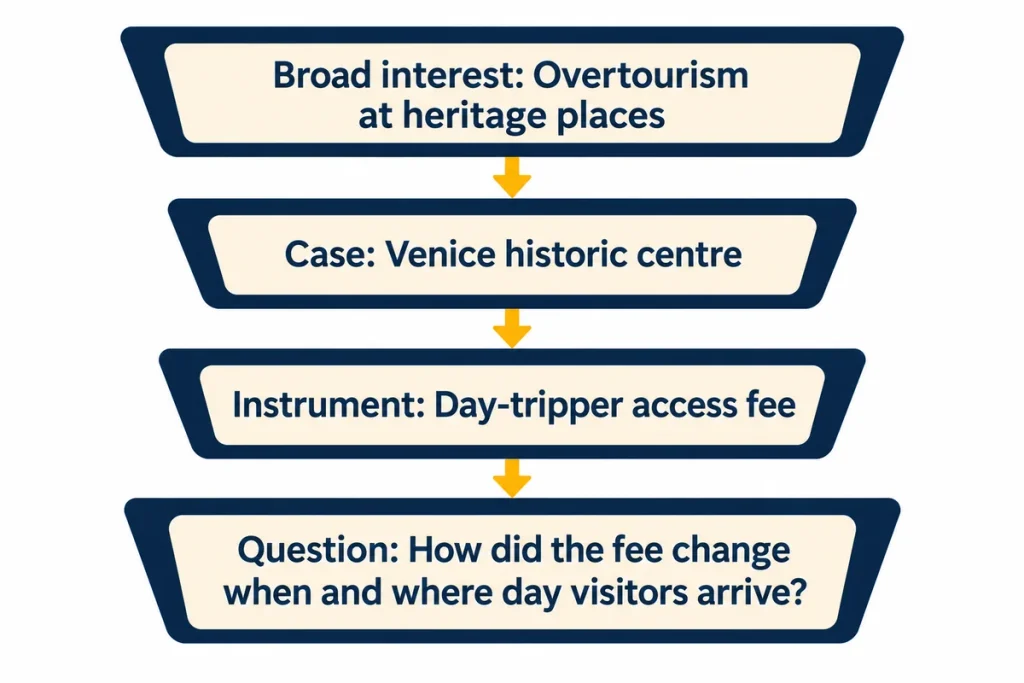
A good heritage tourism question moves from a broad interest to a case, an instrument, a group of people and a source of evidence. Take Venice as an example: overtourism at heritage places becomes the historic centre, then the day-tripper access fee, then the question of how the fee changed when and where day visitors arrive, answered with registration data and a short survey. Our guide on choosing a research topic explains the wider logic.
If your idea is still broad, the dissertation topic finder can suggest angles, and the research question generator helps you phrase the question once you have a case.
Three checks help before you commit. Can you name the case and the date range? Can you name two sources of evidence you can reach within your timeline? Can you explain, in one sentence, what a reader will understand after your study that they did not before? If any answer is no, narrow again.
Worked Examples: Aims and Objectives for Heritage Tourism Research
The examples below show how a topic becomes an aim with linked objectives. Use the aims and objectives generator to test your own wording, and read our guide on aims, objectives and research questions for the rules behind them.
Example A: Visitor pressure on the final 100 km of the Camino (Master’s)
Aim: To assess whether monthly pilgrim arrivals in 2025 exceeded the practical capacity of hostels and trails on the final 100 km of the Camino de Santiago. Objectives: (1) to compile monthly Compostela statistics for 2023 to 2025; (2) to estimate hostel capacity along two routes using published directories; (3) to interview six hostel operators about peak-season constraints.
Example B: Visitor spend at one local attraction (undergraduate)
Aim: To test whether the proportion of visitor spend retained on site at one local heritage attraction matches the 32p in £1 reported by the National Lottery Heritage Fund in 2010. Objectives: (1) to collect at least 100 exit surveys over four weekends; (2) to separate on-site from local off-site spend; (3) to compare results with the 2010 figures and explain differences.
Example C: The first UK living heritage inventory (Master’s)
Aim: To examine how organisers of two ticketed festivals prepared nominations for the UK Inventory of Living Heritage. Objectives: (1) to analyse the inventory’s seven categories and nomination criteria; (2) to interview organisers about who decided what to nominate; (3) to compare their reasons with tourism objectives stated in public documents.
Example D: Digital interpretation and repeat visits (Master’s)
Aim: To test whether augmented reality interpretation increases repeat-visit intention at one small heritage site. Objectives: (1) to design two matched interpretation versions, with and without augmented reality; (2) to survey visitors before and after use; (3) to compare repeat-visit intentions and report limits such as novelty effects.
Methods and Data Sources for a Heritage Tourism Dissertation
Match the method to the question first, then check you can reach the data. Our guide on choosing a research methodology helps with the decision, and the explanation of primary and secondary research clarifies what counts as which.
| Question type | Suitable methods | Evidence routes (UK and international) |
|---|---|---|
| Visitor pressure and capacity | Counts, trail counters, mapping, self-assessment tools, interviews with managers | Site management plans, UNESCO state of conservation reports, VisitEngland attraction surveys, Pilgrim’s Office statistics, Angkor Enterprise statements |
| Authenticity and experience | Surveys with scales, importance-performance analysis, interviews, content analysis of reviews | On-site samples, public reviews with ethical safeguards |
| Policy and governance | Document analysis, case study, comparative policy analysis | World Heritage Committee decisions, Historic England Heritage Counts, Heritage Fund strategy and delivery plans, government consultation responses |
| Community and Indigenous tourism | Participatory mapping, ethnography, interviews guided by community protocols | Community agreement, ethics approval, local management plans |
| Economic value | Spend surveys, contingent valuation, multiplier analysis | Historic England economic reports, Oxford Economics reports for the Heritage Fund, national tourism statistics |
| Digital interpretation | Experiments, usability tests, accessibility audits | Site apps, project documentation, participant data |
If you plan interviews, our guide to getting ethics approval explains what committees usually ask. For tourism-specific support at any stage, our tourism dissertation help page shows what is available.
Choosing Cultural Tourism Research Topics by Level
Undergraduate projects usually work best with one site, a small sample and a clear count or survey, such as the visitor-flow, spend and audio-guide topics above. Master’s projects can compare two cases or use secondary datasets, as with the Heritage at Risk, Visitor Attraction Trends and Heritage Fund topics. PhD work should build or test theory, for example by challenging the authorised heritage discourse, applying the Nara principles or evaluating the Faro idea of heritage communities.
For wider tourism ideas outside heritage, browse our tourism dissertation topics and travel and tourism topics lists, then return here once you have a place, a practice or a policy in mind.
Common Mistakes in Heritage Tourism Dissertations
- Treating World Heritage status as proof that visitor numbers will rise. Test it with before-and-after data instead.
- Generalising from one site. Say what your case can and cannot show.
- Skipping community consent. Studies involving Indigenous or local communities need agreement as well as ethics approval.
- Using destination marketing as evidence. Promotional pages show how a place is sold, not how visitors behave.
- Presenting live policy as settled. Say what stage a decision has reached and give the date you checked.
- Using “heritage” and “history” as if they mean the same thing. Define your terms in the first chapter.
Cultural and Heritage Tourism Dissertation FAQs
What is the difference between cultural tourism and heritage tourism?
The ICOMOS charter uses cultural heritage tourism to mean all tourism activity in heritage places and destinations, covering tangible and intangible, cultural and natural, past and contemporary dimensions. The National Trust for Historic Preservation in the United States defines heritage tourism as travel to experience places, artifacts and activities that authentically represent the stories and people of the past and present. In practice the terms overlap, so define yours early and stay consistent.
Can I write a heritage tourism dissertation without fieldwork?
Yes. Committee decisions, state of conservation reports, Heritage Counts data, visitor attraction surveys and policy documents give you evidence without collecting new data. Our guide to writing a dissertation proposal shows how to justify a desk-based design.
Will I need ethics approval?
Usually yes if you interview or survey people, and often no for analysis of published documents, but your university decides. Communities with their own protocols may require extra agreement.
Which topics on this list change fastest?
The Stonehenge scheme, Venice’s fee, the UK living heritage inventories, Pakistan’s Tentative List and the Heritage at Risk Register change most often. For these, check the official source and record the date you accessed it.
Where to Go Next with Your Heritage Tourism Topic
Pick two or three topics, check the data route for each and discuss them with your supervisor before choosing one. If you want feedback on a draft proposal, our research proposal support can help you shape it. Everything here is for reference and learning, so use it in line with your institution’s policy.