
Forensic Accounting Dissertation Topics: Free, Narrow Titles on Fraud, Financial Crime and Expert Evidence

Choosing from forensic accounting dissertation topics is easier once you know which side of the discipline you want: investigating fraud and financial crime, supporting courts and tribunals, or building detection models from data. The titles below follow that split, and each one names the statute, case, dataset or standard a proposal would actually rest on. Every title is free to adapt.
Questions to settle before you choose forensic accounting dissertation topics
- Which topic can I finish with data I can actually download, rather than data I hope an employer will share?
- Do I want an investigation angle (fraud, money laundering), a courtroom angle (expert evidence, quantum) or a data angle (detection models)?
- Which UK rules can I treat as settled, and which are still proposals?
- How do I study a real scandal without treating allegations as proven findings?
- Will my ethics committee treat public enforcement data differently from interviews with practitioners?
- How narrow must a title be before it reads like a proposal rather than a chapter heading?
Forensic accounting is wider than fraud. It also covers loss quantification, valuation, asset tracing and the duties of experts. However, most published work concentrates on fraud and quantitative methods: one survey of forensic accounting journals found exactly that, and argued that other topics and methods deserve more attention (DiGabriele and Huber, 2015). That gap is why several groups below lean towards litigation support, insolvency and qualitative design. Pure audit-quality questions fit better in the auditing dissertation topics collection.
Position correct as of October 2026. Several items are moving: the SFO whistleblower reward consultation closes on 8 January 2027, the revised ISA (UK) 240 applies from 15 December 2026, the FCA is due to take over anti-money laundering supervision of accountancy firms, and the UK cryptoasset regime starts on 25 October 2027. Where a title depends on a proposal, the explanation says so. Check the FRC, Home Office, SFO, FCA and HM Treasury before you cite any of them.
UK Acts and regulators appear because they give a proposal a clear anchor. Students elsewhere can swap in the equivalent law and data source for their own country, and should check their own university’s rules on ethics approval, referencing and marking.
Failure to prevent fraud and corporate liability: forensic accounting research topics
Forensic accounting dissertation topics on corporate liability test how organisations show that their fraud controls were reasonable. Questions about board oversight in general, rather than fraud evidence, belong in the corporate governance dissertation topics collection.
1. How far do the six principles in the Home Office guidance on the failure to prevent fraud offence differ from the six principles behind the Bribery Act 2010 section 7 defence? The offence sits in sections 199 to 206 and Schedule 13 of the Economic Crime and Corporate Transparency Act 2023 (ECCTA) and has applied to large organisations since 1 September 2025. The Home Office guidance on the failure to prevent fraud offence is advisory, and the organisation carries the burden of proving reasonable procedures on the balance of probabilities. A doctrinal comparison suits Master’s students combining law and accounting.
2. Whether the intent-to-benefit element of section 199 ECCTA reaches false accounting used to hit internal profit targets, tested on the facts of Tesco’s 2014 profit overstatement. The offence is not retrospective, so Tesco works as a thought experiment rather than a precedent. Tesco’s overstatement was later put at £326m, and the SFO’s published record of the Tesco case describes a culture that encouraged “pulling forward” income to meet targets. Compare that with false accounting under section 17 of the Theft Act 1968, which is a listed base offence. Suits Master’s level.
3. What the ECCTA reform of the identification doctrine adds to the deferred prosecution route that Tesco Stores Ltd used in April 2017. The SFO agreed that deferred prosecution agreement on 10 April 2017 with a £129m fine, yet the individual prosecutions that followed produced no conviction. Compare how corporate attribution worked before and after the reform, and note the Fisher Review’s proposal to extend deferred prosecution agreements to individuals. Doctrinal work, Master’s level.
4. Fraud prevention procedures disclosed by FTSE 350 companies for financial years ending after 1 September 2025, coded against the six Home Office principles. Build a coding frame from the principles (top-level commitment, risk assessment, proportionate procedures, due diligence, communication and training, monitoring and review) and have a second reader check a subset. Early reports will be few, so describe the sample honestly and treat the study as a baseline. Works at undergraduate or Master’s level.
5. How should a board evidence “reasonable fraud prevention procedures” if challenged? An interview study with internal audit and compliance leads. The guidance says it will rarely be reasonable not even to have carried out a risk assessment, so interview questions can start from the risk assessment file. Plan eight to twelve interviews through professional networks, secure ethics approval early, and expect confidentiality limits. Master’s level.
6. Provision 29 of the UK Corporate Governance Code and anti-fraud controls: which fraud controls will audit committee chairs treat as “material controls” before the first declarations in 2027? The FRC will not prescribe a number of material controls, and the declaration applies to periods beginning on or after 1 January 2026. The ICAEW’s guide to the UK Corporate Governance Code is a sensible starting point for interview questions. Public evidence is thin until 2027, which makes this a Master’s or PhD design built on interviews and readiness statements.
7. Did mandatory identity verification for directors and persons with significant control, in force from 18 November 2025, change the pattern of new director appointments? An interrupted time series on Companies House data. Because the rule applies to every company, there is no untreated comparison group, so causal claims must stay modest. Officer appointments can be collected through the free Companies House API. Suits a Master’s student with basic scripting skills.
8. Reconstructing control of dissolved UK shell companies from public filings, and what the exercise shows about gaps that identity verification does not close. Choose companies already named in public enforcement cases rather than private individuals, then follow persons with significant control, charges and officer histories. Write a short ethical protocol explaining what you will not publish. A good undergraduate project because the data are free.
9. How should accountancy firms’ confidentiality duties be balanced against private-to-private information sharing on economic crime? An appraisal of the Home Office call for evidence that closed on 18 May 2026. The call for evidence sat alongside the Fraud Strategy 2026 to 2029. Check the Home Office for any response before you write, and anchor the analysis in the Proceeds of Crime Act 2002 and the ICAEW Code of Ethics. Master’s or PhD policy analysis.
10. How should a private equity portfolio group apply the large-organisation size test and the “associated person” definition, which covers subsidiaries, when deciding where fraud prevention procedures must sit? Use the guidance’s own examples, then contrast the associated person concept in the Bribery Act 2010. A doctrinal question for Master’s level that rewards careful reading over data collection.
11. Would civil penalties for fraud and for facilitating money laundering, which the Home Office is still considering, add deterrence beyond the failure to prevent fraud offence? The Fraud Strategy 2026 to 2029, published on 9 March 2026, points to the Public Authorities (Fraud, Error and Recovery) Act 2025 as a possible model. Compare criminal, civil and regulatory routes using deterrence theory. Master’s or PhD level.
Financial statement fraud dissertation topics: detection models and case reconstructions
Forensic accounting thesis topics on misreporting split into two designs: detection models tested on many firms, and reconstructions of a single named case. General fair-presentation questions that involve no suspected fraud fit the financial accounting dissertation topics collection instead.
12. Can the Beneish M-score flag Patisserie Holdings, Carillion and Tesco before the market learned of the problem? A matched-pair case study. The M-score is the eight-variable model from Beneish’s 1999 paper on earnings manipulation. Pair each company with an industry peer, compute scores from published annual reports, and discuss hindsight bias openly. With so few firms the analysis stays descriptive, which suits undergraduate or Master’s level.
13. First-digit and second-digit Benford tests on English local authority spend-over-£500 files: how much does the publication threshold distort conformity? The threshold truncates the low end of the distribution, so a failed test may reflect how the data were built rather than error. Report Nigrini’s mean absolute deviation ranges and compare them with a simulated threshold-truncated series. Needs spreadsheet or R skills, Master’s level.
14. Replicating the Dechow, Ge, Larson and Sloan F-score on SEC enforcement cases, then testing whether a gradient-boosted model improves out-of-sample detection once class imbalance is handled. The original study used 2,190 enforcement releases issued between 1982 and 2005. Collect newer cases from the SEC’s AAER index, because a widely used university dataset of misstatement events stops at 2014. Master’s or PhD, with coding.
15. How do conclusions about fraud predictors change when the same firms are classified using SEC enforcement releases, restatements or securities class actions? A hand-collected study of 1,099 SEC enforcement cases found systematic biases in four popular misconduct databases, so database choice is a design decision rather than a detail. Build an overlap matrix and rerun one published model under each label. Suits Master’s or PhD students who can access Compustat-type data.
16. Do management-defined performance measures under IFRS 18, effective for periods beginning on or after 1 January 2027, give FTSE 250 companies a new channel for earnings management? A pre-adoption study of adjusting items. Code the reconciling items in “adjusted profit” tables in current annual reports and note which would need disclosure under the new definition. Check the UK Endorsement Board for UK adoption status before relying on the date. Master’s level.
17. Which revenue practices did the High Court find at Autonomy, and how would a forensic accountant reconstruct hardware and reseller revenue from the 2011 acquisition accounts? Mr Justice Hildyard held in 2022 that HP had substantially succeeded, and the full judgment runs to 1,657 pages, so choose one issue rather than the whole case. A later quantum ruling put HPE’s loss at £646m, and a further hearing was to settle the final sum, so check its outcome. PhD or ambitious Master’s level.
18. Where did the €1.9bn in Wirecard’s reported cash go? A reconstruction of what bank confirmation and trustee-account testing would have shown. The balances could not be verified and Wirecard filed for insolvency in 2020. Germany’s audit regulator fined EY €500,000 and barred it from new public-interest audits for two years, and a parliamentary review criticised reliance on verbal assurances. The criminal trial of former chief executive Markus Braun began in December 2022 and he denies the charges, so write about evidence procedures, not guilt. PhD or Master’s level.
19. Which of the red flags that the FRC said Grant Thornton missed at Patisserie Valerie appear in the ACFE’s behavioural and document red-flag lists? The FRC’s 2021 findings described a serious lack of competence in the 2015 to 2017 audit work, and the administrators reported accounts overstated by about £94m. Build a red-flag matrix and explain each match in plain language. A strong undergraduate topic because every source is public.
20. Why did signs of loss-making contracts at Carillion not trigger a going concern challenge in the 2016 audit? A reconstruction from the FRC’s October 2023 findings. The FRC found that KPMG did not respond to numerous indicators that core operations were loss-making and that cash flows relied on short-term, unsustainable measures. KPMG’s fine was £21m after a reduction from £30m. Link your analysis to the going concern standard revised in March 2026. Master’s level.
21. Short-seller research as an external fraud detector: abnormal returns around Muddy Waters’ 31 January 2020 report on Luckin Coffee, Luckin’s April 2020 admission and the SEC’s December 2020 settlement. Luckin’s shares fell from $36.40 to $32.49 on the day of the report. The SEC’s 2020 press release on Luckin Coffee alleged more than $300m of fabricated retail sales and a $180m penalty. Run an event study with several event dates and discuss confounding news. Master’s level.
22. How well do linguistic cues in annual report narratives, scored with the Loughran-McDonald dictionary, separate pre-misstatement years from control years in SEC enforcement cases? Form 10-K text is free on EDGAR. The dictionary was built for US filings, so state that limitation if you extend the work to UK reports. Master’s or PhD level.
23. Do fraud prediction models trained on pre-2005 misstatements still work on cases from the last decade? This is a concept drift test. The SEC keeps issuing enforcement releases, with numbering above 4,500 by January 2026, so newer cases exist but need hand collection. PhD level, or Master’s with strong coding skills.
24. Accrual quality for UK private companies: estimating modified Jones model residuals from the Companies House Free Accounts Data Product, and how far small-company filing exemptions limit the exercise. The Free Accounts Data Product holds daily files for 60 days and monthly files for the previous year, and about 75% of accounts are filed electronically. Reduced small-company accounts will limit which variables exist. Master’s level with data skills.
25. How could a forensic accountant test the reliability of Scope 3 emissions claims, and when would a misstatement become actionable under the FCA anti-greenwashing rule or the consumer enforcement powers of the Digital Markets, Competition and Consumers Act 2024? The FCA rule has applied since 31 May 2024. Design a reperformance test using supplier data samples and compare it with regulator decisions. Master’s level.
Audit and assurance: forensic accounting topics on the auditor’s fraud duties
Forensic accounting topics in this area ask what auditors must do about fraud, and what regulators say went wrong when they did not. Questions about control frameworks rather than audit judgements fit the risk management dissertation topics collection.
26. How do fraud-related statements in FTSE 350 auditor’s reports for years before the 15 December 2026 effective date compare with what ISA (UK) 240 (Revised March 2026) will require? The FRC’s April 2026 announcement of the revised fraud and going concern standards promises enhanced risk assessment and greater transparency in reporting for publicly traded entities. Since 2019 auditors have had to explain how far an audit can detect irregularities, including fraud. A content analysis now gives a baseline for later comparison. Undergraduate or Master’s level.
27. How will ISA (UK) 240 and ISA (UK) 570, both revised in March 2026 with the same effective date, interact in audits of loss-making listed companies? Interview audit managers or partners about planned methodology changes, or analyse firm guidance where it is public. Because neither standard has yet applied to a full audit, frame findings as expectations. Master’s level.
28. Professional scepticism across three regulators’ findings: coding the German findings on EY and Wirecard, the FRC’s findings on KPMG and Carillion, and the FRC’s findings on Grant Thornton and Patisserie Valerie into scepticism themes. A cross-case qualitative design. Different jurisdictions and sanction regimes limit comparison, so explain that limit in your method. Master’s or PhD level.
29. What can FRC firm-level audit quality inspection reports show about findings on revenue recognition and management override, by firm and by sector? Inspections target higher-risk files, so they cannot support claims about prevalence. Check the FRC’s current publication format before you commit. A content analysis suits Master’s level.
30. With the Audit Reform Bill withdrawn in January 2026 and ARGA shelved, which governance gaps do audit committee chairs and investors say remain? The FRC continues as regulator without the statutory footing ARGA would have provided, and the government has turned towards modernising corporate reporting. An interview study fits Master’s or PhD level, and it needs the dated position line above because policy may change again.
31. How often do key audit matters in FTSE 350 auditor’s reports name revenue recognition as a presumed fraud risk, and does the wording differ by sector? ISA (UK) 240 allows the presumption to be rebutted, so the wording shows how auditors explain their choices. Code a sample of reports with a simple rubric. Descriptive work like this suits undergraduates.
32. Do UK-listed companies that also report under US Sarbanes-Oxley section 404 describe material controls differently from UK-only peers ahead of Provision 29? The FRC has said SOX reporters are building on their existing approach and that Provision 29 goes beyond financial controls. The sample of dual reporters will be small, so use content analysis rather than inference. Master’s level.
33. KPMG’s £14.4m settlement in May 2022 for misleading the FRC’s inspectors: what would a forensic review of audit working paper integrity need to test? The penalty related to falsified documents and misleading information given to audit inspectors. Without file access you can still design a test plan covering metadata, version history and timing. Master’s level.
34. Does telling investors how far an audit can detect fraud narrow the expectation gap? A randomised online experiment using audit report wording. Auditors have had to give that explanation since periods starting on or after 15 December 2019. Randomise two or three wordings, measure investors’ expectations, and pre-register your analysis. Use the dissertation sample size calculator to plan numbers. Master’s level.
Money laundering, sanctions and beneficial ownership: forensic accounting research topics
Forensic accounting dissertation topics on illicit finance work best when they rest on public registers, regulator notices or statistics. Questions about the regulation of banks as institutions fit the banking law dissertation topics collection.
35. What can the NCA’s annual suspicious activity report statistics show about the defence against money laundering regime, and what can they not show? Volumes of reports and requests for a defence are easy to count, but outcomes are hard to link back to a single report. Say clearly what the statistics measure, and check the latest edition before you quote figures. Master’s level.
36. How effective is professional body supervision of accountancy service providers under the Money Laundering Regulations 2017, and what changes when the FCA becomes the single professional services supervisor? The government chose that model in October 2025, and HM Treasury published its consultation response in June 2026. The FCA is due to take over from the 22 professional body supervisors, after which OPBAS will close. The sources reviewed did not give a fixed transition date, so check HM Treasury. Master’s or PhD policy analysis.
37. Mirror trade statistics from UN Comtrade as a screen for over-invoicing between the UK and its largest trading partners: how much of the gap is misinvoicing, and how much reflects CIF and FOB valuation or timing differences? Compare exporter-reported and importer-reported values by product code. Adjust for freight and insurance before you interpret any residual. A statistics-led Master’s topic that uses open data.
38. How complete is beneficial ownership information in the Register of Overseas Entities? A sample of overseas entities that own UK property. The register began on 1 August 2022 under the Economic Crime (Transparency and Enforcement) Act 2022. Match register entries with HM Land Registry’s data on overseas company ownership, which has licence conditions you must read first. Master’s level.
39. What have unexplained wealth orders achieved since the Criminal Finances Act 2017, judged from National Crime Agency announcements and reported judgments such as the Court of Appeal’s decision in the Hajiyeva case? Only a handful of orders exist, so a qualitative case review fits better than statistics. Separate what courts decided from what the press reported. Master’s or PhD level.
40. Which red flags recur in OFSI monetary penalty and disclosure notices, and how would a forensic accountant structure a look-back review of a bank’s sanctions controls? The notices are public, so you can code breaches by control failure, sector and detection route. Turn the pattern into a review plan with sample sizes and evidence requests. Master’s level.
41. Did the “appropriate address” requirement for registered offices introduced by ECCTA change clustering at shared addresses used by company formation agents? Bulk company data include registered addresses, so you can count companies per address before and after March 2024. Report aggregates only and do not name agents or individuals. Master’s or PhD level.
42. When can a forensic accountant share findings with a client without committing the tipping-off offence in section 333A of the Proceeds of Crime Act 2002? Build a decision tree from the statute, the ICAEW’s guidance and the regulated-sector conditions, then test it on three invented scenarios. A doctrinal exercise with practical value, Master’s level.
43. How much do small accountancy practices spend on anti-money laundering compliance, and how does suspicious activity reporting vary with practice size? A survey design. Primary data bring ethics approval, a sampling frame and response-rate risk, so plan for a modest sample and report non-response honestly. The statistical test selector helps match tests to the question types. Undergraduate or Master’s level.
Payment fraud, deepfakes and cryptoasset tracing: forensic accounting thesis topics
Forensic accounting thesis topics on digital finance need dated facts, because losses and rules change quickly. The UK Finance Annual Fraud Report 2026 recorded £1.28bn of payment fraud losses in 2025, up 4%, with unauthorised losses falling 5% to £703.4m while authorised push payment (APP) losses rose 19% to £576.4m. For legal angles on computer misuse and online offending, see cybercrime law dissertation topics. Students who want market or technology angles on tokens can also read the cryptocurrency dissertation topics and blockchain dissertation topics collections.
44. Why do the Payment Systems Regulator’s 89% reimbursement rate for in-scope APP losses and UK Finance’s 61% reimbursement of all APP losses differ? A reconciliation of the two measures. The regulator’s figure covers the first 15 months of the reimbursement framework, while UK Finance reports £354.3m reimbursed against £576.4m of losses in 2025. Document the population, period and loss definition behind each figure, then rebuild both from published tables. A clear undergraduate or Master’s project.
45. Investment scam losses of £221.5m in 2025: what the payment-channel breakdown implies about where bank interventions would bite. Investment fraud rose 40% and is now the largest APP category by value. Combine the published channel splits with a simple cost-benefit argument for friction at the point of payment. Undergraduate level.
46. Do loss and recovery outcomes in advance-fee fraud differ by payment method, and does section 75 of the Consumer Credit Act 1974 explain the difference for card payments? Advance-fee losses jumped 65% to £58.4m, driven by deposits for goods and holiday rentals that did not exist. Use the report’s category data, state the limits of aggregate figures, and bring in the statute for credit card purchases. Master’s level.
47. Which payment authorisation controls would have stopped the HK$200m transfer in the 2024 Arup deepfake video call fraud, and how would a forensic accountant test that those controls were operating? A finance worker made 15 transfers to five Hong Kong accounts after a call in which every other participant was a deepfake, and Arup confirmed the incident in May 2024. Build a control matrix covering dual approval and call-back verification, then design reperformance tests. Good at undergraduate level.
48. Can firm-level APP scam performance data published by the Payment Systems Regulator separate bank-specific control quality from differences in customer mix? Use regression with controls for size and payment volumes. Check which body now publishes the series, because the regulatory landscape for payments is changing. Master’s level.
49. Graph-based mule account detection: how far do results on the Elliptic Bitcoin dataset or a synthetic transaction benchmark transfer to real bank data? The Elliptic data set paper describes over 200,000 Bitcoin transactions with labelled illicit and licit cases. Report class imbalance, time splits and the gap between benchmark and operational settings. Master’s or PhD level.
50. How should a forensic accountant trace stolen ether through cross-chain swaps? A study of the Bybit theft of about US$1.5bn in February 2025. The FBI said North Korean actors converted some assets to bitcoin and dispersed them across thousands of addresses on several blockchains, and Bybit offered a 10% bounty for tracing. Use public block explorers only and avoid attributing conduct to individuals beyond official statements. Master’s level with technical skills.
51. What do the debtors’ 2023 interim reports to the US bankruptcy court show about control failures at FTX, and which of them were accounting records failures? Code each failure as governance, custody, record-keeping or related-party control. The reports are long, so limit the study to one category. PhD or Master’s level.
52. Which provisions in the FCA’s final cryptoasset rules of 30 June 2026 and the planned Financial Crime Guide update would matter most for evidence in a tracing investigation? The regime starts on 25 October 2027 and the FCA planned to consult in late 2026 on decentralised finance guidance and the Financial Crime Guide. Treat unpublished material as unknown, and update the analysis if the consultation appears. Master’s level policy work.
53. How reliable is on-chain screening of stablecoin flows to unhosted wallets, given the issues raised in the FATF’s targeted report on stablecoins and unhosted wallets in March 2026? Combine a literature review with a small tracing sample on public chains. State what screening tools can and cannot see. Master’s or PhD level.
54. Do the UK travel rule for cryptoasset transfers, in force from 1 September 2023, and the EU Transfer of Funds Regulation, applying from 30 December 2024, create different data trails for investigators? Compare the data fields, thresholds and exemptions in each text, and verify the dates against the official sources. A doctrinal comparison suited to Master’s level.
55. Return smoothing and Ponzi screens: testing for discontinuity at zero and serial correlation in hedge fund returns, following Bollen and Pool. Data usually come from licensed hedge fund databases through WRDS, so confirm access first. Report false positives alongside detections. PhD or Master’s level.
56. Did strong customer authentication reduce remote card purchase fraud losses? A time-series analysis of UK Finance data, where those losses reached £423.5m in 2025. Remote purchase losses rose 13% last year. Use losses as a share of card spending, and treat the March 2022 enforcement date as a candidate break point. Undergraduate or Master’s level.
Public sector, tax and procurement fraud: forensic accounting research ideas
Forensic accounting research ideas in the public sector often come with free official data. Questions about tax rules rather than evasion evidence fit the tax accounting dissertation topics collection.
57. Company age at application and later dissolution among Bounce Back Loan borrowers: a design using Companies House data and published scheme repayment statistics. Over £1.9bn of Bounce Back Loans have been flagged to the British Business Bank as suspected fraud. Individual loan records are not public, so work at aggregate level or on a sample of cases already in the public domain, and say so in your limitations. Master’s level.
58. Coding the Covid Counter Fraud Commissioner’s findings on control failure: pre-payment checks versus pay-and-chase. The final report of the Covid Counter Fraud Commissioner found £10.91bn lost to fraud and error, of which £1.79bn has been recovered, and described controls as inadequate. Build a coding frame, then compare schemes. A good undergraduate topic because the source is one public document.
59. Do the civil penalty powers in the Public Authorities (Fraud, Error and Recovery) Act 2025 strike a defensible balance between recovery and procedural fairness, compared with HMRC’s civil penalty regime? The Act became law on 2 December 2025. Compare appeal rights, burdens of proof and proportionality safeguards. Master’s level doctrinal work.
60. What explains the rise in the corporation tax gap to 18.1% in HMRC’s 2026 estimates, and how much sits with small business non-compliance? HMRC put the 2024 to 2025 tax gap at 6.4%, or £59.2bn, with small businesses accounting for 62% and evasion for 12%. Read Measuring tax gaps alongside practitioner interviews. Master’s level.
61. Three successive HMRC editions revised the 2022 to 2023 tax gap from 4.8% to 5.7% and then 6.6%: what do the revisions say about measurement uncertainty? Compare the tables edition by edition and use HMRC’s uncertainty ratings for each component. Estimating hidden activity is itself a forensic problem. Master’s or PhD level.
62. Threshold bunching in Contracts Finder awards: do contract values cluster just below procurement thresholds, and did the Procurement Act 2023, in force since 24 February 2025, change the pattern? Thresholds are revalued periodically, so use the figures in force on each award date. Notices now sit on Find a Tender as well as Contracts Finder. Master’s level with statistics.
63. How do detected fraud figures in the CIPFA Fraud and Corruption Tracker reflect counter-fraud effort rather than underlying incidence in English councils? The tracker records fraud detected or prevented, so more investigators can produce higher counts without more fraud. Compare detections with reported counter-fraud staffing and budgets. Undergraduate level.
64. How closely do charities’ serious incident reports to the Charity Commission match what trustees disclose in annual reports about fraud? A comparison using the register’s open data. Match incident categories and years where both sources allow, then explain mismatches. Undergraduate or Master’s level.
65. The Kittel principle and “should have known” in missing trader VAT appeals: which due diligence records would a forensic accountant examine to test whether a trader had the means of knowledge? Read First-tier Tribunal decisions, list the evidence each side relied on, and turn it into a due diligence checklist. Master’s level combining law and accounting.
66. NHS bodies and the failure to prevent fraud offence: how far do contractors and agency staff count as associated persons, and how do NHS organisations use the NHS Counter Fraud Authority’s supplementary guidance? Read the statutory guidance next to the NHS-specific material and annual reports. Undergraduate or Master’s level.
Expert evidence, litigation support and quantum: forensic accounting dissertation ideas
Forensic accounting dissertation ideas on litigation support are less crowded than fraud detection. Criminal-procedure questions beyond the accounting evidence fit the criminal law dissertation topics collection, and contract or shareholder disputes sit nearer the commercial law dissertation topics collection.
67. How do the reliability requirements in paragraph 7.1.1 of the Criminal Practice Directions 2023 apply to forensic accounting opinions on money flows and lifestyle analysis? The CPS legal guidance on expert evidence summarises the duty to the court under Criminal Procedure Rules Part 19. The Directions also expect pre-hearing discussion between experts and a methodology section. Master’s level.
68. Should the Kennedy v Cordia admissibility test apply differently to a forensic accountant who quantifies loss than to an expert in a natural science? The Supreme Court asked whether the evidence will assist the court, whether the witness has the necessary knowledge, whether the witness is impartial and whether there is a reliable body of knowledge. Argue whether loss quantification has such a body, and where it does not. Master’s or PhD level.
69. What do joint statements of forensic accounting experts add in civil fraud claims? A study of how issues were narrowed in published High Court judgments. Search the National Archives’ Find Case Law service, code the issues agreed and disputed, and note that only contested cases reach judgment. Master’s level.
70. How should an engagement letter for a forensic accountant be drafted so that working papers keep litigation privilege after Director of the SFO v ENRC [2018] EWCA Civ 2006? The Court of Appeal held that lawyers’ interview notes and forensic accountants’ books-and-records review material were protected because criminal proceedings were reasonably in contemplation. Draft sample clauses and justify each against the reasoning. Master’s level.
71. How do courts treat minority and marketability discounts when valuing shares in section 994 Companies Act 2006 unfair prejudice buy-outs? Compare quasi-partnership and non-quasi-partnership cases and the accountants’ valuation evidence in each. Private company valuation is a recognised part of forensic accounting practice, so literature on valuation methods will help. Master’s or PhD level.
72. Before-and-after versus yardstick methods in lost-profit claims: how have English judges weighed competing forensic accountants’ models? Code reasons given for preferring one model, including data quality and causation assumptions. Master’s or PhD level.
73. How did the High Court derive HPE’s £646m loss in the Autonomy quantum judgment, and how would the difference-in-value method be tested against the accountants’ evidence? The judge measured the gap between the price paid and what HP would have paid had Autonomy’s true financial position been presented. Check whether the final damages hearing has since concluded. PhD level.
74. What does “systemic” mean in Second Sight’s terms of reference and its July 2013 interim report, and what scope-setting lessons does the Post Office Horizon Inquiry evidence offer forensic accountants? Second Sight was appointed in 2012 and dismissed in 2015, and its witnesses were asked in evidence what “systemic” meant. The Post Office Horizon Inquiry publishes the evidence. Master’s or PhD level.
75. Should the common-law presumption that computer systems operate correctly be reformed for accounting records after Horizon? Bates v Post Office [2019] EWHC 3408 (QB) found Horizon was not robust, and the Court of Appeal quashed 39 convictions in Hamilton v Post Office [2021] EWCA Crim 577 (see the Court of Appeal’s summary in Hamilton). Check the Ministry of Justice for any reform proposals before you argue for change. Master’s level.
76. Do the conditions in the Post Office (Horizon System) Offences Act 2024 for automatic quashing fit the accounting evidence in the original prosecutions? A review of its offence, prosecutor and time-period criteria. Read the Act’s commentary on legislation.gov.uk and map each criterion to the kinds of shortfall alleged. Master’s level, with a law lean.
77. Did Jones v Kaney [2011] UKSC 13 change forensic accountants’ willingness to act as experts? A survey of practitioners. The case ended expert witness immunity from negligence claims. Pilot your questionnaire first and plan for a small sample. Master’s level.
Insolvency, asset tracing and matrimonial disclosure: forensic accounting topics
Forensic accounting topics in this area usually end as evidence about what a person or company knew, owned or hid. Divorce disclosure questions that go beyond the accounting evidence fit the family law dissertation topics collection.
78. How do forensic accountants evidence the date by which a director knew there was no reasonable prospect of avoiding insolvent liquidation in wrongful trading claims under section 214 of the Insolvency Act 1986? Fraudulent trading under section 213 requires dishonesty, whereas section 214 combines an objective standard with the director’s actual knowledge. Rebuild cash-flow forecasts and balance sheet tests from a sample of reported judgments. Master’s level.
79. When does the creditor duty in BTI 2014 LLC v Sequana SA [2022] UKSC 25 begin to bite, and how would a forensic accountant date the point at which insolvent liquidation or administration became probable? Apply cash-flow and balance sheet tests to a collapsed company with published administrators’ reports, such as Patisserie Holdings. Hindsight bias is the main risk, so state your cut-off rule before you look at the outcome. Master’s or PhD level.
80. Valuing the consideration in section 238 transactions at an undervalue: which expert methods have courts accepted, and how do they treat contemporaneous versus hindsight valuations? Collect reported decisions, then tabulate the valuation method, the date of valuation and the outcome. Master’s level.
81. Applying the lowest intermediate balance rule from Roscoe v Winder [1915] to commingled bank and exchange accounts: how should a forensic accountant present a tracing schedule that a court can follow? Build a worked example with deposits, withdrawals and a balance that dips below the claim. Test it on a simulated cryptoasset exchange account. Master’s level.
82. Fraud on disclosure in financial remedy proceedings: what did Sharland v Sharland [2015] UKSC 60 change for forensic accountants who test Form E disclosure? The Supreme Court dealt with a consent order obtained after dishonest disclosure. Map the kinds of evidence a forensic accountant would use to test a Form E, from bank statements to company accounts. Master’s level.
83. How accurate are indirect income methods (net worth, expenditure and bank deposits) on simulated small-business accounts with a known amount of under-declaration? Build the simulation in R or Python, vary the size and pattern of concealment, and report detection rates. Because the data are simulated, no sensitive information is needed. Master’s or PhD level.
84. How have courts applied section 12 of the Insurance Act 2015 to fraudulent claims, and what accounting evidence separates exaggeration from fabrication, given fundamental dishonesty under section 57 of the Criminal Justice and Courts Act 2015? Code reported decisions by type of evidence relied on. Master’s level.
85. Phoenix companies: tracing the re-use of company names and directors after insolvency in Companies House data, and testing what section 216 of the Insolvency Act 1986 actually restricts. Use dissolved and insolvent companies from public enforcement cases, and keep results aggregated. Master’s or PhD level.
Whistleblowing, internal investigations and professional ethics: forensic accounting topics
Forensic accounting topics on reporting and ethics link rules to behaviour. Questions about bribery statutes more than accounting evidence fit the anti-corruption law dissertation topics collection, while broader moral reasoning questions fit the business ethics dissertation topics collection.
86. Which design features of the SEC whistleblower programme would transfer to the SFO reward scheme now out for consultation, where a reward follows a corporate conviction or alternative enforcement action? The SEC has paid more than $2.2bn to 444 whistleblowers up to late 2024, including a record award of almost $279m in 2023, and HMRC’s strengthened scheme offers up to 30% where at least £1.5m of tax is collected. The consultation closes on 8 January 2027, and the Fisher Review’s second report, Fraud in the Digital Age, recommended legislating for SFO rewards. Master’s or PhD policy analysis.
87. Can the SFO’s revised corporate cooperation guidance of 13 October 2026 and the proposed whistleblower rewards pull in different directions? Companies are encouraged to self-report, while staff could be rewarded for reporting first, and commentators have asked how the two will be reconciled. A policy analysis with game-theoretic reasoning suits PhD level, and it needs the dated position line because both measures may change.
88. What do the reporting-channel shares in the ACFE’s 2026 data (web 46%, email 34%, phone 23%) imply for hotline design in UK mid-sized firms? Occupational Fraud 2026: A Report to the Nations analyses 2,402 cases from 143 countries, and these are shares of reporting mechanisms used, so they do not add to 100%. Survey hotline providers or users about channel preferences. Undergraduate or Master’s level.
89. How well do qualifying disclosures about accounting irregularities succeed before Employment Tribunals under the Public Interest Disclosure Act 1998? Code published tribunal decisions by type of disclosure, recipient and outcome. Master’s level.
90. Reconstructing the escalation path after the 2014 whistleblower contact with Tesco’s new chief executive, from the SFO’s record of the case. Tesco announced the overstatement on 22 September 2014 and the SFO opened its investigation in October 2014. Build a timeline of who knew what, and when. A good undergraduate case study.
91. Where does the duty of confidentiality in the ICAEW Code of Ethics give way to a duty to disclose? A decision-tree analysis for forensic accountants who discover money laundering during an engagement. Test the tree on three invented fact patterns and ask practitioners to review it. Master’s level.
Fraud behaviour, the forensic accounting profession and research gaps
Forensic accounting research topics about people ask why fraud happens, who investigates it and what the field still neglects. Offender-focused questions that lean on criminal behaviour fit the criminology dissertation topics collection.
92. Do the ACFE 2026 behavioural red flags with the highest median losses fit pressure, opportunity or rationalisation better than fraud-diamond “capability”? The five costliest flags were excessive pressure from within the organisation ($532,000), past legal problems ($400,000), unusually close ties with a vendor or customer ($300,000), refusal to take vacations ($250,000) and a “wheeler-dealer” attitude ($250,000). Map each flag to Cressey’s triangle and to Wolfe and Hermanson’s diamond, and show where the mapping is a judgement. Undergraduate level.
93. Does a fraud-specialist mindset improve trainee accountants’ fraud risk assessments? A vignette experiment adapted from Chui (2010). The PCAOB suggested the mindset, and Chui’s University of North Texas dissertation tested it experimentally. Adapt the vignette to a UK setting, randomise the instruction, and use the guide on how to choose a statistical test to plan the analysis. Master’s or PhD level.
94. Has forensic accounting in the UK become a distinct profession? Updating Hegazy (2015) with job advertisements and interviews. Hegazy’s Middlesex University thesis used Abbott’s system of professions to examine UK practice. Collect public vacancies and interview a small number of practitioners about boundaries with audit and law. Master’s or PhD level.
95. Which skills separate published UK postgraduate forensic accounting module specifications from practitioner job advertisements? Code both document types with one skills framework and report overlap. Undergraduate or Master’s level.
96. How do UK forensic accountants and senior managers describe corporate culture as a driver of fraud, compared with the Australian interview evidence of Lukmanjaya (2019)? The Queensland University of Technology thesis found that employee conduct tends to mirror management. Replicate the interview guide in the UK and analyse differences thematically. Master’s or PhD level.
97. Why do firms underuse forensic accounting services? A planned-behaviour survey adapting the Curtin University (2011) study of large Malaysian companies to the student’s own country. The original asked which factors shape the behavioural intention to use such services. One adapted study counts as one topic, so choose the country you can reach. Master’s level.
98. Has the diversity of topics and methods in forensic accounting journals increased since DiGabriele and Huber’s 2015 classification? Their paper found fraud and quantitative methods dominated. Classify articles published since, for example in the Journal of Forensic Accounting Research, and use the 58 future research areas flagged in a 2024 literature review in Cogent Business & Management to seed your coding frame. Master’s or PhD level.
Data analytics, AI and digital evidence: forensic accounting dissertation topics
Forensic accounting dissertation topics in analytics suit students who can code. Wider data techniques belong in the data mining dissertation topics collection, and model-focused questions fit the artificial intelligence dissertation topics collection.
99. How many three-way match violations and duplicate payment patterns can conformance checking find in the BPI Challenge 2019 purchase-order log? The log comes from a multinational coatings company and holds 76,349 purchase documents and 251,734 items, with item categories that include three-way matching with or without goods-receipt-based invoicing. Values are anonymised, so analyse patterns, not amounts. See the BPI Challenge 2019 dataset record. Master’s level.
100. How should error rates for AI-assisted disclosure review be reported to a court, given the Fisher Review’s call for a technology-first approach under national standards? Disclosure in the Digital Age made 45 recommendations in March 2025, and the government accepted most of them in July 2026, with pilots planned. Propose a reporting template covering recall, precision and sampling method. Master’s or PhD level.
101. Chain of custody for accounting data taken from ERP systems: how far do the four principles of the UK police good practice guide for digital evidence translate to forensic imaging and analytics? Compare each principle with a realistic extraction workflow and list the points where accounting systems behave differently from seized devices. Undergraduate or Master’s level.
102. What role should a forensic accountant play in designing search-based extended disclosure under Practice Direction 57AD in the Business and Property Courts? Look at how issues for disclosure are agreed and where accounting data volumes shape the choice of model. Master’s level.
103. Could an explainable gradient-boosted fraud score, with SHAP explanations, meet the reliability test in paragraph 7.1.1 of the Criminal Practice Directions 2023? Build the model on a public dataset, document its methodology as an expert would, and argue where the explanation would fail cross-examination. Master’s or PhD level.
How to turn forensic accounting dissertation topics into a researchable proposal
A topic is ready when you can name the first document you will open: a judgment, a regulator’s notice, a dataset file or an interview schedule. Work through four checks in one sitting. First, find the source and confirm you can download it today. Second, write the question as one sentence that names the object of study. Third, decide what evidence would change your mind. Finally, list what you will leave out.
If a title still feels wide, shorten the period, the sample or the rule you test. The guide on how to choose research topics explains the narrowing steps, and the guide to writing a research question shows how to phrase the result.
Methods and evidence routes for forensic accounting dissertations
Match the method to the evidence you can reach. UK readers can use Companies House, the FRC, the SFO, HMRC and the Home Office. International readers can use the SEC, the ACFE’s global case data, UN Comtrade and the FATF, and should look for their own country’s register or regulator where a topic names a UK source.
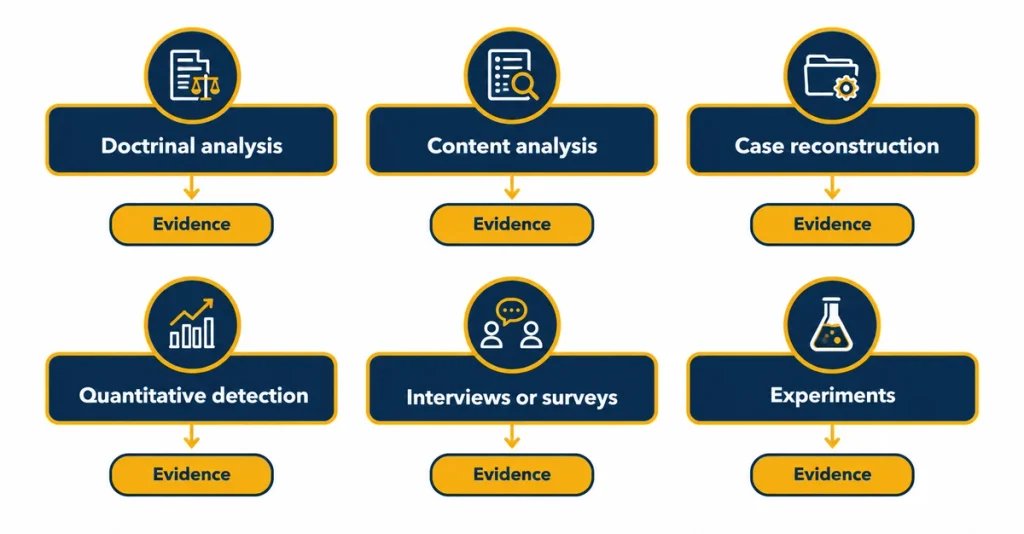
| Route | Suits topics | Typical evidence | Check before you commit |
|---|---|---|---|
| Doctrinal analysis | 1, 2, 42, 68, 79 | Legislation, case reports, regulator guidance | Whether the law is settled or proposed on the date you write |
| Content analysis | 4, 26, 31, 64 | Annual reports, auditor’s reports, FRC notices, charity filings | A coding frame and a second coder |
| Case reconstruction | 17 to 20, 28, 74 | Judgments, regulator notices, inquiry evidence | Allegations versus findings, and hindsight bias |
| Quantitative detection | 12 to 14, 23, 24 | SEC enforcement releases, Companies House accounts data, council spend files | Class imbalance, missing data and licence terms |
| Interviews or surveys | 5, 6, 30, 43, 96 | Practitioners reached through professional networks | Ethics approval, access and confidentiality |
| Experiments | 34, 93 | Online panels or trainee cohorts | Sample size, randomisation and ethics |
Aims and objectives: four worked examples for forensic accounting topics
Each example below turns one topic into an aim with objectives you could actually measure. The guide to writing aims, objectives and research questions explains the logic, and the research aims and objectives generator can draft a first version.
Example from topic 4: fraud prevention disclosures in FTSE 350 reports
Aim: to assess how far FTSE 350 annual reports for years ending after 1 September 2025 describe fraud prevention procedures that map to the six Home Office principles.
- To build a coding frame from the guidance, with decision rules for each principle.
- To code a stratified sample of reports and measure agreement between two coders.
- To compare disclosure depth between FTSE 100 and FTSE 250 companies and across sectors.
Example from topic 13: Benford tests on council spend files
Aim: to establish how far a £500 publication threshold changes first-digit and second-digit conformity in English local authority spend data.
- To extract twelve months of spend files for ten councils and clean duplicate and negative entries.
- To compute mean absolute deviation for first and second digits for each council.
- To simulate threshold truncation on a Benford-conforming series and compare the simulated and observed deviations.
Example from topic 44: reconciling two APP reimbursement rates
Aim: to explain why the Payment Systems Regulator’s 89% rate for in-scope losses and UK Finance’s 61% rate for all APP losses differ.
- To document the population, period and loss definition behind each measure.
- To rebuild both rates from published tables where the data allow.
- To estimate how much of the difference comes from scope exclusions and timing.
Example from topic 93: a fraud-specialist mindset experiment
Aim: to test whether instructing trainee accountants to adopt a fraud-specialist mindset changes their fraud risk ratings.
- To adapt a validated vignette to a UK setting and pilot it with a small group.
- To randomise participants between a standard audit instruction and a fraud-specialist instruction.
- To compare mean risk ratings between groups using a test chosen before data collection.
Common mistakes in forensic accounting dissertations
- Treating allegations as findings. Use the language of courts and regulators. For example, the Wirecard criminal trial began in December 2022 and the former chief executive denies the charges.
- Letting hindsight drive a case study. If you test a model on a company you already know failed, say how you chose comparators before you saw results.
- Promising data you cannot get. Bank transaction data and employer ledgers rarely arrive on time, so confirm access in writing before you commit.
- Claiming a gap without searching. A short search of journals and the topics above protects you from repeating a published study.
- Mixing audit and investigation roles. An auditor’s duty under ISA (UK) 240 differs from a forensic investigator’s brief, and your question should say which one you study.
- Skipping the date. For fast-moving rules, add a line that states the position and the date.
Forensic accounting dissertation topics: frequently asked questions
Can I write a forensic accounting dissertation without primary data?
Yes. Doctrinal analysis, content analysis of public documents, case reconstruction and public datasets all work, and topics such as 2, 12, 19, 58 and 61 need no interviews. Ethics requirements still vary by university, so read the guide to ethics approval for dissertation research and ask your supervisor.
Can I name real companies and individuals in a case study?
Usually you can, if you rely on court judgments, regulator notices and published accounts and describe them accurately. Avoid private individuals, say clearly when proceedings are unresolved, and ask your supervisor about your university’s policy.
Do I need a law background for the legal topics?
Not always, but the doctrinal titles reward careful reading of statutes and cases. Check whether your department expects Harvard or a legal style such as OSCOLA for legal sources, and ask about it early.
Which topics suit undergraduates best?
Look for one public source and a clear coding or comparison task. Topics 8, 19, 44, 47, 58, 63 and 92 fit that pattern, and each can be scoped to a small sample.
Where to go next with your forensic accounting topic
Need help narrowing one of these titles? The dissertation topic finder can turn it into a research question you can defend. If you would like structured support with a forensic accounting proposal, accounting dissertation help covers topic refinement, aims and methodology. A research proposal writing service can also shape the plan before you submit it. Any model material is for reference and learning and should be used in line with your institution’s policy.