
How to Do a Systematic Review for Your Dissertation: A Health Student’s PRISMA Walkthrough

I need to run a systematic review for my dissertation. Can I actually submit one, or will my supervisor expect something lighter? Which version of PRISMA do I follow, do I need a protocol, and how many databases are enough? Can I do it alone, and where does AI fit without putting my marks at risk?
Those questions sit behind most health dissertations built on published research. A review of this kind answers one focused question by finding, appraising and synthesising existing studies with a method written down before you search. It is secondary research, so you collect no new data. Because the full method is demanding, many programmes ask for a lighter version, and the first job is to find out exactly what your module handbook requires.
Scope: health, nursing and allied health reviews are the focus here. Education and social science reviews follow the same logic but often use other registers and appraisal tools, such as the Campbell Collaboration, and the PROSPERO register only accepts reviews with a health-related outcome.
Can a Systematic Review Be a Dissertation? What UK Universities Expect
Short answer: sometimes. A full review is rarely realistic for one student, so many programmes expect a systematic-style review that borrows the same methods. Oxford’s Bodleian Libraries say full reviews usually take at least 12 months and need a team of two or more, which they describe as generally not feasible for a master’s or medical student project. York St John’s library says undergraduate and master’s students are more likely to be asked for a systematised review, which follows the principles of a systematic review but is less rigorous and less in depth. Our guide on how to do a scoping review goes into more detail.
The label also varies. Lincoln’s library notes that an academic may still call a systematised review “systematic”, because the term is used flexibly. Your assessment brief, not the label, decides what you must deliver.
Systematic Review, Systematic Literature Review and Literature Review Compared
Oxford’s master’s guide separates three review types by the features each one includes.
| Feature | Literature review | Systematic review | Systematic literature review |
|---|---|---|---|
| Clearly defined question | No | Yes | Yes |
| Written plan or protocol | No | Yes, a registered protocol | Yes, an informal plan |
| Systematic database search | No | Yes, usually 4 or more databases | Yes, 2 to 4 databases |
| Screening of results | No | Yes, at least 2 screeners | Yes, 1 screener |
| Risk of bias assessment | No | Yes | Optional |
| Data extraction | No | Yes | Optional |
| Synthesis of findings | Yes | Yes | Yes |
A systematised review sits close to the right-hand column. UCL describes it as keeping a structured search while simplifying appraisal and synthesis, and says it is often used in student projects. If your module only asks for a literature review chapter, the guide to writing a literature review chapter covers that shorter route.
Before you commit, email your supervisor and get written answers to three questions:
- Is a systematic review allowed for this module, or is a systematised review expected?
- Can a single author submit one, or is a second screener required?
- Which elements are mandatory: a protocol, a PRISMA flow diagram, risk of bias appraisal or a meta-analysis?
Is a Systematic Review Realistic for Your Dissertation? A Feasibility Check
Run a feasibility check before you register your topic. UCL’s library guidance frames viability around four areas, and each one becomes a question you can answer within a week.
- Scope: is the question focused enough to answer? A pilot search shows how many records a draft question returns, and too many or too few both signal a problem.
- Evidence: is there enough accessible literature? UCL suggests a scoping review or narrative synthesis when evidence is sparse.
- Time and tools: can you fit every stage before the deadline? Screening and appraisal take time, so plan the stages backwards from your submission date.
- Team and review type: are you working alone? UCL notes that solo reviewers may need to choose a scoping, rapid or systematised review.
Also search for existing reviews on your topic. UCL recommends checking early, because a recent review of the same question can prevent duplication and may change your focus. If you are still choosing a question, the evidence-based practice nursing topics show how review questions look in practice.
PRISMA 2020: Which Version Is Current and What It Covers
Short answer: PRISMA 2020 is the current main reporting guideline. The official PRISMA website, checked in November 2026, lists PRISMA 2020 as the main guideline. It consists of a statement paper with a 27-item checklist, an expanded checklist, an abstract checklist and template flow diagrams for original and updated reviews. A separate explanation and elaboration paper gives examples of good reporting.
PRISMA tells you what to report, not how to conduct the review. Conduct standards come from sources such as the Cochrane Handbook for Systematic Reviews of Interventions, which is at version 6.5 (2024), and the JBI Manual for Evidence Synthesis. Therefore, keep the PRISMA checklist open while you draft your methodology and results instead of ticking it off at the end.
The flow diagram comes in four templates: new or updated reviews, each with a version for searches of databases and registers only and a version that adds other sources. Pick the template that matches where you actually searched.
PRISMA Extensions and Updates to Check Before You Start
The official extension register includes PRISMA-P for protocols, PRISMA-ScR for scoping reviews, PRISMA-S for reporting searches, PRISMA-LSR for living reviews and PRISMA-Children and Adolescents. The main statement mainly covers reviews of the effects of interventions, so check the register when your question is about diagnostic accuracy, children or another specialised area.
The register also lists work in progress, including an update of the scoping review extension and a partial update of PRISMA 2020 on the use of AI tools. Some websites describe a “PRISMA 2026”, but the official site still lists PRISMA 2020 as the main guideline. Cite PRISMA 2020, and ask your supervisor if a marker names a different version.
Position correct as of November 2026; check the PRISMA website for the current status.

How to Do a Systematic Review for a Dissertation, Step by Step
Work through the stages in order, because each one feeds the next. Nottingham’s study guide lists five key stages, UCL lists six and Oxford’s master’s guide lists six steps. The names differ, but the sequence stays the same.
Step 1: Turn Your Topic Into a Focused Review Question With PICO
A focused question is the foundation of everything that follows. Split it into parts with a framework. PICO (population, intervention or exposure, comparator and outcome) suits effectiveness questions, and SPIDER was designed for qualitative evidence. Oxford’s Centre for Evidence-Based Medicine also warns that a vague question means you will not find the information you need.
Here is an invented teaching example, not a published review: in adults with type 2 diabetes in UK primary care (P), do nurse-led structured education programmes (I) compared with usual care (C) improve HbA1c (O)? If your wording is the sticking point, the guide to writing a focused research question helps, and the research question generator can draft a first version.
Step 2: Write a Systematic Review Protocol and Decide Whether to Register It
A protocol is the plan you write before you search. UCL strongly recommends one for anyone doing a review, and says most protocols include author details, the question and objectives, eligibility criteria, the sources to search, a draft search strategy, how you will manage results, your approach to appraisal and how you will extract and analyse data. PRISMA-P is the checklist for protocols.
Registration is a separate decision. PROSPERO accepts systematic review protocols with a health-related outcome, and it does not accept scoping reviews or literature reviews that use a systematic search. Ideally, register before screening starts. UCL adds that registration may not be necessary for undergraduate or taught postgraduate projects, or when you do not plan to publish. Alternatives such as the Open Science Framework accept any review type. Check your programme handbook before deciding.
Step 3: Set Eligibility Criteria Before You Screen
Write the rules that decide which studies enter your review before you see any results, then test them on a small batch of records. A separate walkthrough covers inclusion and exclusion criteria for a systematic review, with a worked table and the mistakes that weaken them.
Step 4: Build and Record Your Search Strategy
A search strategy must be thorough enough to avoid missing key studies and transparent enough for someone else to repeat. Work through these decisions in order:
- Databases: ask your academic liaison librarian which health databases your programme provides. Oxford’s master’s guide expects 2 to 4 databases, and a comprehensive review typically uses at least three, such as MEDLINE, Embase and CENTRAL. Reviews in psychology often add PsycINFO. Existing reviews in your area show which databases others used.
- Platforms: a platform such as Ovid or PubMed is the interface, while MEDLINE is the database behind it. Each platform has its own filters and syntax, so adapt the strategy for each one.
- Search terms: group synonyms with OR and join different concepts with AND. Add truncation (such as nurs*), UK and US spellings (behaviour and behavior), and subject headings such as MeSH in MEDLINE or Emtree in Embase alongside free-text keywords.
- Testing: run a draft, read the first 30 results and adjust. If the number of hits is unmanageable or tiny, change the strategy before you commit.
- Extra sources: decide whether to include grey literature such as reports and policy documents, and hand-search the reference lists of included studies. Record the numbers for your flow diagram.
- Recording: for each database, note the date, platform, exact search string, limits and number of results. Run all searches on the same day, export the records and put the full strategies in an appendix.
An illustrative string for the diabetes example might read (“type 2 diabetes” OR “diabetes mellitus, type 2”) AND (nurse-led OR “nurse led”) AND (education OR “self-management”). Treat it as a pattern only, because the syntax and field tags differ between databases.
Step 5: Screen Studies and Complete Your PRISMA Flow Diagram
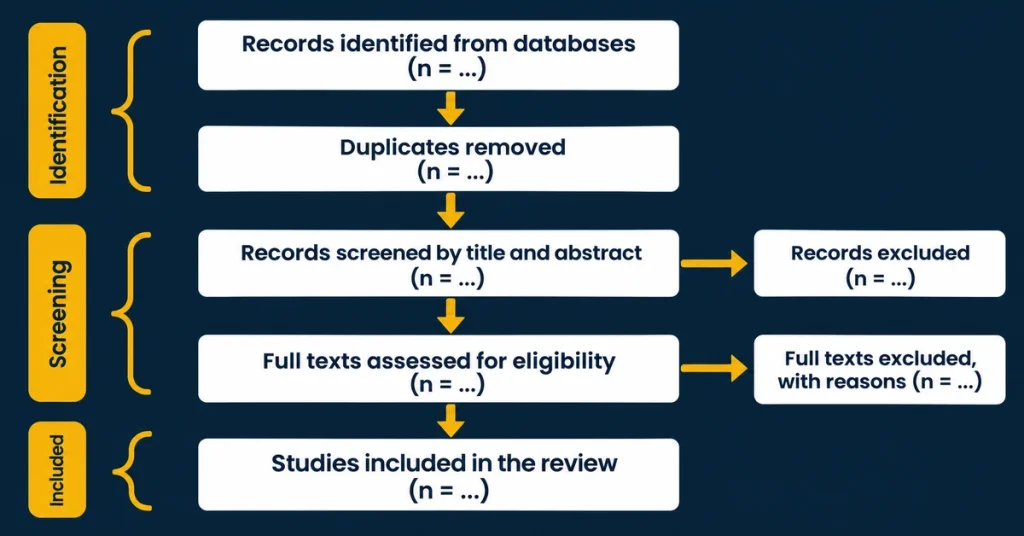
Import every record into a reference manager such as EndNote, remove duplicates and note the counts, because the flow diagram needs them. Then screen titles and abstracts against your criteria, retrieve the full text of the possible matches and record a reason for every full-text exclusion. Piloting your criteria on a small batch first helps you spot vague wording.
The ideal is two independent screeners, but Reading’s library says that is not always feasible for students, and Oxford says master’s students commonly screen all records themselves. If you work alone, state it as a limitation, since a single reviewer raises the chance of selection bias, and ask your supervisor whether someone can check a sample of your decisions. If two people screen, report their agreement, for example with Cohen’s kappa.
Tool access depends on your university. Rayyan, Covidence and EndNote all support screening, but Oxford has an institution-wide Covidence licence while Reading’s library says it has none, so ask your librarian before paying for anything. Finally, the flow diagram should show records identified per database, duplicates removed, records screened, full texts assessed, exclusions with reasons and studies included. There is no perfect number of included studies, so the aim is a search and selection process you can defend.
Step 6: Extract Data With a Form You Have Piloted
Build your data extraction form before you start and test it on a few studies. Typical fields include author, year, design, sample size, population, intervention, comparator and outcomes. For each outcome, record the measure, which direction of the scale is better and the follow-up time points. Also extract the data, not the authors’ conclusions, so that you draw your own from your own analysis.
Step 7: Appraise Study Quality With the Right Risk of Bias Tool
Quality appraisal judges how far each study can be trusted. A review based on weak studies stays weak however well you search, and a standard tool makes your judgements accountable and comparable with other reviews. Match the tool to the study design:
| Study design | Common tool |
|---|---|
| Randomised controlled trials | Cochrane RoB 2 |
| Non-randomised studies of interventions | ROBINS-I |
| Diagnostic accuracy studies | QUADAS-2 |
| Qualitative, cohort, case-control and other designs | CASP checklists or JBI critical appraisal tools |
| Existing systematic reviews | ROBIS or AMSTAR 2 |
Oxford lists risk of bias assessment as optional for a systematic literature review but required for a full systematic review. Therefore, confirm the requirement in writing, and name your chosen tool in the protocol.
Step 8: Synthesise the Evidence and Grade Your Confidence
Synthesis combines the findings to answer your question. A narrative synthesis describes and compares results across studies without pooling them, while a meta-analysis pools numerical results statistically. If the included studies differ markedly in populations, interventions or outcome measures, pooling may not be sound, and a narrative synthesis is the safer choice. Check whether your programme expects pooling at all.
- Narrative synthesis: group studies by theme, outcome or design, and report the direction and size of effects. Avoid summarising how many studies were “statistically significant”, because significance alone says nothing about size.
- Meta-analysis: decide in advance between a fixed-effect and random-effects model, check heterogeneity with forest plots and the I² statistic, and plan checks such as sensitivity analysis. Software such as RevMan is widely available.
- GRADE: this framework rates certainty of evidence across five domains (risk of bias, inconsistency, indirectness, imprecision and publication bias) as high, moderate, low or very low. Check whether your programme expects it.
Step 9: Write Up the Review as Dissertation Chapters
A review dissertation does the work of several chapters at once, so follow your department’s template if it gives one. A common mapping looks like this:
- Introduction: background, the rationale for a review and your question or objective.
- Methodology: the protocol, eligibility criteria, sources, search, selection, extraction, appraisal, synthesis and registration status. The guide to the methodology chapter covers the general structure.
- Results: the flow diagram, a table of included studies, appraisal results and the synthesis, as set out in the guide to the results chapter.
- Discussion: what the evidence shows, how strong it is and what it means for practice. Cover the limits of both the included studies and your own review process, as the guide to the discussion chapter explains.
- Conclusion and appendices: a brief answer to the question, with full search strategies, the extraction form and any excluded-study list in the appendices.
Do You Need Ethics Approval for a Systematic Review Dissertation?
Short answer: usually not NHS research ethics review, but your university may still want a form. The Health Research Authority lists secondary research such as literature, rapid, scoping or systematic reviews among the alternatives for students that do not need research ethics committee or R&D review. Universities set their own process, though, so some ask for a light-touch check or a declaration. Read the guide to ethics approval for a dissertation and confirm with your supervisor.
Position correct as of November 2026; check the Health Research Authority website and your university’s ethics process for current rules.
Can You Use ChatGPT or Other AI Tools in a Systematic Review?
Short answer: only in a limited, declared, assistive role, and only where your university allows it. UCL’s library says AI tools are not yet reliable enough to replace humans at any core stage of a review, and that any use must be reported. It also says AI used as a second screener is not equivalent to independent dual human screening.
- Searching: generative AI can suggest extra search terms, but UCL advises against relying on it for a full strategy or for translating one between databases, because it can invent subject headings.
- Extraction and appraisal: AI tools can misread numbers and methods or make up data, so human checking is essential.
- Writing: tools that screen papers, extract data and generate a report count as contributing to your work, which UCL says is likely unacceptable in most academic contexts.
- Review software: UCL notes that Rayyan, Covidence and EPPI-Reviewer use machine learning but do not generate content, so rules on generative AI may not apply to them. Check your own policy.
Reading’s library adds that uploading full-text articles to AI tools can raise copyright and ethical issues. Keep a log of every AI use, check each output against the original source and acknowledge the use in your methodology.
Seven Mistakes That Weaken a Systematic Review Dissertation
- A question that is too broad. UCL warns that broad questions create unmanageable results and vague conclusions.
- Searching before the protocol exists. Decisions made after you have seen the results invite bias.
- Searching one database and calling it systematic. Oxford expects at least two for a master’s project.
- Losing the search record. Without dates, strings and counts for each database, you cannot complete the flow diagram or let others repeat the search.
- Copying the authors’ conclusions into your extraction table. Extract data, then reach your own conclusions.
- Counting “significant” studies. Report direction and size of effect instead.
- Overclaiming from weak evidence. A review is only as strong as its weakest included studies, so match your wording to the quality and certainty you found.
Systematic Review Dissertation FAQs
How many studies do I need to include?
No source I checked sets a minimum. Reading’s library says there is no perfect number and that thorough searching, screening and selection should leave you confident that you found the relevant studies. If few studies meet your criteria, say so, discuss the gap and ask your supervisor whether your programme sets a minimum.
How long does a systematic review dissertation take?
Oxford says a full review usually takes at least 12 months, and York St John says more than six months. Systematic literature reviews and systematised reviews are designed to fit a dissertation timescale, but the stages still add up. Map each stage to your submission date with the dissertation timeline planner.
Can I do a systematic review without a meta-analysis?
Yes. A meta-analysis is an optional statistical step used only when the studies are similar enough to pool. Otherwise, use a structured narrative synthesis and explain why pooling was not appropriate.
Is a scoping review easier than a systematic review?
Not necessarily easier, but different. A scoping review maps a broad or emerging topic instead of answering a narrow question, and it is reported with PRISMA-ScR. PROSPERO does not accept scoping reviews. UCL suggests it as an option for solo reviewers, so ask which your module expects.
Next Steps for Your Systematic Review Dissertation
This week, draft your question, write a one-page protocol and book a session with your librarian before you run any searches. If you want an experienced second reader on your methodology chapter before it goes to your supervisor, dissertation methodology help is available. For subject-specific support in nursing, medicine or allied health, there is also healthcare dissertation support. Any support is for reference and learning, so follow your institution’s policy on how work may be used.