
How to Do a Scoping Review: A Step-by-Step Guide for Dissertation Students

Is a scoping review the right choice for my question, or do I need a systematic review? Can I realistically complete one for my dissertation? What goes into the protocol, and where can I register it? How many databases are enough, and what does PRISMA-ScR actually ask me to report?
Knowing how to do a scoping review comes down to nine linked decisions, from a broad question framed with PCC to a transparent final report. The steps below follow the JBI methodology, which builds on the earlier Arksey and O’Malley and Levac frameworks, and the reporting advice follows PRISMA-ScR. Examples lean towards health, nursing and education because that is where most of the guidance was written. The logic works in any discipline, although the databases and grey literature sources will change.
What Is a Scoping Review and When Should You Choose One?
A scoping review maps the evidence on a broad topic. It shows what has been studied, which methods and populations appear, how the key concepts are defined and where the gaps sit. It can draw on evidence from any research design and may also include non-research sources such as policy documents (Peters et al., 2020). Our guide on doing a case study dissertation goes into more detail.
Munn et al. (2018) describe the typical reasons to choose this approach: identifying and mapping the available evidence, clarifying concepts or definitions, examining how research on a topic has been conducted, and finding knowledge gaps. A scoping review can also act as a precursor to a systematic review by confirming that the inclusion criteria and questions make sense. Our guide on how to calculate sample size for a dissertation goes into more detail.
When a Scoping Review Is the Wrong Tool
If your question asks whether an intervention works, or how large an effect is, a scoping review cannot answer it. Those questions need the quality appraisal and synthesis of a systematic review. Choosing a scoping review only because it looks lighter produces a piece of work that appears comprehensive but cannot support effectiveness claims. Let the question choose the method: if it asks what is known and how the evidence is shaped, scope it. If it asks how well something works, review it systematically.
If you are still deciding between approaches, choosing a research methodology that fits your question is worth settling with your supervisor before you start any searching.
Scoping Review vs Systematic Review: Which Fits Your Question?
Both follow a transparent, protocol-led process, but they answer different kinds of questions. The JBI Manual sets out the defining characteristics of each, and a scoping review sits between a traditional literature review and a systematic review. Our guide on how to do a systematic review for a dissertation goes into more detail.
| Feature | Traditional literature review | Scoping review | Systematic review |
|---|---|---|---|
| Typical question | Often informal | Broad, usually framed with PCC | Focused, often framed with PICO |
| A priori protocol | No | Yes | Yes |
| PROSPERO registration | No | No | Yes |
| Explicit, transparent search strategy | No | Yes | Yes |
| Standardised data extraction form | No | Yes | Yes |
| Mandatory critical appraisal | No | No | Yes |
| Synthesis into summary findings | No | No | Yes |
Many students confuse a scoping review with an ordinary chapter. A standard dissertation literature review argues a position using selected sources, whereas a scoping review documents a repeatable search and reports what was found, whatever it shows.
Scoping Review Methodology: Arksey and O’Malley, Levac and JBI
Arksey and O’Malley (2005) published the first widely used framework, with five required stages and an optional consultation stage. Levac, Colquhoun and O’Brien (2010) clarified each stage and argued that consultation should be a required component. JBI then expanded the original six steps into nine, with the first three devoted to protocol development, which neither earlier framework prescribed (JBI Manual, 2024).
One distinction saves students a lot of confusion. JBI explains how to conduct a scoping review, while PRISMA-ScR is the checklist for reporting it. The JBI approach is designed to be congruent with the checklist, so you can use both together. You can read the full methodology in the JBI Manual chapter on scoping reviews.
How to Do a Scoping Review Step by Step: The Nine-Step Workflow
The workflow below mirrors the JBI sequence. Treat it as a map: you will move back and forth between steps, because scoping searches and extraction forms are usually refined as you learn more about the evidence.
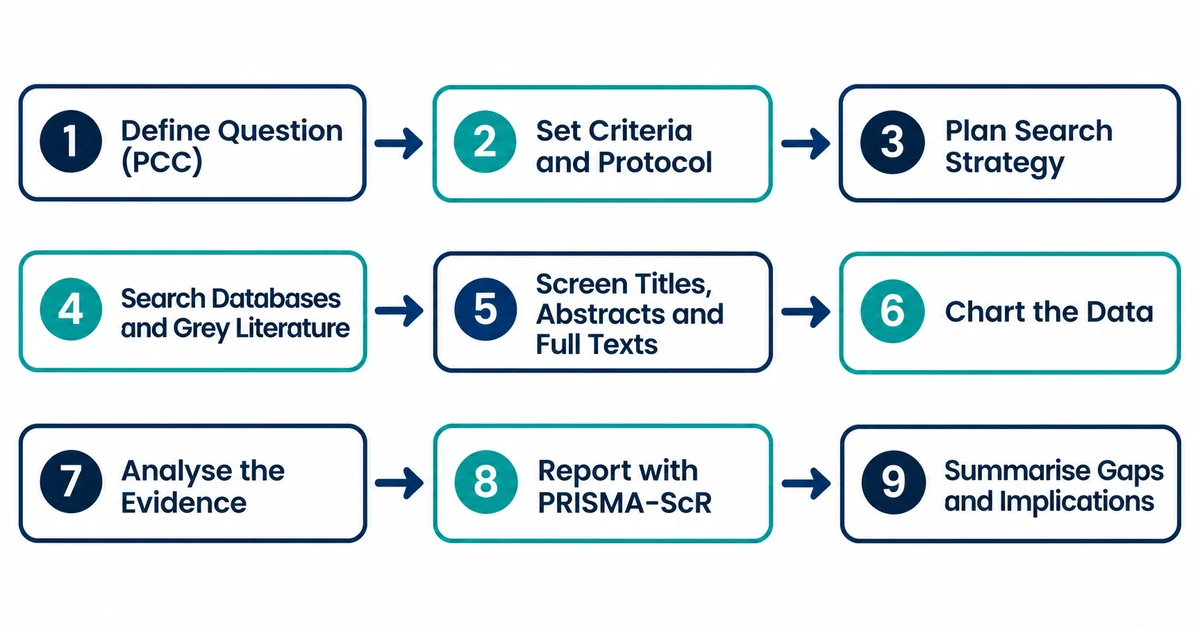
- Define the objective and the review question.
- Set the eligibility criteria.
- Describe the planned approach in a protocol.
- Search for the evidence.
- Select the evidence.
- Extract (chart) the evidence.
- Analyse the evidence.
- Present the results.
- Summarise the evidence and note implications.
Step 1: Define Your Objective and Question with the PCC Framework
Your question controls every later decision, including eligibility criteria, search terms, screening and extraction. If it is unclear, the whole review loses coherence. JBI suggests the PCC approach for scoping review questions: Population, Concept and Context. Some questions use only part of PCC, and a few justify a different format such as PICO, for example when the scoping review feeds into a later systematic review (JBI Manual, 2024).
Objectives and questions should line up. An objective is an active statement of what the review will do, and the question is what it will answer. If you need practice, the guide to writing aims, objectives and research questions shows how the three connect, and the research question generator can help you test a first draft.
Here is an illustrative worked example. The topic is the use of artificial intelligence in nursing education.
| PCC element | Example |
|---|---|
| Population | Nursing students |
| Concept | Artificial intelligence tools used for teaching or learning |
| Context | Higher education |
| Review question | What evidence is available on the use of artificial intelligence in nursing education? |
| Possible sub-question | Which types of tools, outcomes and countries appear in the evidence? |
Step 2: Set Eligibility Criteria and Write the Scoping Review Protocol
JBI requires an a priori protocol, a plan written before searching begins. It sets out the objectives, the criteria for including and excluding sources, which data you will extract and how you will present them. A protocol limits reporting bias, and any later deviation should be highlighted and explained in the final review (JBI Manual, 2024).
Build the criteria from your PCC elements first, then add practical limits such as source type, language and date range. Every limit needs a justification in the protocol, such as the date a technology first appeared or the languages your team can read. The principles behind writing eligibility criteria carry over well, although scoping criteria are usually broader.
| Criterion | Include | Exclude |
|---|---|---|
| Population | Pre-registration nursing students | Other student groups with no nursing data |
| Concept | Artificial intelligence used in teaching, learning or assessment | AI discussed only in clinical practice |
| Context | Higher education institutions | Settings outside formal education |
| Source type | Primary studies, reviews and eligible grey literature | Sources outside the predefined types |
| Language | English, if justified in the protocol | Other languages, if excluded and justified |
| Date range | A predefined, justified period | Sources outside that period |
Registration is not the same as having a protocol. PROSPERO currently does not accept scoping reviews, so teams register on the Open Science Framework or publish the protocol in a journal such as JBI Evidence Synthesis or BMJ Open. Registering is recommended rather than compulsory. For a dissertation, your supervisor and department will decide what is expected, and that includes whether your review needs ethics approval. Reviews of published literature often have different requirements from studies with participants, so check the ethics approval process and your handbook early.
Step 3: Build Your Search Strategy with the JBI Three-Step Approach
JBI recommends a three-step search. First, run an initial limited search of at least two databases relevant to the topic, such as MEDLINE and CINAHL for a health question, to find a handful of seed articles. Second, harvest the keywords and indexed terms (for example MeSH headings) from those articles and build a full strategy for your key database. Third, screen the reference lists of the included sources for anything the databases missed (JBI Manual, 2024).
Boolean operators then combine your terms. OR joins synonyms within one concept, AND links different concepts, and brackets keep the logic in order. Here is an illustrative PubMed-style string for the worked example. It is not a validated search, and controlled vocabulary terms must be checked in the database before use.
("Students, Nursing"[Mesh] OR "nursing students"[tiab] OR "student nurses"[tiab])
AND
("Artificial Intelligence"[Mesh] OR "artificial intelligence"[tiab] OR "machine learning"[tiab])
AND
(education[tiab] OR teaching[tiab] OR curriculum[tiab] OR training[tiab])
JBI also recommends including the full strategy for at least one major database as a protocol appendix, and it points to the PRESS guideline for peer review of electronic search strategies, with the main search ideally run by a librarian and checked by another. Many university libraries offer subject librarian support, so ask whether someone can review your strings before you finalise them.
Step 4: Search Databases and Grey Literature
There is no fixed number of databases. JBI asks for a search as comprehensive as time and resources allow, covering published and unpublished sources, and any limits must be stated and justified. In practice, choose databases that match your discipline: MEDLINE, CINAHL and Embase for nursing and medicine, PsycINFO for psychology, ERIC for education, and Scopus or Web of Science for broad coverage. Adapt the syntax for each database, record the date and platform, and save the exact string you ran.
Grey literature, such as government reports, policy documents, theses and organisational websites, often matters more in a scoping review than in a systematic one. Plan where you will look, how long you will spend and how you will record what you find, because grey sources are harder to export into reference software and many reviewers handle them in a spreadsheet instead.
Step 5: Screen Titles, Abstracts and Full Texts
Screening is the stage where most counting errors creep in, so keep a log from the start. The JBI selection process runs in this order:
- Collate every record from databases and grey literature into one file in reference management software.
- Remove duplicates, and record how many you removed, because the flow diagram needs the figure.
- Screen titles and abstracts against the criteria. Ideally two people screen independently.
- Retrieve and screen the full texts in the same way.
- Record a reason for every full-text exclusion.
- Check reference lists of included sources, forwards and backwards, until no new sources appear or you reach a limit you can justify.
Working alone is common in student projects. JBI says a single screener is not recommended outside rapid reviews, and offers alternatives where two independent reviewers are not possible: one person screens everything while another checks a proportion, or a second person checks only the excluded records. If you are the only reviewer, say so plainly in your limitations and agree a checking arrangement with your supervisor. When in doubt about a record at title and abstract stage, keep it for full-text screening. Tools named in the JBI Manual include EndNote, the SRA Deduplicator and Covidence for duplicates, and citationchaser and SpiderCite for citation searching.
Step 6: Chart or Extract the Data
Arksey and O’Malley called this stage charting the data, while JBI uses extraction, and the two terms are used interchangeably in practice. Build a standardised form with written guidance for each item, include a draft in your protocol, and pilot it with everyone who will extract data. Best practice is for two people to extract independently. If that is not possible, one person extracts and another checks all or part of the work (JBI Manual, 2024).
Start with population, concept and context, then add the items that answer your question. Expect to revise the form after piloting, and record each change.
| Field | Information to record |
|---|---|
| Author and year | Citation details |
| Country | Where the work took place |
| Aim | Purpose of the source |
| Study design | Qualitative, quantitative, mixed methods, policy or other |
| Population and sample | Participants and sample size, where relevant |
| Concept | How the main concept was defined or used |
| Key findings | Findings that relate to your review question |
| Gaps noted | Limitations or future research the authors identify |
Step 7: Analyse the Extracted Evidence
Scoping review analysis is mostly descriptive. A numerical summary shows how many sources fall into each category, such as design, country or year, and a qualitative layer groups what the sources say about your concept (Levac et al., 2010). JBI interim guidance by Pollock et al. (2023) describes basic descriptive counts and qualitative content analysis for this purpose. If you code free text into themes, the process in thematic analysis for a dissertation is a useful companion, provided you explain exactly how you coded.
Critical appraisal is not part of the standard approach. JBI does not advocate it, because scoping questions rarely need sources judged for bias. The exceptions are limited: a funder or decision-maker may ask for it, or you may describe quality features within the extraction table. Even then, JBI says descriptive quality results should not drive recommendations for practice or policy.
Step 8: Present the Results and Report with PRISMA-ScR
Most scoping reviews present findings in tables, with bar charts for frequencies, line charts for trends over time and world maps for where the evidence comes from. JBI notes that large tables can go in supplementary material, with a summary visual in the main text, and that any visual needs a supporting narrative (JBI Manual, 2024).
PRISMA-ScR, published by Tricco et al. (2018), contains 20 essential reporting items and 2 optional ones. It was developed by an expert panel following EQUATOR Network guidance. The checklist item on selection results asks you to account for the sources screened, assessed and included, with reasons for exclusion, ideally in a flow diagram. The official PRISMA-ScR resources include the checklist and explanatory paper. Note that PRISMA 2020 introduced revised flow diagram templates, and library guidance suggests consulting them alongside PRISMA-ScR, so ask your supervisor which layout your department expects.
Position correct as of November 2026: an update to PRISMA-ScR is in development, and a 2026 scoping review identified 37 potential new reporting items to be tested in a Delphi survey. Check the PRISMA website and the EQUATOR Network for the current status before you submit.
Step 9: Summarise the Evidence, Gaps and Implications
The last step connects your findings back to the objective. State what the evidence covers, which concepts are defined inconsistently, where the gaps are, and what that means for research, practice or policy. Keep conclusions inside what a descriptive map can support. A scoping review can show that few studies exist on a topic, but it cannot show that an intervention works.
How to Structure a Scoping Review Dissertation
JBI’s reporting structure runs from title, abstract and introduction through review questions, inclusion criteria, methods, results, discussion and conclusions. Many UK dissertations adapt this to the standard chapters, but departments differ, so confirm the format with your supervisor and module handbook before you start writing. A common mapping looks like this:
- Introduction: the topic, why mapping the evidence matters, and your PCC-based question.
- Methodology: the protocol in past tense, covering eligibility criteria, searches, screening and extraction. The advice on writing a dissertation methodology applies, with the review steps replacing participant recruitment.
- Results: the flow diagram, the characteristics of included sources and the charted findings.
- Discussion: what the map shows, where the gaps are and the limitations of your search.
- Conclusion: implications and recommendations for future research.
If you would like a second opinion on a protocol or search strings, dissertation methodology support is available, and your supervisor and subject librarian should remain your first checks.
Common Scoping Review Mistakes to Avoid
- A question that is too narrow or too vague. A narrow effectiveness question belongs in a systematic review, and a vague one produces thousands of irrelevant records.
- Starting searches before the protocol is agreed. Changes after the fact must be reported as deviations.
- Poorly documented searches. Without the date, database, platform and exact string, nobody can repeat your search.
- Skipping the pilot. An untested screening or extraction form leads to inconsistent decisions.
- Not recording exclusion reasons. The flow diagram and supplementary list depend on them.
- Using the wrong checklist. PRISMA 2020 is for systematic reviews, while PRISMA-ScR is for scoping reviews.
- Claiming findings the map cannot support. Avoid saying an approach works or is effective.
Scoping Review FAQs
Can I register a scoping review protocol on PROSPERO?
No. PROSPERO currently does not accept scoping reviews. Library guidance and the JBI Manual point to the Open Science Framework or Figshare for registration, or to journals that publish protocols. Check the registry’s current eligibility rules before you register, because policies can change.
How many reviewers do I need?
Ideally two, working independently at screening and extraction. If you are working alone, JBI describes checking approaches in which a second person reviews a proportion or the excluded records. State your approach in the methodology and limitations.
How many databases should I search?
There is no fixed number. JBI asks for an initial search of at least two relevant databases, then a comprehensive strategy within the limits of your time and resources, plus grey literature and reference list checking. Choose databases that suit your discipline and justify each choice.
Does a scoping review need quality appraisal?
Not as a standard step. JBI does not advocate it, though a decision-maker or funder may request a descriptive appraisal, and any such results should not be used to recommend changes in practice or policy.
Can a scoping review include grey literature?
Yes. Scoping reviews can include policy documents, reports and other non-research sources alongside published studies, and JBI encourages searching for both published and unpublished evidence.
Is PRISMA-ScR compulsory?
It is a reporting guideline rather than a rule, but journals and supervisors commonly expect scoping reviews to follow it. Check your module handbook or target journal’s author instructions.
Key Sources to Cite
- Arksey, H. and O’Malley, L. (2005) ‘Scoping studies: towards a methodological framework’, International Journal of Social Research Methodology, 8(1), pp. 19-32.
- Levac, D., Colquhoun, H. and O’Brien, K.K. (2010) ‘Scoping studies: advancing the methodology’, Implementation Science, 5, p. 69. doi:10.1186/1748-5908-5-69.
- Munn, Z. et al. (2018) ‘Systematic review or scoping review? Guidance for authors when choosing between a systematic or scoping review approach’, BMC Medical Research Methodology, 18, p. 143. doi:10.1186/s12874-018-0611-x.
- Peters, M.D.J. et al. (2020) ‘Updated methodological guidance for the conduct of scoping reviews’, JBI Evidence Synthesis, 18(10), pp. 2119-2126. doi:10.11124/JBIES-20-00167.
- Tricco, A.C. et al. (2018) ‘PRISMA extension for scoping reviews (PRISMA-ScR): checklist and explanation’, Annals of Internal Medicine, 169(7), pp. 467-473. doi:10.7326/M18-0850.
Ready to plan your own review? Test your first question with the free tools, then map your stages against the dissertation timeline guide so screening and extraction do not get squeezed at the end. Work produced with any support is for reference and learning and should be used according to your institution’s policy.