
How to Do a Case Study Dissertation: A Health Student’s Step-by-Step Guide

I think a case study dissertation could suit my project, but can one ward, one service or one policy really carry the whole thing? Is a case study the same as a case report? Do I need NHS ethics approval to study a team I know? Where does PRISMA fit, if it does at all? And how do I stop a marker calling my work descriptive?
A case study is an in-depth study of one bounded, real-life case, such as a service, programme, team or policy. It uses several sources of evidence to explain how or why something happens in its context. Crowe and colleagues (2011), writing for health services research, say the approach suits how, what and why questions, and that it fits best when a controlled experiment would be inappropriate or impossible.
Short answer on PRISMA: it applies only if your project is a review of published studies. If you collect evidence from a live case, a different set of guidance applies, and the sections below show which route fits you.
Scope: the examples come from nursing, public health, allied health and health management. A business case study or a case study assignment follows different conventions, so read your module handbook before you commit to a design.
What Is a Case Study Dissertation, and How Does It Differ From a Case Report?
Short answer: a case study dissertation is an empirical research design, whereas a case report is a clinical account of one or a few patients. Students often confuse the two, and also confuse both with a case study assignment, where you analyse a scenario you were given. Which one your module wants decides the guidance you follow.
| Type | What you study | Guidance to follow |
|---|---|---|
| Empirical case study | One or several bounded cases, such as a ward, service or policy, using interviews, documents, observation or routine data | Case study methodology (Yin, Stake or Merriam) and your marking criteria |
| Clinical case report or case series | One patient, or a small group, described in detail | The CARE reporting checklist |
| Review of case reports or case studies | Published reports, found and appraised systematically | PRISMA 2020, plus an appraisal tool such as the JBI checklists for case reports |
| Case study assignment | A scenario you are given and analyse against theory | Your assessment brief and university skills guides |
The CARE guideline is a 13-item checklist developed by consensus and published in 2013 (Gagnier et al.). It asks for items such as a timeline, the patient perspective and informed consent. For example, the University of Hull’s library guide says it covers case study assignments for undergraduates and does not tackle the case study as a research method.
Prof Martyn Denscombe, in advice published on Think Postgrad, argues that a case study gives master’s students depth within tight time limits. However, he sets conditions: the purpose must be clear, the choice of case justified, the case compared with others of its type, and the basis for any generalisation explained. Keep those four tests in mind through every step below.
Does PRISMA Apply to a Case Study Dissertation? The Current Version Checked
Short answer: only when your dissertation is a review. PRISMA is a reporting guideline for systematic reviews, so it does not govern a study that gathers evidence from a live case.
The official PRISMA website lists PRISMA 2020 as the main statement, with a checklist and flow diagram (Page et al., 2021). Some websites describe a “PRISMA 2026”, but the official site does not list one, and at least one publisher that announced it later printed a correction. Therefore, cite PRISMA 2020 unless your supervisor names another version. Position correct as of November 2026; check the PRISMA website for the current status.
PRISMA does fit if your “case study” is a literature-based project on published case reports. In that case, report with PRISMA 2020 and appraise each report with a JBI critical appraisal checklist for case reports. Published reviews of case reports have used exactly that pairing. A step-by-step systematic review walkthrough for health dissertations covers each stage, and the same route needs eligibility rules written before you screen. If you want to map a broad area instead of answering a narrow question, a scoping review is reported with PRISMA-ScR.
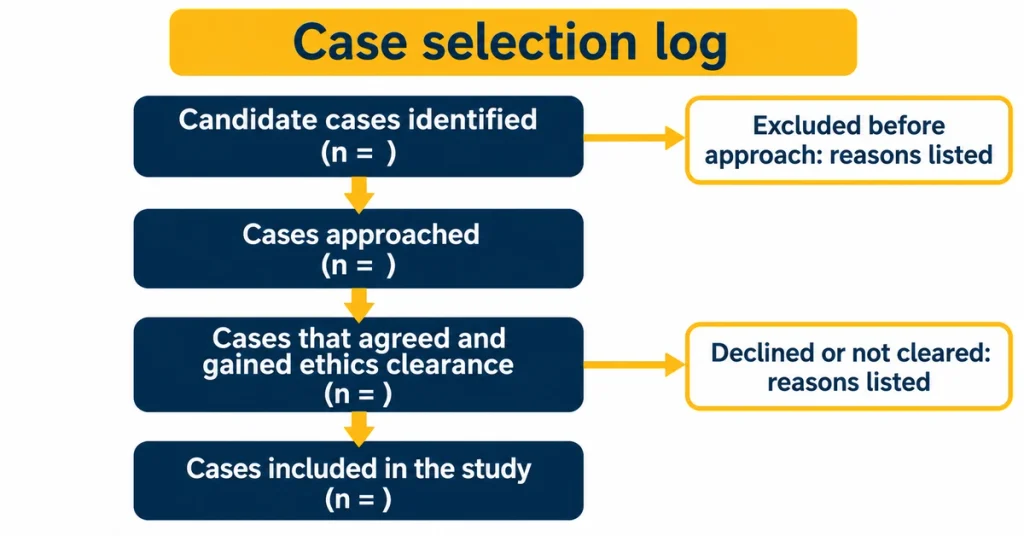
PRISMA does not fit interviews, documents and observations gathered in one service. Even so, a PRISMA-style habit helps: record each selection decision so a reader can follow how you moved from candidate cases to the case you studied (Step 6 below). Treat that log as a transparency device and never describe it as PRISMA compliance.
Case Study Dissertation Steps for Health Students
The order below follows the stages Crowe et al. (2011) describe: defining the case, selecting it, collecting and analysing data, interpreting and reporting. Ethics and quality checks are added because a health project cannot skip them.
Step 1: Confirm What Your Module Expects From a Case Study
Email your supervisor and ask three things. Is a single case acceptable, or are comparisons expected? Must you name a methodologist such as Yin or Stake? Does ethics clearance come before you contact anyone? Then read the marking criteria for verbs such as justify, critically evaluate and generalise, because they show what the marker will look for in your methodology. If you are still weighing designs, the guide to choosing a research methodology sets out the options.
Step 2: Write a How or Why Question That Fits a Case Study
Case studies answer explanatory questions well, such as how an intervention is being implemented and why one strategy was chosen over another (Crowe et al., 2011). Questions that ask whether a treatment works, or how common a problem is, belong to other designs.
Invented teaching example, not a published study: “How do ward managers on one acute medical unit put a falls-prevention bundle into routine practice, and why do staff apply it unevenly?” A matching aim could be to explain how the bundle is applied in practice. Three connected objectives might be to describe the bundle as written in policy and as staff report it, to identify what staff say helps or blocks its use, and to compare day and night shift practice. If your wording is the sticking point, see the guide to writing a focused research question, the research question generator for a first draft, and the walkthrough on aims, objectives and research questions.
Step 3: Choose Your Case Study Design
You face two decisions. First, single or multiple cases. Second, whether each case has one unit of analysis (holistic) or several nested subunits (embedded). Yin names these four designs, and he also separates descriptive, explanatory and exploratory studies. Stake instead classes cases as intrinsic (chosen for their own interest), instrumental (used to understand an issue) or collective (several cases studied together).
| Author | Paradigm | Design stance | Evidence |
|---|---|---|---|
| Yin | Post-positivist | Planned in advance around a question, propositions and a unit of analysis | Qualitative and quantitative |
| Stake | Constructivist | Flexible, with the focus refined as the study proceeds | Qualitative |
| Merriam | Constructivist | Stepwise but flexible, starting from a literature review and framework | Qualitative |
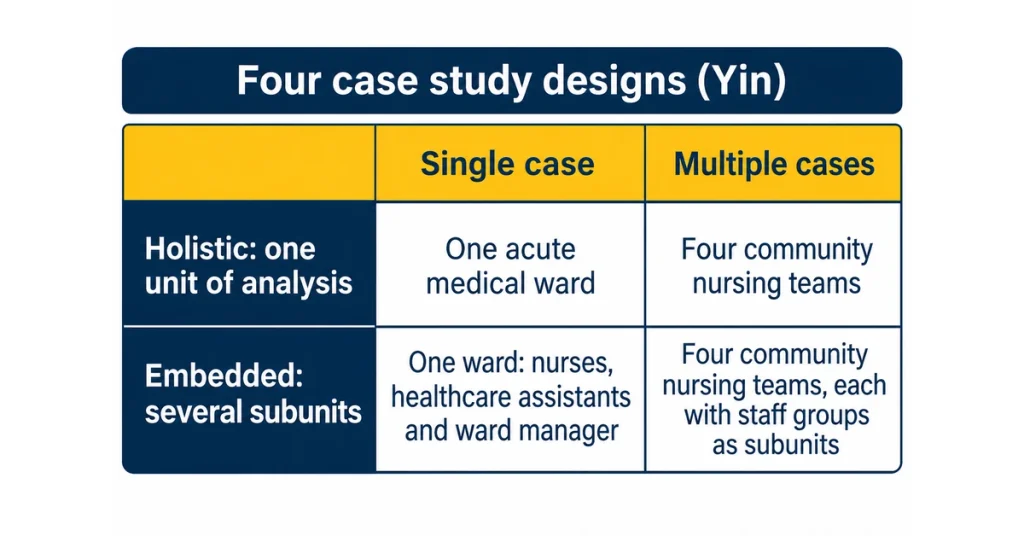
Pick one author’s logic and keep to it. Sibbald et al. (2021) note that researchers often blend approaches without saying so, which weakens consistency. A single case is easiest to defend when it is critical for testing a theory, extreme or unique, typical, revelatory because it was previously inaccessible, or studied over time (Yin, as summarised in Oncology Nursing Forum, 2015).
Step 4: Define and Bound the Case
A case needs a boundary. Crowe et al. (2011) say to fix the time period, the group, organisation or area, the types of evidence you will collect and your priorities for analysis. Stake offers a useful test: the case is the noun (the acute medical unit) and the phenomenon is the verb (embedding the falls bundle). Also state what lies outside the case, because trying to answer too broad a question gives an unclear case.
Step 5: Add Theory or Propositions to Guide the Analysis
Yin’s design has five components: a research question, propositions, a unit of analysis, logic linking the data to the propositions, and criteria for interpreting findings. Theory then gives your evidence a structure. Published implementation case studies have used frameworks such as the Consolidated Framework for Implementation Research and normalisation process theory (see Sibbald et al., 2021, for examples). However, do not force the case to fit the framework. Crowe et al. advise allowing unexpected issues to emerge. The guide to writing a theoretical framework shows how to justify your choice.
Step 6: Select and Justify Your Case or Cases, and Keep a Selection Log
Selection depends on your design. An intrinsic case is chosen for its uniqueness. For an instrumental study a typical case can work, although an atypical case may reveal more about causes. In collective studies you choose cases for comparison or replication. Yin suggests two or three literal replications when the theory is straightforward and five or more when it is subtle (as reported by Crowe et al.). No formula sets the number of cases, so agree a realistic figure with your supervisor.
Access matters as much as interest. Crowe and colleagues dropped one site in their electronic health records study because access was poor and competing demands made cooperation difficult. Therefore, check that your chosen site will let you in before you commit. Because case selection is purposive, the guide to choosing a sampling method helps you word the justification.
Here is where a PRISMA-style habit earns its place. Keep a selection log with these entries:
- The candidate cases you considered and how you found them
- The criteria you applied, written before you approached anyone
- Which cases you approached, and which declined or were not cleared, with reasons
- The case or cases you included, and why they suit your question
Step 7: Sort Out Ethics, Access and Anonymity Early
Start with the Health Research Authority’s two decision tools: Is my study research? and Do I need NHS REC review? The HRA notes that service evaluation looks like research but is not, and that its governance sits with the health and care team. Your project may therefore need NHS review, university review, local service approval or a combination. Read the guide to ethics approval for a dissertation and confirm the route with your supervisor before you contact staff or patients.
Anonymity needs particular care. Crowe et al. warn that cases are often easily identified by insiders, so anonymise carefully and obtain informed consent. A small unit described in rich detail can identify its staff even without names. Position correct as of November 2026; check the Health Research Authority website and your university’s ethics process for current rules.
Step 8: Collect Evidence From More Than One Source
Using several sources, known as triangulation, is a defining feature of case study research. Qualitative sources include interviews, focus groups, observation and documents such as policies and meeting papers. Quantitative sources include questionnaires, audits and routine healthcare data (Crowe et al., 2011). For example, the guide to semi-structured interviews covers the interview stage, while primary and secondary research explains how document and routine data differ from data you generate yourself. Resist collecting everything. Crowe et al. report that too much data squeezed the time left for analysis in one of their studies.
Step 9: Analyse Each Case First, Then Compare Across Cases
In a collective study, analyse each case on its own before comparing (Crowe et al., 2011). Yin lists five analytic techniques: pattern matching, explanation building, time-series analysis, logic models and cross-case synthesis. He also advises testing plausible rival explanations. Alternatively, the Framework approach offers five stages for large datasets: familiarisation, identifying a thematic framework, indexing, charting, and mapping and interpretation. Choose one or two techniques and justify them. If you code interviews, thematic analysis for a dissertation sits comfortably inside a case study.
Step 10: Test the Quality and Rigour of Your Case Study
Critics say case studies lack rigour, so show yours is sound. Crowe et al. recommend theoretical sampling, respondent validation (participants checking your interpretation) and transparency about each decision, including your own role. Yin’s four tests are construct validity, internal validity, external validity and reliability. Stake’s checklist for judging a case study report asks, for example, whether the case is adequately defined, whether the data sources were well chosen and whether anyone was put at risk. Sibbald et al. also recommend using a named quality framework, such as Tracy’s eight criteria. The guide to reliability and validity explains how to report these checks.
Generalisation needs the same care. Case study findings generalise to theory, not to populations, so word your claims accordingly and say what readers in similar settings might take from your case.
Step 11: Write Up Your Findings in Dissertation Chapters
Follow your department’s template if it gives one. Otherwise, a common mapping works as follows:
- Introduction: the problem, your question and why a case study answers it
- Literature review and framework: what is known, and the theory or propositions you test
- Methodology: design, case boundary, selection log, ethics, evidence sources and analysis
- Findings: a description of each case, then the cross-case comparison
- Discussion and conclusion: what the case shows, its limits and what it means for practice
Crowe et al. add that readers need enough context to see how you reached your conclusions, and that case sites and participants must stay anonymous if you promised it. The guides to the methodology chapter, the results chapter and the discussion chapter cover the general structure. If you want an experienced second reader on the design before it reaches your supervisor, dissertation methodology help is available.
Health Case Study Examples to Learn From
Crowe et al. (2011) set out four published health case studies. They were run by research teams, so scale the design down for a dissertation, but the choices they made are a useful model.
| Focus | Design | Cases | Evidence |
|---|---|---|---|
| Recruiting South Asian people into UK asthma research | Single intrinsic | The recruitment issue | In-depth interviews with UK and US researchers, plus a short questionnaire |
| Planning a respiratory service led by GPs with a special interest | Multiple case | Four primary care organisations | Interviews, local documents, patient diaries, news items and a workshop |
| Introducing electronic health records in NHS hospitals | Mixed methods, longitudinal, collective | Five NHS trusts | Interviews, documents, field notes, observation and quantitative data |
| How healthcare students learn about patient safety | Mixed methods, collective | Eight cases across four professions | Curricula and handbooks, views from leads, tutors and students, and observation |
Need a subject-specific starting point? The public health nursing dissertation topics show how service and programme questions can be framed for a case study.
Weaknesses of a Case Study and When Not to Use One
Short answer: the main criticisms are weak rigour and limited generalisability, and both can be reduced by design. Sibbald et al. (2021) add that reporting is often inconsistent and that authors sometimes choose a case study as a default when no other method fits. Crowe et al. list the common pitfalls and fixes:
- Wrong case: build deep knowledge of the literature and justify your choice
- Too much or too little data: focus collection on your research question
- A fuzzy boundary: limit the case by time and place, and say what is out of scope
- Lack of rigour: triangulate, validate with respondents and stay transparent
- Ethical problems: anonymise and obtain informed consent
- Forced theory: allow unexpected findings and state your epistemological position in advance
Avoid a case study when you need to test whether an intervention works against a control, or to estimate how common something is across a population. Also avoid it when you cannot secure access to the site, or when approvals will not fit your timetable. The HRA’s Director of Approvals has noted that the permissions a project needs affect its timeline, so plan backwards from your deadline with the dissertation timeline planner.
Case Study Dissertation FAQs
Can a case study be used in a dissertation?
Yes, if the module allows it and you meet Denscombe’s four tests: a clear purpose, a justified case, a comparison with similar cases and a stated basis for generalising. Confirm the requirement in your handbook first.
What are the five components of a case study design?
In Yin’s approach they are the research question, the propositions, the unit of analysis, the logic that links data to propositions, and the criteria for interpreting findings. Exploratory studies may carry fewer propositions.
How many cases do I need?
There is no formula. One case is defensible when it is critical, unique, typical, revelatory or longitudinal. Multiple cases add comparison and replication but also workload, so agree the number with your supervisor.
Is a case study dissertation qualitative or quantitative?
It can be either, or both. Stake and Merriam use qualitative evidence, whereas Yin supports mixing qualitative and quantitative sources (Sibbald et al., 2021).
Can ChatGPT write my case study?
It cannot visit your site, interview your participants or take responsibility for your analysis. Use AI tools only as your university’s policy allows, declare any use and never paste participant data into a public tool.
Your Next Steps
This week, draft your how or why question, run the two HRA decision tools and email your supervisor the three questions from Step 1. Then start your selection log before you approach any site. If you want specialist input on a health project, healthcare dissertation support is available. Any support is for reference and learning, so use it according to your institution’s policy.