
How to Do a Focus Group for Your Dissertation: Plan, Run and Analyse It

Before you book a room or write a single question, a few things need settling:
- Is a focus group the right way to collect my dissertation data, or should I interview people one by one?
- How many people do I need in each group, and how many groups should I run?
- What do I ask, in what order, and for how long?
- Do I need ethics approval, and what can I honestly promise about confidentiality?
- How do I analyse the transcripts and explain all of it in my methodology chapter?
A focus group for your dissertation is a recorded, moderated discussion in which a small group of participants talk about one defined topic, and the way they respond to each other becomes your data. A sound design usually plans at least two groups for each type of participant, with about four to eight people in each group, sessions of one to two hours, and a topic guide of open questions. You then record, transcribe and analyse the discussion, most often thematically.
The steps below suit qualitative and mixed-methods projects in education, business, health, psychology and other social science subjects. Your supervisor, and your university’s ethics and data protection rules, always take priority, so treat the advice as a planning frame, not a rulebook.
What Is a Focus Group in Dissertation Research?
A focus group is a facilitated group discussion that helps you understand people’s views and experiences, as the official GOV.UK guidance on focus group studies explains. The facilitator guides the conversation, and the participants share characteristics that matter to your topic.
What separates it from interviewing several people in one room is interaction. The University of Reading’s methods guide describes focus groups as a way to use exchanges between participants to explore a topic in depth. It also stresses that they do not aim to produce data you can generalise to a population. That is why you recruit for a range of perspectives, not for a representative sample.
Because you gather the material yourself, it counts as primary data collected first-hand. Some studies rely on focus groups alone. Others run them before a questionnaire or alongside interviews (Salkind, 2010).
Should I Use a Focus Group or Interviews for My Dissertation?
Start from your research question, not from the method. Breen (2006) suggests asking whether you need participants to share and compare experiences, to generate ideas, or to explore issues of shared importance. A yes to any of those points towards focus groups. However, if you need reliable comparisons between groups, evidence of actual behaviour, an institution-wide picture or change over time, Breen advises complementing the groups with another method or choosing a different one.
Interviews and focus groups also pull in different directions. Focus groups suit ideas that form in a social setting, while one-to-one interviews suit individual experiences that social pressure could distort (Breen, 2006). Reading’s guide adds that sensitive topics are a poor fit for a group. Likewise, GOV.UK warns that a focus group study is not a time-saving alternative to an interview study. If individual accounts matter more for your question, a step-by-step method for semi-structured interviews will serve you better.
| Method | Choose it when | Think twice when |
|---|---|---|
| Focus group | You want shared experiences, new ideas or a breadth of views from people with similar characteristics | The topic is sensitive, you need individual narratives, or you need data that generalise |
| One-to-one interview | You need each person’s own experience and reflection, free from group pressure | You want ideas to build up through discussion between participants |
| Questionnaire | You need data that generalise, or comparisons across large groups | You do not yet know the range of experiences worth asking about |
Many dissertations combine methods. In Breen’s case study, focus groups ran alongside computer diaries, because students’ accounts of what they did could not confirm what they actually did. In the same spirit, you might run focus groups to find out which issues matter, then build a questionnaire for your dissertation around them. If you are still weighing designs, a guide to choosing a research methodology helps you compare the options side by side.
How Do I Plan a Focus Group for My Dissertation?
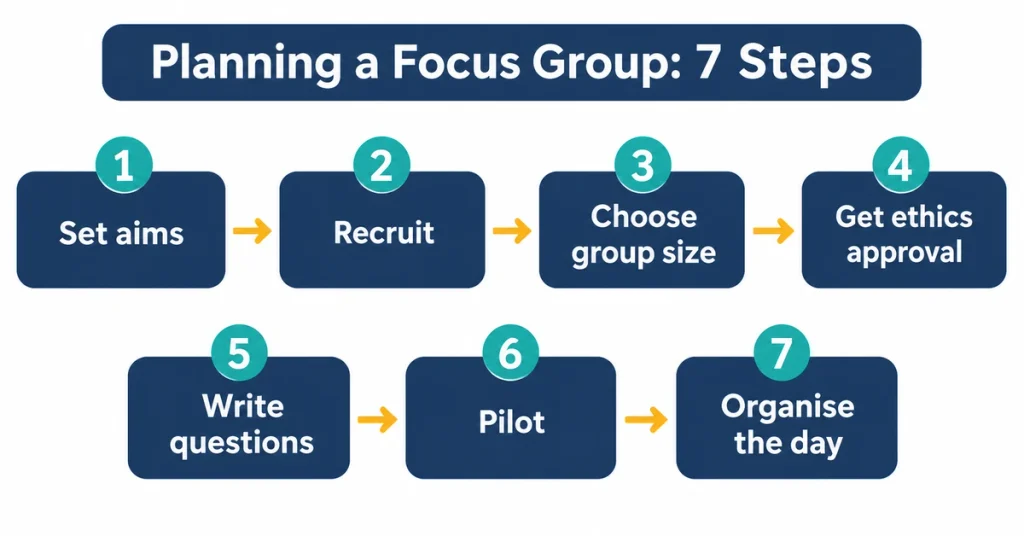
Seven decisions cover the planning stage. Work through them in order, because each one shapes the next.
Step 1: What Do I Want to Get Out of the Focus Group?
Breen (2006) recommends finishing one sentence before anything else: “What I expect to get out of this research is…” From that sentence you can derive your research questions, then test whether a group discussion can answer them. Reading’s guide adds three useful prompts: what do you already know, what else do you need to know, and is a focus group genuinely the best way to find out? If your sentence is vague, tighten your aims, objectives and research questions first.
Step 2: Who Should I Recruit?
GOV.UK describes two routes. Homogeneous sampling recruits people who are similar, while heterogeneous sampling recruits varied participants to widen the range of experience. Breen advises keeping each group homogeneous and splitting participants by whatever matters for your question. In her case study, arts and science students formed separate groups because they were expected to use computers differently.
Mixing can backfire. Reading’s guide warns that people with certain characteristics may contribute less in a mixed group, so mixing participants with different levels of authority needs care. The Royal Academy of Engineering adds two practical points: a focus group is not an open meeting, so use a screening questionnaire, and avoid anyone who knows far more about the topic than the rest, because the others will defer to them. Your decisions here should follow from a clear sampling method that you can justify in your methodology.
Step 3: How Many People Do I Need in a Focus Group, and How Many Groups?
Published guidance does not agree on one number, which is useful to know when you justify yours:
- Breen (2006): four to six people per homogeneous group, in a study of students’ learning experiences.
- University of Reading: four to eight people.
- GOV.UK: six to eight often works well, and smaller groups can work too.
- Krueger (2002): five to ten, with six to eight preferred.
- Royal Academy of Engineering: six to ten, and never more than ten.
Six to eight sits comfortably inside most of those ranges. Recruit above your target, because people drop out. A Faculty Focus article written for doctoral researchers suggests over-recruiting by 20 to 50 per cent.
For the number of groups, Reading’s guide calls it good practice to run more than one, with two per participant characteristic if you compare types. A study by Hennink, Kaiser and Weber on saturation in focus group research points the same way. In their data from ten discussions, four groups were enough to identify a range of issues, but more were needed to understand those issues fully. One group per participant type surfaced the issues, two gave a fuller picture, and further groups added little. Their data came from a health study, so treat the figures as a guide, not a rule.
GOV.UK offers a practical stopping rule: keep recruiting until new groups stop producing new insights. A real example from its guidance involved four groups and 15 participants before the researchers judged they had reached saturation.
Step 4: Do I Need Ethics Approval, and What Do I Tell Participants?
Reading’s guide says you will likely need ethical approval if the data might feed into a publication or public presentation. For a dissertation, your own university’s committee decides, so follow its process before you recruit anyone. A guide to getting ethics approval for a dissertation walks through the typical stages.
Participants should know in advance that the session will be recorded, how their data will be protected and that taking part is voluntary. Be honest about confidentiality. You can ask everyone to keep what is said in the room private, but the UK Statistics Authority’s guidance on qualitative research notes that you cannot guarantee they will. Reading’s sample wording also points out that withdrawing may not remove contributions once a summary has been anonymised, so say so before people agree.
Step 5: How Do I Write the Focus Group Questions?
Write a topic guide: a short, ordered set of open questions with prompts. Krueger (2002) and Reading’s guide both use the same five-part sequence:
- Opening questions, so everyone speaks early.
- Introductory questions that bring in the topic.
- Transition questions that move towards the core issue.
- Key questions that answer your research questions.
- Ending questions that summarise and check for gaps.
On quantity, the Royal Academy of Engineering suggests six to eight questions in its kit list, and eight to ten main questions for a 90-minute session, plus extra probes. Breen adds that the key questions belong in the final third of the discussion, after a warm-up, and that it helps to note your planned minutes beside each question.
Krueger’s advice on wording is practical. Keep questions open, avoid ones that invite a yes or no, and ask about influences and features instead of leaning on “why”. “Think back” questions, which return people to a real experience, work better than hypotheticals. Treat the guide as flexible, because participants often jump ahead or loop back (Royal Academy of Engineering; Reading).
Step 6: Should I Pilot the Focus Group?
Yes, where you can. Breen recommends piloting with at least three groups, so you can check how questions land, revise their order and judge your own moderating. If your population is small, she suggests workarounds: check meaning during the session itself, send the questions to participants beforehand, or hold a second session after an initial analysis. Whatever you do, note it, because your methodology should show how you refined the instrument.
Step 7: What Do I Need to Organise Before the Day?
- Venue: GOV.UK recommends a neutral place, since people speak more openly there, and Breen advises picking whatever suits participants, with round or oval tables to encourage talk.
- Timing: avoid exam periods (Breen) and plan for one to two hours (GOV.UK).
- Equipment: two audio recorders with spare batteries, as the Royal Academy of Engineering suggests, plus name cards and consent forms.
- Refreshments: offer simple options and check for allergies and dietary needs.
- Roles: a moderator plus a silent note-taker or observer (Krueger; Royal Academy of Engineering).
Working alone is harder. Reading advises a co-moderator where possible, so ask a peer to take notes if you can. If you cannot, say so in your methodology, record carefully and sketch the seating plan as soon as the session ends (Krueger, 2002).
How Do I Run the Focus Group on the Day?
Krueger’s recommended opening has four parts: welcome, overview of the topic, ground rules and the first question. The first few minutes set the tone, so build rapport before you start recording the real discussion, perhaps with a light icebreaker (Reading).
Typical ground rules include one voice at a time, respectful disagreement, no right or wrong answers, and confidentiality. Then check that everyone means the same thing by key terms. Reading suggests asking, “When I say this term, what does it mean to you?” because it also gives every participant an easy first contribution.
Once the discussion is moving, your job is to steer lightly:
- Aim for participants to talk to each other, not to you (Royal Academy of Engineering; Reading).
- Keep your own views out of it, and avoid reactions such as “that’s good”, which signal approval (Reading; Krueger).
- Use silence. Reading notes it can draw out answers, and Krueger suggests a pause of about five seconds before probing.
- Handle dominant talkers, shy participants and ramblers with gentle control, and invite quieter people by name (Krueger).
- Summarise after each topic and ask whether you have understood correctly (Reading).
To close, Krueger suggests three steps: summarise and seek confirmation, restate the purpose and ask whether anything was missed, then thank everyone. Keep your notebook handy afterwards, because Reading points out that participants sometimes say interesting things once the recorder is off.
Can I Run an Online Focus Group for My Dissertation?
You can, and your ethics committee will want to know how you will manage it. The Royal Academy of Engineering notes that Zoom, Teams and Google Meet all work, but that the discussion is usually harder to moderate, turn-taking is trickier and rapport between participants is weaker than in person.
Research on web conferencing is more encouraging. Kite and Phongsavan (2017) found it a realistic alternative to face-to-face groups, especially for participants spread across different places, and they set aside time at the start of the online sessions for a short tutorial on the platform. Willemsen and colleagues (2022) list eight factors to plan for: preparation, number of participants, duration, a break, platform usability, interaction, team roles and privacy. A scoping review by Tran and colleagues (2021) found that recruiting across locations and flexible timing helped, while limited computer skills and poor access to technology were common barriers.
How Do I Record, Transcribe and Anonymise Focus Group Data?
Always audio-record with consent, because you cannot moderate and capture a verbatim record at the same time (Reading). Your note-taker should log who speaks and note non-verbal reactions that audio misses, such as nods, laughter and visible disagreement (Krueger).
When you transcribe, Krueger advises writing word for word, marking the moderator’s turns, identifying each speaker and noting laughter, shouting and interruptions. Overlapping voices make group recordings slow to type. Estimates of the time involved vary widely, from about one hour per recorded hour in Reading’s guide to around eight hours in Krueger’s older advice. So budget generously: four 90-minute groups give six hours of audio, which could mean anywhere from six to 48 hours of transcription.
Anonymise as you go, so nobody can be identified from the transcript (Reading). If your study needed ethics approval, follow the committee’s rules on storing and destroying recordings.
How Do I Analyse Focus Group Data for My Dissertation?
Most students use thematic analysis. Braun and Clarke (2006) set out six phases: familiarising yourself with the data, generating initial codes, searching for themes, reviewing themes, defining and naming themes, and producing the report. The phases are recursive, so you will move back and forth between them. Their later work on reflexive thematic analysis renamed some phases and asks you to state which version you are using. A dedicated guide to thematic analysis for a dissertation covers the coding itself in more detail.
What makes group data different is that the conversation is part of the evidence. Krueger lists the questions to ask of every comment:
- Context: what triggered this remark, a moderator question or another participant?
- Internal consistency: did anyone change position after hearing others, and what prompted it?
- Frequency and extensiveness: which topics came up often or took up lots of time, and what was missing?
- Intensity: where did feeling run high, as shown by tone, speed or emphasis?
- Specificity: which comments rest on real experience, as opposed to vague or hypothetical claims?
Breen makes similar points about extensiveness, intensity and specificity, and recommends summarising the main themes, the most noteworthy quotes and any unexpected findings. She also treats strong agreement as a good sign of reliability and frequent opinion shifts as a reason for caution. For deeper interaction analysis, Onwuegbuzie and colleagues (2009) propose a micro-interlocutor approach that records who responds, in what order and with what nonverbal cues.
If you count codes, Breen suggests an independent second coder and at least 80 per cent agreement before claiming reliability. Even then, counts describe your groups only, since focus groups do not aim to generalise. For more on credibility checks, see this overview of reliability and validity in research.
How Do I Write Up a Focus Group in My Methodology and Findings?
In the methodology chapter, Breen’s reporting advice translates into a checklist. Describe your sample and how people were reached. Explain how you introduced the topic, why the questions run in that order, what the pilot changed and how long sessions lasted. Add a reflexive note on how your own position may have shaped the moderating, and say what you did to maximise reliability. Alongside that, justify the choice of focus groups over interviews using the reasoning in the earlier section, and explain your analysis route in a sentence or two. The full dissertation methodology chapter guide shows where each piece belongs.
In the findings, present themes with short anonymised quotations and show where the group split or changed its mind. Reporting that shows the interaction is what separates focus group analysis from a pile of mini-interviews. If you want an expert second opinion on how you have justified your design, dissertation methodology help is available for chapter-level support, and your work should always be used according to your institution’s policy.
What Are the Strengths and Limitations of Focus Groups?
Discuss both honestly in your methodology. On the plus side, GOV.UK notes that group dynamics promote discussion, idea sharing and debate, that groups give breadth of shared experience, and that the method works at every stage of developing a product or service. Reading adds that groups can draw out people who would not give feedback alone.
On the minus side, you need people to be in the same place at the same time, and GOV.UK points out that you may need a separate note-taker. The Royal Academy of Engineering notes costs such as incentives, small samples (never more than ten per group) and a large volume of data to analyse. Confidentiality cannot be guaranteed, and results do not generalise, which is why the Academy recommends checking findings against quantitative methods.
What Focus Group Mistakes Should I Avoid?
- Running a group interview, where you ask each person the same question in turn, instead of encouraging participants to talk to each other.
- Relying on one group and making big claims, when Reading calls more than one good practice.
- Cramming too many topics into one session, which reduces depth (Faculty Focus).
- Piling questions on top of each other, or asking leading ones (Breen; Krueger).
- Mixing participants with very different status, so the quieter group goes silent.
- Skipping the pilot, then discovering a confusing question halfway through the data.
- Overpromising confidentiality in the consent form.
- Reporting what was said but ignoring how the group shaped it.
What Does a Focus Group Study Look Like in Practice?
A Published Example
GOV.UK’s guidance describes a study by Olsen and colleagues (2019) that explored what adults with physical disabilities wanted from a fitness-tracking app. The team chose active participants who had used fitness tracking before, so everyone had shared experience to debate. They used an experienced facilitator and an observer taking notes, ran four groups with 15 participants and stopped once they reached saturation. Sessions were recorded and transcribed, and the data went through thematic analysis. Participants also rated features as “must have”, “nice to have” or “not needed”, which shows how a focus group can yield some simple quantitative data too.
A Hypothetical Plan You Can Adapt
Imagine an MSc student asking how part-time MBA students balance study and work. She expects experiences to differ between first-years and final-years, so she plans two participant types with two groups each, which matches the “two per type” logic above. She aims to seat six people per group and recruits eight. Each session runs 90 minutes with a peer taking notes, and her topic guide follows the five-part sequence:
- Opening: “Tell us your name and one word for how this term has felt.”
- Introductory: “When I say balancing study and work, what does that mean to you?”
- Transition: “Think back to a recent week when both felt heavy. What was going on?”
- Key: “What helped you keep up? What got in the way? What would you change about how the programme is timetabled?”
- Ending: a short summary, then “Have we missed anything?”
This is an illustrative plan, not a published study. Her own numbers, questions and sampling would still need her supervisor’s agreement and ethics approval.
Quick Answers About Focus Groups for Dissertations
How long should a focus group last?
GOV.UK calls one to two hours usual, the Royal Academy of Engineering gives 45 to 120 minutes, and Faculty Focus suggests 60 to 90 minutes for dissertation work. Plan around 60 to 90 minutes and confirm with your supervisor.
Is a focus group qualitative or quantitative?
It is primarily a qualitative method (Salkind, 2010). GOV.UK notes you can also collect some quantitative data, for example by asking participants to rate options, but the discussion itself is the main evidence.
Can I run a focus group on my own?
It is possible but harder. Krueger and Reading both recommend an assistant to take notes and run the recorder, so ask a peer and explain any limitation in your methodology.
What makes a good focus group topic?
A topic where participants share experiences, generate ideas or weigh issues that matter to the whole group (Breen, 2006). If you are still shaping yours, the free dissertation topic finder can help you narrow it down.
What Should I Do Next?
Write your “What I expect to get out of this research” sentence today, then draft a five-part topic guide and decide your group size and number of groups. Add ethics approval, recruitment, transcription and analysis to your schedule, since they take longer than the sessions themselves. A free dissertation timeline planner can turn those tasks into dates.
References
- Braun, V. and Clarke, V. (2006) ‘Using thematic analysis in psychology’, Qualitative Research in Psychology, 3(2), pp. 77-101.
- Breen, R.L. (2006) ‘A practical guide to focus-group research’, Journal of Geography in Higher Education, 30(3), pp. 463-475.
- Faculty Focus, ‘How many focus groups are enough focus groups for dissertation research?’
- Hennink, M., Kaiser, B.N. and Weber, M.B. (2019) ‘What influences saturation? Estimating sample sizes in focus group research’, Qualitative Health Research, 29(10), pp. 1483-1496.
- Kite, J. and Phongsavan, P. (2017) ‘Insights for conducting real-time focus groups online using a web conferencing service’, F1000Research, 6, 122.
- Krueger, R.A. (2002) Designing and conducting focus group interviews. University of Minnesota.
- Office for Health Improvement and Disparities (2020) Focus group study: qualitative studies. GOV.UK.
- Olsen et al. (2019) ‘Content and feature preferences for a physical activity app for adults with physical disabilities: focus group study’, JMIR mHealth and uHealth.
- Onwuegbuzie, A.J., Dickinson, W.B., Leech, N.L. and Zoran, A.G. (2009) ‘A qualitative framework for collecting and analyzing data in focus group research’, International Journal of Qualitative Methods, pp. 1-21.
- Royal Academy of Engineering, How to plan and run focus groups, Ingenious public engagement evaluation resources.
- Salkind, N.J. (2010) Encyclopedia of research design. Thousand Oaks, CA: SAGE.
- Tran, B. et al. (2021) ‘A scoping review of virtual focus group methods used in rehabilitation sciences’, International Journal of Qualitative Methods, 20.
- UK Statistics Authority, Ethical considerations associated with qualitative research methods.
- University of Reading, How to run a focus group, Methods Guides.
- Willemsen, R.F. et al. (2022) ‘Online synchronous focus group interviews: practical considerations’, Qualitative Research.