
Free Political Science Dissertation Topics With Methods, Data and Research Questions

Choosing from political science dissertation topics is easier once you know what each one would ask of you: which dataset, which method, which cases, which ethics route. Every topic below is free to use, narrow enough to read as a proposal title, and paired with the kind of evidence you could realistically collect. Position correct as of October 2026.
Questions to settle before you commit to political science dissertation topics
- Can I answer this with data I can actually download or access, or does it depend on interviews I may not get?
- Does my question need a comparison across cases, or will one well-chosen case be enough?
- Is this about explaining an outcome (why did it happen), describing it, or judging it against a normative standard?
- Am I choosing a live reform that may change before I submit, and have I framed the question so it survives that?
- Which theory gives my argument its spine, and is it one my supervisor can assess?
- Will I need ethics approval, and what would my university expect for interviews, surveys or social media data?
A few topics here rest on legislation or decisions still moving through Parliament or other bodies. Where that is the case, the explanation states the stage reached, and the headline is worded around the lasting question so it still works if the outcome changes. Check the position again shortly before you register your proposal.
These political science research topics cover UK politics, elections, comparative politics, political theory, public policy, political economy, communication, conflict, climate and representation. Detailed international relations ideas sit in the international relations dissertation topics list, so only a few security and foreign policy topics appear here. Country-specific topics can usually be moved to your own country if the data exist. Each university sets its own rules on word count, ethics and referencing, so check yours before you begin. If you are still deciding between broad areas, the guide on how to choose research topics can help you narrow the field first.
Political science dissertation topics on UK politics, devolution and the constitution
UK politics dissertation topics work best when anchored in a specific statute, institution or election result. The evidence is unusually open: Hansard, committee reports, the Electoral Commission and legislation.gov.uk are all freely available.
1. How far did the Hereditary Peers Act 2026 change the House of Lords’ working relationship with the Commons?
A legislative-behaviour study could compare Lords amendments, defeats and ping-pong before and after the reform using Hansard and Lords division data. Suited to a Master’s project. The pitfall is attributing every change in behaviour to the Act when the membership mix and the government’s majority also shifted.
2. Which powers and funding rules give Strategic Authorities under the English Devolution Act 2026 real discretion rather than delegated administration?
Read the Act alongside the integrated settlement documents and compare it with earlier combined-authority deals. A documentary analysis with a handful of elite interviews is realistic at Master’s level. Narrow it to one policy area, such as transport or skills, so the comparison stays manageable.
3. Does an integrated settlement for mayoral authorities change how central departments control local spending?
Treat it as a principal-agent question. Spending documents, Treasury guidance and National Audit Office reports provide the evidence, and two or three authorities make a workable case set. A good undergraduate version simply compares one authority’s pre- and post-settlement rules.
4. Can the Community Right to Buy in the English Devolution Act be compared with the Localism Act 2011 assets of community value regime in practice?
Local authority registers of assets of community value are public, so you could count listings, challenges and completed community purchases. Interviews with parish councils are optional. The risk is that registers are inconsistently kept, so build in a data-cleaning step.
5. Why did the SNP and Reform UK perform as they did in the 2026 Scottish Parliament election, and what does the result suggest about the independence cleavage?
Use constituency and regional list results with polling and, where available, survey data from the Scottish election study. Ecological inference should be treated cautiously. Because coalition talks and policy follow-ups may still be unfolding, centre your question on explanation of the vote rather than predicting the government’s future.
6. What did the 2022 UK Supreme Court reference on a Scottish independence referendum settle about the limits of devolved power?
A doctrinal and political reading of the judgment, the Scotland Act 1998 and reaction from both governments. Suited to a politics or law-and-politics student. Keep it to the constitutional argument; a separate chapter on public opinion would split the project.
7. To what extent does the closed-list system used for the Senedd produce proportional outcomes compared with the old mixed system?
Recalculate seat allocations from published results using the D’Hondt formula and compare disproportionality using the Gallagher index. This is a clean quantitative project for a student comfortable with spreadsheets or R.
8. What limits a minority government in the Senedd, and how do budget deals and confidence arrangements work in practice?
Compare minority parliaments in Wales, Scotland (2007 to 2011 and 2016 to 2021) and Westminster. The evidence is budget votes, committee scrutiny and press statements. The caution is that the governing arrangement after the 2026 election may continue to evolve, so describe it as at the date you write.
9. Does the Windsor Framework’s Stormont brake give Northern Ireland’s Assembly meaningful influence over EU law that applies there?
Examine the text of the Framework, parliamentary debates and the voting thresholds required, then reason through hypothetical triggers. Political science plus some law. The brake has been discussed far more than used, so treat claims about its effects as arguments to test rather than outcomes.
10. What did the Dissolution and Calling of Parliament Act 2022 change about prime ministerial power over election timing?
Compare early elections before the Fixed-term Parliaments Act 2011, under it, and after repeal. Use election dates, parliamentary debates and the constitutional literature on prerogative. A manageable undergraduate dissertation if you restrict yourself to the 2017, 2019 and 2024 elections.
11. How did the Senedd (Members and Elections) Act 2024 reshape the party politics of candidate selection?
Study party rule books, selection contests and candidate lists. Interviews with party officials are possible but may be hard to secure, so have a documentary plan as a backup. Link the topic to the literature on gender quotas and list-order effects.
12. How should regional list compensation be measured when a party wins most of its seats in constituencies?
A methodological question that suits a quantitative student: define compensation, calculate it for the Scottish Parliament from past results, and test the sensitivity of your conclusions to the measure you choose. Be explicit about the formula you use.
Political science dissertation topics on elections, voting behaviour and parties
Electoral political science dissertation topics rely on strong public datasets. The British Election Study, the Electoral Commission and the Manifesto Project cover most UK questions, while the European Social Survey supports cross-national work.
13. How inefficient was the 2024 general election vote distribution, and which parties gained or lost most from it?
Calculate the votes-to-seats ratio per party and an efficiency measure at constituency level, then compare it with 2019 and 2017. The data are public and the arithmetic is simple, so this works well at undergraduate level if you present it clearly.
14. What explains turnout of 59.7% at the 2024 general election, and which groups stayed home?
Combine constituency turnout figures with BES panel data and Census characteristics to test competing accounts: disaffection, lack of competition and demographic change. A common pitfall is ecological inference, so label your claims about individuals carefully.
15. What would the 2024 result have looked like under AV, STV and a closed-list system, and how sensitive is Reform UK’s seat share to the choice?
A simulation project. State assumptions about second preferences openly, use BES vote-switching and second-preference questions where available, and treat results as scenarios, not forecasts.
16. How has the effective number of parties changed across UK nations since 2010?
Compute Laakso-Taagepera indices at national and constituency level, and contrast Scotland, Wales, Northern Ireland and England. A short, well-defined quantitative project for a Master’s student comfortable with a statistics package.
17. What do the 2026 local elections reveal about the strength of the Conservative and Labour vote when only a third of councils are contested?
Account for the thirds cycle and different council mixes before drawing national conclusions. Use Electoral Commission result files and the BBC or Local Elections Archive Project data if accessible. Be careful about comparing unlike electorates.
18. Can the voter ID requirement for UK elections be evaluated as a natural experiment, and what are its limits?
Compare turnout and rejected-ballot data across the places and elections where it was introduced in stages. The main design pitfall is that the pilots were not randomly assigned, so discuss selection bias and confounders as part of the method.
19. Did lowering the voting age to 16 in Scotland and Wales change habits of participation, and what does that imply for England?
Use the Scottish independence referendum and later elections as comparators, drawing on youth survey data and turnout studies. The Representation of the People Bill raises the question again, but its final shape may change, so frame the enduring question about the effects of early enfranchisement.
20. How would the political finance and donations rules proposed in the Representation of the People Bill change who can fund parties?
Compare the Bill’s text with the Political Parties, Elections and Referendums Act 2000 and donation data from the Electoral Commission register. Because the Bill was still in the Lords at the time of writing, treat this as an analysis of proposals.
21. What would automatic voter registration have changed in the electoral register, and what evidence from other countries applies?
A comparative policy study of registration systems, using register completeness estimates and international examples. Good for a Master’s student wanting a policy angle with a clear evidence base.
22. How reliably can tactical voting be measured in the British Election Study?
Compare direct survey questions with inferred measures from vote choice and constituency context. A measurement-focused project that suits a student who wants to develop methodological skills as much as substantive findings.
23. How much of the 2019 to 2024 vote shift is visible in BES panel data on switching between parties?
Panel data let you follow the same individuals across waves. Build a transition matrix and ask which switches were driven by Brexit identity, economic perceptions or leader evaluations. Master’s level; requires some familiarity with longitudinal analysis.
24. What did the Runcorn and Helsby by-election show about competition between Labour and Reform in northern England?
A single-constituency case study using candidate literature, local press and result detail. Small and tidy, so useful at undergraduate level, though you should avoid generalising from a single by-election.
25. What explains Plaid Cymru’s gains in 2026, and can ecological inference separate voter movement from changes in turnout?
Using ward or constituency results with Census data, estimate transfers between parties and compare the methods commonly used for this problem. Honest discussion of uncertainty is more valuable than a single confident number.
26. How did coalition bargaining shape the BJP’s position after the 2024 Indian general election?
A comparative case drawing on the Election Commission of India’s published results, party statements and coalition literature. Suited to a student who reads secondary scholarship in English and has some background in South Asian politics.
27. Does the Louisiana v. Callais case change how redistricting and racial representation can be studied in US congressional elections?
Combine the court’s reasoning with district-level data on race, party and turnout. The case outcome may affect future maps, so organise the dissertation around the lasting question of how law and districting interact.
28. What drove the AfD’s support in the 2025 German federal election, and how does it differ between east and west?
Use state and district election results with socio-economic indicators from German statistical authorities. Quantitative at Master’s level; the pitfall is treating a regional pattern as an individual-level explanation.
Comparative politics and democratic backsliding dissertation topics
Comparative political science dissertation topics usually stand or fall on case selection and measurement. V-Dem, ParlGov, the Quality of Government Institute and Afrobarometer provide free, well-documented data for most of the topics below.
29. How and why did V-Dem’s classification of the United States change in its latest democracy reports?
Examine the indicators behind the change, compare them with other indices and discuss what the differences tell us about measuring democracy. A critical measurement chapter makes this stronger than a purely descriptive one.
30. Which countries improved or declined most in V-Dem’s most recent annual report, and what do those cases share?
A small-N comparison using the V-Dem dataset to select cases, followed by short case narratives. A good way to practise most-similar and most-different design logic.
31. Which institutional constraints survive when a governing party holds two-thirds of a parliament, as in Hungary?
Analyse the constitution, Venice Commission opinions and the development of constitutional court powers. Law and politics combined; keep the question specific to avoid writing a general history.
32. How does Hungary’s use of veto in EU unanimity decisions fit models of bargaining and issue linkage?
Look at Council votes and negotiated outcomes, drawing on bargaining theory. The evidence is public statements and Council records; interviews with officials are rarely feasible.
33. What explains conflict between a president and a government in Poland’s semi-presidential arrangement after the 2023 election?
Compare vetoes, appointments and constitutional tribunal disputes. Useful as a case within the cohabitation literature, with documents available in English from official and press sources.
34. What does the annulment of the 2024 Romanian presidential election suggest about electoral integrity, intelligence evidence and judicial review?
The case is contested and best handled through court documents, election-observer reports and the legal-political literature. Keep to what has been published, and avoid claims about hidden evidence.
35. How should the Georgian foreign influence law be understood within the literature on regulation of civil society?
Compare it with foreign-agent laws elsewhere, using NGO reports, European institutions’ statements and the legal text. Careful use of sources is vital because commentary is highly polarised.
36. What predicts cabinet survival in European coalition governments in the ParlGov dataset?
Run a survival analysis using duration, ideological range and the number of parties. Master’s level; a good fit for students who want to practise event-history modelling.
37. How durable are power-sharing provisions in the PA-X peace agreements database?
Code the type of provisions in agreements from PA-X, then compare their durability with conflict recurrence from UCDP. A strong quantitative topic, provided you describe how you define “durability.”
38. How well do V-Dem indicators explain Pakistan’s civil-military balance across successive governments?
Use V-Dem civil-liberties and executive indicators alongside historical documentation. A thoughtful way to combine quantitative indicators with historical judgment, with the pitfall that composite scores can hide events.
39. Why did Mali, Burkina Faso and Niger withdraw from ECOWAS, and what does it show about regional organisations under military rule?
Use communiqués, ECOWAS protocols and secondary literature. The evidence is publicly available but contested; clearly separate what is documented from what is interpreted.
40. How does public support for democracy, as measured by Afrobarometer, relate to acceptance of military takeovers?
Pool several survey rounds, then compare countries that experienced coups with those that did not. Needs basic regression skills. Avoid causal language unless your design supports it.
41. What explains the limited impact of Colombia’s total peace policy on armed-group demobilisation?
Draw on the peace-process literature, government reports and conflict event data. A policy evaluation approach works well, with an emphasis on what counts as success.
42. How has the Government of National Unity in South Africa altered coalition politics at national and provincial levels?
Use post-2024 policy agreements, parliamentary votes and provincial results. Interviews are unrealistic for most students, so rely on documents and press.
43. How does martial law in Ukraine affect electoral legitimacy and the postponement of elections?
A normative and legal-political question drawing on Ukrainian law, Council of Europe standards and public opinion data. Because the situation is changing, present your argument as conditional on the circumstances at the time of writing.
Political theory topics for a political science dissertation
Political theory dissertation topics are judged on the clarity of the argument, not on data. Pick one thinker or one concept, define it carefully, and test it against an objection or a concrete case. Primary texts are the evidence, so choose a topic where you can read the original, not only summaries.
44. Can Rawls’s difference principle be defended against the objection that it ignores responsibility for choices?
Set out the principle in A Theory of Justice, then use luck-egalitarian critiques to test it. A Master’s-level argument, or a careful undergraduate essay-style dissertation if you restrict yourself to one objection.
45. Does Arendt’s account of the right to have rights explain the position of stateless people better than a human-rights framework?
Read The Origins of Totalitarianism alongside contemporary discussion of statelessness. Anchor it in one present-day case, such as people without nationality in a named country, so the argument does not stay abstract.
46. How far does Pettit’s republican idea of freedom as non-domination differ from negative liberty in workplace regulation?
Choose a concrete regulatory setting and show where the two concepts give different advice. Good for students who like conceptual analysis applied to policy.
47. What does Mouffe’s agonistic pluralism imply for the design of parliamentary debate?
Link the theory to observable features of debating chambers, using Hansard extracts. The danger is treating a normative argument as an empirical finding.
48. Do citizens’ assemblies meet the standards that deliberative democrats set for legitimate decision-making?
Select two or three assemblies, such as those on climate or constitutional questions, and evaluate them against criteria from Habermasian and Fishkin-style accounts. Reports and evaluations are public.
49. Is selecting legislators by lot compatible with democratic equality?
A theory topic with strong historical roots in Athens. Focus on one objection, such as competence or accountability, and examine contemporary proposals for a second chamber chosen by lot.
50. Can decolonial critiques of the canon be reconciled with teaching Hobbes, Locke and Mill in political theory courses?
Engage with specific arguments about empire in Locke or Mill and ask what follows for curriculum or interpretation. Make sure you cite actual critics, not just the general debate.
51. Does Mill’s harm principle justify limits on online hate speech?
Apply Mill’s On Liberty to a defined regulatory proposal such as the Online Safety Act 2023. The pitfall is losing track of the difference between legal and moral arguments.
52. How should Habermas’s public sphere theory be revised for algorithmically curated platforms?
A theoretical project that benefits from a small illustrative case. Position yourself within the existing literature on platforms and public reason.
53. Is Walzer’s idea of complex equality a useful tool for assessing access to health care?
Apply the idea of separate spheres of justice to a specific allocation problem. A practical way to give a classic text a modern use.
54. What does Hobbes’s account of sovereignty contribute to modern debates about emergency powers?
Compare Leviathan with the Coronavirus Act 2020 debates or another emergency measure. Take care to separate interpretation of Hobbes from your own argument.
55. Can Rousseau’s general will survive objections from public choice theory?
An undergraduate-friendly comparison of two traditions. Confine yourself to a single formal objection, such as Arrow’s theorem, and assess whether it undermines the idea.
Public policy research topics for a political science dissertation
Public policy dissertation topics in political science fit best when you pair a theoretical framework with one concrete decision. Evidence can come from official statistics, parliamentary inquiries, audit reports and the National Audit Office, or the Institute for Fiscal Studies. The research question generator may help you phrase the question.
56. Does the Advocacy Coalition Framework explain the long conflict over school-age relationship education reforms?
Map coalitions, belief systems and policy-learning events from consultations and parliamentary evidence. Choose the framework only if you can name the competing coalitions and their core beliefs.
57. How well does Kingdon’s Multiple Streams model account for the adoption of the Online Safety Act 2023?
Trace problem, policy and politics streams using government papers, committee reports and campaign statements. Strong for undergraduates because the process is well documented.
58. Does punctuated equilibrium theory describe changes in UK defence spending priorities after 2022?
Use budget documents to measure how large changes cluster, then relate them to attention shifts. Apply the Defence Investment Plan only to the extent it has been published and verified.
59. What can implementation theory tell us about the delivery of the Integrated Care Systems created in England in 2022?
A case study of two systems, using board papers, inspections and, if you can obtain ethics approval, interviews with managers. NHS research access is slow, so build in time.
60. How effective has the Public Sector Equality Duty been as a mechanism for policy change in local government?
Review equality impact assessments and legal challenges. Combine a documentary sample with a short coding frame, and avoid generalising from a few councils.
61. Why do local authorities in England differ in their use of discretionary housing payments?
Request or download council data, then explain variation with deprivation and political control. Needs basic regression or comparison of means.
62. To what extent does the National Audit Office shape departmental behaviour through value-for-money reports?
Track follow-up actions after reports and Public Accounts Committee hearings. A good fit for a student interested in accountability institutions.
63. How should policy learning from the Scottish baby box be assessed when transferred to other jurisdictions?
Examine documentation on programme design in Scotland and in places that adopted the scheme. The risk is overlooking context; deliberately address transferability.
64. Does the evidence support the claim that devolution has led to policy divergence in health and education across the UK nations?
Compare indicators and policy choices across the four nations. Use official statistics but be careful about definitions that differ between nations.
65. How can regulatory impact assessments be used to evaluate better-regulation promises in the UK?
Review a sample of assessments for quality and consistency, using the Regulatory Policy Committee’s opinions. Appropriate for students interested in regulation and public administration.
66. What explains the survival or failure of pilot policies in UK social security, using Universal Credit as a case?
Trace pilots, evaluations and policy changes through reports and parliamentary scrutiny. A policy history approach works well.
67. How transparent are public body decisions under the Freedom of Information Act 2000, and who benefits from disclosure?
Analyse a set of FOI requests, using published disclosure logs, and classify outcomes. Consider ethical issues in handling named individuals’ data.
Political economy and welfare topics for a political science dissertation
Political science dissertation topics in political economy connect institutions with material outcomes. The economics dissertation topics list covers more technical economics, while the topics below stay on the political side.
68. How do fiscal rules constrain a UK Chancellor, and what is the political cost of changing them?
Analyse the Office for Budget Responsibility’s role, the rules adopted over time and the reaction to rule changes. Suited to students who like institutions and numbers equally.
69. Did Brexit alter the political coalition behind free-trade policy in the UK?
Use trade agreements, party statements and interest group submissions. The question needs a clear definition of what “coalition” means.
70. How do interest groups affect the design of UK industrial strategy?
Take consultation responses to a named strategy document and code who asked for what. A neat design for a documents-based project.
71. What explains cross-country variation in the generosity of unemployment benefits among OECD countries?
Use comparative welfare-state data and test power-resources and varieties-of-capitalism explanations. Requires panel-data methods at Master’s level.
72. How far do political parties’ manifestos on welfare predict their actions in office?
Use the Manifesto Project for coding, then compare pledges with enacted legislation. Define “fulfilled” carefully.
73. How do public ideas of deservingness shape support for limits on child-related benefits in UK welfare politics?
Use existing items from the British Social Attitudes survey, or a survey experiment if you can plan one. Check the current rules on child-related benefits before you write, since they have been a live political issue. If you plan new data collection, secure ethics approval early.
74. What explains the political resilience of the UK triple lock on state pensions?
Combine voting patterns by age with party commitments. The question gives scope for both quantitative and documentary analysis.
75. Do economic perceptions or actual conditions drive vote choice more in post-Brexit Britain?
Use BES data to compare subjective evaluations with regional economic data. A classic economic voting design with a UK flavour.
Political communication, technology and AI topics
Political science dissertation topics on communication now often involve platform data, so ethics and data access deserve as much attention as theory. Read your university’s rules on social media data, and consider platform terms before you collect anything.
76. How do the rules for political advertising in EU Regulation 2024/900 change what parties can do on large platforms?
Analyse the text, platform responses and any announced withdrawals from political advertising. Evidence is mainly regulatory and corporate documents. Verify each platform’s current position before you write about it.
77. How has the Online Safety Act 2023 affected the moderation of political speech on social media?
Examine Ofcom codes and guidance, platform policy statements, and civil-society commentary. Keep the question limited to implementation, not a general argument about free speech.
78. Which framing strategies did party leaders use in televised debates during the 2024 UK general election?
Content analysis of transcripts using a coding scheme from framing theory. Check coder reliability on a subsample, because it adds credibility.
79. Do TikTok videos from UK political parties reach different audiences from their Facebook content?
Collect public posts within platform rules, and compare engagement and framing. Confirm ethical and legal limits with your supervisor before you start.
80. How often do generative AI tools produce misleading answers to voters’ questions about registration and voting rules?
Test a defined set of prompts against official Electoral Commission guidance, and code accuracy. A creative, practical design that must be reproducible, so record model versions and dates.
81. What does the use of deepfakes in recent elections suggest about the effects of synthetic media on trust?
Review documented cases and fact-checker reports, along with experimental work on persuasion. Avoid claims that deepfakes changed outcomes unless research shows it.
82. How do newspapers in different nations of the UK report devolved policy differences?
Sample articles from several outlets and compare coverage using content analysis. Newspaper databases are generally available through university libraries.
83. Does exposure to partisan news increase affective polarisation, according to panel survey evidence?
Use panel data such as BES or Understanding Society, compare news exposure measures and polarisation scores. Pay attention to selection into news diets.
84. Can computational text analysis of Hansard identify shifts in the language of immigration debate?
Download Hansard speeches, apply topic models or dictionaries, and validate your results by reading a sample. Needs basic Python or R.
Conflict and security political science research topics
Security-focused political science dissertation topics lean on event and conflict datasets. UCDP and ACLED are the main open sources, and you should record dataset versions and download dates. For wider international relations theory, see the international relations dissertation topics list.
85. How do UCDP and ACLED differ in their coding of fatalities in the same conflict, and what does that mean for quantitative findings?
Pick one country-year sample, align the definitions and compare. A methods-driven project that teaches how data choices shape conclusions.
86. Do ceasefire agreements in the PA-X database that include monitoring provisions last longer than those without?
Code monitoring clauses, then run a simple survival analysis. Fine for a Master’s student; include a section on how agreements are defined and dated.
87. What explains variation in how armed groups govern civilians, using ACLED event data for one region?
Combine event data with qualitative reports from humanitarian bodies. Narrow to one region and one period to stay manageable.
88. How do NATO members’ commitments to higher defence spending relate to domestic coalition politics?
Compare announcements, parliamentary votes and public opinion in a handful of members. Focus on political bargaining, not military analysis.
89. How are candidates evaluated in the UN Secretary-General selection, and what role does the Security Council’s straw-poll process play?
Study the procedures, General Assembly resolutions and candidate dialogues. The selection is ongoing at the time of writing, so frame the question around the process and its legitimacy.
90. How do UK-EU reset negotiations illustrate asymmetric bargaining after Brexit?
Compare the stated aims of each side with joint statements. A summit may not have concluded when you read this, so describe the position at your writing date.
91. What did the Chagos Archipelago negotiations reveal about the relationship between international law and strategic interests?
Review the International Court of Justice advisory opinion, treaty text and parliamentary debates. The agreement’s progress has been uneven, so write about the argument rather than the final settlement.
92. To what extent do sanctions regimes on Russia achieve the political goals set by their designers?
Define goals from official statements, then compare them with outcomes using trade and policy data. Avoid claims about causes that you cannot support.
93. Why do rebel groups sign peace agreements, and how do spoilers affect implementation?
Use bargaining and spoiler theories, applying them to a well-documented case such as Northern Ireland or Colombia. Choose one case to keep the analysis deep.
94. How should the responsibility to protect doctrine be assessed after its use in Libya and its non-use in Syria?
A normative and historical comparison using Security Council resolutions and diplomatic statements. Avoid summarising the whole doctrine.
Climate and environmental politics topics
Climate politics topics for a political science dissertation benefit from a clear political lens: who decides, who pays and who is excluded. For scientific and technical angles, see the climate change dissertation topics list.
95. How do the presidency arrangements for COP31 shared between Türkiye and Australia change negotiating dynamics?
Look at announcements, negotiating-bloc positions and past host-country agenda-setting. The arrangement is recent, so check official United Nations Framework Convention on Climate Change documents before making claims.
96. What explains the gap between net-zero pledges and policy instruments in UK local authorities?
Code climate action plans from a sample of councils and compare with budgets. A realistic documents-based project.
97. Why do carbon taxes succeed politically in some countries and fail in others?
Compare two or three cases such as Sweden and Canada, using policy design literature. Resist the temptation to include too many cases.
98. How has the just transition been framed by trade unions in coal and oil regions?
Use union statements, policy papers and, if you secure approval, interviews. Interviews with workers raise sensitive ethical questions that need careful handling.
99. Does public support for climate policy depend on perceived fairness of costs more than on concern about climate change?
Use survey data from the European Social Survey or similar surveys. A strong design for a quantitative student.
100. How effective are climate citizens’ assemblies in changing the agenda of legislatures?
Compare follow-up actions by governments in France, the UK and Ireland using official responses and assembly reports. Measure change carefully and say what counts as influence.
Gender, identity and political representation topics
Political science dissertation topics on representation connect data on who holds office with the policies they pursue. The Inter-Parliamentary Union publishes comparative figures for women in parliament, and reported global average representation sits at around 27.5%. UK Parliament data show 263 women MPs after the 2024 election. Verify the latest figures before you quote them.
101. Does a higher share of women MPs change the topics raised in parliamentary questions?
Use Hansard text data, code the policy area, then compare male and female MPs. Controlling for party, seniority and constituency matters as much as the raw difference.
102. How have all-women shortlists affected candidate selection in the Labour Party?
Use party rules, candidate data and published studies. Interviews with selectors may be hard to secure, so plan on a documentary design.
103. What does IPU research on violence against women parliamentarians show, and how might it be used in comparative research?
The IPU reported that around three quarters of surveyed women MPs had experienced psychological violence. Use this as a starting point to compare parliamentary codes of conduct. Treat the topic sensitively and use published sources.
104. How do the parliamentary conduct and complaints procedures at Westminster and the devolved legislatures differ in dealing with harassment?
Review the published procedures and annual reports. Good for a policy-minded student who wants an institutional comparison.
105. To what extent do ethnic minority MPs speak for minority interests in Westminster debates?
Combine Hansard speech analysis with biographical data. Define “minority interests” before you code, and avoid assuming one group has one set of interests.
106. How does intersectionality shape the analysis of descriptive representation in the UK Parliament?
Apply the concept to combined characteristics of gender, ethnicity and class using public member data. A mixed theoretical and empirical project.
107. Do citizens trust women and men politicians differently when handling economic and security issues?
A survey experiment replicates a well-known design. It needs ethics approval and a reasonable sample, so check feasibility with your supervisor.
Choosing a method and a data source for your topic
The topic should dictate the method, not the reverse. The table below shows how common political science approaches match typical questions and evidence, so you can test your shortlist against what is realistic in your timeframe.
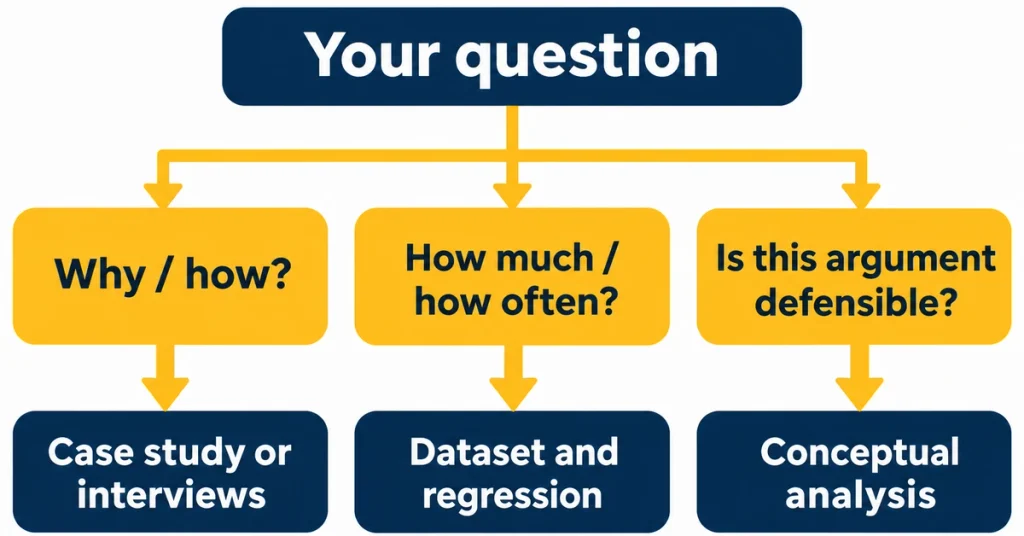
| Question type | Typical method | Example evidence | Main risk |
|---|---|---|---|
| Why did an outcome occur in one or two cases? | Case study, process tracing | Archives, Hansard, speeches | Selecting only confirming evidence |
| What explains variation across many units? | Regression, panel data | V-Dem, ParlGov, BES, ESS | Omitted variables and measurement error |
| How do actors justify positions? | Discourse or content analysis | Speeches, manifestos, media | Coder subjectivity |
| What do officials or activists think? | Semi-structured interviews | Interview transcripts | Access and ethics |
| Does a message or design change attitudes? | Survey experiment | Online panel | Sample quality and ethics |
| Is an argument coherent and defensible? | Conceptual analysis | Primary texts | Drifting into summary |
Datasets worth knowing for a political science dissertation
- Elections and attitudes: British Election Study, European Social Survey, World Values Survey (World Values Survey), Comparative Manifesto Project
- Party positions: Chapel Hill Expert Survey
- Longitudinal UK data: Understanding Society and the UK Data Service
- Legislation and debate: legislation.gov.uk and Hansard
Before you collect new data from people, plan your ethics route. Guidance from the American Political Science Association on principles and guidance for human subjects research is a useful reference, although your own university’s committee will make the decision. The guide on how to get ethics approval for a dissertation explains the usual process, and how to choose a research methodology helps you decide between approaches.
How to narrow a broad political science idea
- Pick one institution, one law, one election or one dataset rather than a whole theme
- Limit the time period to a few years or one electoral cycle
- Choose one or two cases, and say why
- Write the question so that you could be proved wrong
- Check your data exist before you commit
When your question is still loose, the dissertation topic finder and the research aims and objectives generator can help turn it into something markable. A guide to aims, objectives and research questions shows how they fit together.
Worked examples
Example A. Aim: to assess how far the closed-list Senedd system changes proportionality. Objectives: (1) recalculate seat allocations using published results under both systems; (2) compute the Gallagher index for each; (3) test whether the finding changes if different assumptions about the vote are used.
Example B. Aim: to evaluate whether monitoring provisions in peace agreements are associated with longer-lasting settlements. Objectives: (1) code monitoring clauses in a defined sample from PA-X; (2) match agreements to conflict recurrence data from UCDP; (3) estimate survival times and report the uncertainty.
Example C. Aim: to explain the shift in voters between the 2019 and 2024 elections using panel data. Objectives: (1) construct a transition matrix from BES waves; (2) compare the role of Brexit identity and economic perceptions; (3) discuss limits arising from panel attrition.
Example D. Aim: to judge whether citizens’ assemblies meet deliberative standards. Objectives: (1) specify criteria from the deliberative theory literature; (2) apply them to three assemblies using published reports; (3) conclude on which criteria were met and which were not.
Political science dissertation length, level and common mistakes
How long should a political science dissertation be?
Undergraduate dissertations commonly run from 8,000 to 12,000 words and Master’s dissertations from 12,000 to 20,000, but programmes differ, so confirm the limit in your handbook. The dissertation word count calculator can help you split the total across chapters, and the dissertation timeline planner helps with planning the schedule.
Which level suits which kind of topic?
Undergraduates often do best with a single well-documented case, an existing dataset or a conceptual argument on one thinker. Master’s students can usually handle comparative design, panel data or original interviews. PhD students should treat any topic here as a starting point for a literature gap rather than a finished question.
Common mistakes in political science dissertations
- Choosing a topic that depends on events that have not happened yet
- Treating correlation in cross-national data as proof of cause
- Using index scores without checking what they measure
- Writing a literature summary instead of an argument
- Collecting interview data without allowing for delays in ethics approval
Getting help with your political science dissertation
If you want support with shaping a proposal, the research proposal writing service can help refine your question and plan. Students who need help with the later stages may also look at dissertation methodology help or literature review help. For level-specific support, see masters dissertation help.
Frequently asked questions about political science dissertation topics
What is a good political science dissertation topic?
A good topic names one institution, event, law or dataset, asks a question that evidence could answer, and fits your level and timeframe. If you cannot say which data or texts you would use, it is probably still too broad.
Can I use a current event for my dissertation?
Yes, but frame the question around the lasting issue rather than the latest headline. Events can change before you submit, so state the date your analysis is correct to and keep a note of developments.
Do I need primary data for a political science dissertation?
Not necessarily. Many strong projects use existing datasets, archival records, legislation and parliamentary debates. Collecting your own data adds ethics approval and time pressures.
How do I choose between a qualitative and a quantitative approach?
Start from the question. If it asks how much or how often, quantitative methods tend to fit. If it asks why or how actors reasoned, qualitative ones usually fit better. Some good projects combine both.