
How to Write a Limitations Section: Scope vs Limitations vs Delimitations

Your discussion chapter is drafted, the word count is tight and your supervisor has written “add limitations” beside the last paragraph. Knowing how to write a limitations section turns that comment from a worry into a chance to show you understand your own research. The short answer: name each constraint precisely, say what it does to your findings, explain how you reduced the damage and point to what future studies could do better.
Settle these questions before you draft a word:
- Which of my weaknesses are real limitations, and which are boundaries I chose on purpose?
- Which constraints change how far my conclusions can reach?
- Should they sit in my methodology, my discussion or my conclusion?
- How do I admit a weakness without losing marks?
The advice below suits undergraduate and Master’s dissertations at UK universities. Conventions differ between departments, so treat it as a sound default and check your module handbook and marking criteria before you commit to a structure. Where the handbook says something different, the handbook wins.
What Is a Limitations Section in a Dissertation?
A limitations section explains the constraints that restrict how far your findings can be trusted or applied. Its job is honesty with a purpose: it shows the reader that you know where your evidence is strong and where it is thin.
UK guidance describes limitations from slightly different angles. The University of Southampton’s methodology guidance treats them as usually logistical, such as constraints of time, scope and access. Its results and discussion guide adds that some limitations only emerge once you have analysed your data, limited generalisability being one example. The University of Westminster describes limitations as constraints outside the researcher’s control that affect the outcome, and links them to generalisability, validity and reliability. The University of Portsmouth frames them as problems that arose during data collection or analysis and restricted the research.
Why include them at all? Portsmouth’s guidance says that being open about these limits makes your work more credible, not less. Westminster likewise presents acknowledging limits as a strength, because it shows you know your findings may not apply to every context. However, there is a ceiling. Southampton warns against overstating limitations, since that can undermine the reliability and credibility of the whole study.
Scope vs Limitations vs Delimitations: What Is the Difference?
Scope is what your study covers. Delimitations are the boundaries inside that scope which you set deliberately and can justify. Limitations are the constraints you could not fully avoid, and they affect how far your findings stretch. The simplest test is control: you decide your delimitations, while circumstances create your limitations.
The examples below use one illustrative research question, invented for teaching purposes: How does term-time paid work relate to seminar attendance among second-year business students at one UK university?
What is the scope of a study?
Scope covers the topic, population, setting, time frame and method of your research. Write it as a short statement drawn directly from your research questions. If those questions still feel loose, tighten them first by working through aims, objectives and research questions.
This study examines the relationship between hours of term-time paid work and seminar attendance among second-year undergraduate business students at one UK university during one academic year.
What are research delimitations?
Delimitations are intentional boundaries. The University of Westminster’s methodology guide lists areas where you might set them: population, location, sector, research objective and methods. A delimitation always needs a reason. “Second-year students only” is a boundary, but “second-year students only, because placement-year and part-time students follow different timetables” is a justified delimitation.
What are research limitations?
Limitations are constraints that arise despite your planning: a low response rate, self-reported data, restricted access to participants or a design that cannot show cause and effect. Unlike a delimitation, you did not choose them, and the reader needs to know how they shape what your findings can support.
Scope, delimitations and limitations compared
| Term | Question it answers | Who decides | Example from the study above |
|---|---|---|---|
| Scope | What does the study cover? | You, guided by your research questions | Term-time paid work and seminar attendance among second-year business students at one university |
| Delimitation | What did I leave out on purpose, and why? | You | Excluding placement-year and part-time students because their timetables differ |
| Limitation | What constrains my findings despite my planning? | Circumstances | Attendance is self-reported, so recall errors may affect the results |
One feature of a study can sit on either side of the line. Choosing a single university is a delimitation. If only a small share of invited students then respond, that shortfall is a limitation. Treat each one separately, and never present a deliberate boundary as a flaw.
Terminology also varies. Some UK departments never use the word delimitations and fold the idea into scope, research boundaries or methodology instead. Explain the concept the way your handbook does. Westminster advises mentioning both delimitations and limitations at some point in the methodology chapter, although your department may place them elsewhere.
How to Write a Limitations Section Step by Step
Laerd Dissertation describes three moves: announce the limitations that most affected your findings, reflect on each one and justify your choices, then look forward to how future research could overcome them. Laerd suggests spending most of your words on the reflecting move, with roughly 10 to 20 per cent each on announcing and looking forward. Other dissertation guides use a four-part pattern for each limitation: the limitation, its effect, what you did about it and what future research could do. The steps below combine both approaches.
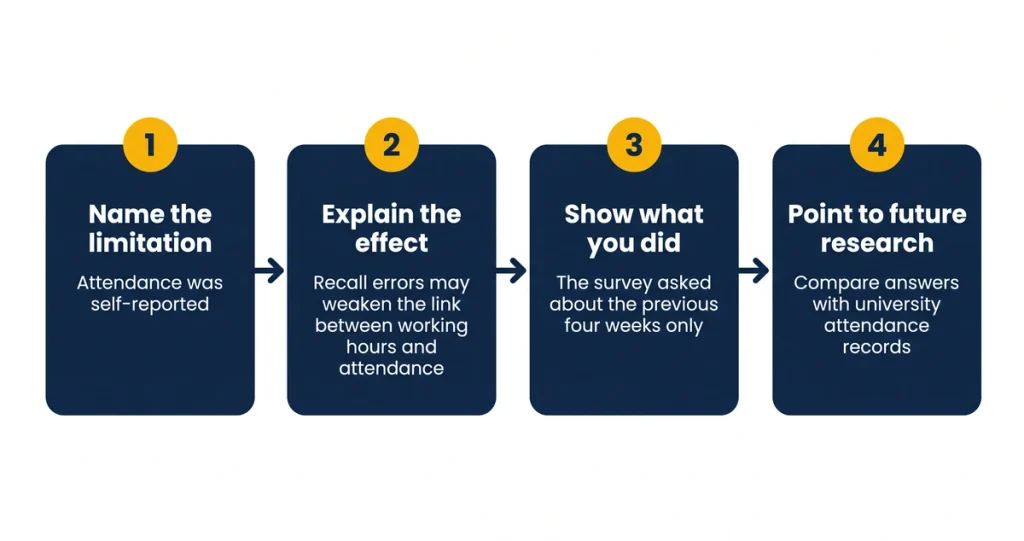
Step 1: Identify the limitations that matter
List every constraint you noticed while planning, collecting and analysing data. Then keep only those that affected your ability to answer your research questions. Laerd advises against trying to cover every possible limitation, and Southampton’s warning about overstressing them points the same way. A handful of well-explained limitations reads better than a long list of minor ones.
Step 2: Explain how each one affects your findings
Naming a limitation is not enough. Say which claim it puts at risk and in which direction. “The sample was small” tells the reader nothing, whereas “the small sample means the comparison between year groups may be unreliable” tells them exactly where to be careful.
Step 3: Show what you did and justify your choices
Describe the steps you took to reduce the problem, such as a fixed reporting period, a pilot or a second coder. Laerd notes that a limitation which looks serious in theory may have caused less damage in practice, and that a justifiable reason, such as being unable to obtain a full list of the population, can explain a choice. However, if the cause was avoidable, such as starting data collection too late, say so plainly rather than dressing it up as an outside constraint.
Step 4: Point to future research
Close each limitation with a specific next step. Southampton’s guidance says recommendations usually follow limitations, linking what could be improved to how later researchers might address it. Therefore, “future studies could compare survey answers with institutional attendance records” beats “more research is needed”.
A weak limitation and a strong one
Weak version:
The data were self-reported, so the results may not be accurate.
Strong version, using the same illustrative study:
Attendance was self-reported, so some students may have misremembered how many seminars they attended. This could weaken the observed relationship between working hours and attendance, particularly for students with irregular timetables. To reduce the problem, the survey asked only about the previous four weeks. Even so, the findings should be read as indicative. Future research could compare survey responses with university attendance records, where data protection rules and ethical approval allow.
The strong version names the problem, states its effect on one specific claim, shows what the researcher did, qualifies the conclusion and points forward, all in five sentences.
Common Types of Dissertation Limitations (and How to Explain Them)
Small or narrow samples
State the number, the group and the claim it restricts. Southampton gives an example in which a smaller sample is named as a limitation but presented as sufficient because the interviews were detailed, so explain why your sample still supports your conclusions. It helps to settle this early: choosing a sampling method and running your numbers through the dissertation sample size calculator give you the evidence to defend whatever you ended up with.
Self-reported data
Participants may misremember, round up or answer in a way they think looks acceptable. Explain which of your measures depend on self-report, and how the way you worded and timed your questions reduced the risk. Careful question design matters here, and designing a dissertation questionnaire covers how to word items clearly.
Time, access and resources
Southampton describes these as the typical logistical constraints. They count as genuine limitations only when you can show how they shaped the design: a gatekeeper who allowed access to one site only, or an ethics approval process that shortened your data collection window. “I ran out of time” on its own reads as poor planning, not as a limitation.
Research design and measurement
A cross-sectional design captures one moment, so it can show an association but not the direction of cause. Measurement limitations connect to reliability and validity, which Westminster names directly in its definition. If you need a refresher, checking reliability and validity explains how to judge your own instruments.
Researcher bias and positionality
Sheffield Hallam University’s guide notes that no researcher is fully objective, and that positionality matters most in qualitative and practice-based research, where you may also work in the setting you study. Reflect on it only if your position genuinely affected your methods or procedure. A short, specific statement carries more weight than a general confession of bias.
Examples of Research Limitations in Different Methods
Whether something counts as a limitation often depends on your design. Laerd’s example: the lack of probability sampling matters more in quantitative work than in qualitative work. Use the vocabulary of your own approach, and choose your method knowingly by reading how to choose a research methodology before you decide what to defend. The sentences below are illustrative models, so adapt them to what you actually did.
Qualitative interview study
Qualitative work usually speaks of transferability and positionality, not generalisability. If you are planning interviews, designing and running semi-structured interviews shows where these issues start.
Ten students from one Master’s programme were interviewed, so the findings describe their experiences and may transfer only to similar programmes. As a former member of the programme, I may have shaped how participants answered. I recorded my assumptions in a reflective journal and checked my themes against the transcripts, but future research could use an interviewer with no connection to the programme.
Quantitative survey
The survey was cross-sectional, so it records working hours and attendance at a single point in term. The results can show an association but cannot show whether paid work changes attendance. A longitudinal design following the same students across a year would test that directly.
Secondary data
Existing datasets were collected for another purpose, so their variables may not match your definitions exactly. Say which variable you had to approximate, and what that does to your claims. The trade-offs are covered in primary vs secondary research.
Mixed methods
Each strand brings its own limitations, and combining them adds one more: how well the strands fit together. Discuss both, and explain whether the interviews were used to interpret the survey patterns or only to illustrate them.
Where Should Limitations Go in a Dissertation?
There is no single answer, and UK guidance genuinely differs. Check your handbook, then ask your supervisor if it is silent. The main options are below.
In the methodology chapter
Westminster advises discussing a method’s limitations, and how you handled them, within your justification of the method. Sheffield Hallam asks for something narrower here: the general disadvantages of your chosen method as the literature describes them, not the shortcomings of your own project. Both fit inside a well-argued dissertation methodology.
In the discussion chapter
Southampton places limitations that emerge after data analysis in the discussion, and suggests contextualising them, for example by comparing them with limitations in other studies. The final part of writing the discussion chapter deals with this qualifying step.
As a separate section or in the conclusion
Portsmouth’s suggested structure gives Limitations its own section after the Discussion and before the Conclusion. Laerd treats the research limitations section as a subsection of the conclusions chapter. Southampton’s guide adds that limitations may sit in the conclusion, depending on the dissertation’s narrative flow and departmental conventions. If you are working on the closing chapter, writing the conclusion shows how the pieces fit.
Whichever structure you follow, avoid repeating the same sentences in three chapters. Mention a method’s general weaknesses where you justify it, explain data-driven limitations once where you interpret results, and cross-refer instead of copying.
How Long Should a Dissertation Limitations Section Be?
No universal word count applies. Laerd suggests roughly 200 to 500 words for a short, standalone critique, but that is one source’s recommendation and not a rule. Your module handbook and marking criteria decide, and a limitation mentioned in two sentences inside the methodology needs far fewer words than a full section. Spend your words on depth for the few limitations that matter, not on breadth.
Common Mistakes When Writing Research Limitations
- Listing every flaw. Keep the ones that affect your conclusions and drop the trivial ones.
- Apologising. Replace “unfortunately” and “I was unable” with a plain statement of the constraint and its effect.
- Presenting delimitations as limitations. A boundary you chose and justified is a design decision, not a flaw.
- Using generic limitations. Any dissertation could contain “the sample was small”. Tie each point to your own method, sample and claims.
- Contradicting your methodology. If you defended your sampling in the methodology, do not call it a serious weakness in the discussion without explaining what changed.
- Hiding real problems. A weakness the reader can already see is better named than ignored, and a viva, if your programme includes one, may ask what you would do differently. Be ready to explain why each limitation was unavoidable or a reasonable trade-off.
- Leaving out the forward step. A limitation with no response feels unfinished.
How to Link Limitations to Future Research
Each limitation should lead naturally to one concrete improvement. Pair them like this:
| Limitation | Future research direction |
|---|---|
| Single university sample | Repeat the study across several institutions with different student profiles |
| Self-reported attendance | Compare survey answers with institutional attendance records, where access is permitted |
| Cross-sectional design | Follow the same students across an academic year |
Southampton suggests keeping recommendations few, because too many can leave your discussion ending on what should be done instead of what you achieved. It also notes that if recommendations appear in the discussion, you need not repeat them in the conclusion, and that reading how authors in your field phrase suggestions for future studies is a useful tip. Framing recommendations as actions also makes limitations sound constructive.
Limitations Section FAQs
Is a small sample size a limitation or a delimitation?
It depends on why the sample is small. If you chose a narrow group deliberately and can justify it, the boundary is a delimitation. If you planned for more participants and fewer took part, the shortfall is a limitation. Either way, explain what the sample can and cannot support.
Can a dissertation have both limitations and delimitations?
Yes, and most do. Delimitations describe the boundaries you set, while limitations describe constraints that remain despite them. Keep the two apart so the reader can see which choices were yours.
Does admitting limitations lose marks?
The guidance above points the other way: Portsmouth says openness increases credibility, and Southampton warns only against overstating weaknesses. Marking depends on your department’s criteria, so read them, and make sure each limitation is specific, sized and paired with a response.
Do qualitative dissertations have limitations too?
Yes. They are framed differently, usually around transferability, researcher positionality and the depth and range of the sample, instead of statistical generalisability.
Should limitations go in the conclusion?
Sometimes. Laerd places them in the conclusions chapter and Southampton says they may sit there depending on your narrative and conventions, while Portsmouth gives them their own section before the conclusion. Check your handbook, and confirm with your supervisor.
Next Steps for Your Draft
Run your finished draft against the dissertation checklist to see whether your limitations, scope and conclusions agree with each other. If you are short of time, the dissertation timeline planner can reserve a block for redrafting them.
Still unsure how your limitations connect to your argument? Discussion chapter feedback can review interpretation and structure. Model and reference work is intended for learning, so use it in line with your institution’s academic integrity policy.